This is just a small sample of the many
Antique Pressing Irons we have sold.
Click link to see other
Sales Archive Pages on this Site.
We Buy Quality Antiques Contact Us at AntiqBuyer@gmail.com
Special Note Concerning
Iron Prices: Sad Irons / Pressing Irons Prices are evolving:
After 20 years of steady increases in values,
which culminated in a bubble burst, iron prices have now settled back to levels of the past.
Prices seen reflect actual recent sale results from this website or a general price that is more in line w/ today's market.
Irons
pictured without prices represent earlier sales whose sale results are outdated and do not accurately reflect current market values.
Ebay results closely reflect current market values for many sad irons. Check eBay completed / SOLD results to see current values for
many antique irons.
Our current offering of Antiques for sale are at our sister Website Patented-Antiques.com.
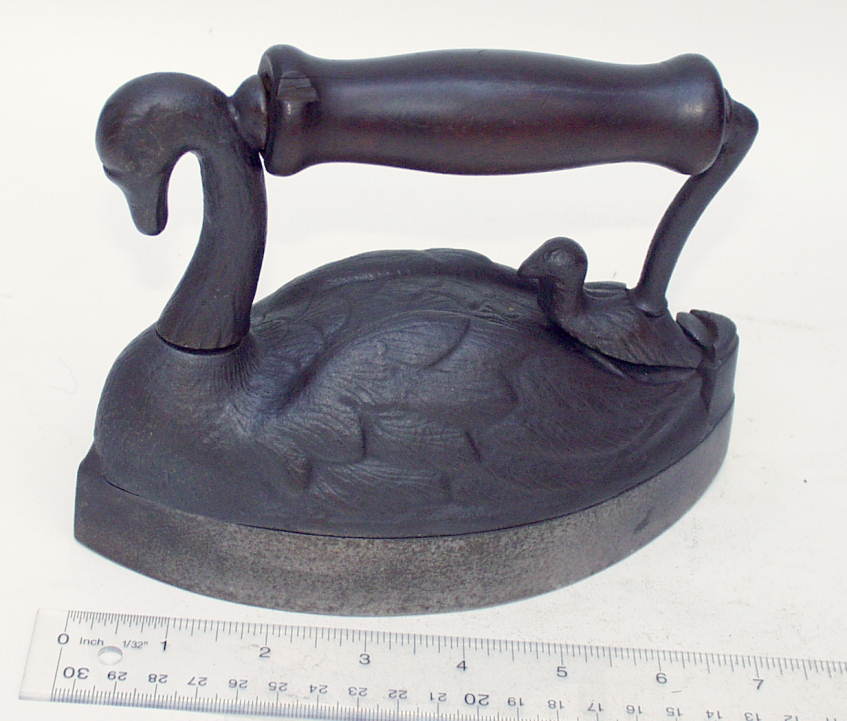 Rare
Barnes Patent Swan-on-Swan Box Iron The Swan-on-Swan Barnes patent
box iron is the single most desirable and sought after of all American patented
irons! It is such a great piece that its true value and appeal is not limited
to just iron collectors. Its appeal extends to Americana / Folk Art collectors
who want only the best and rarest of pieces. It is truly a great
piece of Americana---not just an iron!
Rare
Barnes Patent Swan-on-Swan Box Iron The Swan-on-Swan Barnes patent
box iron is the single most desirable and sought after of all American patented
irons! It is such a great piece that its true value and appeal is not limited
to just iron collectors. Its appeal extends to Americana / Folk Art collectors
who want only the best and rarest of pieces. It is truly a great
piece of Americana---not just an iron! There are other irons that are sought after and bring big dollar at auctions, but none have the presence, fame, or curb appeal as the heralded Barnes Patent Swan-on-Swan box iron.
The condition of this example is super and a nicer one will be hard to ever come by! There is lots of original nickel left on the base portion, and the top portion is clean and rust or pit free. The one small apology is the small chip in the handle, but in relation to the overall condition this is so minor as to not affect the appeal or value at all.
The quality of the casting of this iron are second to none. Few irons I have ever seen or handled show the detail and craftsmanship that this iron does. The detailing is so exact you can count the veins in the feathers on the larger swan's back
The smaller swan at the rear acts as the latch to open the iron. It works properly, and is a nicely detailed aspect as well. The iron opens to reveal the original slug.
Last year when Carole and I were at the American River with Madison our Black Lab we witnessed this very thing, as a mother swan ferried her young upstream and away from the danger. A couple of the chicks made the crossing by themselves. But for the others the mother swan went back and they jumped right up on her back, one at a time, and she swam them upstream, through the rapids to their waiting brothers and sisters and safety. It was quite a sight!
The Swan-on-Swan iron was only made for a few short years, but Mr. Barnes put out a few different variations in that time. Most of the differences are in the length and quality of the casting, and this is the 7 1/2 inch version and as far as I can tell the best casting job and the hardest version to find.
Good . . . . . SOLD
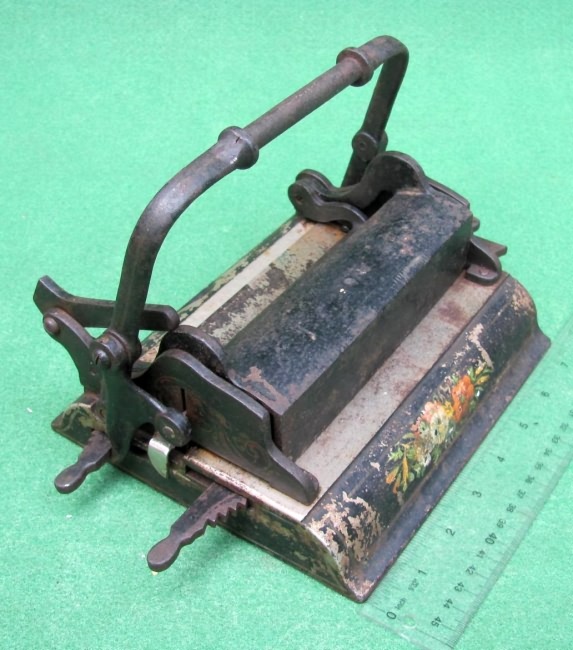 Rare
Plaiting / Pleating Machine /
Iron Rare, rare, rare---this is the
earliest and most unusual mechanical plaiter I've ever offered. In fact
I've never seen another example of this one in any of the many, many iron
collections I've viewed. I don't believe there are any others known.
Rare
Plaiting / Pleating Machine /
Iron Rare, rare, rare---this is the
earliest and most unusual mechanical plaiter I've ever offered. In fact
I've never seen another example of this one in any of the many, many iron
collections I've viewed. I don't believe there are any others known.Plaiters fit well into pressing iron and fluting iron collections. Quoting Mark Durham in his book More American Fluting Iron Patents from the 19th and 20th Centuries, plaiters "are used to impart a sharp-edge fold, or plait (pleat) in fabric." Compare this with fluters, which "impart a series of rounded grooves or waves in cloth or a sharp, shallow crimp." Durham explains that there are two categories of plaiters: 1) plaiting boards that rely on manual setting of the plaits and then pressing by a sad iron, and 2) machine (or mechanical) plaiters.
This mechanical plaiter has a complex and elegant design, with two stepped sawtooth arms that slide back and forth underneath to adjust both the size and spacing of the folds. Each of these sawtooth / stepped arms can be adjusted independently of the other to create just the right plait or pleat.
This plaiter is unmarked as to manufacturer or inventor. The patent that most closely resembles it is the June 19, 1877 patent # 192,216 by Barrow & Solter, which can be viewed using Google Patents, although the unique adjustment mechanism is not mentioned. A later improvement?
The overall condition is very nice. There are some losses to the paint decoration but much of it still remains bright and colorful. The entire machine was nickel plated and parts are very nice but again there have been some losses. The mechanical mechanism operates properly and smoothly. The adjusting bars operate properly. This rare plaiter didn't come out of an iron or any other collection, it's fresh from a New England barn found by a picker who primarily dealt in large artifacts. Highly recommended!!
Very Good . . . . . . SOLD!
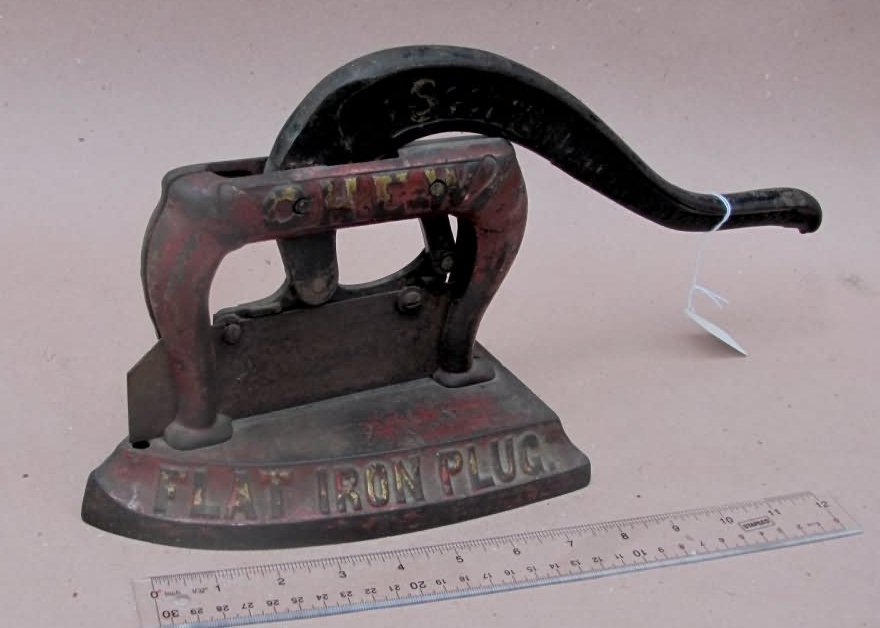 Scotten
Dillon Chew Flat
Iron Tobacco Cutter This is one of the
hardest to find of all iron collecting related pieces there is. It is
a cast iron figural plug tobacco cutter from the well know maker / producer
/ distributor, the Scotten Dillon Tobacco Co.
Scotten
Dillon Chew Flat
Iron Tobacco Cutter This is one of the
hardest to find of all iron collecting related pieces there is. It is
a cast iron figural plug tobacco cutter from the well know maker / producer
/ distributor, the Scotten Dillon Tobacco Co. These can be found with tails or handles out the rear at the base, but I am unsure if this one ever had one. There is no indication of a break at the end of the iron, and there are even traces of red paint there. It could have been filed and cleaned up at some point and the red paint re-applied, but I can not tell. If it was done it was done extremely well. The overall condition of the rest of the cutter is nice and there is lots of original paint and decoration remaining. A rare piece.
Very Good . . . . . . SOLD!
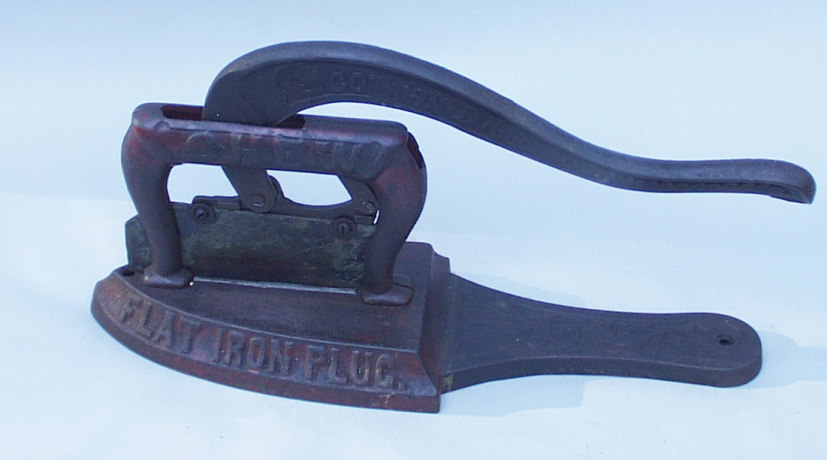 Scotten
Dillon Flat
Iron Tobacco Cutter This figural plug tobacco cutter
is from the well know maker / producer
/ distributor, the Scotten Dillon Tobacco Co. is in super condition.
This is the tailed or handled model and is all proper and nice.
Scotten
Dillon Flat
Iron Tobacco Cutter This figural plug tobacco cutter
is from the well know maker / producer
/ distributor, the Scotten Dillon Tobacco Co. is in super condition.
This is the tailed or handled model and is all proper and nice. A rare piece.
Very Good . . . . . . SOLD!
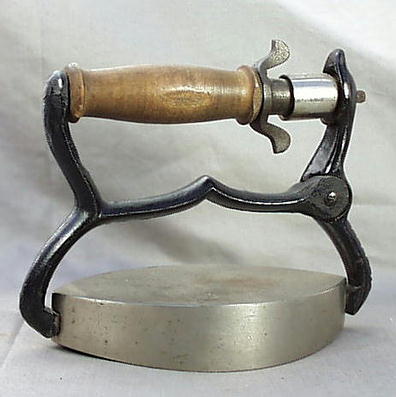 Patented
Removable Handle Revolving Iron
I would guess that this is the rarest American
patented iron that I have ever owned. There are a number of irons that I think
most collectors would agree are to be considered rare---the Dion and the Goat
Fluters come to mind, the Gem Thermometer iron would be another, the Swan-on-Swan
would fit the category, etc. But all of those mentioned are irons that I have
either owned at one time, or have seen in other long-time collections. I would
be really curious to know if there is another example of this iron known, as
the only reference I have ever seen to it was in Esther Berney's collection
as shown in her out-of-print Collector's Guide to Pressing Irons and Trivets,
and I cannot trace where that exact iron is located now that she has passed
on. In any case, her research indicated that the December 25, 1877 patent on
this iron was held by Oliver Avery, Jr. of Groton, New York (home to another
famous iron inventor, Nelson Streeter). This revolving iron consists of a solid
base with 4 ironing surfaces---a wide convex polishing side, two narrow sides,
and a flat side. The handle detaches for heating the base, but for when it was
in use it allows the base to revolve to all four sides without completely detaching
it by means of a wing-nut release on the grip that allows the legs of the handle
to loosen or tighten against the sides of the base. Like many other great ideas
that look good on paper, this one has its problems in actual operation, and
from the way it works I would venture to guess that more than once the hot and
heavy base of this iron inadvertently detached from the handle and landed on
some poor soul's toes. Its cumbersome operation must have made have doomed it
from being a widespread marketing success, undoubtedly explaining its scarcity.
Another great California find!
Patented
Removable Handle Revolving Iron
I would guess that this is the rarest American
patented iron that I have ever owned. There are a number of irons that I think
most collectors would agree are to be considered rare---the Dion and the Goat
Fluters come to mind, the Gem Thermometer iron would be another, the Swan-on-Swan
would fit the category, etc. But all of those mentioned are irons that I have
either owned at one time, or have seen in other long-time collections. I would
be really curious to know if there is another example of this iron known, as
the only reference I have ever seen to it was in Esther Berney's collection
as shown in her out-of-print Collector's Guide to Pressing Irons and Trivets,
and I cannot trace where that exact iron is located now that she has passed
on. In any case, her research indicated that the December 25, 1877 patent on
this iron was held by Oliver Avery, Jr. of Groton, New York (home to another
famous iron inventor, Nelson Streeter). This revolving iron consists of a solid
base with 4 ironing surfaces---a wide convex polishing side, two narrow sides,
and a flat side. The handle detaches for heating the base, but for when it was
in use it allows the base to revolve to all four sides without completely detaching
it by means of a wing-nut release on the grip that allows the legs of the handle
to loosen or tighten against the sides of the base. Like many other great ideas
that look good on paper, this one has its problems in actual operation, and
from the way it works I would venture to guess that more than once the hot and
heavy base of this iron inadvertently detached from the handle and landed on
some poor soul's toes. Its cumbersome operation must have made have doomed it
from being a widespread marketing success, undoubtedly explaining its scarcity.
Another great California find!
Good . . . . . SOLD
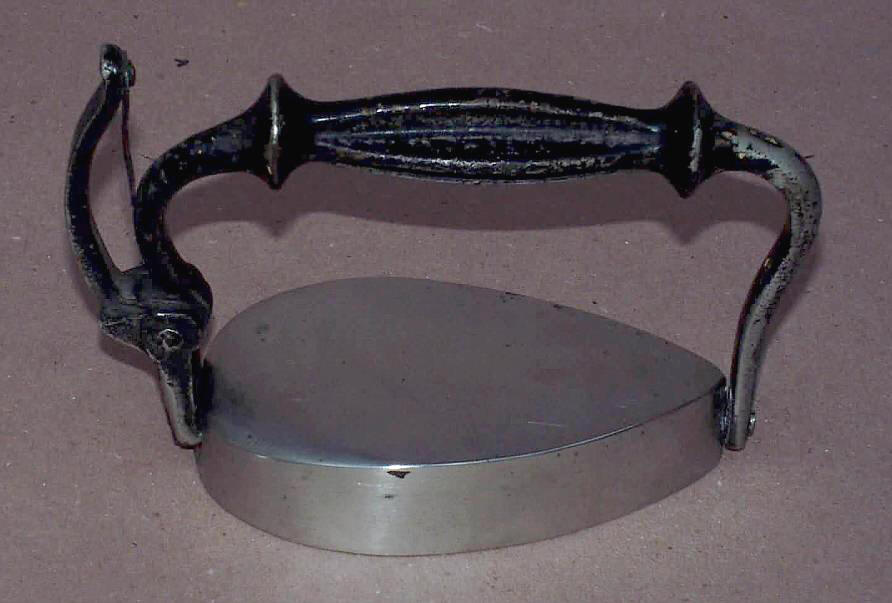 Rare
Revolving Myers Patent Combination Flatiron and Polisher
Rare, Rare, Rare! Frederick Myers
patented a series of irons and is best known for his combination fluter / sadirons,
of which there are probably five or six different ones, including the Goat Fashion
Fluter and the Combination Embossing / Fluting iron with its interchangeable
plates. The common combo irons / Fluters turn up pretty regularly. The Goat
is represented in most major collections but is otherwise scarce. There
are only a handful of the Embossing irons known. And this revolving combination
iron by Myers ranks right up there in rarity with those two. In fact,
I have seen or know of fewer of this iron than those other two. The US patent office granted Myers patent #133245 on Nov. 19,
1875 for this iron.
Rare
Revolving Myers Patent Combination Flatiron and Polisher
Rare, Rare, Rare! Frederick Myers
patented a series of irons and is best known for his combination fluter / sadirons,
of which there are probably five or six different ones, including the Goat Fashion
Fluter and the Combination Embossing / Fluting iron with its interchangeable
plates. The common combo irons / Fluters turn up pretty regularly. The Goat
is represented in most major collections but is otherwise scarce. There
are only a handful of the Embossing irons known. And this revolving combination
iron by Myers ranks right up there in rarity with those two. In fact,
I have seen or know of fewer of this iron than those other two. The US patent office granted Myers patent #133245 on Nov. 19,
1875 for this iron.This iron is in really super condition. The body is nickel plated and very nice with just minor spots. It revolves / rotates with one side being a flatiron and the other side being a polisher. The spring is strong and it locks securely as it should. It appears that the entire iron body and handle were originally nickeled, and then Myers painted the handle and latching mechanism to create a contrasting effect. The black that you see is original, and I would say approximately 80% remains. The grip is cast iron as well, and ribbed. The body is almost heart-shaped. It has a very pleasing look.
One of the rarest of American patented irons! I don't believe any have ever been offered in any of the iron collector club meeting auctions. This is an opportunity to fill out the Myers, the revolving, and / or the combo portions of your collection with just one purchase that won't likely be available again for a long time to come.
Good . . . . . SOLD
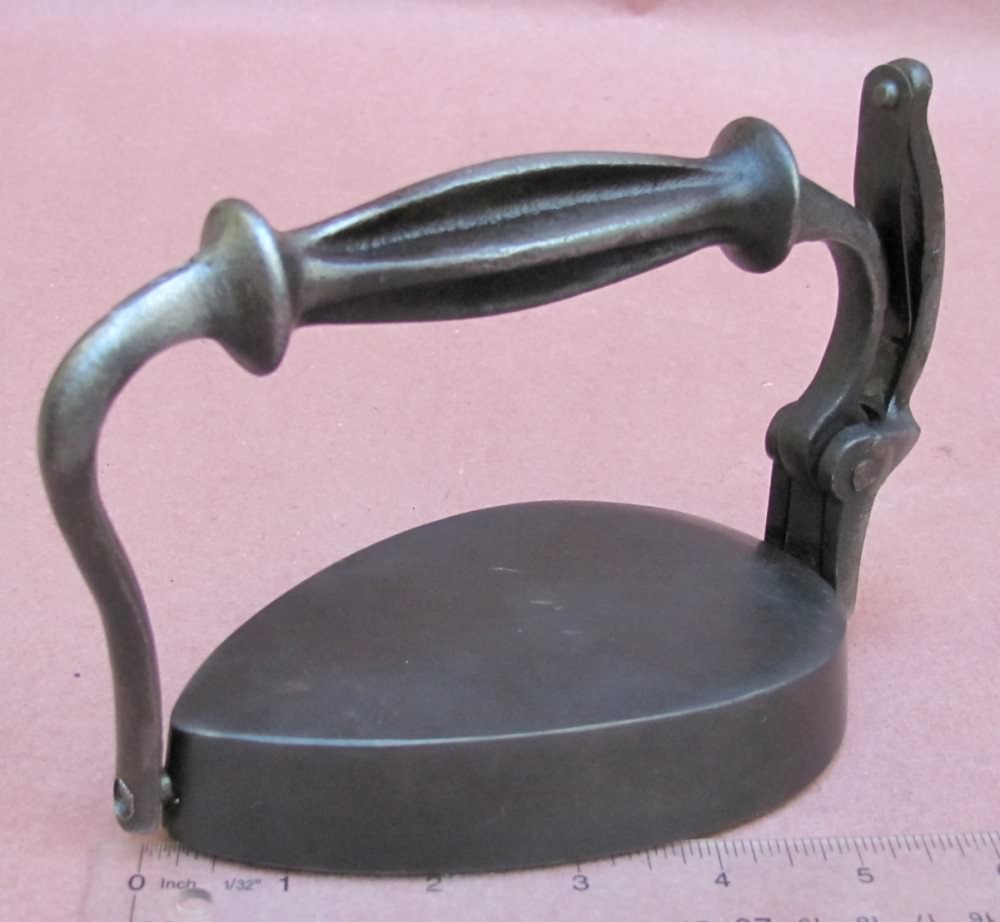 Rare
Myers Patent Revolving Combination Flatiron and Polishing Iron (2)
I know, I did a big write up about how rare
this iron was just above, and here is another one. The correct
observation would be, don't expect the 3rd or others to do quite as
well. Note that this one is not nickel plated as the one
above is. For the fellow that has to have every variation!!
Rare
Myers Patent Revolving Combination Flatiron and Polishing Iron (2)
I know, I did a big write up about how rare
this iron was just above, and here is another one. The correct
observation would be, don't expect the 3rd or others to do quite as
well. Note that this one is not nickel plated as the one
above is. For the fellow that has to have every variation!!
Good . . . . . SOLD!
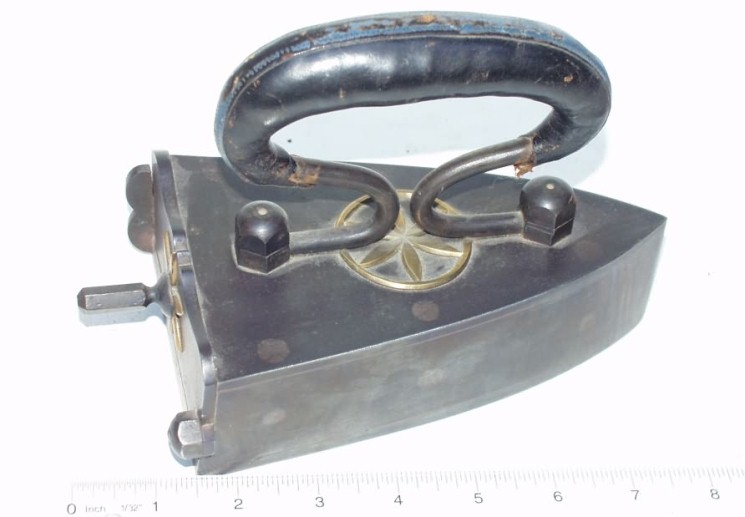 Decorated
Iron Box / Slug Iron This is a wonderful looking
iron. It is a slab type construction and very nicely done. The original
leather handle is in great condition. The brass decoration in the form
of a star or leaf petals is repeated on the top in a circle and again on the
rear door. The blued steel sides show the halos of the pins and posts
used in the construction of the iron after it was finished and are used
a part of the decoration. It has a neat look I have not seen before.
Decorated
Iron Box / Slug Iron This is a wonderful looking
iron. It is a slab type construction and very nicely done. The original
leather handle is in great condition. The brass decoration in the form
of a star or leaf petals is repeated on the top in a circle and again on the
rear door. The blued steel sides show the halos of the pins and posts
used in the construction of the iron after it was finished and are used
a part of the decoration. It has a neat look I have not seen before.
Good . . . . . SOLD
 Rare
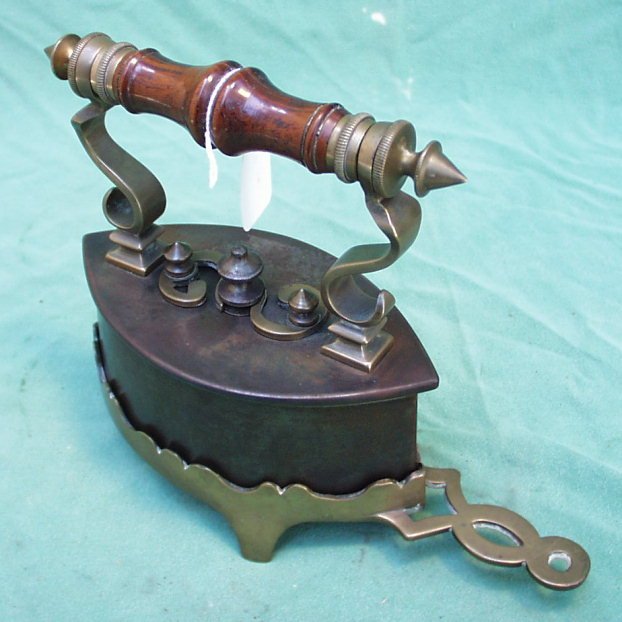
and Elegant Scottish Box Iron Scottish irons
by nature and design are exquisitely designed and detailed, and this one is
no exception. This iron is truly a work of art as much as a utilitarian
object, which explains why this style iron was often given as a gift from a
man to his beloved. Of course nowadays it would be an insult to give your
fiancé an appliance as an engagement present, but things were different back
then. The construction of this iron is second to none and the workmanship
is superb. The main body is cast iron and the elaborate handle posts are
finely cast brass. The turned and machined finials that make up the end caps
of the grip and the locking mechanism are finely machined brass. The lathe-turned
handle grip is a lovely richly-colored exotic hardwood. The top of the
iron removes by loosening the threaded center finial knob so the S-shaped latch
can swing back away. Many times these irons have been separated from their
trivets but this one has amazingly managed to stay complete with its perfectly
fitted brass companion stand for the last 200 years. This piece was the
highlight of our consigner’s collection and is sure to stand out in yours!
He purportedly purchased this iron from Carol Walker, which lends to its provenance
and authenticity. There is one “apology” to note---close inspection reveals
a crack in the narrowest portion of one of the brass end caps, and there is
a tiny crack in the trivet. Even at that it’s a top shelf antique for
anybody’s collection!
Rare
and Elegant Scottish Box Iron Scottish irons
by nature and design are exquisitely designed and detailed, and this one is
no exception. This iron is truly a work of art as much as a utilitarian
object, which explains why this style iron was often given as a gift from a
man to his beloved. Of course nowadays it would be an insult to give your
fiancé an appliance as an engagement present, but things were different back
then. The construction of this iron is second to none and the workmanship
is superb. The main body is cast iron and the elaborate handle posts are
finely cast brass. The turned and machined finials that make up the end caps
of the grip and the locking mechanism are finely machined brass. The lathe-turned
handle grip is a lovely richly-colored exotic hardwood. The top of the
iron removes by loosening the threaded center finial knob so the S-shaped latch
can swing back away. Many times these irons have been separated from their
trivets but this one has amazingly managed to stay complete with its perfectly
fitted brass companion stand for the last 200 years. This piece was the
highlight of our consigner’s collection and is sure to stand out in yours!
He purportedly purchased this iron from Carol Walker, which lends to its provenance
and authenticity. There is one “apology” to note---close inspection reveals
a crack in the narrowest portion of one of the brass end caps, and there is
a tiny crack in the trivet. Even at that it’s a top shelf antique for
anybody’s collection!
Good . . . . . SOLD
 Ornate
Scottish Box Iron
The Scottish box iron is one of the most desirable
forms of early sad or pressing irons made. These irons are almost
all unique and one of a kind works of art and craftsmanship.
Ornate
Scottish Box Iron
The Scottish box iron is one of the most desirable
forms of early sad or pressing irons made. These irons are almost
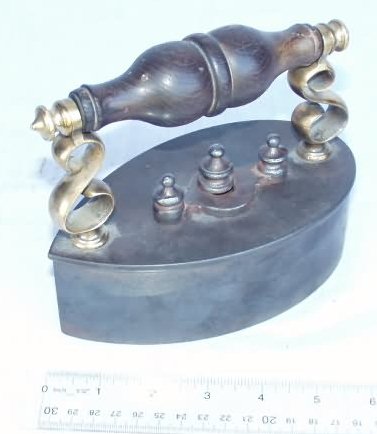
all unique and one of a kind works of art and craftsmanship. The story for most Scottish Box Irons is rather than being manufactured or mass produced that they were hand built as projects by apprentice machinists and trades people about to enter the world as journeymen craftspersons. Different examples show different levels of craftsmanship, and / or different focuses on different manufacturing techniques or skills.
The design of this irons is based primarily on different castings, while some others are more focused on machining. The body on this example is a very nice casting and has visible ribs inside the base on the bottom. The top is an exact fit. The S standards, or upright S posts, on this one are a very graceful and delicate cast brass as opposed to turned or machined as found on some examples. Only the brass end caps with spiral knurling are machined.
Many Scottish Box Irons were never used and were made as pieces of art from their inception. Other were put into service and utilized for their intended purpose. That was the case with this example. It was used.
The latches on these are usually set up to swivel on a pin, and this one has indications in both the body and the latch of a pin, but it is not there. The entire latch comes off when slid from it locking position under the center post. There is a halo of where the pin was on the latch, and its location is also evident from inside the top of the iron. The latch is not attached but works as it should when put into place. Replacing this pin would be an easy and appropriate fix for a competent machinist home hobbyist.
Good . . . . . SOLD
 German
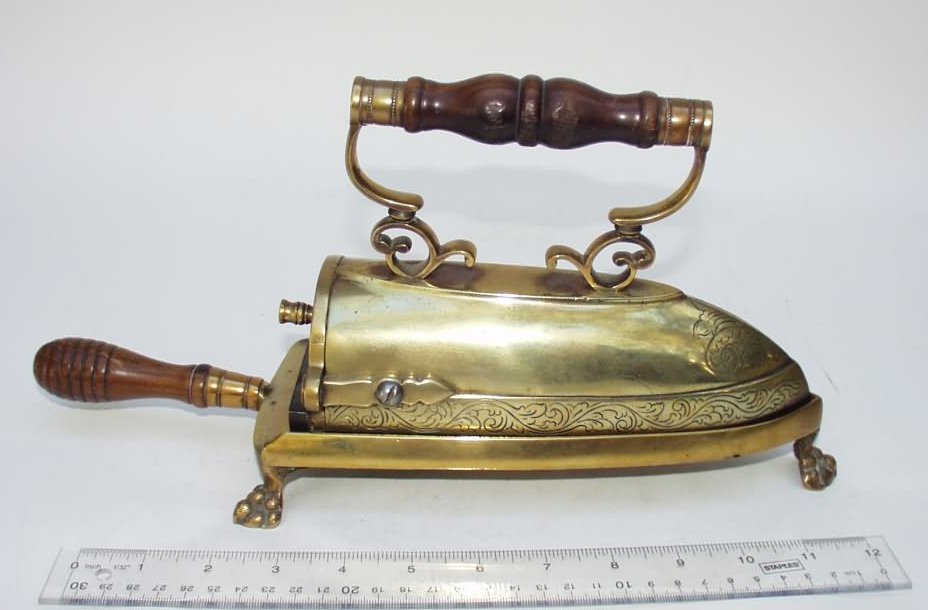
Brass Chisel-Point Decorated Ox Tongue Iron w/ Iron Base & Matching Brass Trivet This is a super nice iron that has some great design elements.
From the finely engraved decoration along the base and edges, to the finely
crafted cast brass standards, to the well designed and turned handle, this iron
has it all. The trivet design is a growing plant that resembles a sunflower
and it has great looking paw feet. The iron has a steel base which is
another very unusual attribute. The swing gate is extra thick and designed
very well.
German
Brass Chisel-Point Decorated Ox Tongue Iron w/ Iron Base & Matching Brass Trivet This is a super nice iron that has some great design elements.
From the finely engraved decoration along the base and edges, to the finely
crafted cast brass standards, to the well designed and turned handle, this iron
has it all. The trivet design is a growing plant that resembles a sunflower
and it has great looking paw feet. The iron has a steel base which is
another very unusual attribute. The swing gate is extra thick and designed
very well.
Good . . . . . SOLD
 Rare
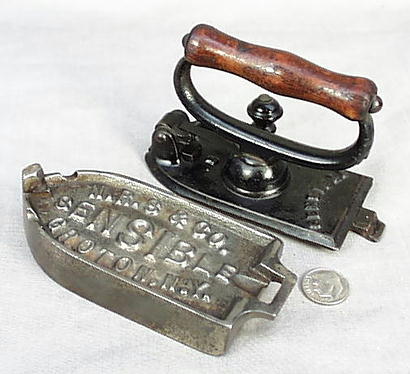
Child Size Streeter's Sensible #5 Box Iron Nelson Streeter of Groton, NY began manufacturing
irons in 1876. His creativity, inventive genius and marketing savvy are evident
in the amazing variety of irons that he produced. One of the hardest to find
Streeter irons is his full-size solid-base removable handle "Sensible" box iron.
An even rarer Streeter piece is this, the child-size version of that box iron.
Known as the Sensible #5, this is an iron that is rarely found and usually seen
only in long-time collections. This example will take your breath away! Measuring
only 4" in length, it is a scaled-down version of the larger model exhibiting
the same design details of the patented Streeter handle and cover release mechanism
as well as the characteristic front and rear latches. If this model was produced
as a "child-size" iron rather than as a salesman sample, it's intent most certainly
was to win over the child's heart to the Streeter brand, so she would never
forget which iron to buy when she grew up. This one is in outstanding condition
retaining nearly all of its original nickel plating and black japanning. The
casting of the lettering is crisp and the release mechanism is tight and works
exactly as it should. It exhibits the characteristic front notches in the lip
of the base.
Rare
Child Size Streeter's Sensible #5 Box Iron Nelson Streeter of Groton, NY began manufacturing
irons in 1876. His creativity, inventive genius and marketing savvy are evident
in the amazing variety of irons that he produced. One of the hardest to find
Streeter irons is his full-size solid-base removable handle "Sensible" box iron.
An even rarer Streeter piece is this, the child-size version of that box iron.
Known as the Sensible #5, this is an iron that is rarely found and usually seen
only in long-time collections. This example will take your breath away! Measuring
only 4" in length, it is a scaled-down version of the larger model exhibiting
the same design details of the patented Streeter handle and cover release mechanism
as well as the characteristic front and rear latches. If this model was produced
as a "child-size" iron rather than as a salesman sample, it's intent most certainly
was to win over the child's heart to the Streeter brand, so she would never
forget which iron to buy when she grew up. This one is in outstanding condition
retaining nearly all of its original nickel plating and black japanning. The
casting of the lettering is crisp and the release mechanism is tight and works
exactly as it should. It exhibits the characteristic front notches in the lip
of the base.
Good . . . . . SOLD
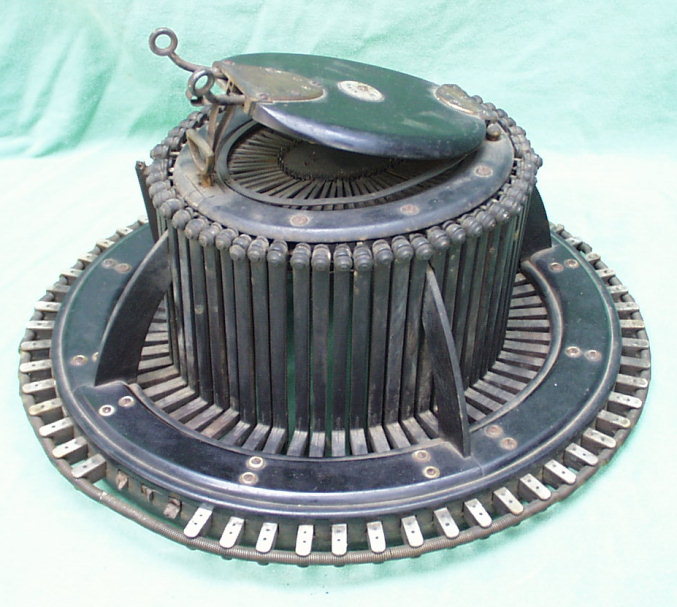 Hat
Makers Conformateur This is a French Conformateur or
hat makers hat sizing tool. It is made of ebony and has mother of pearl
highlights. These are about the most unusual looking devices imaginable,
but they are said to be the best tool for the job of properly sizing hard hats
such as top hats or Stetson-type hats that were in vogue in the 19th century
for the prospective customer. He must have felt very important being fitted
with one of these on his noggin. I know I felt pretty.........big headed
I guess would be the word.........when I put it on.
Hat
Makers Conformateur This is a French Conformateur or
hat makers hat sizing tool. It is made of ebony and has mother of pearl
highlights. These are about the most unusual looking devices imaginable,
but they are said to be the best tool for the job of properly sizing hard hats
such as top hats or Stetson-type hats that were in vogue in the 19th century
for the prospective customer. He must have felt very important being fitted
with one of these on his noggin. I know I felt pretty.........big headed
I guess would be the word.........when I put it on. There is some minor damage to a few of the segmented articulated arms, but it could be repaired easily enough, or will never be noticed if displayed properly.
Good . . . . . SOLD
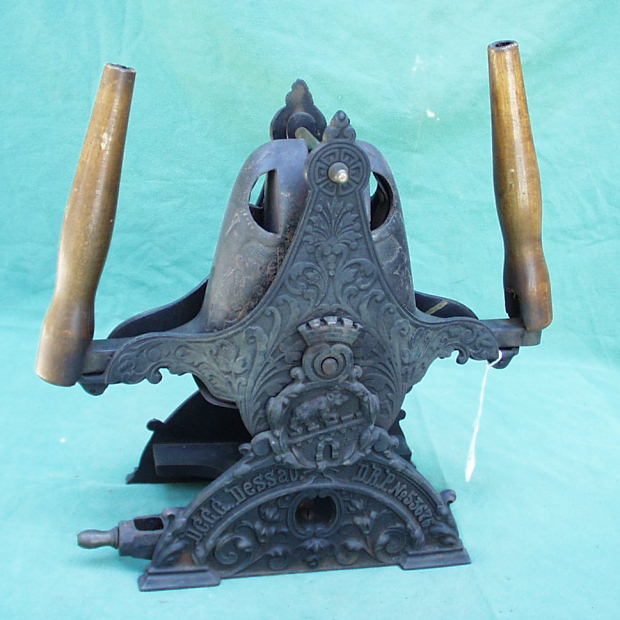 German
Double Rocker Gas Jet Heater w/ Decorated Ox Tongue Irons
This
double rocker gas jet iron heater is in fine condition as are the irons.
Rarely seen in the US!
German
Double Rocker Gas Jet Heater w/ Decorated Ox Tongue Irons
This
double rocker gas jet iron heater is in fine condition as are the irons.
Rarely seen in the US!
Good ........ SOLD!
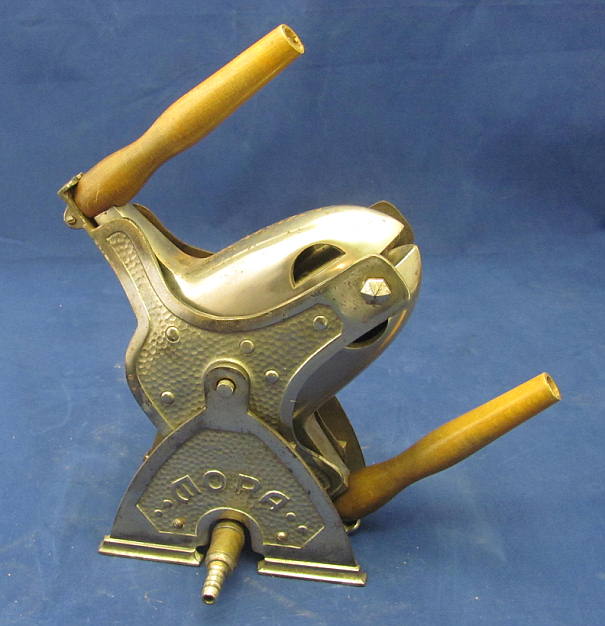 MORA
Gas Jet Rocking Heater with Irons
This is a super piece. It is German and marked "Mora" on the side of the rocking
heater cradle. The condition is great. The two ox tongue hollow-body gas jet irons pictured are
included. The heater would have been connected to a natural gas line
and the burner would have heated first one iron and then, when rocked to the
opposite position, the other. Be sure to look at all the pictures to see the close-ups.
A handsome piece in amazing condition!
MORA
Gas Jet Rocking Heater with Irons
This is a super piece. It is German and marked "Mora" on the side of the rocking
heater cradle. The condition is great. The two ox tongue hollow-body gas jet irons pictured are
included. The heater would have been connected to a natural gas line
and the burner would have heated first one iron and then, when rocked to the
opposite position, the other. Be sure to look at all the pictures to see the close-ups.
A handsome piece in amazing condition! Excellent . . . . . . $695.00 SALE PRICE . . . . . . . . $495.00 SOLD!
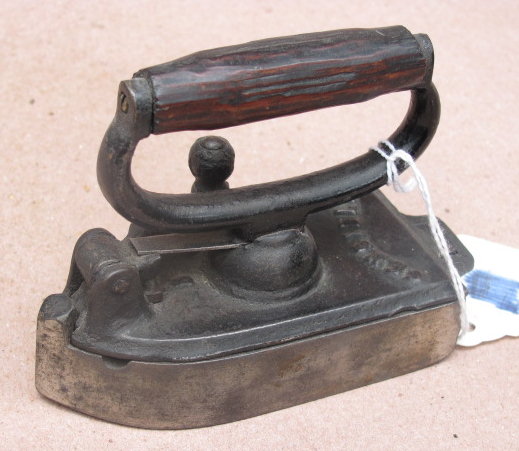 Child
Size Sensible Sad Iron This is a rare little
iron. We have only had a few of these over the years. The handle
shows some wear and tear, but the latch works fine and the top of the iron
is nice.
Child
Size Sensible Sad Iron This is a rare little
iron. We have only had a few of these over the years. The handle
shows some wear and tear, but the latch works fine and the top of the iron
is nice.
Good . . . . . SOLD!
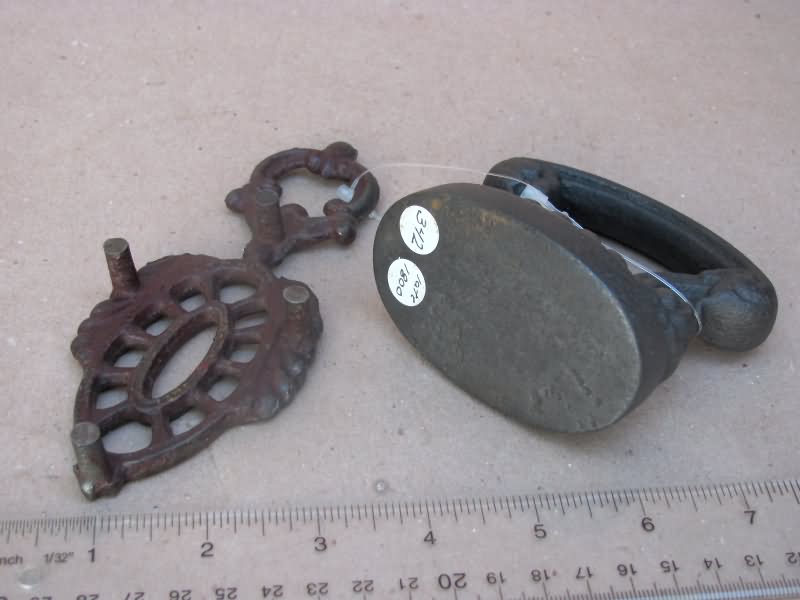 Ornate
Child Size Belgian Cap Iron
The iron is elegant and ornate. The
matching trivet is exceptionally hard to find. Very unusual!!
Ornate
Child Size Belgian Cap Iron
The iron is elegant and ornate. The
matching trivet is exceptionally hard to find. Very unusual!! Good + . . . . . . SOLD!
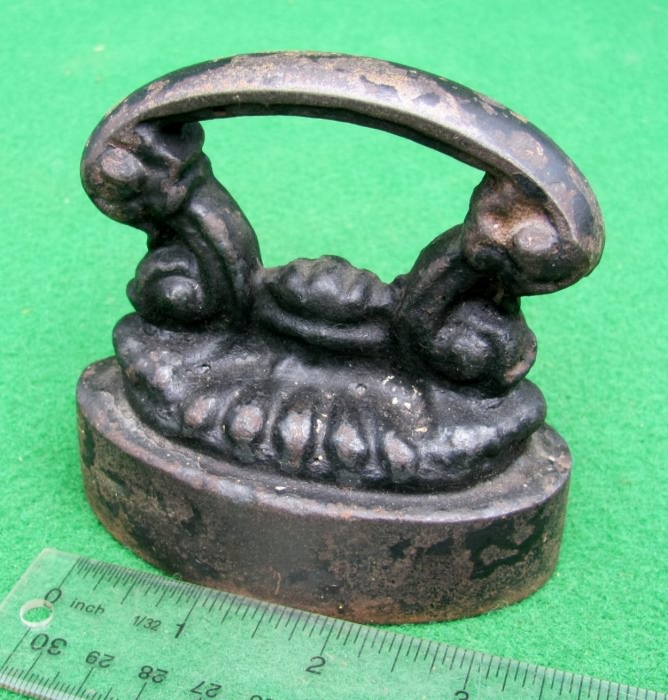 Fancy English
Oval Cap Iron The
decorative casting of this
cap iron is lovely. It has a base that is thicker than normal, and
it's 4" long, so it's quite substantial in appearance. In
his first book Dave Irons labeled this style iron as French (as did
Politzers in their books), but in the
later editions of the Irons' book they are listed as English. There is some rust on the sole
of this one
that will clean. Elegant and stately!
Fancy English
Oval Cap Iron The
decorative casting of this
cap iron is lovely. It has a base that is thicker than normal, and
it's 4" long, so it's quite substantial in appearance. In
his first book Dave Irons labeled this style iron as French (as did
Politzers in their books), but in the
later editions of the Irons' book they are listed as English. There is some rust on the sole
of this one
that will clean. Elegant and stately!
Very Good . . . . . . $250.00 SOLD!
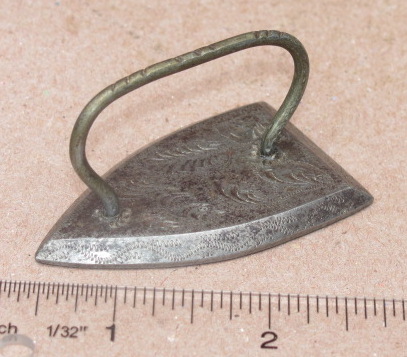 Engraved
Amazoc Iron These little engraved irons are nice. I imagine they
were made as decorative pieces for tourists or rich folk in Mexico. Some
are very detailed, even inlaid and signed. This one has some very nice
engraved designs!
Engraved
Amazoc Iron These little engraved irons are nice. I imagine they
were made as decorative pieces for tourists or rich folk in Mexico. Some
are very detailed, even inlaid and signed. This one has some very nice
engraved designs!
Good . . . . . . SOLD!
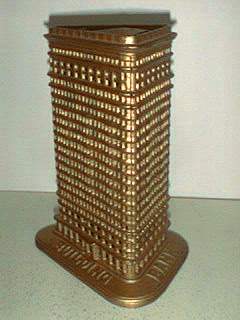 Flat
Iron Building Cast Iron Bank This cast iron bank got its
name from the building in downtown NY that it is named after. I
assume because the footprint of the building resembles an iron.
These banks came in a series of sizes, and this is the medium size one
at 6" tall.
Condition is critical to value, and this is in nicer condition than
most!
Flat
Iron Building Cast Iron Bank This cast iron bank got its
name from the building in downtown NY that it is named after. I
assume because the footprint of the building resembles an iron.
These banks came in a series of sizes, and this is the medium size one
at 6" tall.
Condition is critical to value, and this is in nicer condition than
most!
Good . . . . . . SOLD!
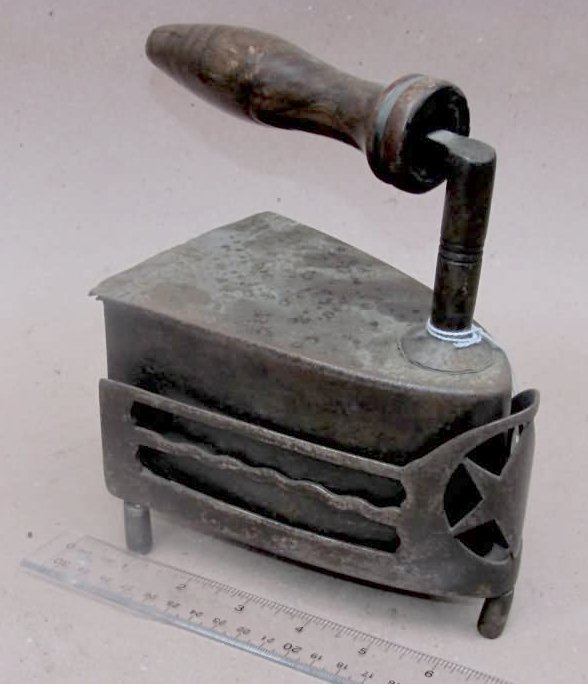 Drop in the Back Sad Iron w/ Cutout Trivet
This European slug iron is in nice condition. It has a great trivet
with a cut out star in the front.
Drop in the Back Sad Iron w/ Cutout Trivet
This European slug iron is in nice condition. It has a great trivet
with a cut out star in the front.
Very Good . . . . . . SOLD!
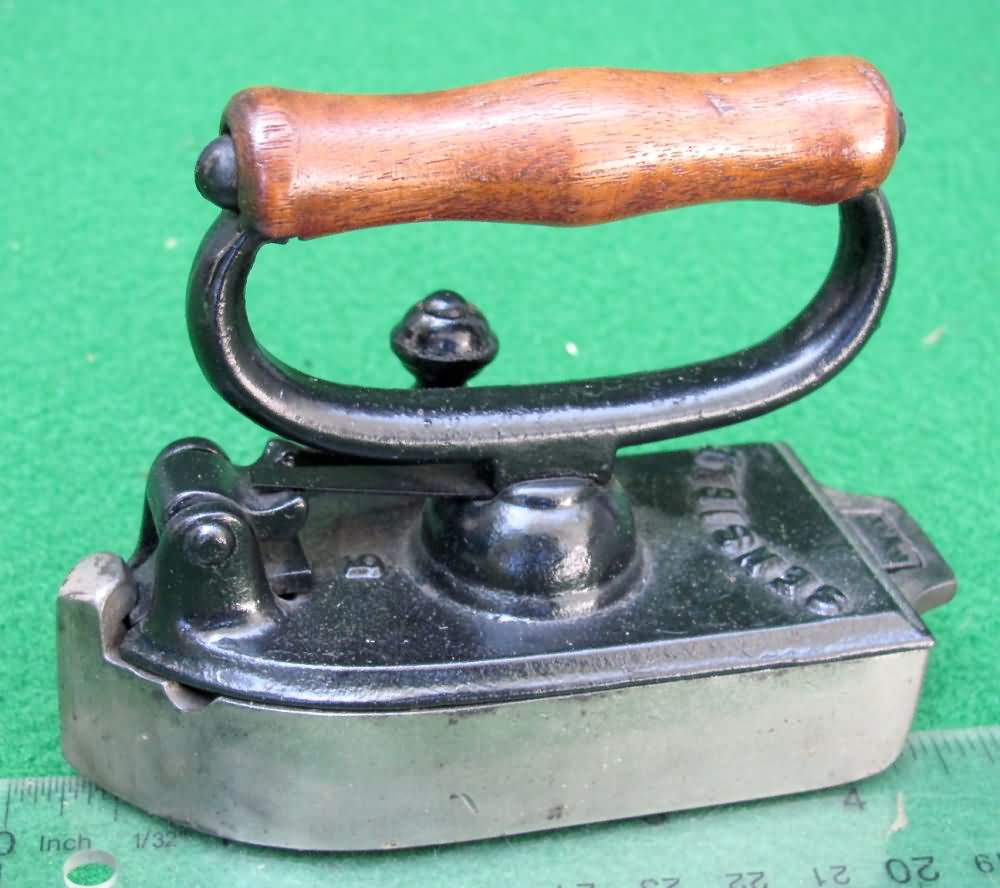 Nelson Streeter
/ Sensible Miniature Removable Handle Iron
This is the nicest condition one of these hard to find little irons I have
ever seen! You'll never have to upgrade!!
Nelson Streeter
/ Sensible Miniature Removable Handle Iron
This is the nicest condition one of these hard to find little irons I have
ever seen! You'll never have to upgrade!!Fine . . . . . . SOLD!
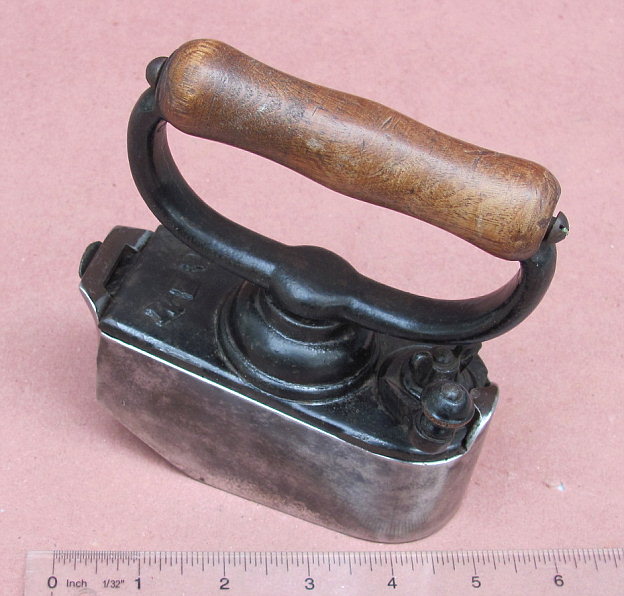 Streeter's
Patent "Gem" Box / Slug Iron
This version is even more rare than the simple removable handle solid bottom
Gem #2. I assume this to be the earlier of the two---more complex in
design and probably more expensive to produce. This is only the second
example of this iron we have ever offered for sale. It's in super nice
condition and complete with its distinctive slug. Like all of Nelson
Streeter's irons it's beautifully designed and finely cast. Highly
recommend!!
Streeter's
Patent "Gem" Box / Slug Iron
This version is even more rare than the simple removable handle solid bottom
Gem #2. I assume this to be the earlier of the two---more complex in
design and probably more expensive to produce. This is only the second
example of this iron we have ever offered for sale. It's in super nice
condition and complete with its distinctive slug. Like all of Nelson
Streeter's irons it's beautifully designed and finely cast. Highly
recommend!! Good + . . . . . . SOLD!
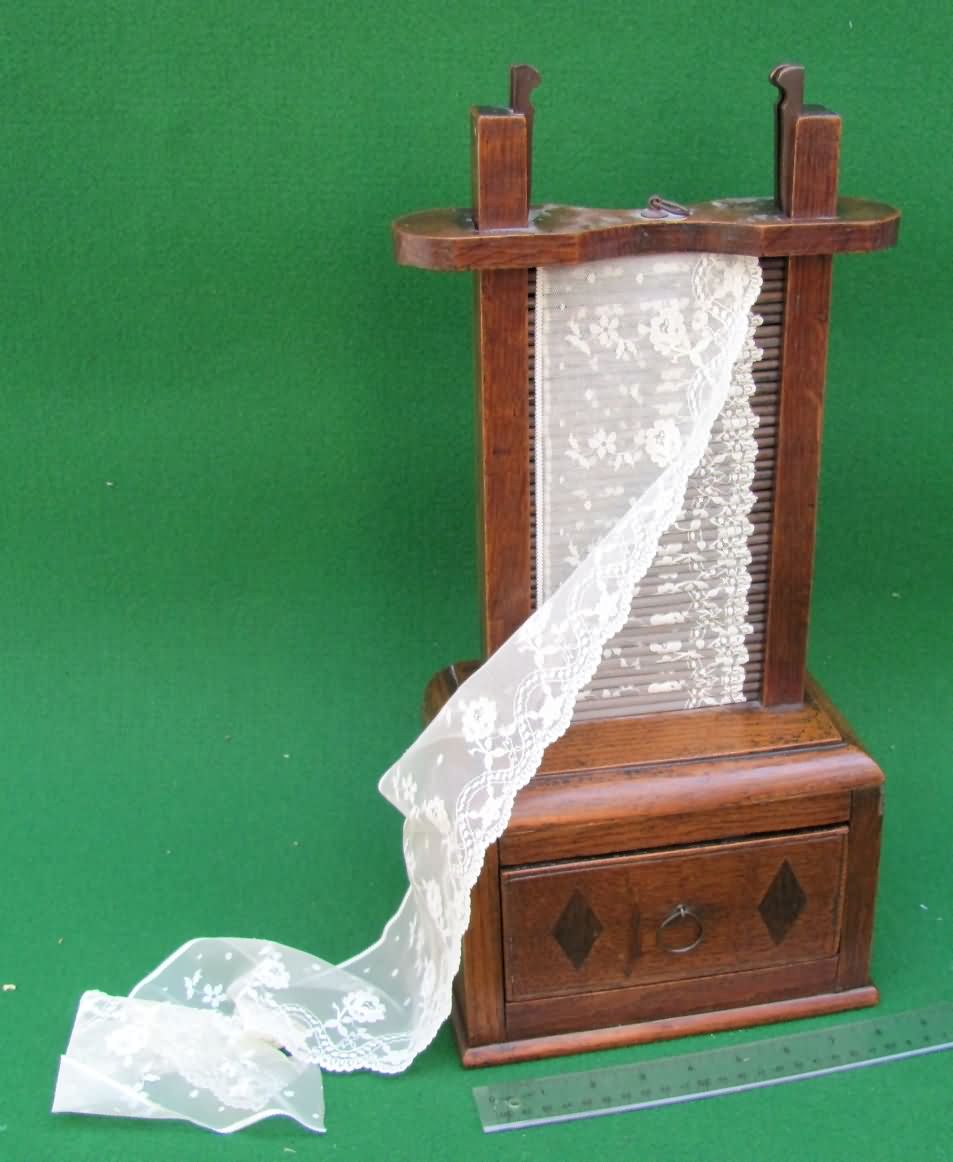 19th
Century Miniature Stacking Plaiter This
is an example of a very rare and early miniature stacking plaiter. This example is in especially nice condition.
Our consignor purchased it a number of years ago from the Carol Walker iron
auction, so it has about the best pedigree you could want.
Stacking plaiters can be found in many different sizes, but the little ones like this
are particularly nice and display really well. Very finely made
and a great looking
addition for the advanced collection!!
19th
Century Miniature Stacking Plaiter This
is an example of a very rare and early miniature stacking plaiter. This example is in especially nice condition.
Our consignor purchased it a number of years ago from the Carol Walker iron
auction, so it has about the best pedigree you could want.
Stacking plaiters can be found in many different sizes, but the little ones like this
are particularly nice and display really well. Very finely made
and a great looking
addition for the advanced collection!!Fine . . . . . . SOLD!
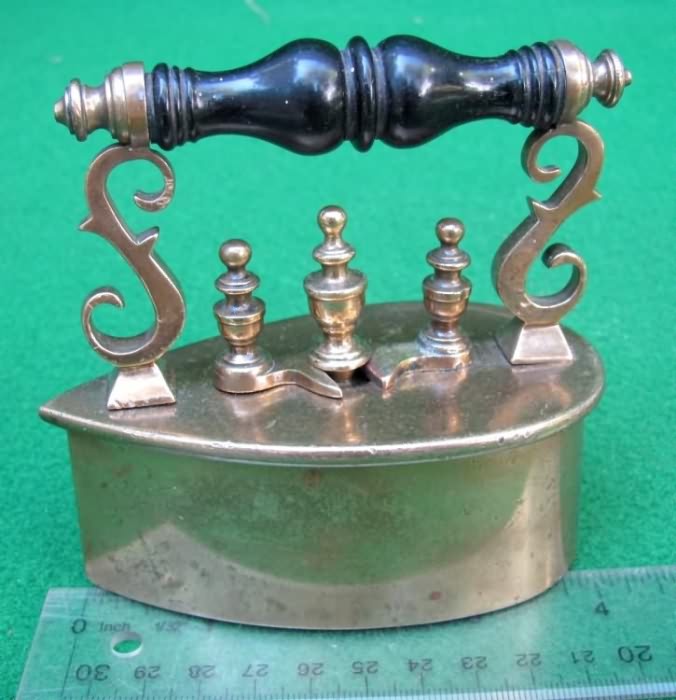 Miniature Scottish Iron
Look carefully at the ruler in the first pic. This iron
is only 4" long and just over 1/2 the size of nearly all other irons of this
design. The workmanship and quality of the castings and machining of
the different parts is second to none. As with most it is unmarked but
the consignor of this irons family were all Scottish with a colorful
background. A super piece.
Miniature Scottish Iron
Look carefully at the ruler in the first pic. This iron
is only 4" long and just over 1/2 the size of nearly all other irons of this
design. The workmanship and quality of the castings and machining of
the different parts is second to none. As with most it is unmarked but
the consignor of this irons family were all Scottish with a colorful
background. A super piece.
Good + . . . . . . SOLD!
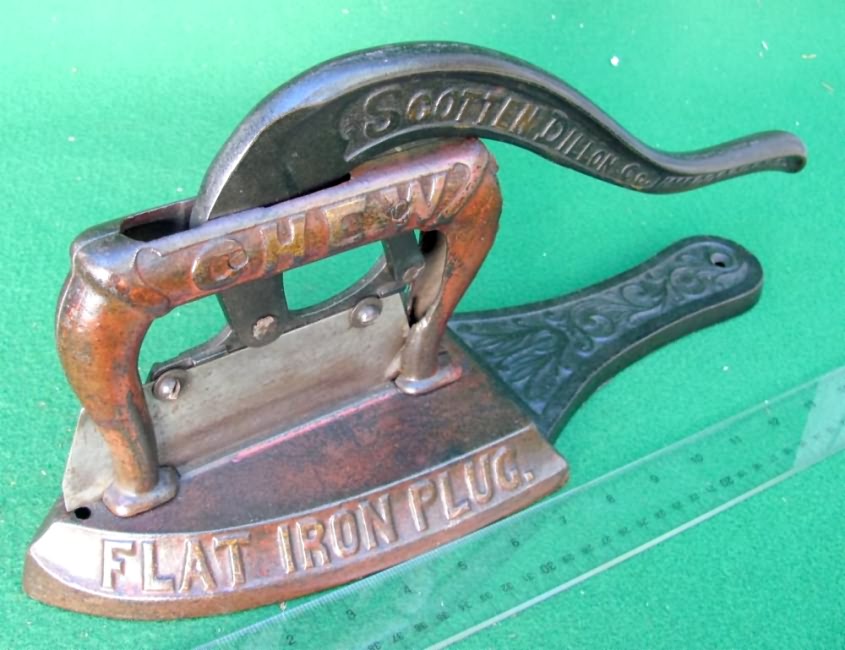 Scotten Dillon Co.Flat Iron Plug Tobacco
Cutter
The Scotten Dillon Co. Flat Iron Plug Tobacco Cutter is one of the most
famous and graphic of all ironing collectibles. It is a great figural casting of
a sad iron shaped tobacco cutter for
cutting a chew tobacco by the name Flat Iron Tobacco. The condition of
this example is
exceptional. It is easily the nicest one we have ever had the pleasure
of selling. Very nice!
Scotten Dillon Co.Flat Iron Plug Tobacco
Cutter
The Scotten Dillon Co. Flat Iron Plug Tobacco Cutter is one of the most
famous and graphic of all ironing collectibles. It is a great figural casting of
a sad iron shaped tobacco cutter for
cutting a chew tobacco by the name Flat Iron Tobacco. The condition of
this example is
exceptional. It is easily the nicest one we have ever had the pleasure
of selling. Very nice!
Good + . . . . . . SOLD!
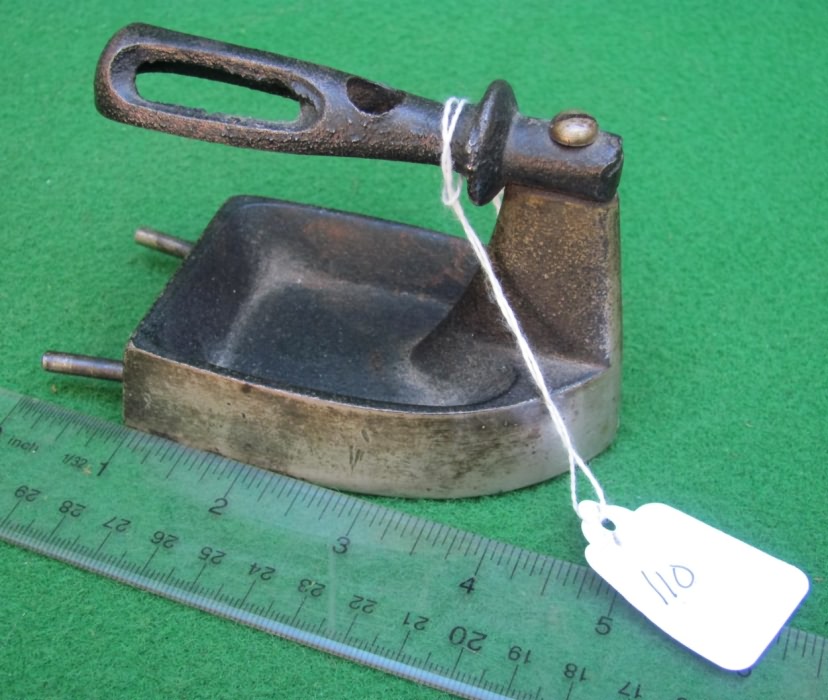 Unusual
Myers Patent
Sad Iron This is a patented iron
that has been previously unidentified, and as far as I recall is not known
in any collections. When we first saw this little iron we noted the
"cutout" design of the metal handle and the hollowed out body. We also
recognized that the pins coming out the back were to be used as a stand or
trivet, so the iron can be tipped back and left standing upright. Initially
I
didn't think too much more about it.
Unusual
Myers Patent
Sad Iron This is a patented iron
that has been previously unidentified, and as far as I recall is not known
in any collections. When we first saw this little iron we noted the
"cutout" design of the metal handle and the hollowed out body. We also
recognized that the pins coming out the back were to be used as a stand or
trivet, so the iron can be tipped back and left standing upright. Initially
I
didn't think too much more about it.But something familiar about the handle got me to thinking. And then I looked at the iron more closely and found the tiny stamp on the heel that reads "Myers Pat". Then the similarity of the handle to that of the Myers patent "Goat fluter" handle really made sense. Twenty minutes later, after conferring with Google, I found the answer---just run "patent number 123,120 January 30 1872" in a Google search to see the patent. It's really a great looking little iron, and no collection of Frederick Myers' irons would be complete without it!
Very Good . . . . . . $395.00 SOLD!
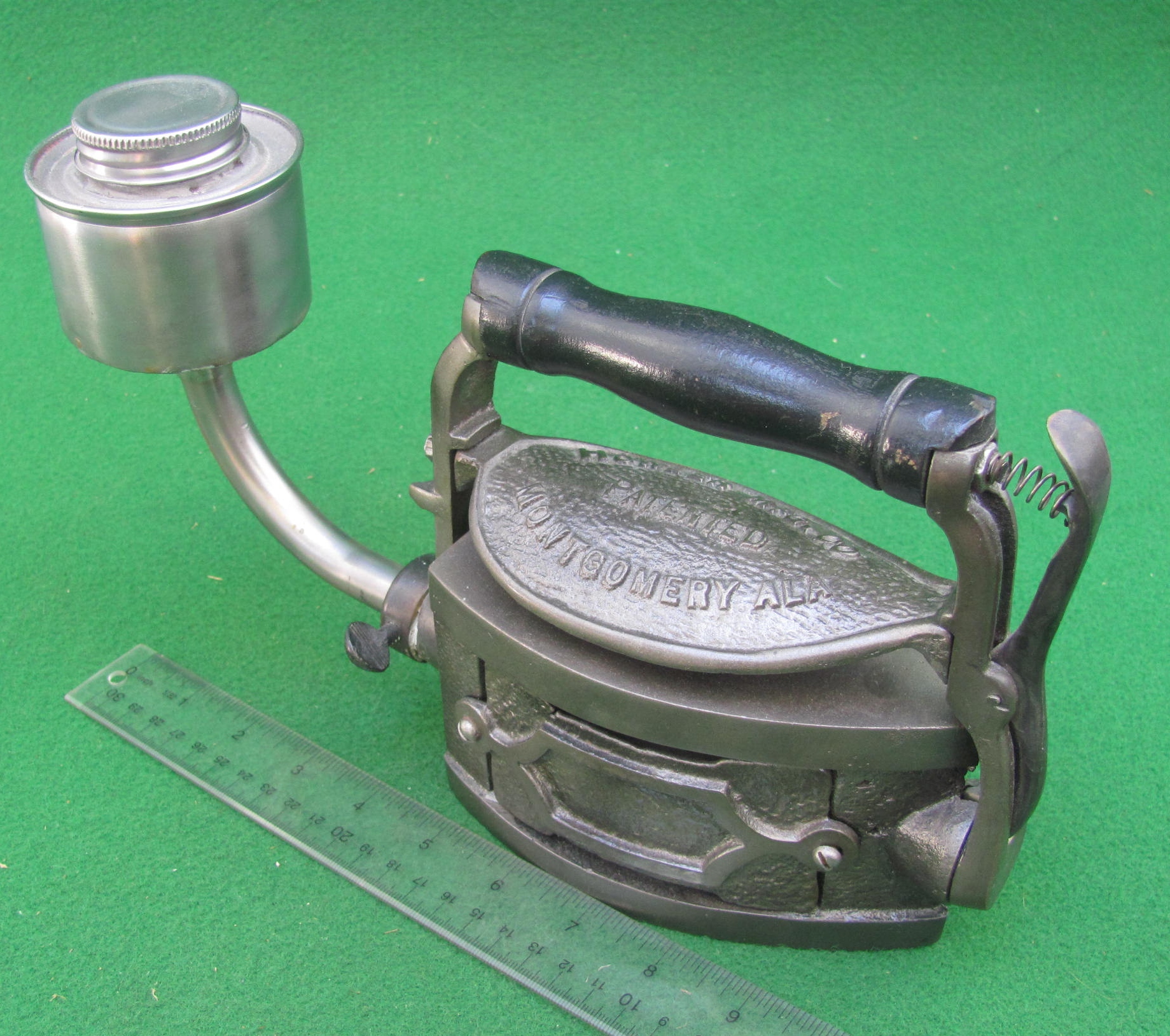 Howler
Mfg. Co. / Montgomery, Alabama Revolving Liquid Fuel Alcohol Iron
I believe this is the only known example of this iron. Nor do I know of any other antique irons hailing from the
state of Alabama. The Howler name and location are boldly cast on the
cast iron heat shield. The heat shield is attached to the handle in such a
manner that it revolves with the handle when revolved.
Howler
Mfg. Co. / Montgomery, Alabama Revolving Liquid Fuel Alcohol Iron
I believe this is the only known example of this iron. Nor do I know of any other antique irons hailing from the
state of Alabama. The Howler name and location are boldly cast on the
cast iron heat shield. The heat shield is attached to the handle in such a
manner that it revolves with the handle when revolved. Wesley E. Cochran was granted a patent for this design in 1909. The patent number is 948,982. The patent mainly describes the burner and the use of alcohol as the fuel to better heat pressing irons. The patent drawing of the burner and valve is a bit different from the tank on this iron. The patent shows a controlling valve as part of the design, and the patent specifically states that the tank is not shown in the patent drawings. This iron was originally found without the burner valve assembly and tank, and so some artistic license was taken when this tank was made. There was also a repair to the thumb latch.
Cochran was granted a number of other patents for lighting devices, including one for a combination light and license plate holder---for carriages and before batteries became commonplace no doubt.
A rare and interesting iron that has a great look!!
Very Good . . . . . . $1995.00 SOLD!
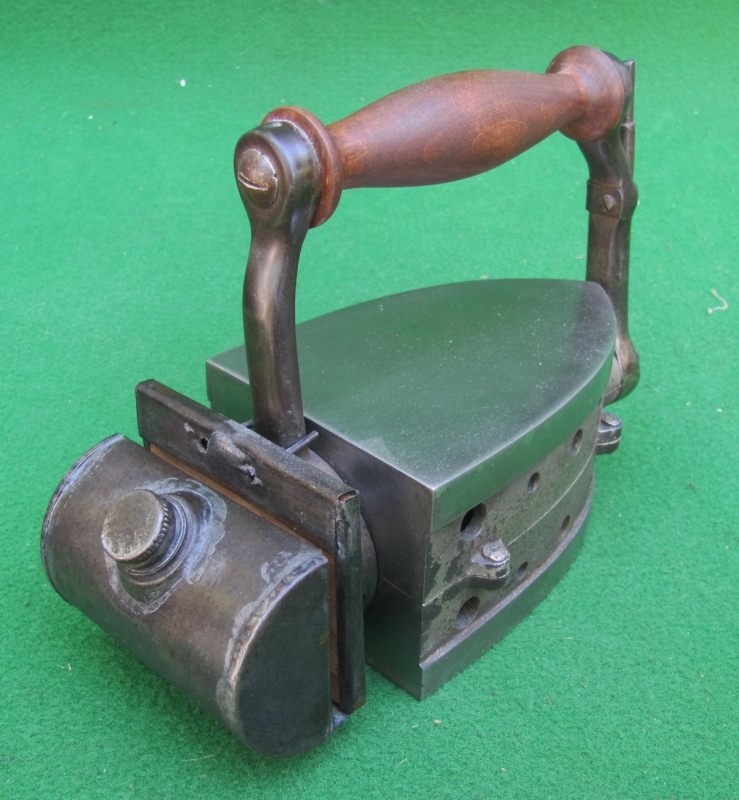 Revolving Alcohol
Fuel
Iron This two face revolving iron
is unmarked as to maker, but the back end is stamped "Pat Mar 5 1885".
Utilizing the principle that heat rises, the idea was that the top face
would be heating while the bottom face was being used. As the bottom
cooled down the iron would be rotated around so the warmer top face could
then be used. I could never figure out how you were supposed to
accomplish the task of rotating a hot iron without using your hands to help
in the process.
Revolving Alcohol
Fuel
Iron This two face revolving iron
is unmarked as to maker, but the back end is stamped "Pat Mar 5 1885".
Utilizing the principle that heat rises, the idea was that the top face
would be heating while the bottom face was being used. As the bottom
cooled down the iron would be rotated around so the warmer top face could
then be used. I could never figure out how you were supposed to
accomplish the task of rotating a hot iron without using your hands to help
in the process.The fuel tank is original and quite different in design from other irons of this type, this one being shaped like a half-round cylinder with an attached heat shield. The metal heat shield is lined with a thin layer of wood as an insulator, OSHA-approved no doubt, and probably devised after an unfortunate mishap during the development. period.
This iron is in great condition and looks to have seen little use. In fact the wick in the tank looks like it never saw a flame. Note the little tin cap that fits over the end of the wick. I imagine the purpose was to snuff out the flame and, by covering the wick, to reduce alcohol evaporation when not in use, an added feature I don't remember ever having seen before. The knob that would have been at the top of the lever release is missing, but a replacement could be fabricated pretty easily. Highly recommend!!
Very Good . . . . . . $1295.00 SOLD!
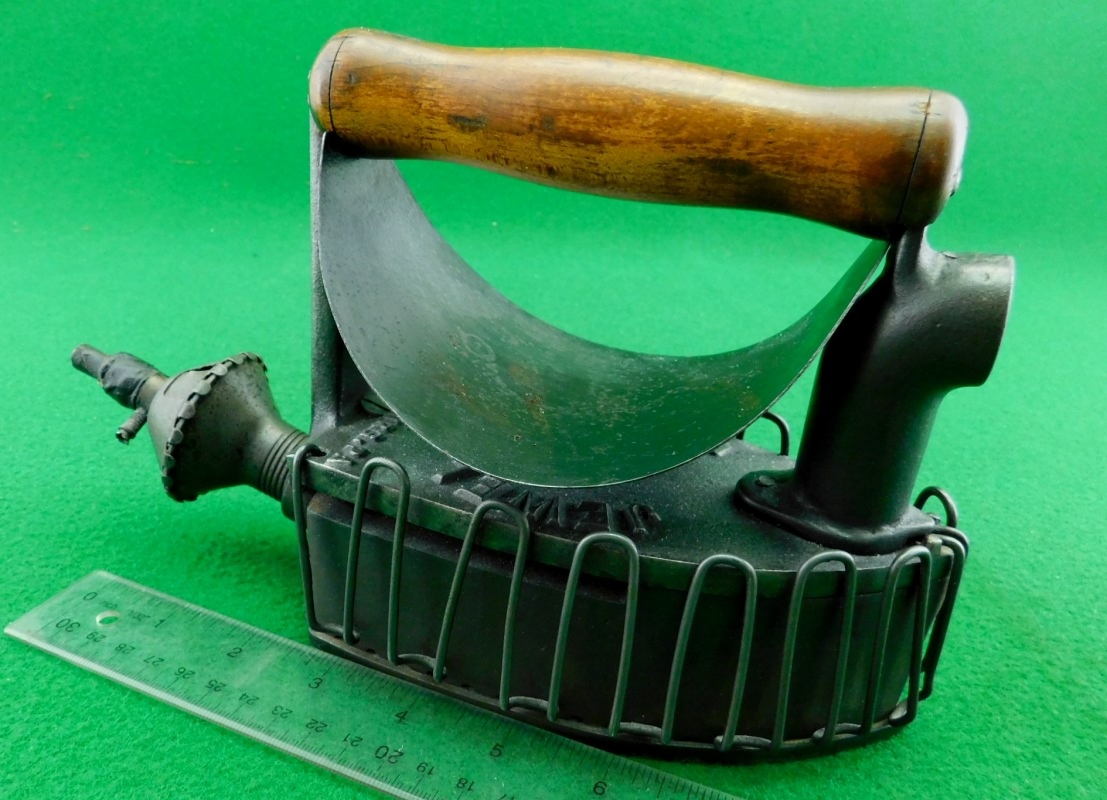 Jewel
Natural Gas Iron This is a rare iron and one
we have never had before. The built-in wire trivet / side shield is
unique and probably deserved a patent if you could figure out what it's
function actually was. It is marked in bold casting under the heat shield
"JEWEL DIAMOND HDW. MFG. CO. PITTSBURG, PA". Rare and
distinctive---highly recommend!!
Jewel
Natural Gas Iron This is a rare iron and one
we have never had before. The built-in wire trivet / side shield is
unique and probably deserved a patent if you could figure out what it's
function actually was. It is marked in bold casting under the heat shield
"JEWEL DIAMOND HDW. MFG. CO. PITTSBURG, PA". Rare and
distinctive---highly recommend!! Very Good . . . . . . $1895.00 SOLD!
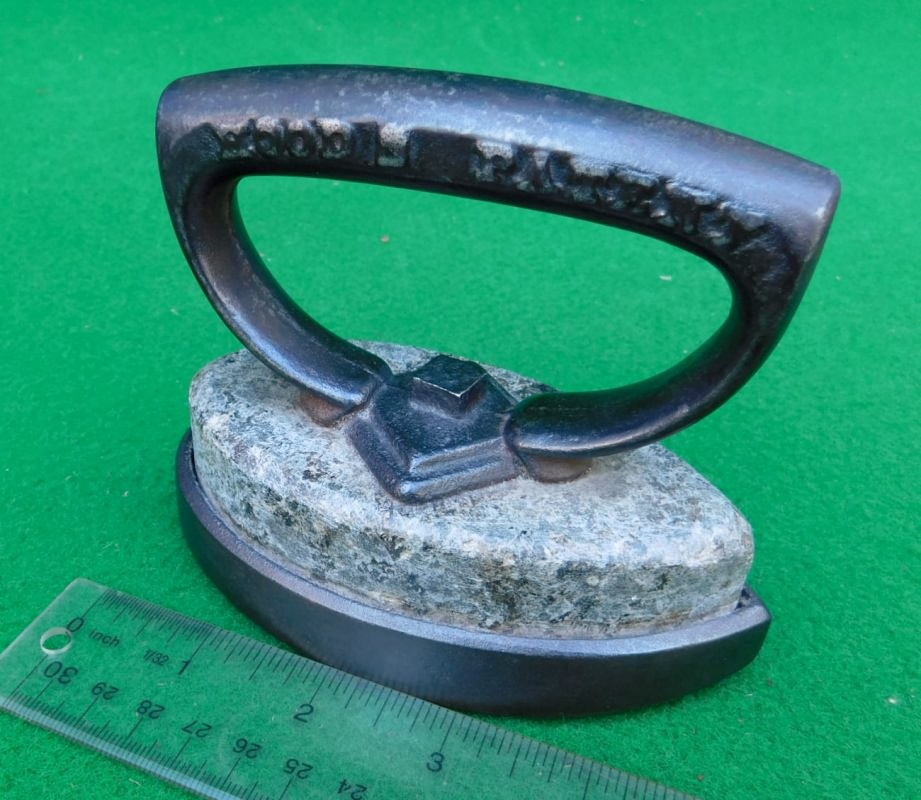 Hood
Patent Soapstone Polishing Iron This is the
small double point shaped polisher version of this iron. The larger spade shape
Hood's soapstone irons came
in several different sizes, but this style was just offered in this one size, and is much
harder to find. The name and the 1867 patent date are cast into the sides of
the handle. A soapstone body with cast iron sole and handle---truely a
unique idea!!
Hood
Patent Soapstone Polishing Iron This is the
small double point shaped polisher version of this iron. The larger spade shape
Hood's soapstone irons came
in several different sizes, but this style was just offered in this one size, and is much
harder to find. The name and the 1867 patent date are cast into the sides of
the handle. A soapstone body with cast iron sole and handle---truely a
unique idea!!
Very Good . . . . . . $275.00 SOLD!
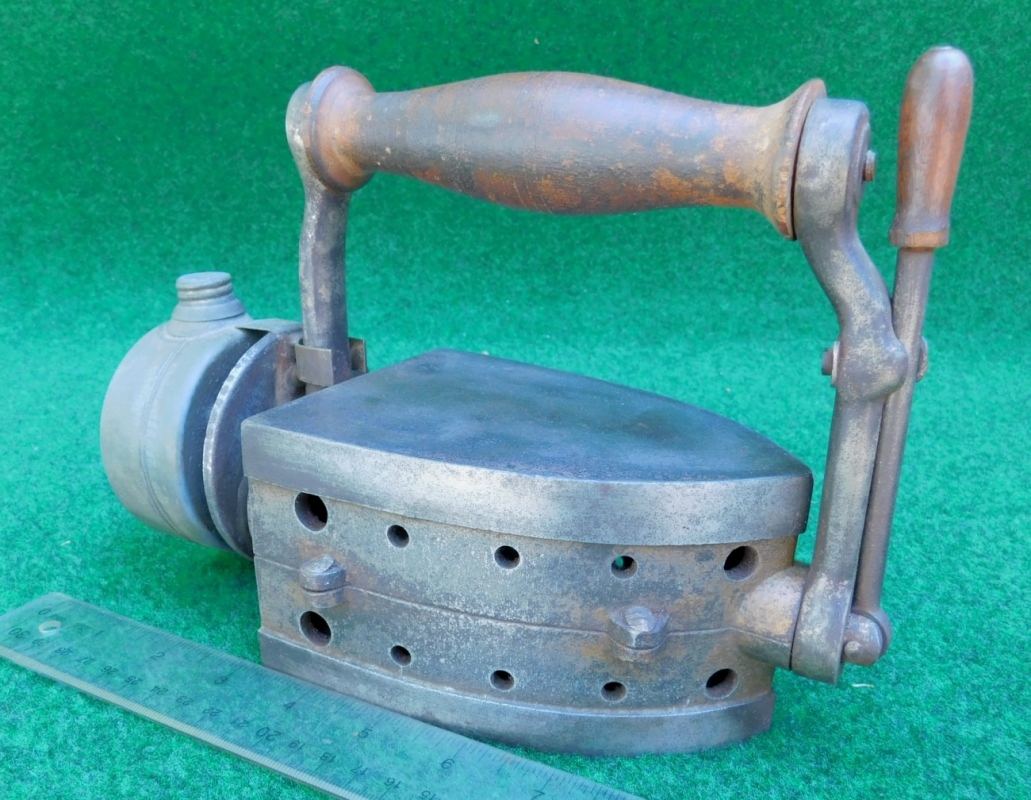 Revolving
Liquid Fuel Pressing Iron This is an
early liquid fuel iron from the pre-petroleum era. Cutting edge technology
for the time. Whale oil was most likely the fuel used. The tank is
original and the latch works. It is in overall very nice condition. Can
you imagine needing your clothes to be pressed before heading off to work or
play back in the 1830's and using this iron?
Revolving
Liquid Fuel Pressing Iron This is an
early liquid fuel iron from the pre-petroleum era. Cutting edge technology
for the time. Whale oil was most likely the fuel used. The tank is
original and the latch works. It is in overall very nice condition. Can
you imagine needing your clothes to be pressed before heading off to work or
play back in the 1830's and using this iron? Very Good . . . . . . $795.00 SOLD!
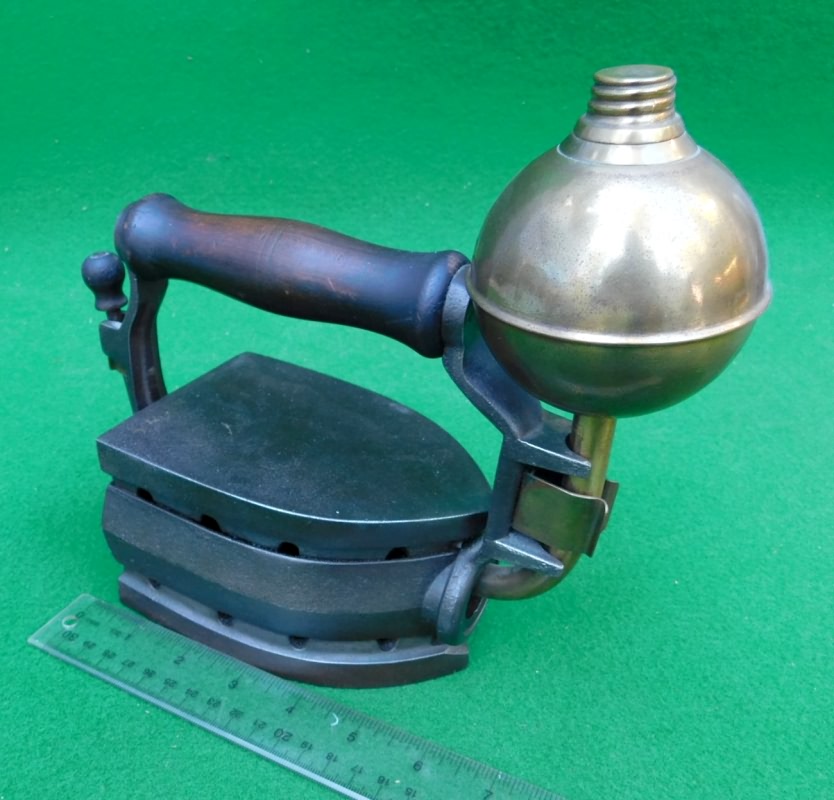 Whale
Oil Fired Revolving Iron This is a variation
we have never had before. The only marking is on the cap of the fuel
tank where it is marked with the letters "M M" and then an "A"within a diamond,
and then "Co". We are not sure what that
refers to. Unlike most revolving fuel irons the tank is located on the
front, not the back, of this example. And because the design
incorporates it into the handle the tank revolves along with the handle,
rather than being stationary to the body as is the case with most other
revolving gas irons. To revolve the iron you release the rear lever to
unlock it, then you turn the base 180 degrees, I imagine hoping that the
fuel tank doesn't come loose and praying that you don't burn yourself in the
process. Now that's a better idea! Highly recommend!!
Whale
Oil Fired Revolving Iron This is a variation
we have never had before. The only marking is on the cap of the fuel
tank where it is marked with the letters "M M" and then an "A"within a diamond,
and then "Co". We are not sure what that
refers to. Unlike most revolving fuel irons the tank is located on the
front, not the back, of this example. And because the design
incorporates it into the handle the tank revolves along with the handle,
rather than being stationary to the body as is the case with most other
revolving gas irons. To revolve the iron you release the rear lever to
unlock it, then you turn the base 180 degrees, I imagine hoping that the
fuel tank doesn't come loose and praying that you don't burn yourself in the
process. Now that's a better idea! Highly recommend!!
Very Good . . . . . . $1995.00 SOLD!
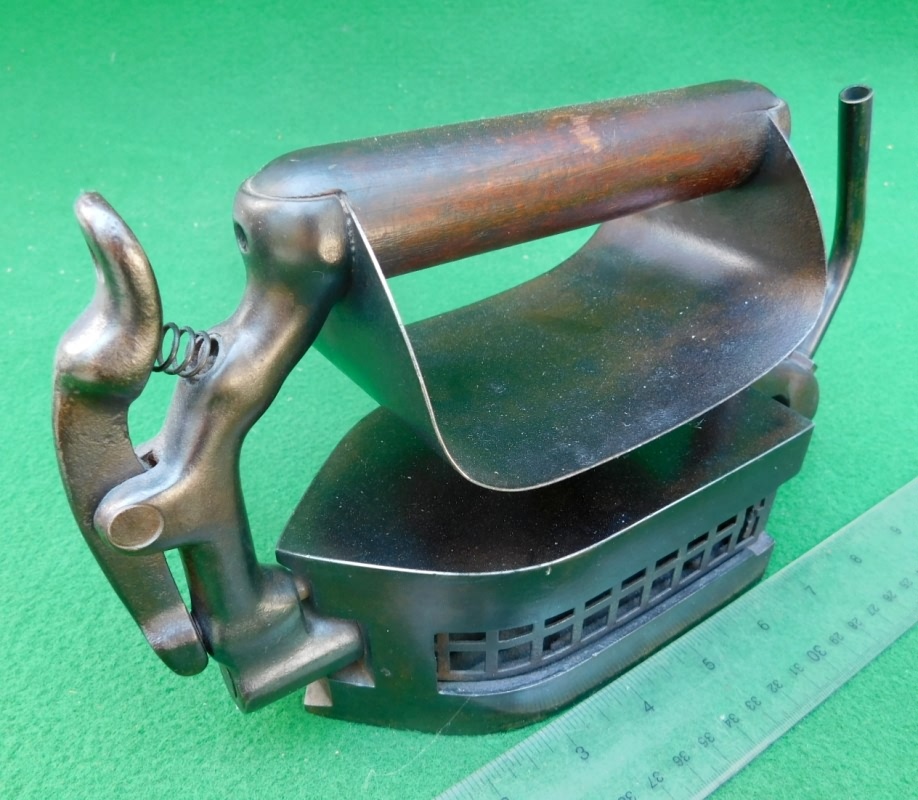 Revolving
/ Rotating Natural Gas Iron
I've had this iron once or twice in the past, and my
research indicated it was manufactured by the Comfort Gas Appliance Mfg. Co
of Boston, Massachusetts.I don't see any markings on this
example. Inside the iron body is a perforated tube within which the mixture of air
and gas would burn. A waffle patterned gridwork of metal provided the
screening to prevent the waste products of combustion and the flame from
shooting outward. What is unusual about this natural gas iron is its
ability to revolve, a feature that allowed for both the top and bottom surfaces of the iron
body to be used so that the iron could be turned over when the bottom face
had cooled. Given the fact that heat rises, the top face of the body would
constantly be heated as the bottom face was being used and cooling. In
theory anyway! A
spring loaded latching mechanism was attached to the handle to provide for
the locking and unlocking of the body. This example is in
excellent condition with a rich dark patina!!
Revolving
/ Rotating Natural Gas Iron
I've had this iron once or twice in the past, and my
research indicated it was manufactured by the Comfort Gas Appliance Mfg. Co
of Boston, Massachusetts.I don't see any markings on this
example. Inside the iron body is a perforated tube within which the mixture of air
and gas would burn. A waffle patterned gridwork of metal provided the
screening to prevent the waste products of combustion and the flame from
shooting outward. What is unusual about this natural gas iron is its
ability to revolve, a feature that allowed for both the top and bottom surfaces of the iron
body to be used so that the iron could be turned over when the bottom face
had cooled. Given the fact that heat rises, the top face of the body would
constantly be heated as the bottom face was being used and cooling. In
theory anyway! A
spring loaded latching mechanism was attached to the handle to provide for
the locking and unlocking of the body. This example is in
excellent condition with a rich dark patina!!Very Good . . . . . . $895.00 SOLD!
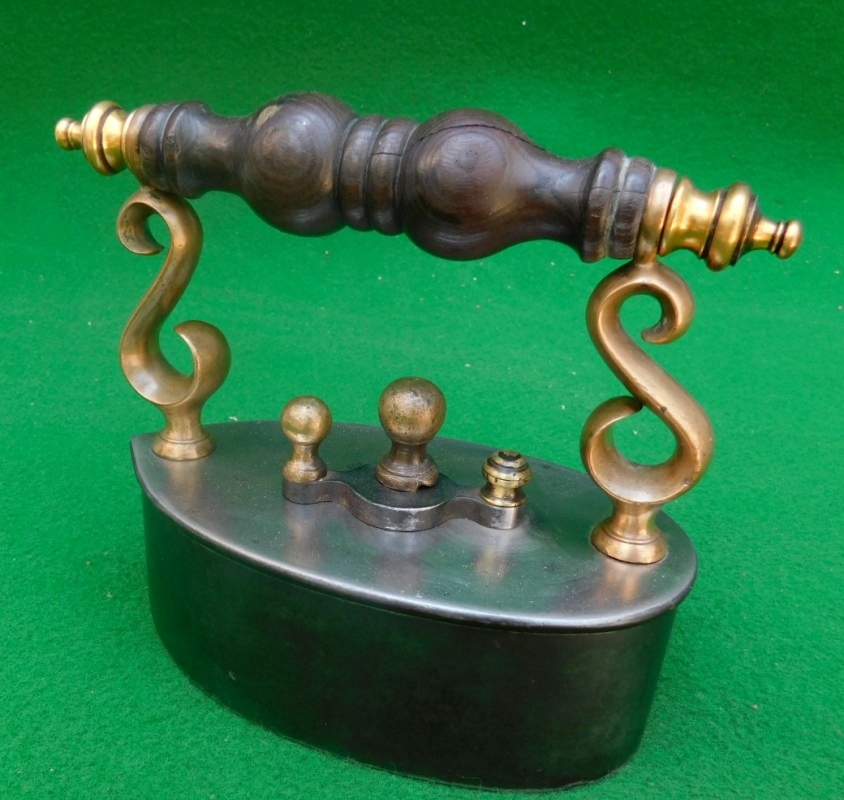 Scottish Box Iron with Slug
Scottish box irons are elegant designs
utilizing interesting combinations of materials and shapes. Showcasing
the talents of the individual craftsman, it has been said that no two
examples of these irons are exactly alike. This beautiful box iron is
just over 6 inches in length. It has ornate S-shaped brass uprights
and a turned wooden grip that is capped with brass ends. I believe
both parts of the base are cast iron with the lid being highly polished and
finished. The swinging latch secures the clasp. The slug is also
a highly individualized and custom fitted shape. These irons have
settled out in price in recent years, and the price of this example reflects
their current market value. A great opportunity to add one of these to
your iron collection if you were unable to do that when they were selling
for two to three times this amount!!
Scottish Box Iron with Slug
Scottish box irons are elegant designs
utilizing interesting combinations of materials and shapes. Showcasing
the talents of the individual craftsman, it has been said that no two
examples of these irons are exactly alike. This beautiful box iron is
just over 6 inches in length. It has ornate S-shaped brass uprights
and a turned wooden grip that is capped with brass ends. I believe
both parts of the base are cast iron with the lid being highly polished and
finished. The swinging latch secures the clasp. The slug is also
a highly individualized and custom fitted shape. These irons have
settled out in price in recent years, and the price of this example reflects
their current market value. A great opportunity to add one of these to
your iron collection if you were unable to do that when they were selling
for two to three times this amount!! Very Good . . . . . . $600.00 SOLD!
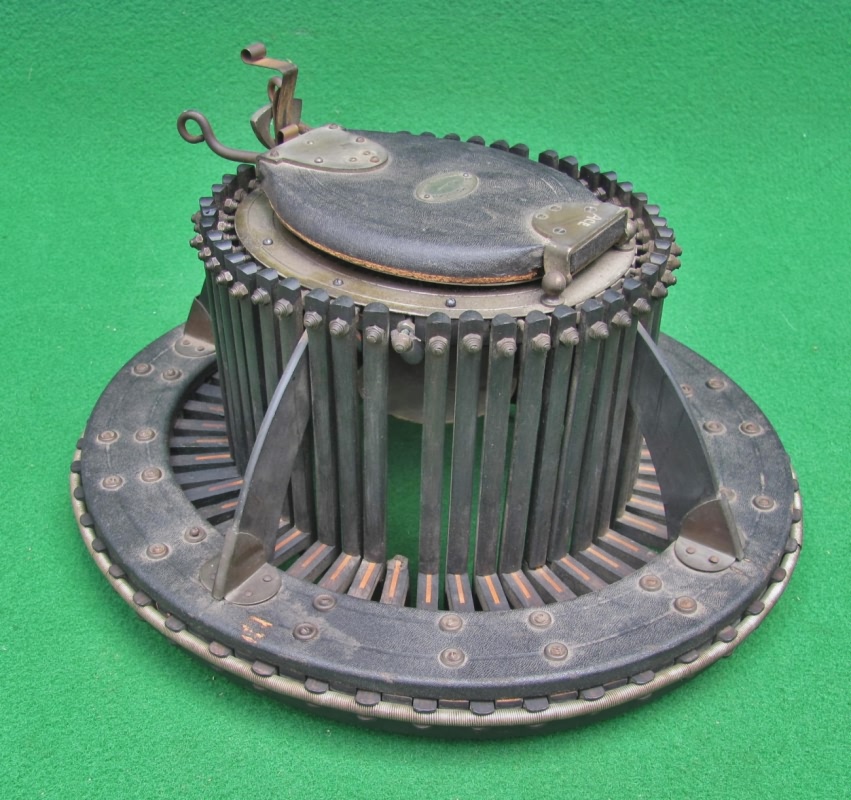 Allie Maillard Conformateur Millinery Hat
Sizing / Measuring Machine
This unusual
device dates from the 19th century when hat making was evolving into an art
form and hat makers needed tools designed to help them in their endeavors.
It has a great look and will be a welcome addition to many collections, or
from what I have seen put back into use making one of those new custom hats
that are so popular. The overall condition is nice and it
is operational noting one missing pin, a few glued pins, and some minor damage
to the tips of a few others. (see pics)
Allie Maillard Conformateur Millinery Hat
Sizing / Measuring Machine
This unusual
device dates from the 19th century when hat making was evolving into an art
form and hat makers needed tools designed to help them in their endeavors.
It has a great look and will be a welcome addition to many collections, or
from what I have seen put back into use making one of those new custom hats
that are so popular. The overall condition is nice and it
is operational noting one missing pin, a few glued pins, and some minor damage
to the tips of a few others. (see pics) There are sites on the internet that have lots of historical info on these Hatter's Hat Making Tools, and lots of examples show up with a Google image search. There is even a site that deals with restorations of them. Nice!!
Good . . . . . $895.00 SOLD!
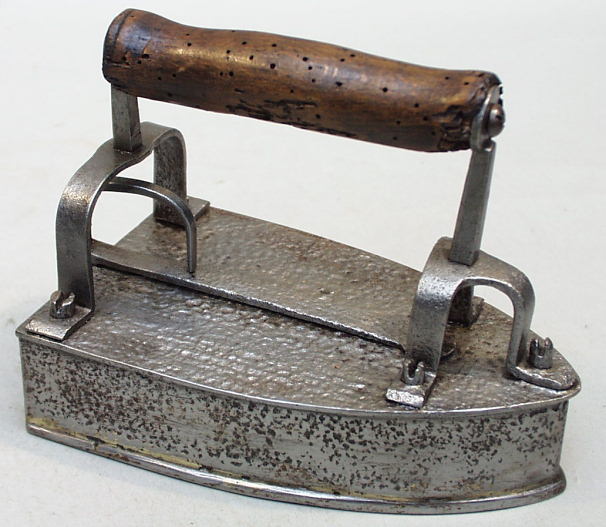 French
Stirrup Handle Swing Gate Box Iron
European stirrup handle irons with spring loaded rear gates are one of
the rarest and hardest to find of all design box irons. This one has a
tree legged front handle support and a U shaped rear. There is
some bug damage to the original handle, but it is solid. A nice
iron!!
French
Stirrup Handle Swing Gate Box Iron
European stirrup handle irons with spring loaded rear gates are one of
the rarest and hardest to find of all design box irons. This one has a
tree legged front handle support and a U shaped rear. There is
some bug damage to the original handle, but it is solid. A nice
iron!!
Good . . . . . SOLD
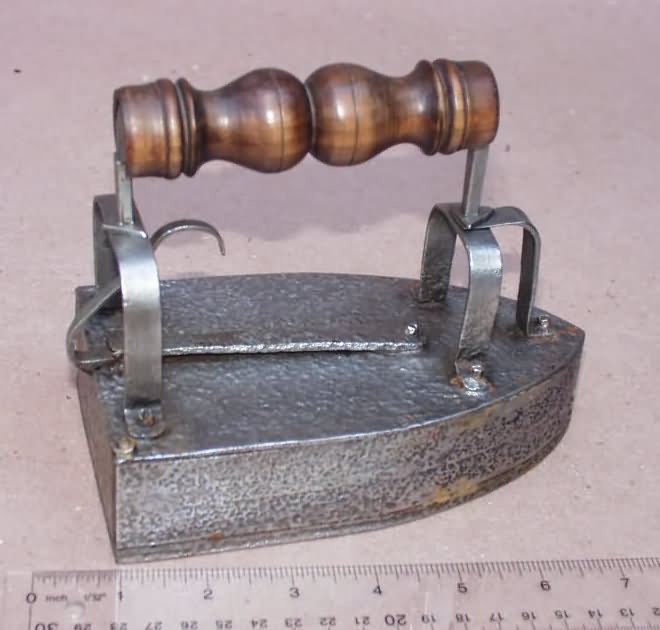 French
Stirrup Handle Swing Gate Box Iron European stirrup handle irons with spring loaded
rear gates are one of the rarest and hardest to find of all design box irons.
I imagine the idea was developed because single post designs had a tendency
to work loose over time, and a design like this with multiple attachment points
would hold up much better and be much more stable. The iron body itself
is a multiple piece design riveted and pinned together along with signs of brazing
at the seams. The door pops open as it should when the trigger is pulled
under the handle, which has great form as well. All in all a nice iron
in nice condition!
French
Stirrup Handle Swing Gate Box Iron European stirrup handle irons with spring loaded
rear gates are one of the rarest and hardest to find of all design box irons.
I imagine the idea was developed because single post designs had a tendency
to work loose over time, and a design like this with multiple attachment points
would hold up much better and be much more stable. The iron body itself
is a multiple piece design riveted and pinned together along with signs of brazing
at the seams. The door pops open as it should when the trigger is pulled
under the handle, which has great form as well. All in all a nice iron
in nice condition!
Good . . . . . SOLD
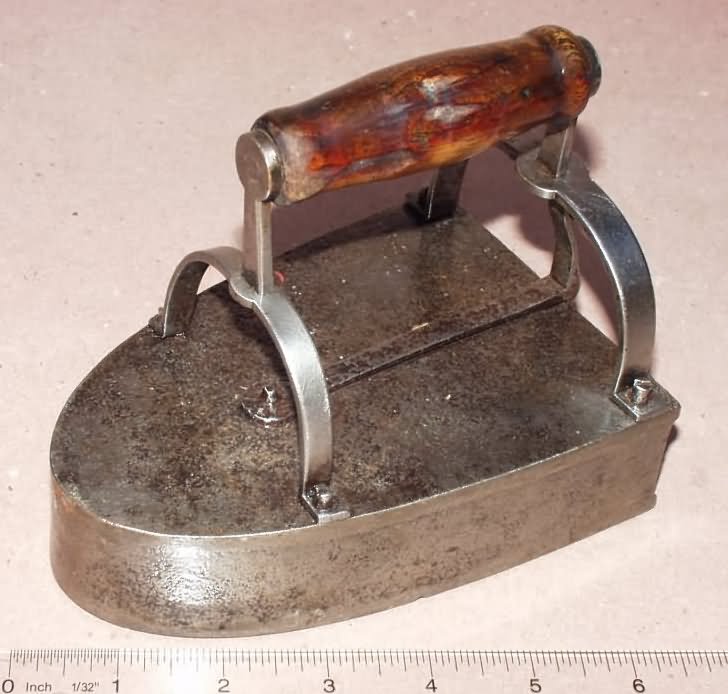 Round
Nose Iron Double Stirrup Handle Spring Loaded Gate Box Iron
European stirrup handle irons with spring loaded rear gates are one those types
of iron that you typically find only in long-time collections. This one
has a round nose design and the handles attach in two places for added stability.
The rear door is spring loaded and pops open when the lever is pressed or pulled
back. A classic and beautifully balance form!
Round
Nose Iron Double Stirrup Handle Spring Loaded Gate Box Iron
European stirrup handle irons with spring loaded rear gates are one those types
of iron that you typically find only in long-time collections. This one
has a round nose design and the handles attach in two places for added stability.
The rear door is spring loaded and pops open when the lever is pressed or pulled
back. A classic and beautifully balance form!
Good . . . . . SOLD
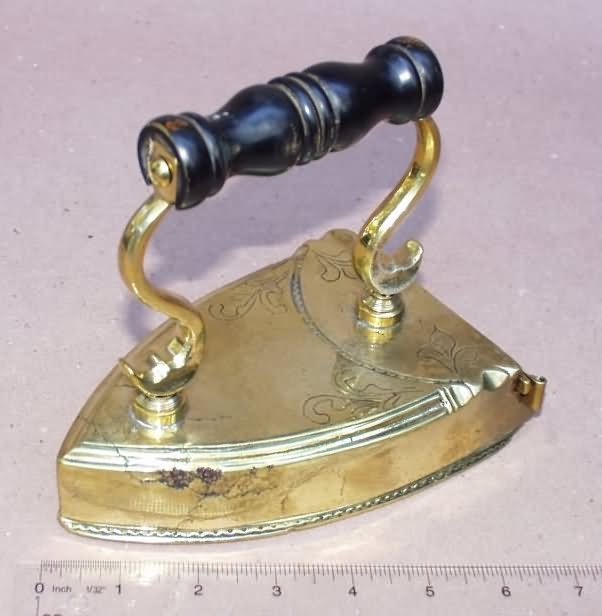 Decorated
Brass Swing Gate Iron This is a very nicely done iron. It shows a high degree of workmanship
and skill in all of its features. Note the decorated and stepped edges
at the top and bottom of the body. It has an almost decorative beaded
base. The top is engraved and the handle posts end in what look like crescent
moon shapes. A gorgeous piece!
Decorated
Brass Swing Gate Iron This is a very nicely done iron. It shows a high degree of workmanship
and skill in all of its features. Note the decorated and stepped edges
at the top and bottom of the body. It has an almost decorative beaded
base. The top is engraved and the handle posts end in what look like crescent
moon shapes. A gorgeous piece!
Good . . . . . SOLD
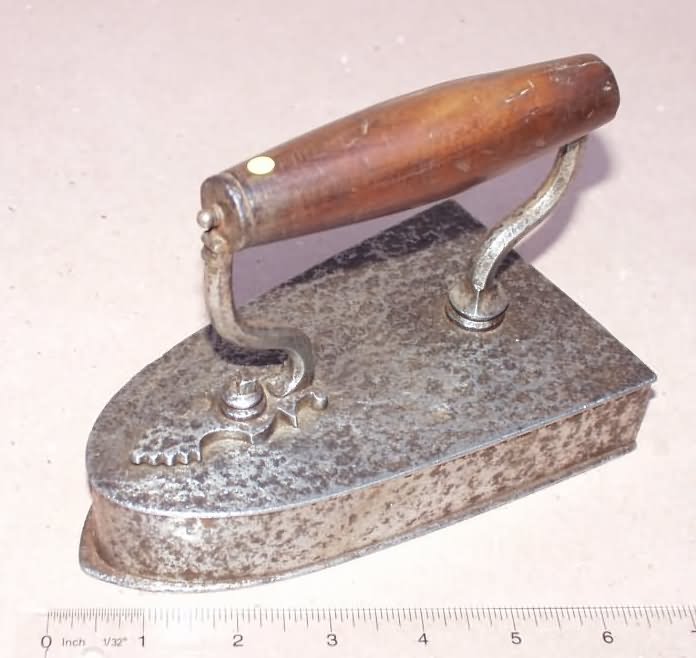 Primitive
Decorated Drop-in-the-Back Box Iron Note the elongated toe extending past the round nose in this iron. Also
note the decorative front handle post at the attachment point and the fine file
work that went into creating that. The standards have outward sweeps to
allow for a larger handle and those posts both show a nice degree of workmanship
and pride in its making. An unusual form and a nice early iron!
Primitive
Decorated Drop-in-the-Back Box Iron Note the elongated toe extending past the round nose in this iron. Also
note the decorative front handle post at the attachment point and the fine file
work that went into creating that. The standards have outward sweeps to
allow for a larger handle and those posts both show a nice degree of workmanship
and pride in its making. An unusual form and a nice early iron!
Good . . . . . SOLD
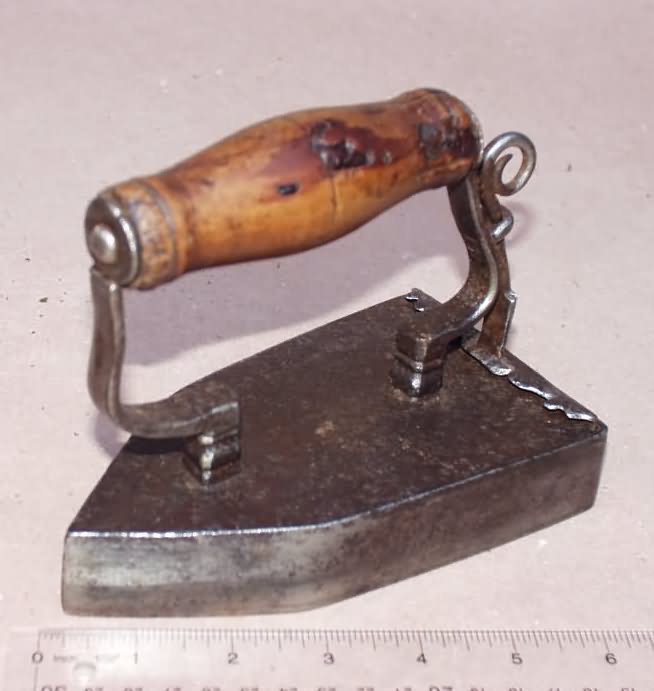 "Monkey
Tail" Lift Gate Box Iron
This iron predates the time of mass production, or at a minimum was made in
an area where new technologies had not yet appeared. The maker added a
couple of nice design elements to the iron. Note the monkey tail, or rat
tail, design to the lift gate. And note the decorative edge along the
top of the gate. He had to turn this piece of metal, and then he filed
in a a fancy design. The standards for the handle are very nice as well.
In addition to having the kicked-out feature to accept a longer handle, they
have a nice transition form and a lot of file work was done on them as well.
The latch hold-up mechanism is very unique as well. A nice early
iron!
"Monkey
Tail" Lift Gate Box Iron
This iron predates the time of mass production, or at a minimum was made in
an area where new technologies had not yet appeared. The maker added a
couple of nice design elements to the iron. Note the monkey tail, or rat
tail, design to the lift gate. And note the decorative edge along the
top of the gate. He had to turn this piece of metal, and then he filed
in a a fancy design. The standards for the handle are very nice as well.
In addition to having the kicked-out feature to accept a longer handle, they
have a nice transition form and a lot of file work was done on them as well.
The latch hold-up mechanism is very unique as well. A nice early
iron!
Good . . . . . SOLD
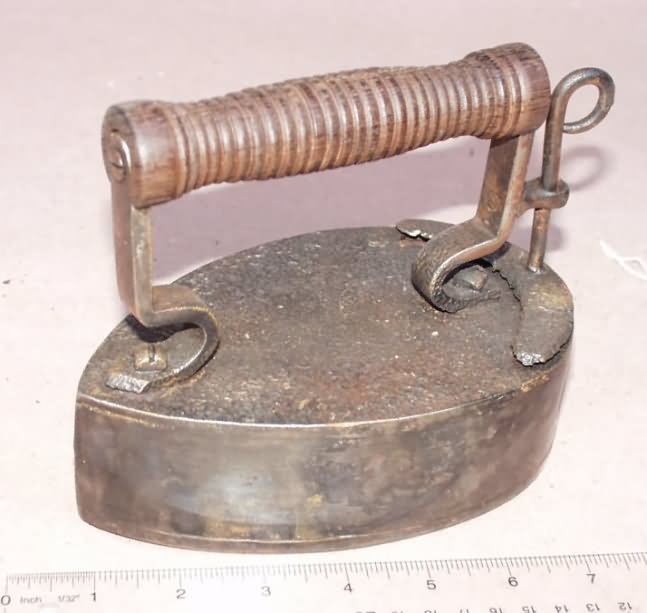 Round
Back Iron Lift Gate Box Iron
The collector's tag identifies this as being Danish and dating from the early
19th century. It has a very nice handle and the half loop handle standards
are a nice decorative touch. It is a three piece slab construction as
opposed to being cast, and there are a lot of detailed pins and rivets and work
that went into forming this early iron. The round back feature is an unusual
design element not seen very often, and the interior of the body has a thick
raised S-shaped to hold the slug up from the bottom. An unusual iron!
Round
Back Iron Lift Gate Box Iron
The collector's tag identifies this as being Danish and dating from the early
19th century. It has a very nice handle and the half loop handle standards
are a nice decorative touch. It is a three piece slab construction as
opposed to being cast, and there are a lot of detailed pins and rivets and work
that went into forming this early iron. The round back feature is an unusual
design element not seen very often, and the interior of the body has a thick
raised S-shaped to hold the slug up from the bottom. An unusual iron!
Good . . . . . SOLD
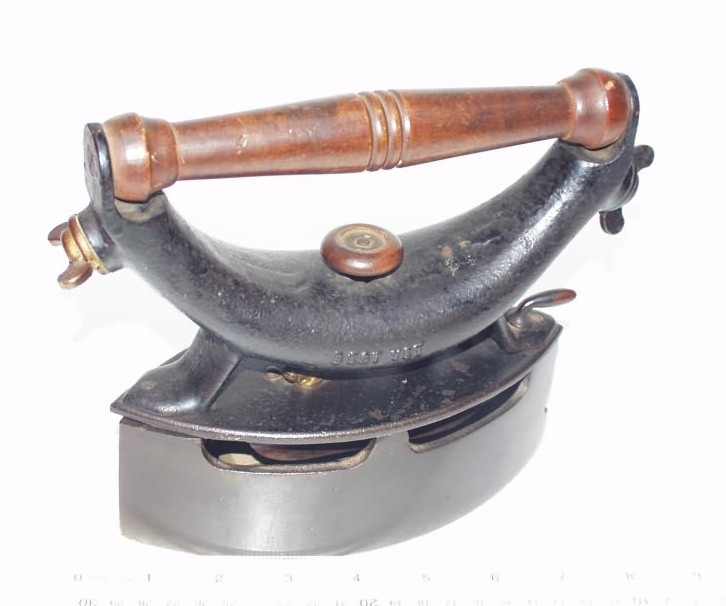 "Best
Yet" Tank in the Handle Gas Iron / California Patent There
are only a few of these unusual gas irons known. Each one a bit
different from the other, either in design, or in how they are marked.
At one point the location is given as Oakland CA and on another the
location is a town that no longer exists and was near Oakland. A nice early iron!
"The Best Yet!!"
"Best
Yet" Tank in the Handle Gas Iron / California Patent There
are only a few of these unusual gas irons known. Each one a bit
different from the other, either in design, or in how they are marked.
At one point the location is given as Oakland CA and on another the
location is a town that no longer exists and was near Oakland. A nice early iron!
"The Best Yet!!"Good . . . . . SOLD
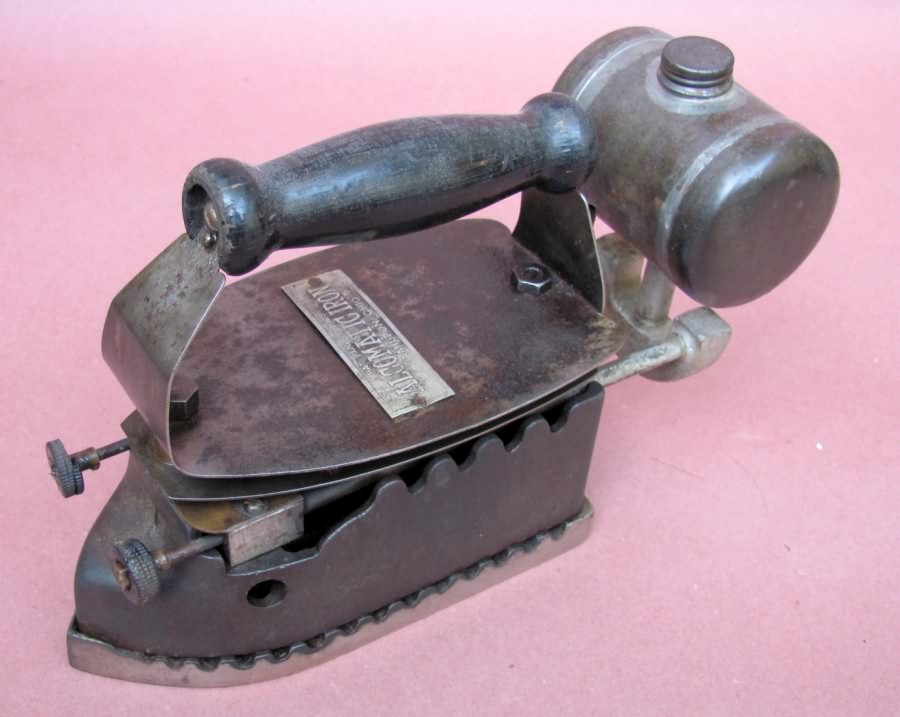 "Alcomatic"
Dual Burner Liquid Fuel Iron
We have only had or seen this iron a few times.
The last one we sold brought something over $1500 on eBay about a year ago.
We had offered it to a couple of iron collectors for less than half that.
They passed, and then one of them ended up as the buyer on eBay for the new higher price.
Go figure!
"Alcomatic"
Dual Burner Liquid Fuel Iron
We have only had or seen this iron a few times.
The last one we sold brought something over $1500 on eBay about a year ago.
We had offered it to a couple of iron collectors for less than half that.
They passed, and then one of them ended up as the buyer on eBay for the new higher price.
Go figure!It is from Hamilton, Ohio and has a patent from the 20's. The name and other info can be found on the plaque under the handle attached to the heat shield. It is still readable. I assume from the name that alcohol was the fuel of choice. I suppose the designer figured that one single burner was not up to the task and so incorporated a second one to make sure things got really hot. I think though that by the time he got it into production electricity was well on its way to becoming the "fuel" of choice when doing the ironing. A pretty rare iron in pretty nice condition!
Good +. . . . . . SOLD!
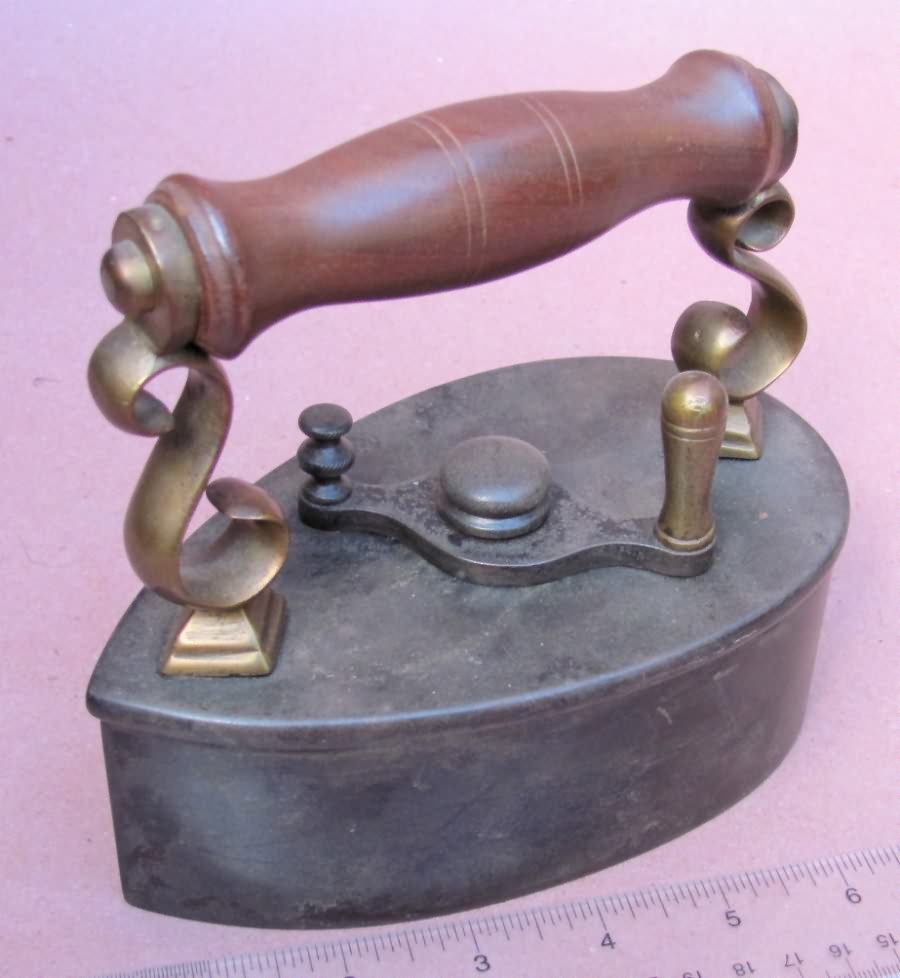 Scottish Box Iron
This Scottish Box Iron is an interesting combination of styles, shapes
and materials. The design of this unique box iron is based primarily on different
castings. Some other Scottish irons designs are more focused on machining
and turned parts like the handle standards.
It has been said that no two of these irons are exactly alike, and some examples rise to levels
of a work of art.
Scottish Box Iron
This Scottish Box Iron is an interesting combination of styles, shapes
and materials. The design of this unique box iron is based primarily on different
castings. Some other Scottish irons designs are more focused on machining
and turned parts like the handle standards.
It has been said that no two of these irons are exactly alike, and some examples rise to levels
of a work of art. The body on this example is a very nice casting. Note the ribs inside the body and the top. The top is an exact fit. The slug is original and a good fit as well. The iron swing lock on top fits like a glove. The handle uprights are a graceful and graphic double S one small, one large with a nice base. The wood handle is nice as well.
Scottish Box Irons are by nature exquisitely designed and detailed, and this one is no exception. The story behind most Scottish Box Irons is that they were hand-built as projects by an apprentice machinist or trades person about to enter the world as a journeyman craftsperson. Different examples show different levels of craftsmanship, and / or different focuses on different techniques or skills associated with different trades. It is also said that these were made by admirers to give to their prospective bride as an expression of their love as well as their skill. The construction of this iron is second to none and the workmanship is superb. That tradition can carry over today when you present this to your beloved as a token of your love and admiration
A super nice iron that will be a highlight of most any collection and might just inspire the receiver to iron more of your clothes!
Good +. . . . . . SOLD!
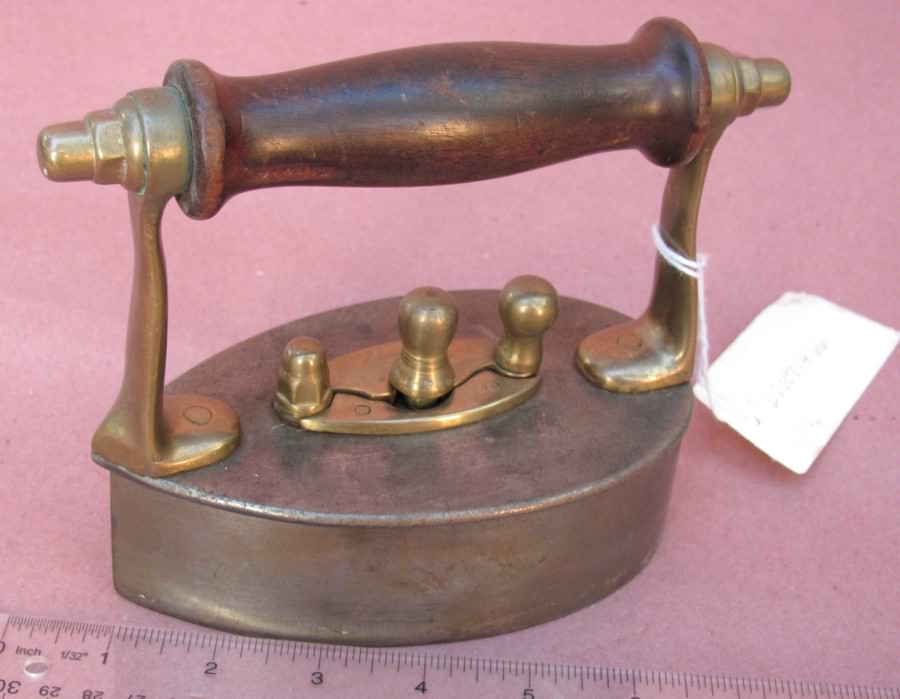 Scottish Box Iron
This Scottish Box Iron is an interesting combination of styles, shapes
and materials. The body on this
example is a very nice casting. The top is an exact fit. The brass lock on top is a design I have not seen before. Typically these are designed
where the entire plate swings out of the way to unlock the top. Here the brass
plate "splits" apart. The uprights are a bit different from the norm as well.
They are a simple design of cast brass with feet at the bottom and a cast eye at the top for the
handle. The wood handle is nice as well.
Scottish Box Iron
This Scottish Box Iron is an interesting combination of styles, shapes
and materials. The body on this
example is a very nice casting. The top is an exact fit. The brass lock on top is a design I have not seen before. Typically these are designed
where the entire plate swings out of the way to unlock the top. Here the brass
plate "splits" apart. The uprights are a bit different from the norm as well.
They are a simple design of cast brass with feet at the bottom and a cast eye at the top for the
handle. The wood handle is nice as well.This iron is truly a work of art as much as a utilitarian object, and explains why this style iron was often given as a gift from a man to his beloved. The construction of this iron is second to none and the workmanship is superb.
A nice iron that will be a highlight of most any collection! Or make the perfect gift to your beloved!! Very Nice!!
Good +. . . . . . SOLD!
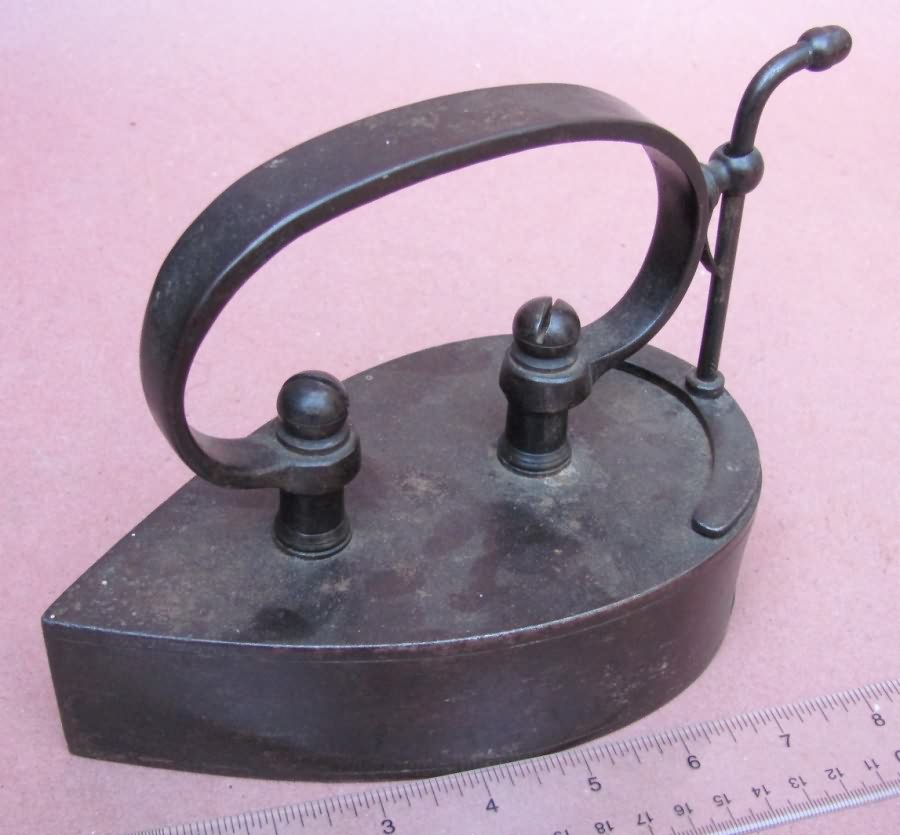 Strap
Handle European Round Back Box Iron This is a very classy looking iron with
its unusual round back design and high loop strap handle. A great iron!
Strap
Handle European Round Back Box Iron This is a very classy looking iron with
its unusual round back design and high loop strap handle. A great iron!
Good + . . . . . . SOLD!
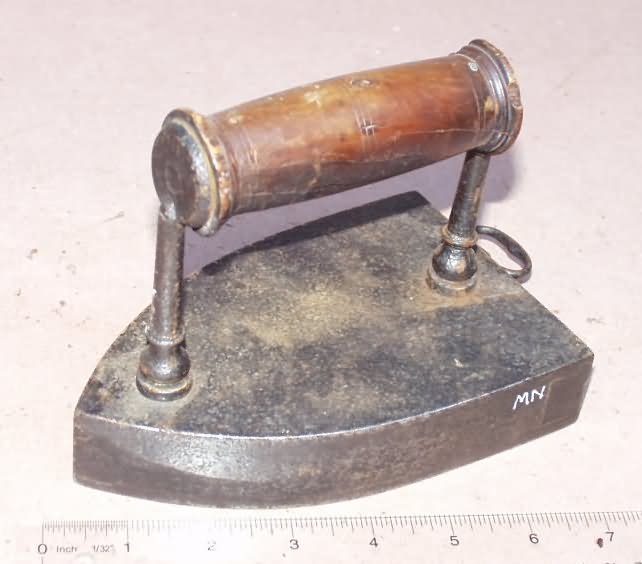 Unusual
Iron Swing Gate Box Iron
This early
iron has nicely formed uprights, and a nice design "turn key" lock on the back
door. The interesting part is that typically the door is hinged
on the opposite side---this one would swing open toward rather than away from
the right handed ironer. I can't recall ever seeing another that opened
in this direction. Perhaps specially made for a left-handed person????
Unusual
Iron Swing Gate Box Iron
This early
iron has nicely formed uprights, and a nice design "turn key" lock on the back
door. The interesting part is that typically the door is hinged
on the opposite side---this one would swing open toward rather than away from
the right handed ironer. I can't recall ever seeing another that opened
in this direction. Perhaps specially made for a left-handed person????
Good . . . . . . . SOLD!
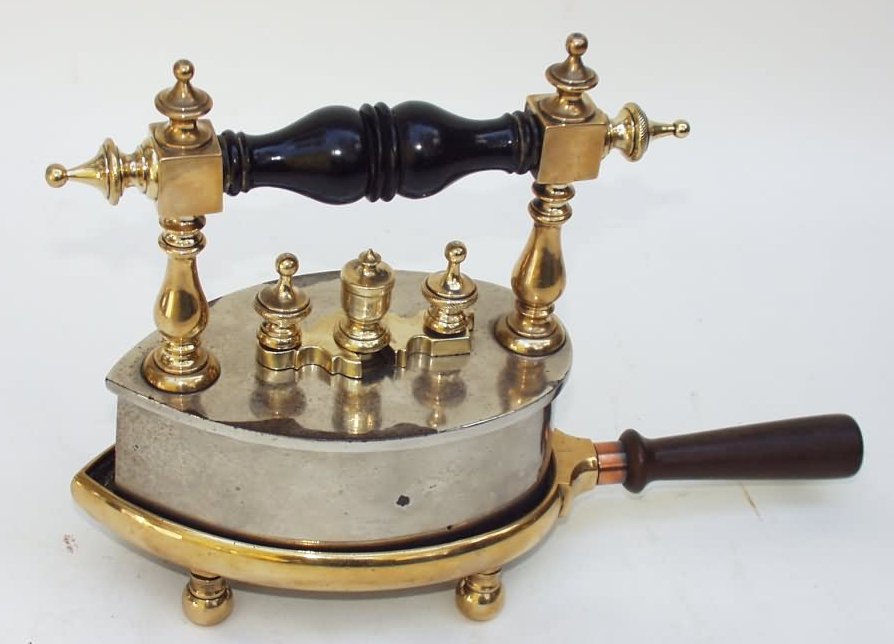 Scottish Box Iron w/ Naval Theme on Trivet
This is a super example at an unheard of price!!
Scottish Box Iron w/ Naval Theme on Trivet
This is a super example at an unheard of price!! Good + . . . . . . SOLD!
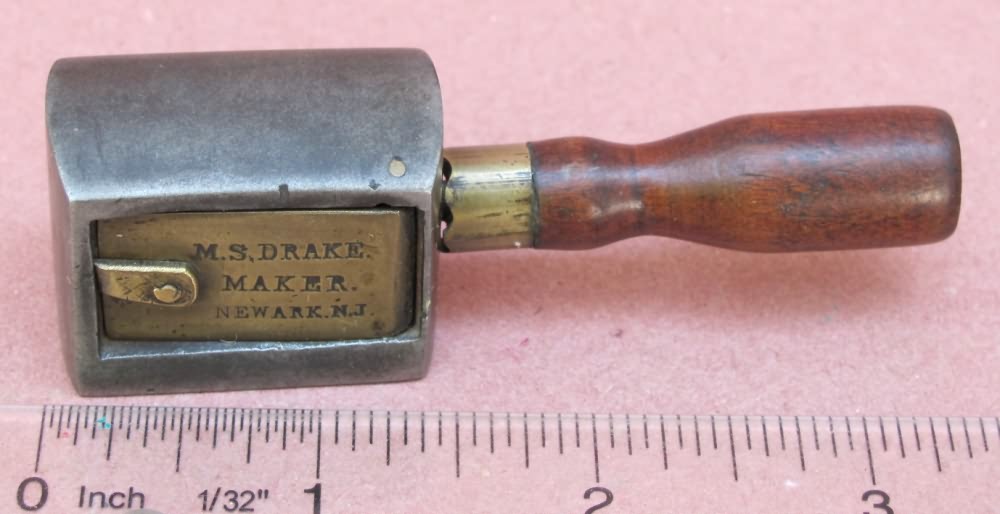 Salesman Sample / Miniature Hatters Iron
This rare little iron is marked M. S. Drake Newark NJ. He held a few
patents related to irons. This exact iron is pictured in one
Politzer's books and is the only one known. Very
nice!!
Salesman Sample / Miniature Hatters Iron
This rare little iron is marked M. S. Drake Newark NJ. He held a few
patents related to irons. This exact iron is pictured in one
Politzer's books and is the only one known. Very
nice!!
Fine. . . . . . SOLD!
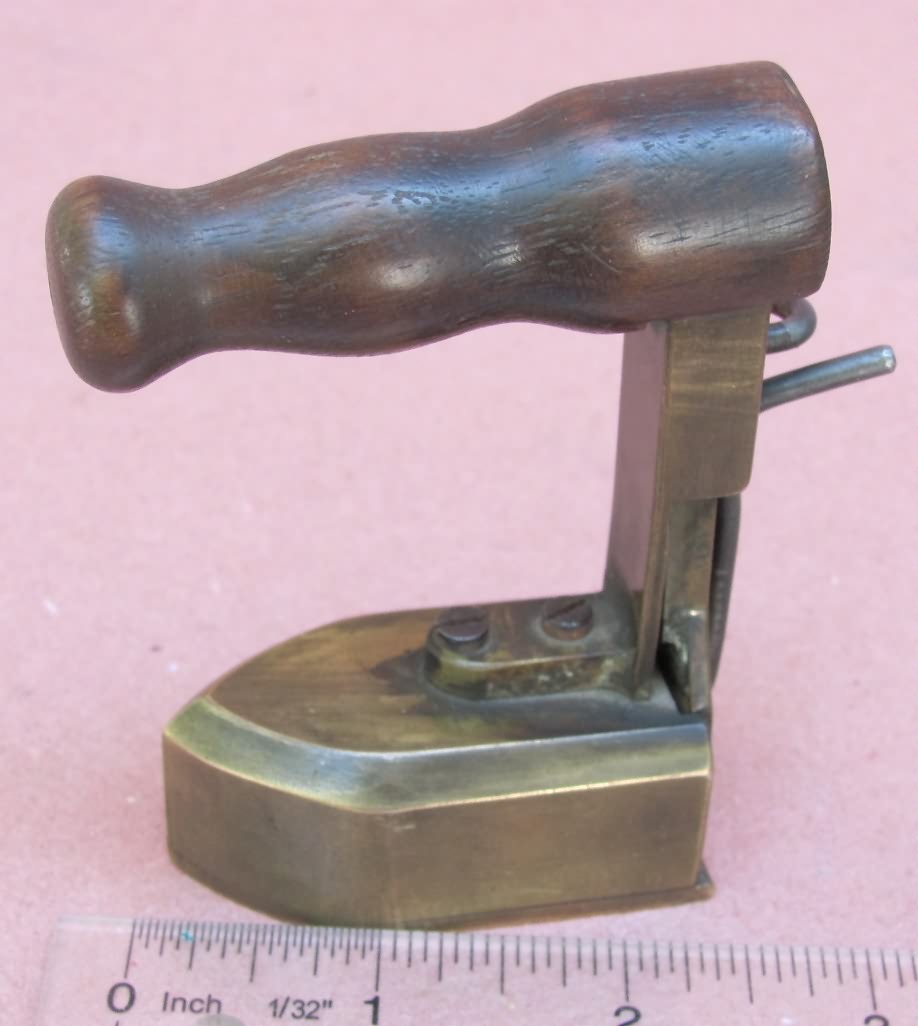 Salesman Sample / Miniature Box Iron
This little iron is also pictured in one of Politzer's books. It
came out of a collection in Oregon of miniature and small irons.
It was one of the highlights of a very small but very nice collection of
irons. That fellow had taste, and a good eye. Very
nice!!
Salesman Sample / Miniature Box Iron
This little iron is also pictured in one of Politzer's books. It
came out of a collection in Oregon of miniature and small irons.
It was one of the highlights of a very small but very nice collection of
irons. That fellow had taste, and a good eye. Very
nice!!
Fine. . . . . . SOLD!
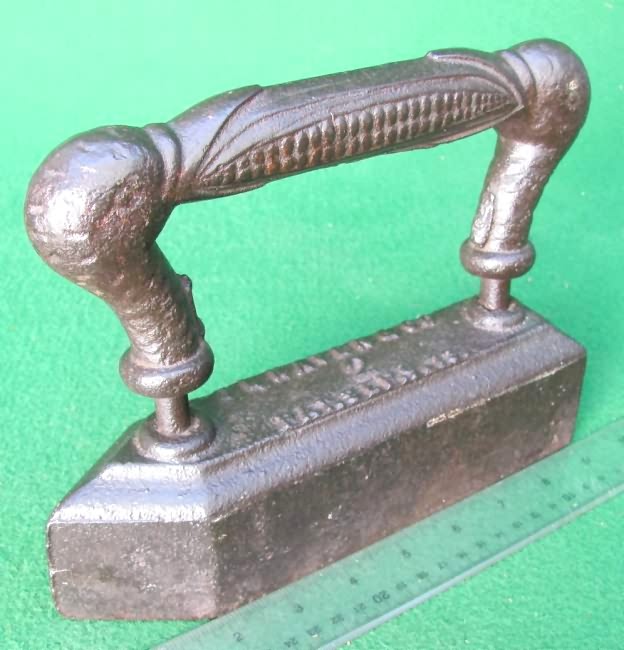 Haven "Crows Eating Corn" Tailor's Iron
This is a rare iron with a figural handle. It's tailor's size,
so it's big and bold. Rarely found except in top notch collections---a super piece!
Haven "Crows Eating Corn" Tailor's Iron
This is a rare iron with a figural handle. It's tailor's size,
so it's big and bold. Rarely found except in top notch collections---a super piece!
Good + . . . . . . SOLD!
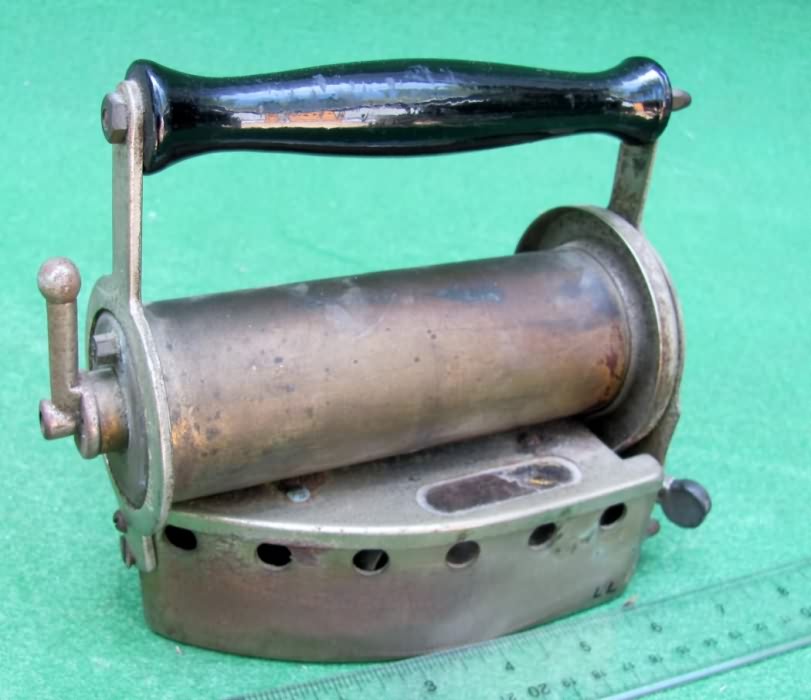 "Pacific Peerless" Patents Pend by Sunset Distributing Co. San Francisco Liquid Fuel Gas Iron
This
is a rare and previously unknown iron. It is not pictured in any of the
references we have. The body design resembles a steam locomotive, with the
elongated cylinder shape fuel tank mounted on top of the base. A similar
liquid fuel iron, with obvious manufacturing similarities, was offered in the
Howard pressing iron collection sold by Greg Martin Auctions some years ago. The handle
design and the round brass tank were the same. The body design was very
different, and the maker marks were a continent apart. This one has mica
viewing windows and is marked on the back of the tank
"Pacific Peerless Patents Pend Sunset Distributing Co. San Francisco".
The one from
the Martin auction was
marked "NY Flatiron Co." California irons from this early time period are
extremely rare. Highly recommend!!
"Pacific Peerless" Patents Pend by Sunset Distributing Co. San Francisco Liquid Fuel Gas Iron
This
is a rare and previously unknown iron. It is not pictured in any of the
references we have. The body design resembles a steam locomotive, with the
elongated cylinder shape fuel tank mounted on top of the base. A similar
liquid fuel iron, with obvious manufacturing similarities, was offered in the
Howard pressing iron collection sold by Greg Martin Auctions some years ago. The handle
design and the round brass tank were the same. The body design was very
different, and the maker marks were a continent apart. This one has mica
viewing windows and is marked on the back of the tank
"Pacific Peerless Patents Pend Sunset Distributing Co. San Francisco".
The one from
the Martin auction was
marked "NY Flatiron Co." California irons from this early time period are
extremely rare. Highly recommend!! Very Good . . . . . SOLD!
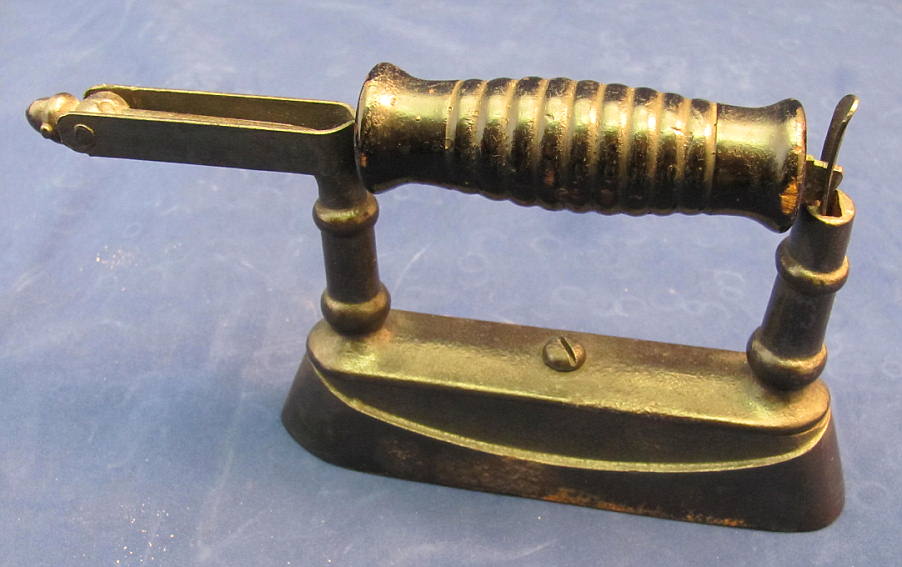 Hinged
Handle Narrow Seam Iron This is an extremely
rare iron. Examples are few and far between. To put it in perspective this is only the second time I have
ever had this iron to offer for sale. The first and only other time was 13 years ago,
and it was this very iron, and I sold it to Carol Walker. The person
who bought it several years later at the Carol Walker auction was so impressed with it that he
didn't sell it when Simmons auctioned the major part of his collection several
years later. But now the time has come for it to be offered on the market
again.
Hinged
Handle Narrow Seam Iron This is an extremely
rare iron. Examples are few and far between. To put it in perspective this is only the second time I have
ever had this iron to offer for sale. The first and only other time was 13 years ago,
and it was this very iron, and I sold it to Carol Walker. The person
who bought it several years later at the Carol Walker auction was so impressed with it that he
didn't sell it when Simmons auctioned the major part of his collection several
years later. But now the time has come for it to be offered on the market
again. This must have been an expensive iron to produce due to the complex design of the "swing-away handle", a design that allowed the grip to remain out of the way and cool while the body was being heated. Coupled with this was the limited market to whom it would have appealed. How many folks would have needed or been willing to purchase a separate, additional, special use iron just to press their seams? I mean really! One of but a few known---highly recommend!!
Very Good . . . . . . $1750.00 SOLD!
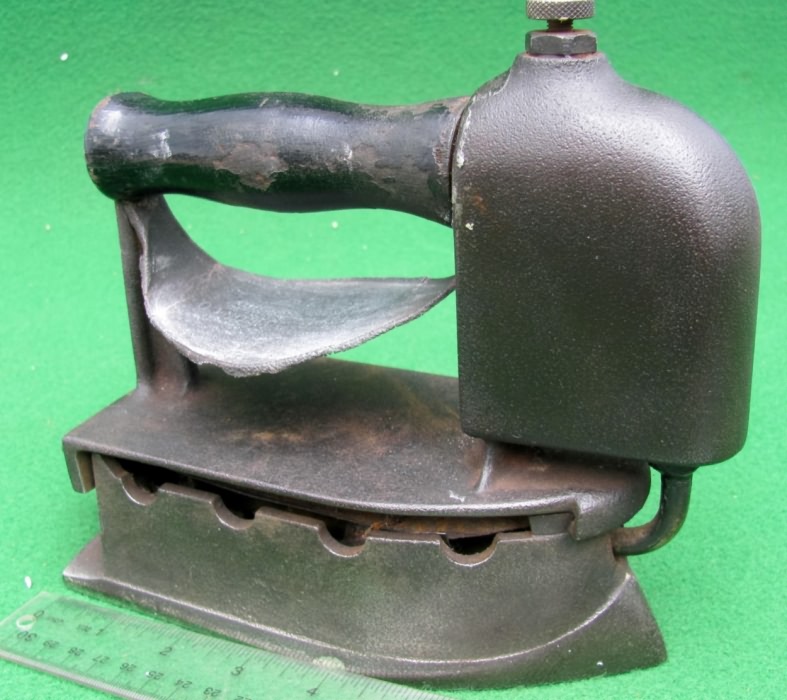 Standard
Gas Iron with
Cast Iron Fuel Tank This rare and unusual gas iron
hails from Mansfield, Ohio. The front-mounted fuel tank is odd and unique,
both in its shape and in the way it is configured into the handle design.
What is most unusual is that, unlike the materials that were typically used
to construct the fuel tanks on irons of this time period, this tank is made
of cast iron. This is one of only a few examples of this iron known. The heat shield
has the company name and location on it. (It has come detached at one end.)
Standard
Gas Iron with
Cast Iron Fuel Tank This rare and unusual gas iron
hails from Mansfield, Ohio. The front-mounted fuel tank is odd and unique,
both in its shape and in the way it is configured into the handle design.
What is most unusual is that, unlike the materials that were typically used
to construct the fuel tanks on irons of this time period, this tank is made
of cast iron. This is one of only a few examples of this iron known. The heat shield
has the company name and location on it. (It has come detached at one end.)This is an unusual iron by a little known manufacturer---Rare!!
Good . . . . . . $1295.00 SOLD!
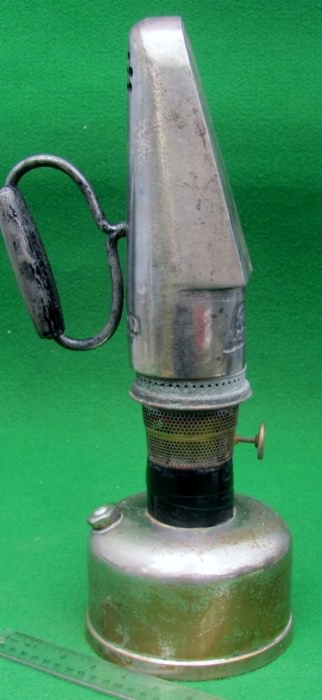
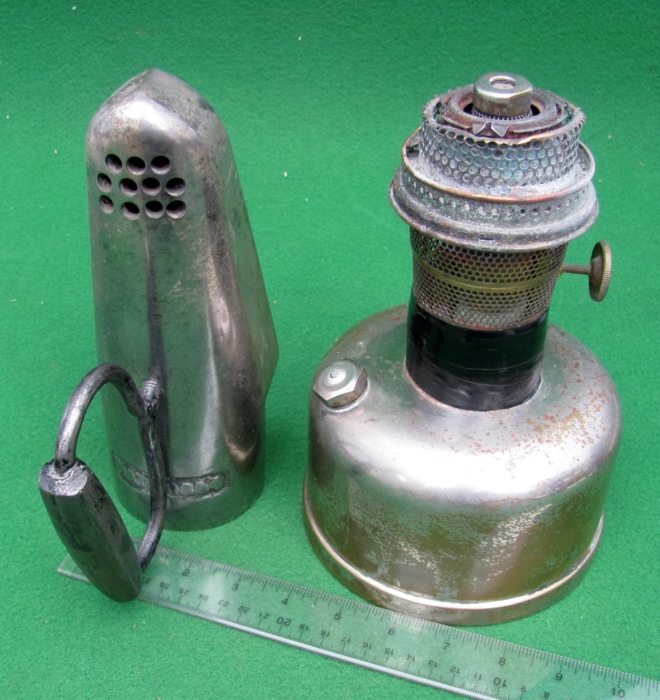 Beyond Rare Patented
Lamp-Heated Pressing Iron According to
Esther Berney the patent for this
extremely rare iron was granted to James Jenkinson of Williamsburg, NY on
December 7, 1869 as patent number 97,515. Shaped like a shoe, and
with a cylindrical hollow interior, it was designed to be heated on top of a
kerosene lamp. Ingenious, inventive, imaginative! But probably
not really practical. The circular opening at the back of the
iron perfectly accommodates the size and shape of the lamp burner and flame,
and elegantly transitions into the shape of the flattened sole. The
round holes in the toe function as a chimney to vent the gases and smoke.
Beyond Rare Patented
Lamp-Heated Pressing Iron According to
Esther Berney the patent for this
extremely rare iron was granted to James Jenkinson of Williamsburg, NY on
December 7, 1869 as patent number 97,515. Shaped like a shoe, and
with a cylindrical hollow interior, it was designed to be heated on top of a
kerosene lamp. Ingenious, inventive, imaginative! But probably
not really practical. The circular opening at the back of the
iron perfectly accommodates the size and shape of the lamp burner and flame,
and elegantly transitions into the shape of the flattened sole. The
round holes in the toe function as a chimney to vent the gases and smoke.There is apparently a lot more research to be done to learn about this iron. The markings on it are unclear but appear to read "PATD 1884" and "CAP.T A. CHAGNON" or perhaps it's "CHACEON", which may relate to a subsequent patent application or improvement in design. In fact, this iron may never have gone into widespread production as the only ones I'm aware of are the one illustrated in the Berney book, another pictured in More Irons by Irons, and one other in a private collection.
This is one of those irons that comes along if you are lucky maybe once in a lifetime. Museum quality---highly recommend!!
Very Good . . . . . . $2495.00 includes the lamp SOLD!
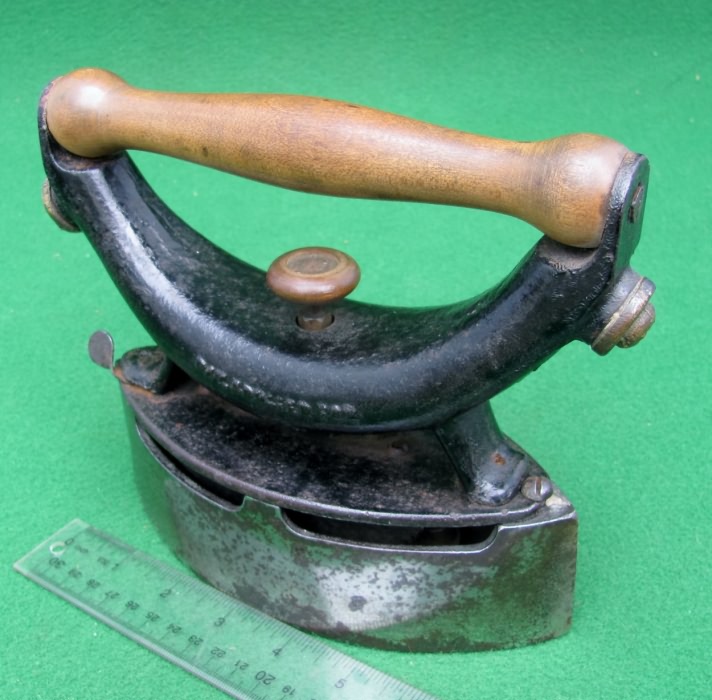 Bet Yet California Gas Iron This
rare gas iron by the Best Yet Mfg. Co. is marked with a location of Elmhurst, CA. Elmhurst was a small town in the
Bay Area that later became part of Oakland. This unusual design iron
has been found marked with either location. This one is marked "Pat Applied For"
while some later ones carry a patent date. The crescent shaped fuel tank,
which is under the handle, is
cast iron. This example is in overall nice condition noting that there
are some spots of light pitting /
corrosion on the base, and that the tail ends of the wing nut are broken off.
A great design and very RARE!!
Bet Yet California Gas Iron This
rare gas iron by the Best Yet Mfg. Co. is marked with a location of Elmhurst, CA. Elmhurst was a small town in the
Bay Area that later became part of Oakland. This unusual design iron
has been found marked with either location. This one is marked "Pat Applied For"
while some later ones carry a patent date. The crescent shaped fuel tank,
which is under the handle, is
cast iron. This example is in overall nice condition noting that there
are some spots of light pitting /
corrosion on the base, and that the tail ends of the wing nut are broken off.
A great design and very RARE!!
Very Good . . . . . . $2495.00 SOLD!
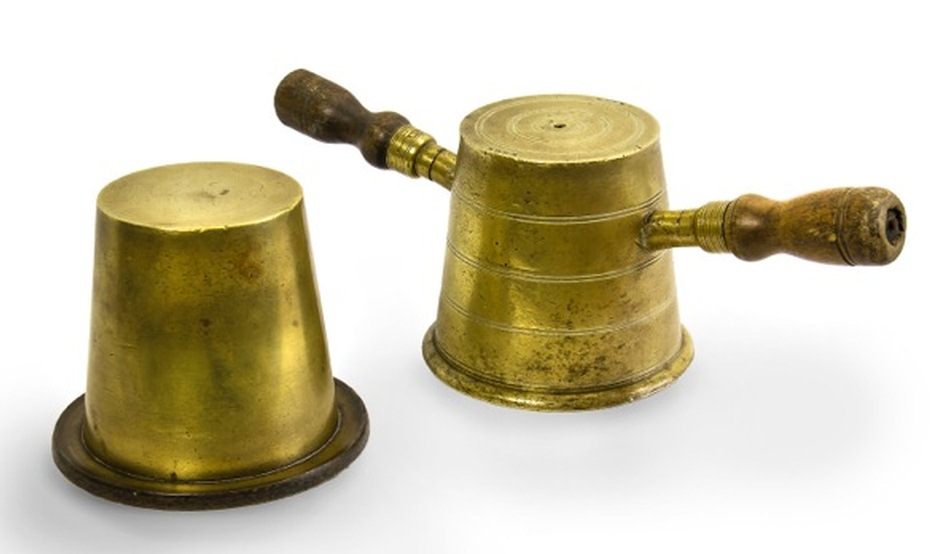 Rare Egyptian
Fez / Hat Iron Known as a Tarboosh
or Fez iron this is an extremely rare
Egyptian hat iron. It is a two-piece ironing implement that would have
been heated on a hot stove and employed to reshape and press the "flower
pot" shaped head covering called "tarboosh" in Egypt and "fez" elsewhere in
the Islamic world. It was used by placing the felt fez over the form
on the left, and then pulling the top half with handles down over the felt hat to perfectly smooth
and shape it.
Rare Egyptian
Fez / Hat Iron Known as a Tarboosh
or Fez iron this is an extremely rare
Egyptian hat iron. It is a two-piece ironing implement that would have
been heated on a hot stove and employed to reshape and press the "flower
pot" shaped head covering called "tarboosh" in Egypt and "fez" elsewhere in
the Islamic world. It was used by placing the felt fez over the form
on the left, and then pulling the top half with handles down over the felt hat to perfectly smooth
and shape it.With Westernization the wearing of this traditional headgear fell out of favor and into disuse, and most of these heavy blocking irons were melted down for the metal. This surviving brass example is 8" high. The base is 9 inches wide and 21" across including the handles. It weighs 35 pounds! We have never had another of these, nor do we remember ever seeing one offered for sale. Highly recommend!!
Very Good . . . . . . $1295.00 SOLD!
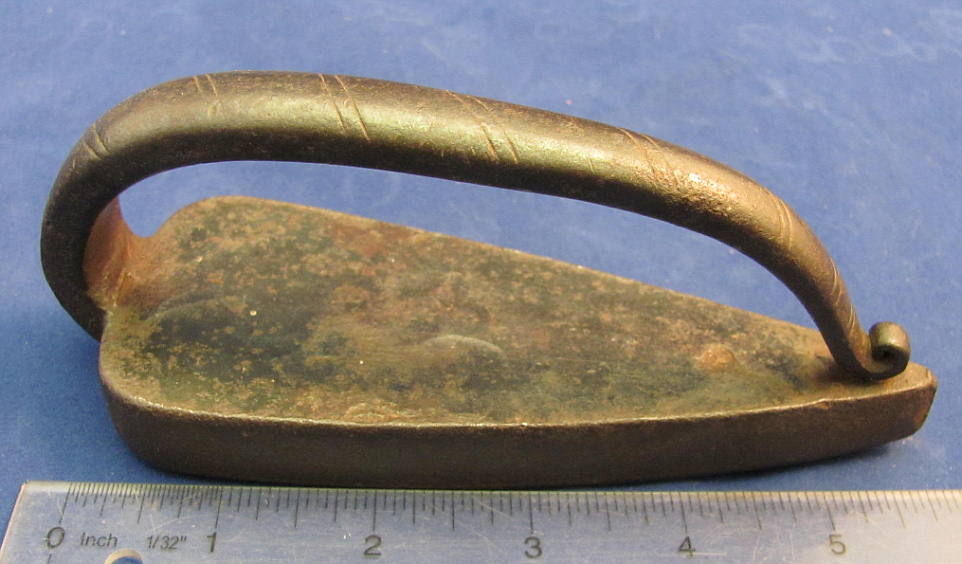 Primitive Antique Blacksmith Made Iron
You shouldn't skip past this one, thinking it's just another of those primitive
one-piece irons. This is like a Porsche compared to a Volkswagen. It is
really a super piece.
Primitive Antique Blacksmith Made Iron
You shouldn't skip past this one, thinking it's just another of those primitive
one-piece irons. This is like a Porsche compared to a Volkswagen. It is
really a super piece.This is a very unusual and handsomely designed blacksmith-made iron. Like others of this style the body and handle are made from a single piece of iron. But what makes it so special is the finely detailed filework that decorates the handle grip. Be sure to look at all the pictures so you can see the close-ups---this is a truly beautiful example. Great form and one-of-a-kind!
Very Good . . . . . . $225.00 SOLD!
This is just a sample of the many
antiques & collectibles we have sold.
Click link to see other
Sales Archive Pages on this Site.
We Buy Quality Antiques Contact Us at AntiqBuyer@gmail.com
Our current offering of Antiques for sale are at our sister Website Patented-Antiques.com.
This website is Copyrighted
Larry & Carole Meeker