This is just a sample of the many
antique sewing machines we have sold.
Click link to see other
Past Sales Archive Pages on this Site.
We Buy Quality Antiques
Contact Us at
AntiqBuyer@gmail.com
Special Note Concerning Prices Seen Below:
Most prices seen reflect actual sale results from this website.
Prices seen
span a long period of time and may not reflect current values. Some
are selling for more, many now sell for less.
On some pieces you will see no price, or a price range,
with or without an explanation. The reasons for that are discussed on the FAQ page.
Our current offering of Antiques for sale are at our sister Website Patented-Antiques.com.
American
Patented Toy
/ Travel Size
Sewing Machines
This.
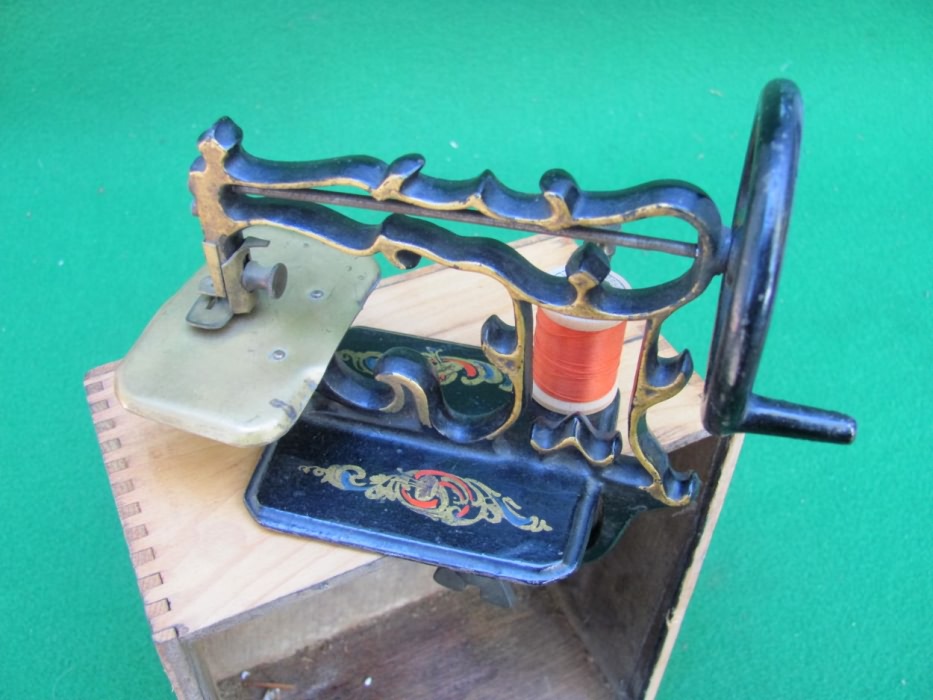 Hancock Patent TSM / Toy Sewing Machine
Sewing machines based on the Henry J. Hancock patents from
the 1860's are well known, highly regarded, and turn up from time to time. They are
considered pretty rare, and rightfully so. There are
several different styles or variants that are typically seen. Do a Google
image search for "Hancock Patent Sewing Machine" and you will see many of the ones I have
had and sold over the years.
Some are marked with one patent date, I have had them with three dates, and some,
like this one, with no markings at all. You can read their descriptions on
our archive site www.Antiqbuyer.com.
Hancock Patent TSM / Toy Sewing Machine
Sewing machines based on the Henry J. Hancock patents from
the 1860's are well known, highly regarded, and turn up from time to time. They are
considered pretty rare, and rightfully so. There are
several different styles or variants that are typically seen. Do a Google
image search for "Hancock Patent Sewing Machine" and you will see many of the ones I have
had and sold over the years.
Some are marked with one patent date, I have had them with three dates, and some,
like this one, with no markings at all. You can read their descriptions on
our archive site www.Antiqbuyer.com. This version is unique. This machine's design, with a large decorated cast iron mounting plate, is a feature that has never been seen before. I have had Hancock sewing machines with the same style head, but the spool pin was mounted differently on each, one with a patented folding design. The condition of this rare and unique machine is like new, with 98% of the original paint and decoration. It has its original hooked needle. There are no apologies.
A bit of history. This rare machine first turned up on eBay about 15 years ago. This variant had never been seen before that. Usually when something odd and unusual turns up on eBay and brings good money several more appear shortly afterward, with sellers trying to cash in at that elevated price that the first one bought. Generally that works for the first one or two, and then prices drop as the demand fades. That did not happen after this machine brought over 3K on eBay. No other examples appeared right after or since. A rare machine in exceptional condition! Opportunity!
Good + . . . . . . . $ SOLD!!
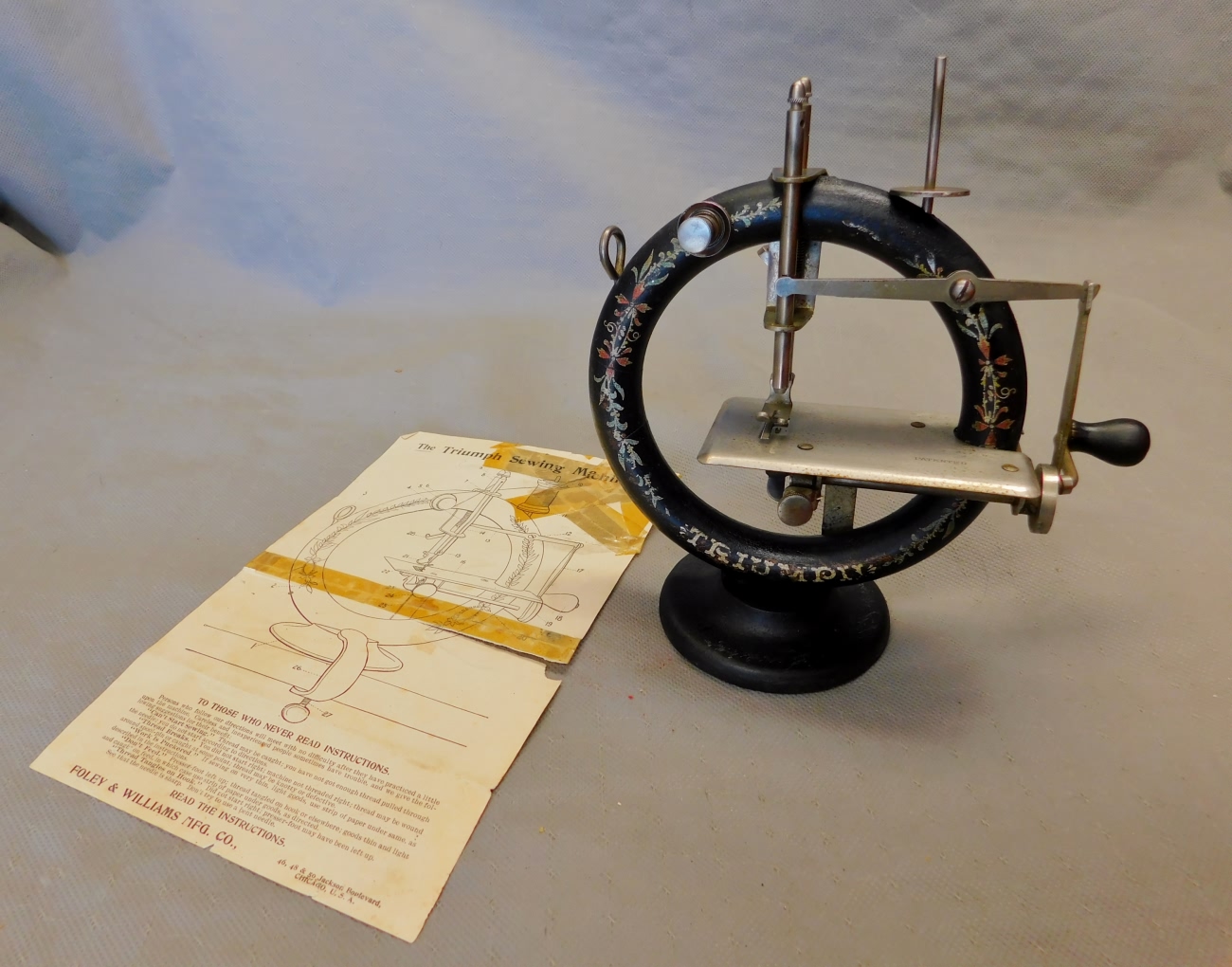 Triumph Wood Body
Patented Toy Sewing Machine
The Triumph is a scarce TSM / miniature sewing machine that features one of the most unusual and graphic designs
that was ever thought up for a TSM / toy sewing machine! The
round body is all wood, painted black and has applied decals for the Triumph
name and vine & berry decorations.
Triumph Wood Body
Patented Toy Sewing Machine
The Triumph is a scarce TSM / miniature sewing machine that features one of the most unusual and graphic designs
that was ever thought up for a TSM / toy sewing machine! The
round body is all wood, painted black and has applied decals for the Triumph
name and vine & berry decorations.There is a metal backing plate to add strength and allow the metal parts to operate. The wooden body was designed with a small section of frame that could be removed to allow fabric to pass through while sewing and then replaced when not in use. It is believed to have been manufactured by the Foley & Williams Co. and is simply marked "Patent" on the nickel plated sew plate.
This example is 100% complete with all of its original parts, including the removable section and its retaining pin. It has a walking presser foot mechanism. The tensioner and spool pin are both present. It has some wear to the name and other decals as seen, but is in overall very nice condition. A "top-shelf" small TSM sewing machine for the collection.
Good +. . . . . . 850.00 SOLD!!
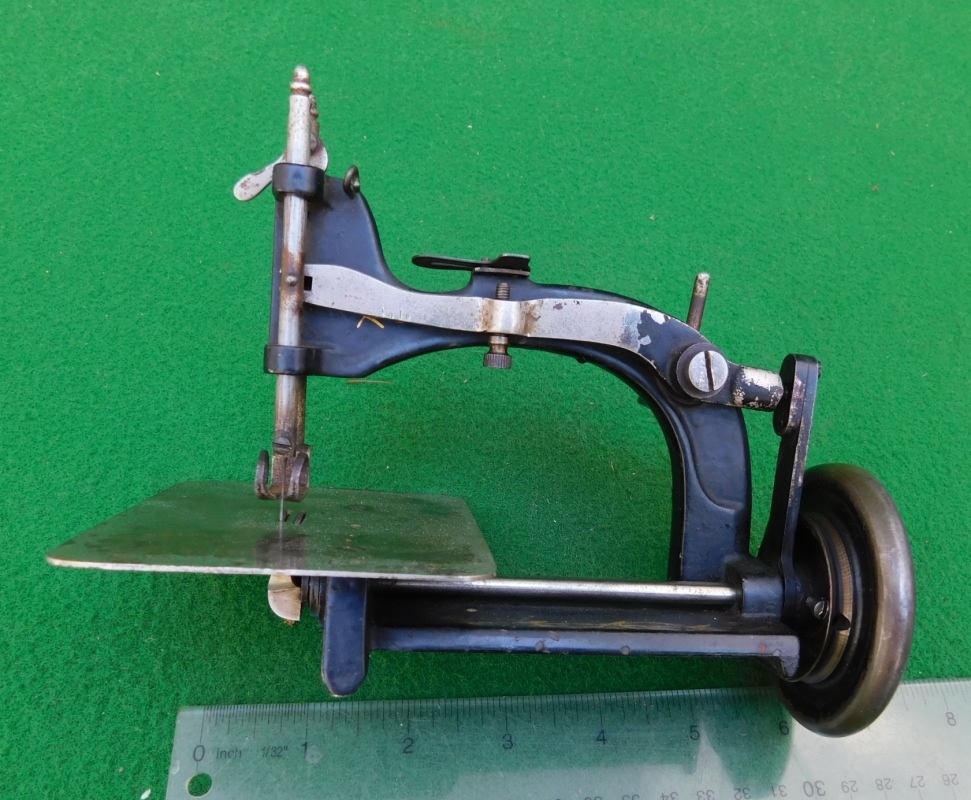 "Daisy"
Child Size Antique Sewing Machine A rare
and unusual TSM looking for its treadle base or the optional table clamp that
can be found for it. The Daisy Treadle TSM Sewing Machine is
considered the best of the toy treadles that can be found. I have
never seen the version with a removable auxiliary table clamp. A rare
thing.
"Daisy"
Child Size Antique Sewing Machine A rare
and unusual TSM looking for its treadle base or the optional table clamp that
can be found for it. The Daisy Treadle TSM Sewing Machine is
considered the best of the toy treadles that can be found. I have
never seen the version with a removable auxiliary table clamp. A rare
thing. The cosmetic condition of this unusual sewing machine is great with nearly all the original black finish & gold decoration remaining. It runs freely and smoothly. It has its original needle. The sew plate has had some nickel loss but is not rusty or pitted. It is marked with the company name, location of Cleveland Ohio, Patented July 3rd 1887 and the word Improved. The serial number is 103732.
In the treadle version the drive wheel fits through a slot cut in the table top so the machine can sit flat. With the aux clamp, the wheel sits to the outside of the table edge. This machine will look great mounted on a block of wood so that wheel is not the first thing to hit the table. Different, Rare, and Nice!!
Fine . . . . . . . $995.00 SOLD!!
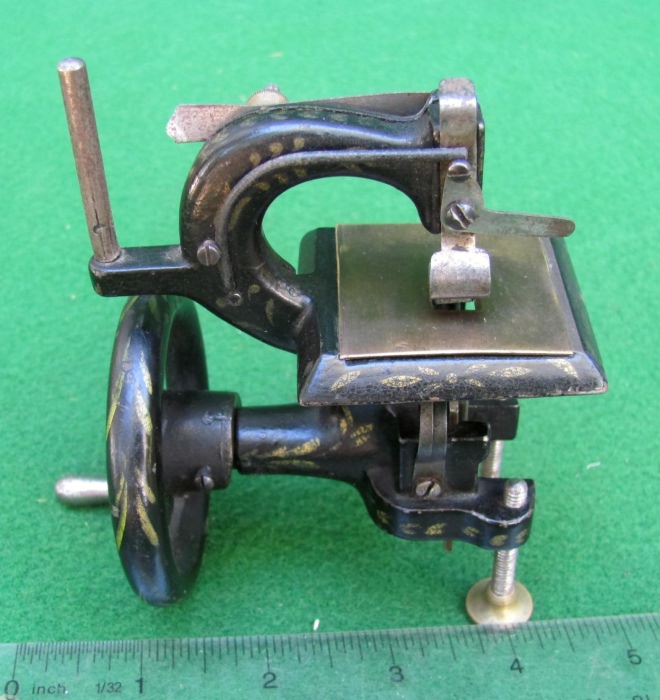 Hook Patent Sewing Machine The
cosmetic condition of this unusual sewing machine is great with nearly all the original finish and
decoration remaining. That is probably because a small spring inside
is broken and it would not operate properly. The spring is still present,
but will not attach as it was designed to due to a small break in it.
It is repairable.
Hook Patent Sewing Machine The
cosmetic condition of this unusual sewing machine is great with nearly all the original finish and
decoration remaining. That is probably because a small spring inside
is broken and it would not operate properly. The spring is still present,
but will not attach as it was designed to due to a small break in it.
It is repairable. In her Smithsonian-sponsored book on sewing machines Grace Cooper states that Albert Hook was granted the patent for this unusual machine on November 30th 1858. The machine is marked with that date. I could not find that patent using Google. In the index she calls off a number of 22179. When you run that number a reissue patent comes up, issued in 1863, as number1592. I'm not sure what that means. You can find that patent using a Google search. Hook was also granted patent number 24027 in 1859 for a similar looking machine, and that patent is also viewable on Google.
This rare antique sewing machine is incredibly small, measuring about 4" tall overall and 2" square. It has a built-in clamp to attach it to a work table. By design, it pushed a hooked needle up from below and formed a chain stitch. Very few were made, and fewer are known to exist today. Grace Cooper gives the machine a nice little write-up. The other major reference on antique sewing machines has a picture and one sentence. There are no other examples to be seen using a Google web or image search, and very little published information beyond what is found in Cooper's book.
Different, Rare, and Nice!!
Good + . . . . . . . $3950.00 SOLD!!
 American
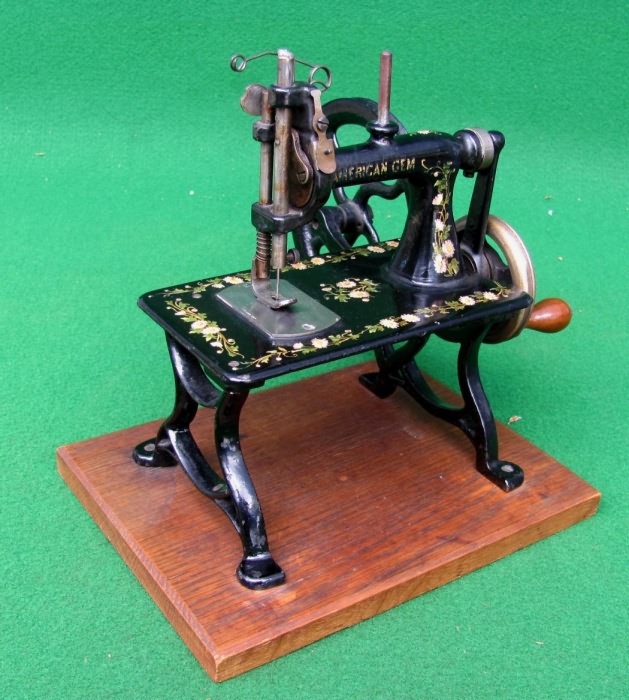
Gem TSM / Toy Sewing Machine w/ Large Speed Enhancing Wheel w/ Instructions
This is a great looking and very hard to find antique sewing machine. The condition
of this example is
exceptional.
The black japanned finish is super nice with just minor losses. The white and yellow Daisy flower decoration running around the perimeter, up the arm, and in the center
of the sewing table, is near perfect. Over the years we have seen quite a few of these sewing machines and the decoration on almost all has been different on each machine,
indicating they were hand-done. Some have birds, others have red, green and gold grape-like vines, but this example with daisy decoration is certainly one of the nicest and
most detailed / elaborate flower motifs we have seen.
American
Gem TSM / Toy Sewing Machine w/ Large Speed Enhancing Wheel w/ Instructions
This is a great looking and very hard to find antique sewing machine. The condition
of this example is
exceptional.
The black japanned finish is super nice with just minor losses. The white and yellow Daisy flower decoration running around the perimeter, up the arm, and in the center
of the sewing table, is near perfect. Over the years we have seen quite a few of these sewing machines and the decoration on almost all has been different on each machine,
indicating they were hand-done. Some have birds, others have red, green and gold grape-like vines, but this example with daisy decoration is certainly one of the nicest and
most detailed / elaborate flower motifs we have seen.These machines are found in two different styles, with the more common version lacking the large speed-enhancing second wheel that this one has. I would say that the models with the speed enhancer are at least 10 times harder to find than those without. The American Gem cast iron sewing machine has a interesting design base that was meant to resemble a real treadle sewing machine stand in miniature size. It is unique among toy sewing machines in this respect, making this design sewing machine a favorite with toy sewing machine collectors and collectors of early full-size machines as well. It is approx. 6" across the legs, and stands about 9" tall. The diameter of the big wheel is about 5 1/2", the little wheel about 2 1/2". The condition of the original wood base is nice, and on the bottom is a page of the original instructions.
The sewing plate is marked "Pat. Apld For", and in both of the references on sewing machines I have there is no information on the actual maker or any further patent information. There is a similar machine in our past sales archive that has maker and location info stamped on the base. This one has a page from the instructions on the bottom, but no maker info. I would estimate this machine to date from the 1880's or so from the look and decoration. It sews a simple chain stitch like other early machines from this era, and a special note should be made that it has oil or lubrication holes at the important bearing points, a feature that would indicate this machine was also marketed as a small working machine for seamstresses, and not a simple toy.
This sewing machine is all-original with no breaks or cracks in the casting and it has not been touched up or restored. This early sewing machine is sure to be a standout in any sewing machine collection! And a really fine addition of Americana for your collection!
Fine . . . . . . . SOLD!!
 Early
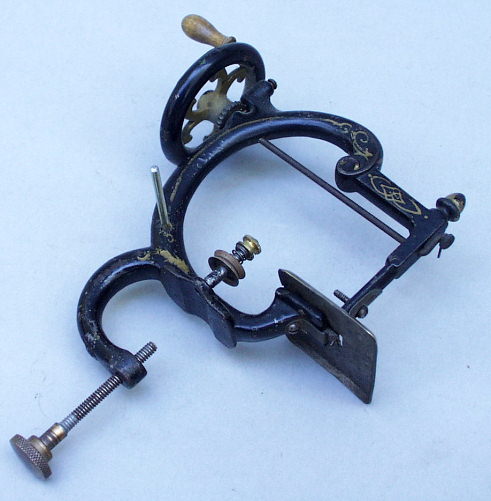
Patented Hancock Integral-Clamp Antique Sewing Machine
The first sewing
machines had barely been invented when Henry J. Hancock received his 1867 patent
for this unusual chain stitch machine. The design of this early sewing
machine, with its very delicate open-frame "skeleton" body and integral clamp,
is incredibly appealing. Examples of this unusual sewing machine are extremely
scarce. Hancocks were only produced for 10 or so years which explains
why they are seldom found and rarely offered for sale. For those antique
sewing machine collectors who seek out examples of the very earliest patents,
this machine is always at the top of their "want list". This particular
example came straight out of a Midwestern estate. The stitchplate is clearly
marked with the 1867 patent date as well as 1868 and 1869 patent improvement
dates. There are no casting flaws or cracks in the delicate casting, and
although there is considerable paint loss, the surface exhibits a dark rich
patina that one would expect from a 130-year-old antique. There is no
pitting or rust, and all and all it looks very good. Likewise the brass
parts have not been polished and retain a deep mellow tone. As is generally
the case in machines of this age, the needle is missing, but other than that
the sewing machine is complete. The seam guide has been adapted from a
different newer sewing machine to resemble the original.
Early
Patented Hancock Integral-Clamp Antique Sewing Machine
The first sewing
machines had barely been invented when Henry J. Hancock received his 1867 patent
for this unusual chain stitch machine. The design of this early sewing
machine, with its very delicate open-frame "skeleton" body and integral clamp,
is incredibly appealing. Examples of this unusual sewing machine are extremely
scarce. Hancocks were only produced for 10 or so years which explains
why they are seldom found and rarely offered for sale. For those antique
sewing machine collectors who seek out examples of the very earliest patents,
this machine is always at the top of their "want list". This particular
example came straight out of a Midwestern estate. The stitchplate is clearly
marked with the 1867 patent date as well as 1868 and 1869 patent improvement
dates. There are no casting flaws or cracks in the delicate casting, and
although there is considerable paint loss, the surface exhibits a dark rich
patina that one would expect from a 130-year-old antique. There is no
pitting or rust, and all and all it looks very good. Likewise the brass
parts have not been polished and retain a deep mellow tone. As is generally
the case in machines of this age, the needle is missing, but other than that
the sewing machine is complete. The seam guide has been adapted from a
different newer sewing machine to resemble the original.Good + . . . . .$1295.00 SOLD
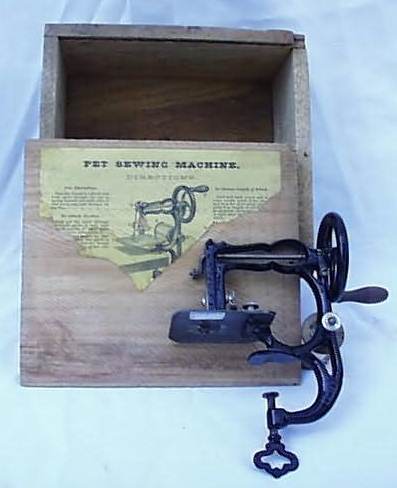 Pet Sewing Machine
w/ Original Box This early sewing machine
is similar to a Hancock Patent. you will probably never see one in
the box again. Special.
Pet Sewing Machine
w/ Original Box This early sewing machine
is similar to a Hancock Patent. you will probably never see one in
the box again. Special. Fine. . . . . . .$2750.00 SOLD!!
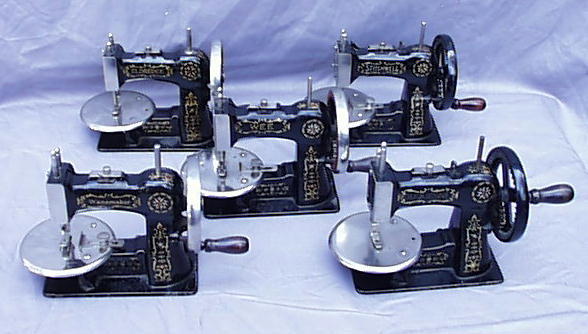 Stitchwell
/ National Sewing Machine Co. Variant Collection
The National Sewing Machine Co. of Belvidere,
Illinois was the brainchild of a fellow named Barnabas Eldredge. Like
other shrewd entrepreneurs of his day, he seemed to catch on quickly to the
notion that you could sell more of the same thing if you marketed that thing
with different
names and with slight variations in the design, making for a toy sewing machine collector's
dream! All of these cast iron machines feature geared handwheels but there
are several variations in design. The standard name on these machines was "Stitchwell" but
you could apparently order a machine that was personalized for an individual,
and several ingenious department stores jumped on the advertising and promotional
bandwagon and had machines personalized with their company or other names.
There are many more to be found but here are
five different variations we are offering for sale to get you well on your way
.
All are in excellent condition, four of the five are in their original boxes,
and original instructions and clamps are included with several as well.
Stitchwell
/ National Sewing Machine Co. Variant Collection
The National Sewing Machine Co. of Belvidere,
Illinois was the brainchild of a fellow named Barnabas Eldredge. Like
other shrewd entrepreneurs of his day, he seemed to catch on quickly to the
notion that you could sell more of the same thing if you marketed that thing
with different
names and with slight variations in the design, making for a toy sewing machine collector's
dream! All of these cast iron machines feature geared handwheels but there
are several variations in design. The standard name on these machines was "Stitchwell" but
you could apparently order a machine that was personalized for an individual,
and several ingenious department stores jumped on the advertising and promotional
bandwagon and had machines personalized with their company or other names.
There are many more to be found but here are
five different variations we are offering for sale to get you well on your way
.
All are in excellent condition, four of the five are in their original boxes,
and original instructions and clamps are included with several as well.
Excellent . . . .$1595.00 / Lot SOLD
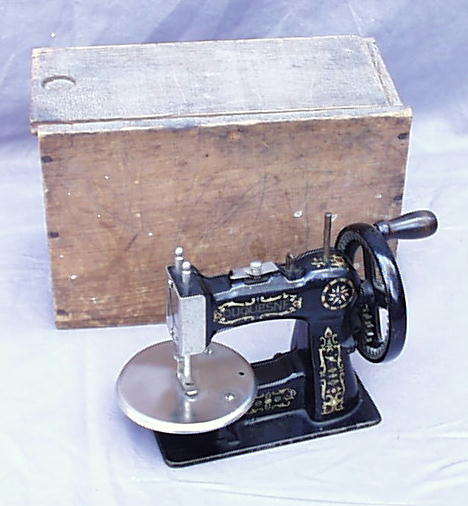 Stitchwell TSM / Toy Sewing Machine Marked Duquesne
Fine condition and the only one w/ this name I have
ever seen.
Stitchwell TSM / Toy Sewing Machine Marked Duquesne
Fine condition and the only one w/ this name I have
ever seen.Excellent . . . .$295.00 SOLD
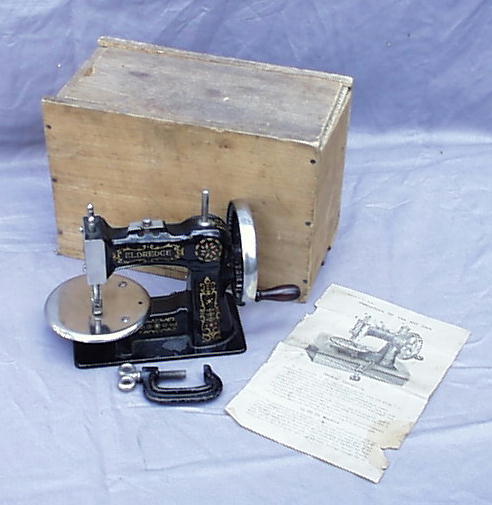 Stitchwell TSM / Toy Sewing Machine Marked Eldridge
Fine condition and one not seen very often.
Stitchwell TSM / Toy Sewing Machine Marked Eldridge
Fine condition and one not seen very often.Excellent . . . .$175.00 SOLD
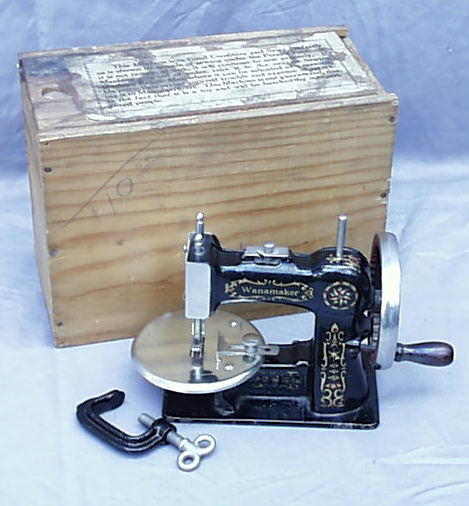 Stitchwell TSM / Toy Sewing Machine Marked Wanamaker
Fine condition and one not seen very often.
Stitchwell TSM / Toy Sewing Machine Marked Wanamaker
Fine condition and one not seen very often.Excellent . . . .$375.00 SOLD
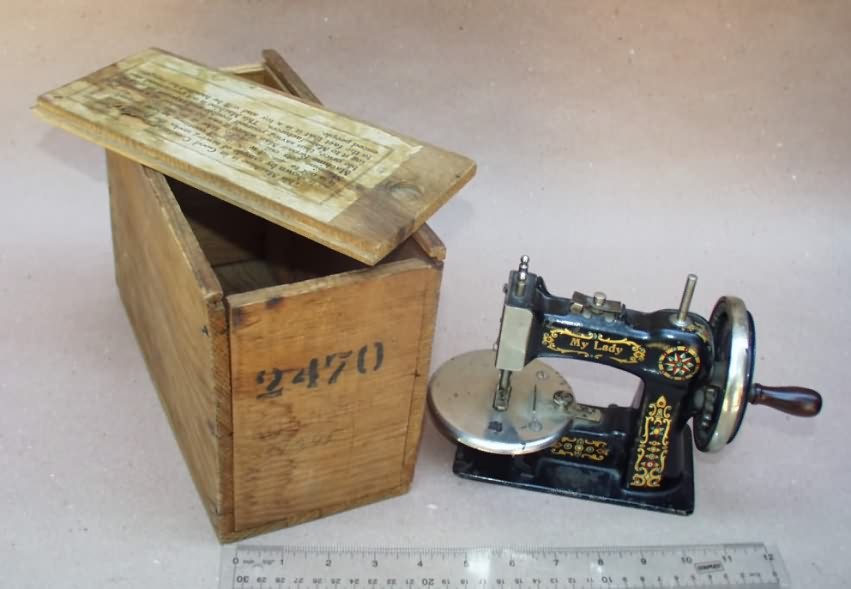 Stitchwell
"My Lady" TSM Toy Sewing Machine in Original
Box As nice as one could ask for. Different, and nice!!
Stitchwell
"My Lady" TSM Toy Sewing Machine in Original
Box As nice as one could ask for. Different, and nice!!
Fine . . . . . . .$495.00 SOLD!
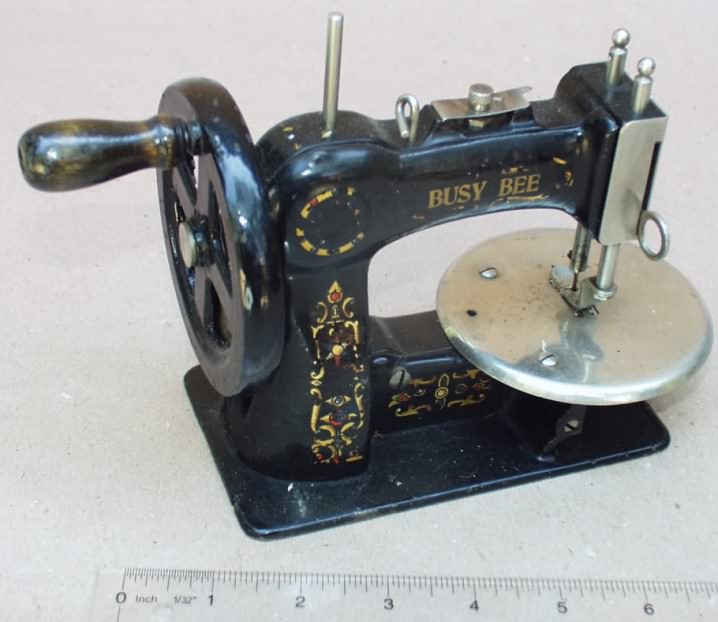 Busy
Bee / Stitchwell TSM Toy Sewing Machine
Different, and nice!!
Busy
Bee / Stitchwell TSM Toy Sewing Machine
Different, and nice!!
Fine . . . . . . .$195.00 SOLD!
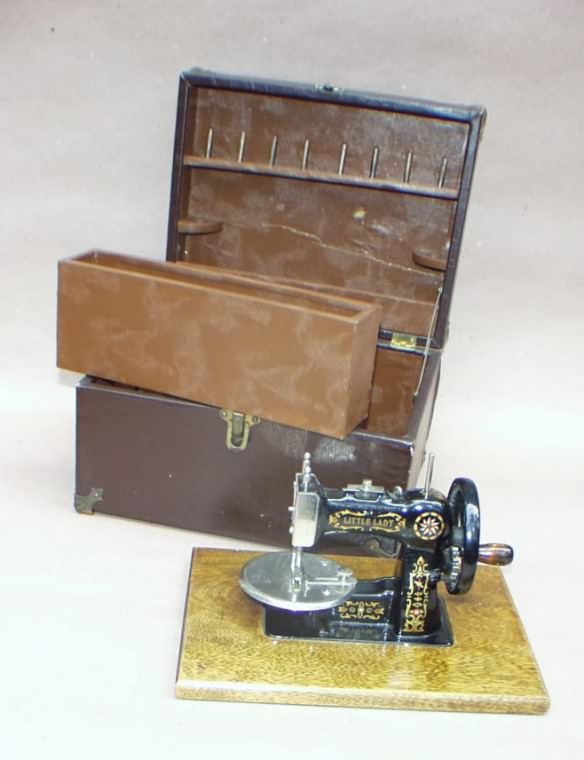 Stitchwell
"Little Lady" TSM Toy Sewing Machine in Suitcase Box I have never seen a
Stitchwell / Little Lady before, and I have never seen any National Sewing
Machine Co. TSM by any name in a suitcase box like this one. I am not sure
if it is factory, or owner built by some little girl's dad back when she first
got it in the 20's or so. The machine is carefully and well mounted to a
piece of oak that perfectly fits into the box. The box is outfitted with
an area for spools and a box for accessories. Very different, and nice!!
Stitchwell
"Little Lady" TSM Toy Sewing Machine in Suitcase Box I have never seen a
Stitchwell / Little Lady before, and I have never seen any National Sewing
Machine Co. TSM by any name in a suitcase box like this one. I am not sure
if it is factory, or owner built by some little girl's dad back when she first
got it in the 20's or so. The machine is carefully and well mounted to a
piece of oak that perfectly fits into the box. The box is outfitted with
an area for spools and a box for accessories. Very different, and nice!!
Fine . . . . . . .$395.00 SOLD!
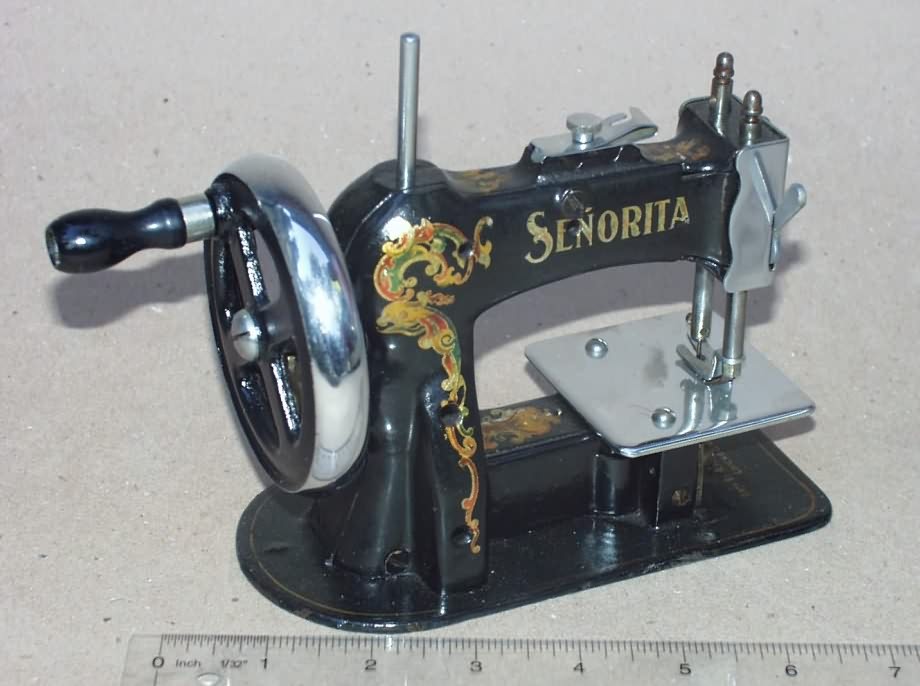 "Senorita"
Patented Child-Size Antique Sewing Machine
The Senorita is one of the rarest of all child size
patented sewing machines. This is the only one I have ever seen, and
there is not one pictured in either of Glenda Thomas's books on sewing
machines.
"Senorita"
Patented Child-Size Antique Sewing Machine
The Senorita is one of the rarest of all child size
patented sewing machines. This is the only one I have ever seen, and
there is not one pictured in either of Glenda Thomas's books on sewing
machines.There is a reference to one in Thomas's second book in an ad for the "Cupid" sewing machine, another rare machine that also hailed from Chicago. That ad refers to the A. M. Crane co as a distributer for the Cupid Mfg.. Co. but this machine is marked Patented and A. M. Crane Mfg. so there is research to be done to figure out exactly what the relationship is between these two machines, and names. The ad indicates that this machine was being marketed towards invalids who were not able to use treadle sewing machines, and that it was a high gear rapid stitcher, the equal to any other machine costing $60.00 or more. Marketing at its finest. The sole reference I could find using Google gave the date as approx 1901 but there was no other info than a line listing.
The condition of this "Senorita" sewing machine fabulous. The black japanned finish is excellent, as are the colorful gold decals running up the column on both sides. The manufactures name and patent info are on the base under the sew plate.
Fine . . . . . . .$975.00 SOLD!
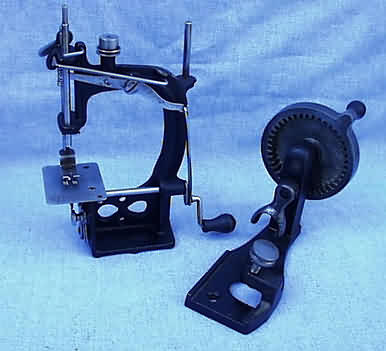 Rare
Spenser Sewing Machine with Auxiliary Crank
It is not often that this machine is found
complete with its auxiliary speed mechanism. It is a geared affair that
attaches to the base of the machine and efficiently converts one turn of the
geared wheel into about three revolutions of the inner handcrank. The machine
itself is marked with the Spenser name, denoting the Boston, MA firm, as well
as with several patent dates. The condition of the black paint is good
although slightly dull in finish. The metalwork is darkened a bit, showing
some loss of nickel. The speed attachment base has had a professional
repair which is hardly discernable, right at the skinniest portion of the base.
It was silver soldered / welded to be as strong as new, and then carefully finished
smooth and repainted. The solid gear wheel of the auxiliary mechanism
is marked "Pat. Apl'd For". This piece is priced to account for the one
apology---it's a rare one!
Rare
Spenser Sewing Machine with Auxiliary Crank
It is not often that this machine is found
complete with its auxiliary speed mechanism. It is a geared affair that
attaches to the base of the machine and efficiently converts one turn of the
geared wheel into about three revolutions of the inner handcrank. The machine
itself is marked with the Spenser name, denoting the Boston, MA firm, as well
as with several patent dates. The condition of the black paint is good
although slightly dull in finish. The metalwork is darkened a bit, showing
some loss of nickel. The speed attachment base has had a professional
repair which is hardly discernable, right at the skinniest portion of the base.
It was silver soldered / welded to be as strong as new, and then carefully finished
smooth and repainted. The solid gear wheel of the auxiliary mechanism
is marked "Pat. Apl'd For". This piece is priced to account for the one
apology---it's a rare one!
Good . . . . .$675.00 SOLD
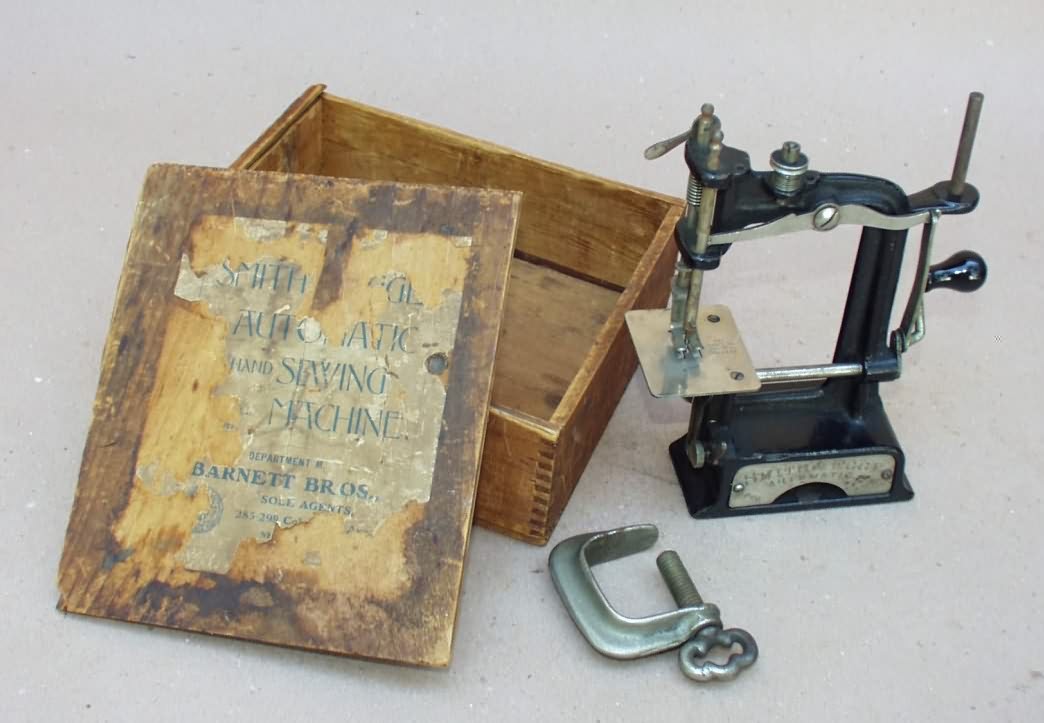 Antique Smith
& Egge Automatic Toy Sewing Machine / TSM in the Box
It is complete with the
original clamp. Very nice!!!
Antique Smith
& Egge Automatic Toy Sewing Machine / TSM in the Box
It is complete with the
original clamp. Very nice!!!
Excellent . . . . .$375.00 SOLD
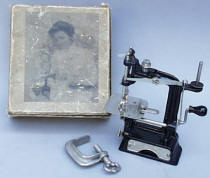 Smith
& Egge Automatic Antique Sewing Machine in the Box
It has been said that Mr. Egge had the reputation of being one of the best and
most ingenious mechanics in the country, while Mr. Smith was active in local
politics. Together they formed a company headquartered in Bridgeport,
Connecticut that manufactured, among other things, some of the finest hand sewing
machines of their day. This example is stamped with the Smith & Egge Automatic
model name on a textured plate attached to the front of the machine. Dating
from right around 1900, it comes complete with its very unusual original cardboard
box. After 100 or so years the box, as would be expected, is in fragile
condition. The lid has been reinforced with tape on the inside, it is
missing one side flap, and there is a fairly good size ding in it as you can
see from the picture. But the image of the Victorian-era woman operating
her sewing machine while sitting in a wicker chair is absolutely charming!
The machine itself is as close to perfect as it could possibly be---I think
it would rate a 10 on anyone's condition chart. It is complete with the
original clamp and tattered, though still readable, instructions. This
one is definitely special!
Smith
& Egge Automatic Antique Sewing Machine in the Box
It has been said that Mr. Egge had the reputation of being one of the best and
most ingenious mechanics in the country, while Mr. Smith was active in local
politics. Together they formed a company headquartered in Bridgeport,
Connecticut that manufactured, among other things, some of the finest hand sewing
machines of their day. This example is stamped with the Smith & Egge Automatic
model name on a textured plate attached to the front of the machine. Dating
from right around 1900, it comes complete with its very unusual original cardboard
box. After 100 or so years the box, as would be expected, is in fragile
condition. The lid has been reinforced with tape on the inside, it is
missing one side flap, and there is a fairly good size ding in it as you can
see from the picture. But the image of the Victorian-era woman operating
her sewing machine while sitting in a wicker chair is absolutely charming!
The machine itself is as close to perfect as it could possibly be---I think
it would rate a 10 on anyone's condition chart. It is complete with the
original clamp and tattered, though still readable, instructions. This
one is definitely special!
Excellent . . . . .$450.00 SOLD
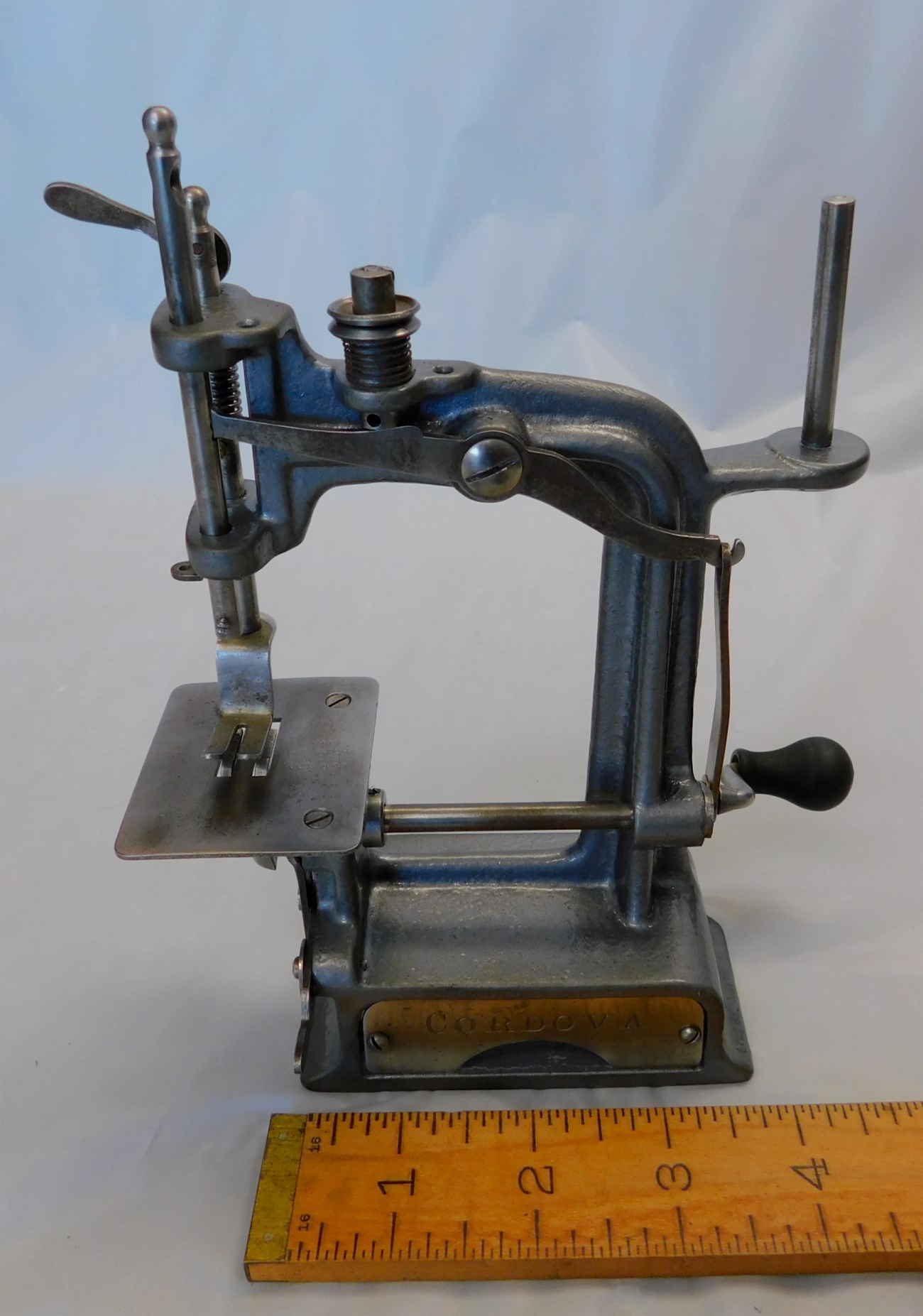 Cordova Cast Iron Toy Sewing Machine / TSM This
small cast iron toy or travel sewing machine looks great. There is no question that this
sewing machine is a Smith & Egge variation. Aside from the obvious resemblance,
it is clearly stamped with Smith & Egge patent information on the stitchplate. It is in excellent
restored
condition with metal parts showing no rust or corrosion. The body is a
silvery color as opposed to the typical black.
Cordova Cast Iron Toy Sewing Machine / TSM This
small cast iron toy or travel sewing machine looks great. There is no question that this
sewing machine is a Smith & Egge variation. Aside from the obvious resemblance,
it is clearly stamped with Smith & Egge patent information on the stitchplate. It is in excellent
restored
condition with metal parts showing no rust or corrosion. The body is a
silvery color as opposed to the typical black.This antique sewing machine dates from around the 1890s give or take. In the scheme of things it is a pretty unusual machine as the only other one to come up with a Google search is one I owned a number of years ago. And it was a bit different as it was a chain drive. There is a mention of Cordova being by Smith & Egge on another website about sewing machines, but he does not have one pictured. This unusual toy sewing machine is definitely a top-shelf item you'll be proud to own and show off!
Good +. . . . . . $395.00 SOLD!!
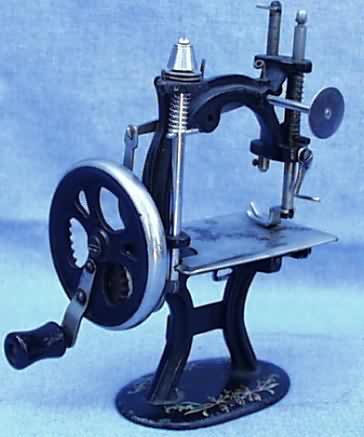 F
& W Reliable Cast Iron Sewing Machine
This unusual Foley & Williams sewing machine was marketed as a machine that
was reliable enough to be used by adults, yet small enough to be used by children.
It is the version with the geared handwheel rather than the simple cam-type
hand crank. This example shows some nickel loss and a bit of paint loss
on the base, but the floral decoration and the Reliable decal are good.
The tension assembly and the spool pin have been professionally remade by The
Watkins with the same precision as the originals.
F
& W Reliable Cast Iron Sewing Machine
This unusual Foley & Williams sewing machine was marketed as a machine that
was reliable enough to be used by adults, yet small enough to be used by children.
It is the version with the geared handwheel rather than the simple cam-type
hand crank. This example shows some nickel loss and a bit of paint loss
on the base, but the floral decoration and the Reliable decal are good.
The tension assembly and the spool pin have been professionally remade by The
Watkins with the same precision as the originals.
Good . . . . .$225.00 SOLD
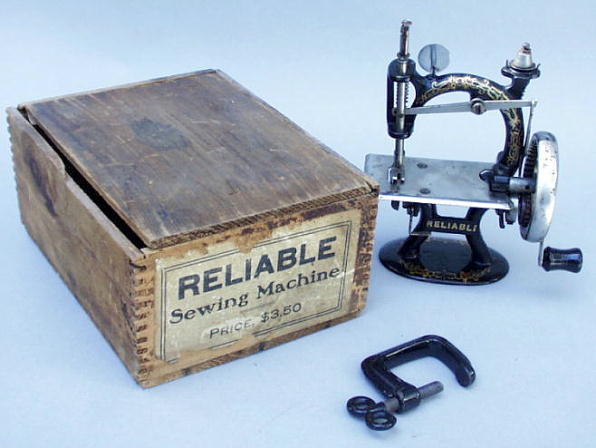 F
& W Reliable Cast Iron Sewing Machine in Original Box
This unusual Foley & Williams sewing machine was marketed as a machine that
was reliable enough to be used by adults, yet small enough to be used by children.
It is the version with the geared handwheel rather than the simple cam-type
hand crank. This example shows some nickel loss and a bit of paint loss
on the base, but the floral decoration and the Reliable decal are good.
The tension assembly and the spool pin have been professionally remade by The
Watkins with the same precision as the originals.
F
& W Reliable Cast Iron Sewing Machine in Original Box
This unusual Foley & Williams sewing machine was marketed as a machine that
was reliable enough to be used by adults, yet small enough to be used by children.
It is the version with the geared handwheel rather than the simple cam-type
hand crank. This example shows some nickel loss and a bit of paint loss
on the base, but the floral decoration and the Reliable decal are good.
The tension assembly and the spool pin have been professionally remade by The
Watkins with the same precision as the originals.
Good . . . . .$375.00 SOLD
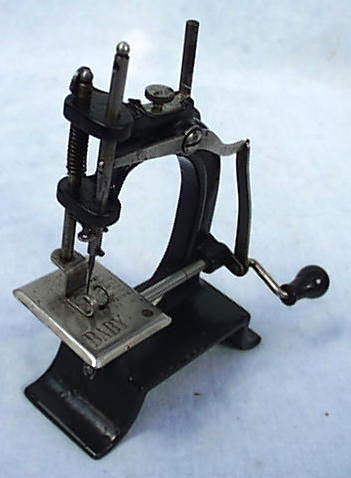 American
"Baby" Antique Toy Sewing Machine
This small
cast iron toy sewing machine is a favorite among collectors. The word
"Baby" is clearly stamped on the stitch plate along with patent dates from 1882,
1883, and 1894. The presser foot on this machine is very distinctive with
its curled up edges meant as a patented feature to protect little fingers.
This example is complete with the needle and ready to display.
American
"Baby" Antique Toy Sewing Machine
This small
cast iron toy sewing machine is a favorite among collectors. The word
"Baby" is clearly stamped on the stitch plate along with patent dates from 1882,
1883, and 1894. The presser foot on this machine is very distinctive with
its curled up edges meant as a patented feature to protect little fingers.
This example is complete with the needle and ready to display.
Excellent . . . . .$195.00 SOLD
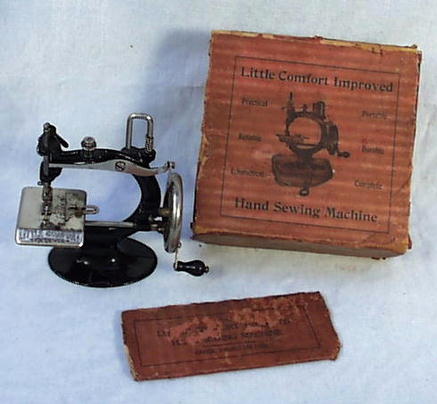 Little
Comfort Improved Hand Sewing Machine in Box
The Smith & Egge Co. of Bridgeport, CT made several
versions of their "Little Comfort" sewing machine. Their "Improved" model
featured a geared handwheel rather than the chain-drive or the direct-drive
versions of their other machines. This is a really well-designed, well-built,
sturdy little machine. It measures only about 7" tall but with it's oversized
base for stability it is quite a bit heavier than many of the other cast iron
"toy" machines. It was no doubt marketed as a "real" working machine capable
of doing all sorts of mending jobs by adults as well as being a first machine
for young girls. Note the interesting spool pin which requires that you
push down on the spring-loaded mechanism to release it from the locked position
in order to insert the spool of thread. It also has a complex tensioner
that is activated by the up-and-down motion of the upper arm as the machine
is cranked. The stitch plate is marked with the Little Comfort name on
the angled front edge as well as with the patent dates of 1896 and 1897.
This example is complete with the seam guide, the needle, the clamp, and a very
tattered cardboard box. And although the metal work on a portion of the
stitch plate and one spot on the hand wheel show some loss of nickel plating and
a little texture, the rest of the metal parts are bright and shiny original
nickel, and the black paint on the body is excellent, so overall it displays
well.
Little
Comfort Improved Hand Sewing Machine in Box
The Smith & Egge Co. of Bridgeport, CT made several
versions of their "Little Comfort" sewing machine. Their "Improved" model
featured a geared handwheel rather than the chain-drive or the direct-drive
versions of their other machines. This is a really well-designed, well-built,
sturdy little machine. It measures only about 7" tall but with it's oversized
base for stability it is quite a bit heavier than many of the other cast iron
"toy" machines. It was no doubt marketed as a "real" working machine capable
of doing all sorts of mending jobs by adults as well as being a first machine
for young girls. Note the interesting spool pin which requires that you
push down on the spring-loaded mechanism to release it from the locked position
in order to insert the spool of thread. It also has a complex tensioner
that is activated by the up-and-down motion of the upper arm as the machine
is cranked. The stitch plate is marked with the Little Comfort name on
the angled front edge as well as with the patent dates of 1896 and 1897.
This example is complete with the seam guide, the needle, the clamp, and a very
tattered cardboard box. And although the metal work on a portion of the
stitch plate and one spot on the hand wheel show some loss of nickel plating and
a little texture, the rest of the metal parts are bright and shiny original
nickel, and the black paint on the body is excellent, so overall it displays
well.
Good + . . . . .$395.00 SOLD
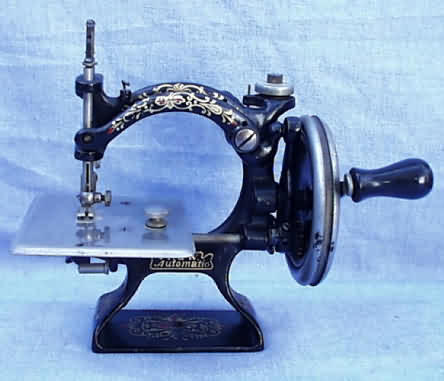 F
& W Automatic Cast Iron Antique Sewing Machine
This machine, produced by the Foley and Williams Co. of Chicago, dates from
just before the turn of the 20th century. At first glance you will notice
a similarity in the design of the rounded double upper arm to that of the popular
Wilcox and Gibbs sewing machine. But the F & W is a significantly smaller
sewing machine, marketed both as a child's machine and for family mending, and
unlike the Wilcox and Gibbs the F & W was produced for just a short period of
time. This example is in nice condition with pretty gold and red decoration.
As with many of this model machine, the spool pin is missing but replacements
are available. The groove in the gearwheel suggests that the machine was
made to be run either by hand or hooked up to a belt or treadle. This
one will display nicely amongst your other Victorian-era sewing machines!
F
& W Automatic Cast Iron Antique Sewing Machine
This machine, produced by the Foley and Williams Co. of Chicago, dates from
just before the turn of the 20th century. At first glance you will notice
a similarity in the design of the rounded double upper arm to that of the popular
Wilcox and Gibbs sewing machine. But the F & W is a significantly smaller
sewing machine, marketed both as a child's machine and for family mending, and
unlike the Wilcox and Gibbs the F & W was produced for just a short period of
time. This example is in nice condition with pretty gold and red decoration.
As with many of this model machine, the spool pin is missing but replacements
are available. The groove in the gearwheel suggests that the machine was
made to be run either by hand or hooked up to a belt or treadle. This
one will display nicely amongst your other Victorian-era sewing machines!
Very Good . . . . .$275.00 SOLD
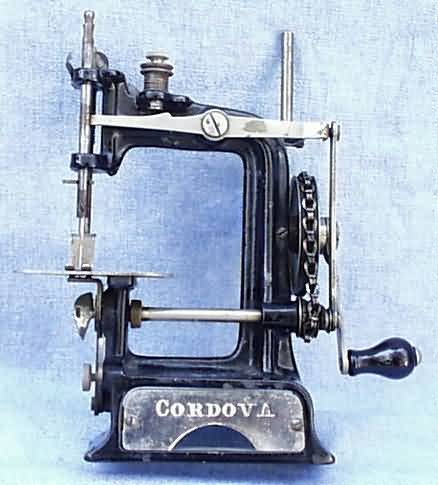 Smith
& Egge "Cordova" Chain Drive Cast Iron Sewing Machine
Very few chain-driven sewing machines were manufactured no doubt due to the
higher cost of manufacture. You occasionally find them marked "Smith &
Egge Automatic" and sometimes marked as "Little Comfort", but seldom found or
offered for sale is the version labeled with the "Cordova" nameplate.
There is no question that this machine was one of the Smith & Egge variations---aside
from the obvious resemblance it is clearly stamped with the manufacturer's name
and patent information on the stitchplate. This example is in excellent
original condition with shiny black paint and bright metal parts showing no
rust or corrosion. This antique sewing machine dates from around 1897
so it is remarkable to see one of these hard-to-find models in such outstanding
condition. It is definitely a top-shelf item you'll be proud to show off!
Smith
& Egge "Cordova" Chain Drive Cast Iron Sewing Machine
Very few chain-driven sewing machines were manufactured no doubt due to the
higher cost of manufacture. You occasionally find them marked "Smith &
Egge Automatic" and sometimes marked as "Little Comfort", but seldom found or
offered for sale is the version labeled with the "Cordova" nameplate.
There is no question that this machine was one of the Smith & Egge variations---aside
from the obvious resemblance it is clearly stamped with the manufacturer's name
and patent information on the stitchplate. This example is in excellent
original condition with shiny black paint and bright metal parts showing no
rust or corrosion. This antique sewing machine dates from around 1897
so it is remarkable to see one of these hard-to-find models in such outstanding
condition. It is definitely a top-shelf item you'll be proud to show off!
Excellent . . . . .$375.00 SOLD
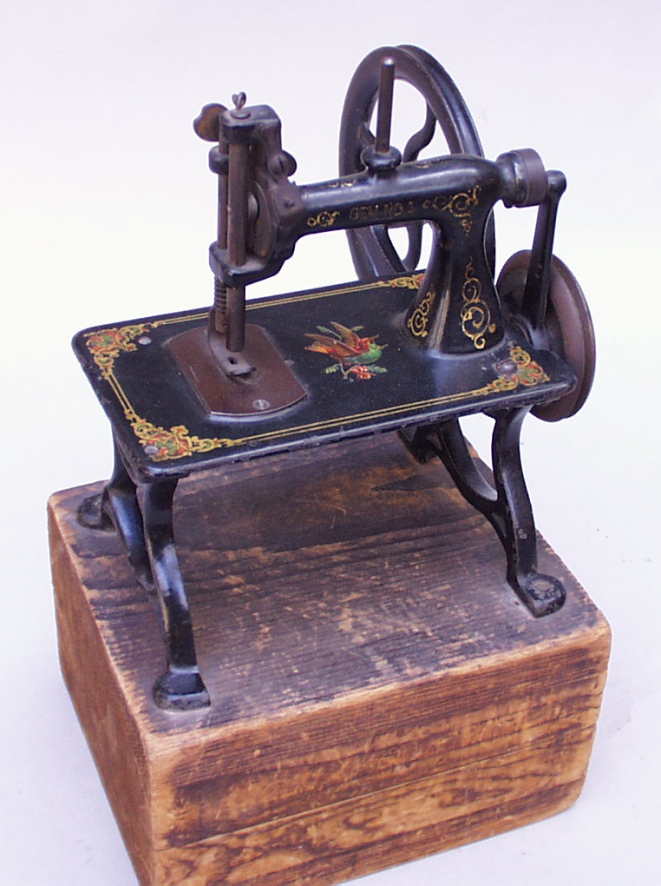 American
Gem Sewing Machine w/ Speed Enhancer This is a
great looking, and very hard to find antique child size sewing
machine.The overall condition is good +. The black japanned finish is
nice with minor losses at the base and along the edges.
American
Gem Sewing Machine w/ Speed Enhancer This is a
great looking, and very hard to find antique child size sewing
machine.The overall condition is good +. The black japanned finish is
nice with minor losses at the base and along the edges. The typical American Gem cast iron sewing machine has a interesting design base that was meant to resemble a real treadle stand. It is unique among toy sewing machines in this respect, and this design sewing machine is a favorite with toy sewing machine collectors and collectors of early full-size machines as well. It is approx 6" across the legs, and stands about 9" tall. This one has the doubly hard to find speed enhancer built into the design.
The sewing plate on this example is marked "Pat. Apld For", and in both of the references on sewing machines I have there is no information on the actual maker or any further patent information. I would estimate this machine to date from the 1880's or so from the look and decoration. It sews a simple chain stitch like other early machines from this era, and a special note should be made that it has oil or lubrication holes at the important bearing points, a feature that would indicate this machine was also marketed as a small working machine for seamstresses and not a simple toy.
This sewing machine is all-original with no breaks or cracks in the casting and it has not been touched up or restored. This early sewing machine is sure to be a standout in any sewing machine collection! And a really fine addition of Americana for your collection!
Very Good . . . . . . . .$1750.00 SOLD!
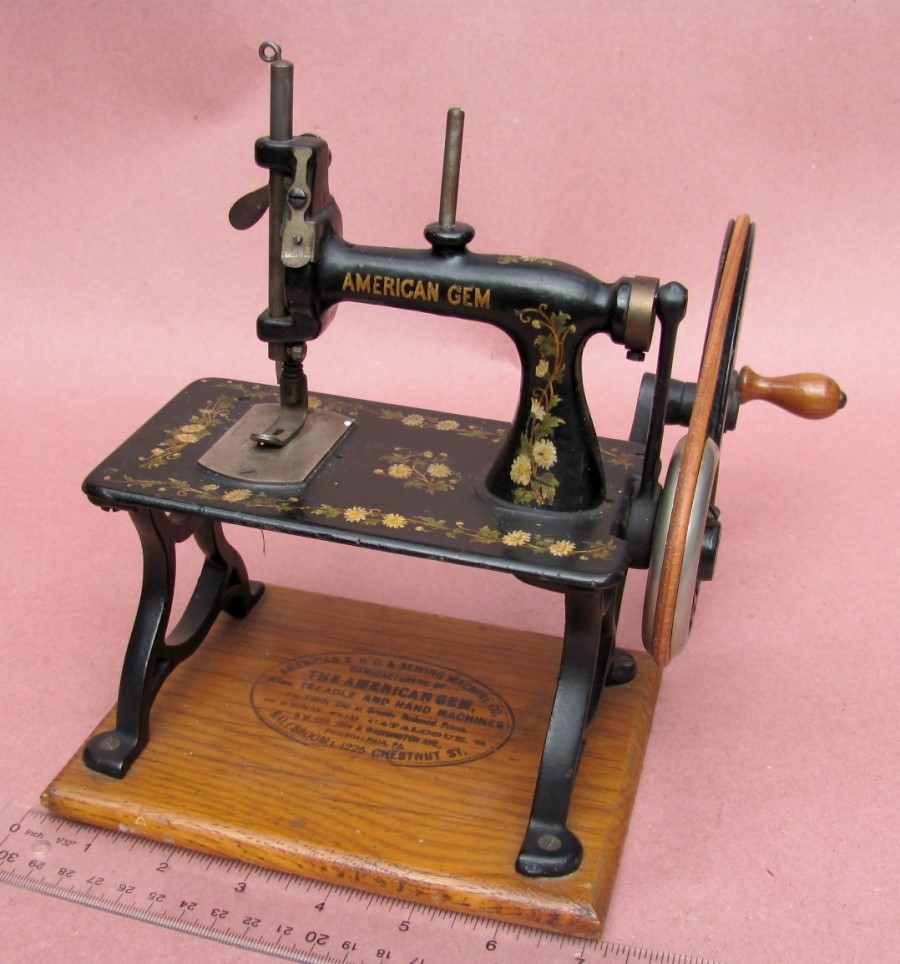 American
Gem Sewing Machine w/ Speed Enhancer, and Original Wooden Base w Advertising
This is a great looking, and very hard to find
antique sewing machine. The overall condition is the best i have ever seen
or had for this machine. This is the second time i have offered this
machine for sale. Over 20 years ago I first saw this machine in a
window at a place we were buying a iron stove along the shore of Mass near
Boston. We expressed interest, and although were originally told it
was not for sale a strong offer changed the owners mind. We sold it to
a dealer collector shortly after for a premium because of the condition and
base. It was sold again, and then sat in a collection for close to 20
years before we took it on consignment to sell for the widower of the last
collector. And so the circle continues.
American
Gem Sewing Machine w/ Speed Enhancer, and Original Wooden Base w Advertising
This is a great looking, and very hard to find
antique sewing machine. The overall condition is the best i have ever seen
or had for this machine. This is the second time i have offered this
machine for sale. Over 20 years ago I first saw this machine in a
window at a place we were buying a iron stove along the shore of Mass near
Boston. We expressed interest, and although were originally told it
was not for sale a strong offer changed the owners mind. We sold it to
a dealer collector shortly after for a premium because of the condition and
base. It was sold again, and then sat in a collection for close to 20
years before we took it on consignment to sell for the widower of the last
collector. And so the circle continues. The black japanned finish is super nice with just minor losses. The white and yellow Daisy flower decoration running around the perimeter, up the arm, and in the center of the sewing table is near perfect. Over the years we have seen quite a few of these sewing machines and the decoration on almost all has been different on each machine, indicating they were hand-done. Some have birds, others have red, green and gold grape-like vines, but this example w/ daisy decoration is certainly one of the nicest and most elaborate flower motifs we have seen
The American Gem cast iron sewing machine has a interesting design base that was meant to resemble a real treadle sewing machine stand. It is unique among toy sewing machines in this respect, and this design sewing machine is a favorite with toy sewing machine collectors and collectors of early full-size machines as well. It is approx 6" across the legs, and stands about 9" tall. The condition of the original wood base is exceptional, and there has never been one seen or found this nice. The two references on toy sewing machines picture this type of sewing machine, but they have no info on the maker or location. All of that info is clearly stenciled on the base under this machine. The condition is fabulous!!
The sewing plate on this example is marked "Pat. Apld For", and in both of the references on sewing machines I have there is no information on the actual maker or any further patent information. I would estimate this machine to date from the 1880's or so from the look and decoration. It sews a simple chain stitch like other early machines from this era, and a special note should be made that it has oil or lubrication holes at the important bearing points, a feature that would indicate this machine was also marketed as a small working machine for seamstresses and not a simple toy. These machines are found in two different styles with the more common version not having the speed enhancing second large wheel that this one does. I would say that the models with the speed enhancer are at least 10 times harder to find, and again, never has one been found with this nice a base.
This sewing machine is all-original with no breaks or cracks in the casting and it has not been touched up or restored. This early sewing machine is sure to be a standout in any sewing machine collection! And a really fine addition of Americana for your collection!
Fine + . . . . . . .$2750.00 SOLD!
 Peerless
Automatic Antique Cast Iron Sewing Machine
When it comes to marketing and advertising it seems that the more things change,
the more they stay the same! The Smith & Egge Manufacturing Co. of Bridgeport,
CT, like so many of its other competitors of the day, made several variations
of the same basic sewing machine, giving each variation a different and very
carefully chosen model name that was sure to inspire confidence in the buying
public. The "Peerless" is one you don't find very often. The basic
difference between this model and the more typical Smith & Egge models that
you see is that the name is cast into the base rather than stamped on an applied
steel plate. This example is in really nice condition and although the
accompanying wooden box is missing the lid and has had some repair to the bottom,
it did its job of protecting the machine for the last hundred or so years.
There are original instructions included though they are just a bit tattered.
Not one that comes along very often!
Peerless
Automatic Antique Cast Iron Sewing Machine
When it comes to marketing and advertising it seems that the more things change,
the more they stay the same! The Smith & Egge Manufacturing Co. of Bridgeport,
CT, like so many of its other competitors of the day, made several variations
of the same basic sewing machine, giving each variation a different and very
carefully chosen model name that was sure to inspire confidence in the buying
public. The "Peerless" is one you don't find very often. The basic
difference between this model and the more typical Smith & Egge models that
you see is that the name is cast into the base rather than stamped on an applied
steel plate. This example is in really nice condition and although the
accompanying wooden box is missing the lid and has had some repair to the bottom,
it did its job of protecting the machine for the last hundred or so years.
There are original instructions included though they are just a bit tattered.
Not one that comes along very often!Excellent . . . . .$275.00 SOLD
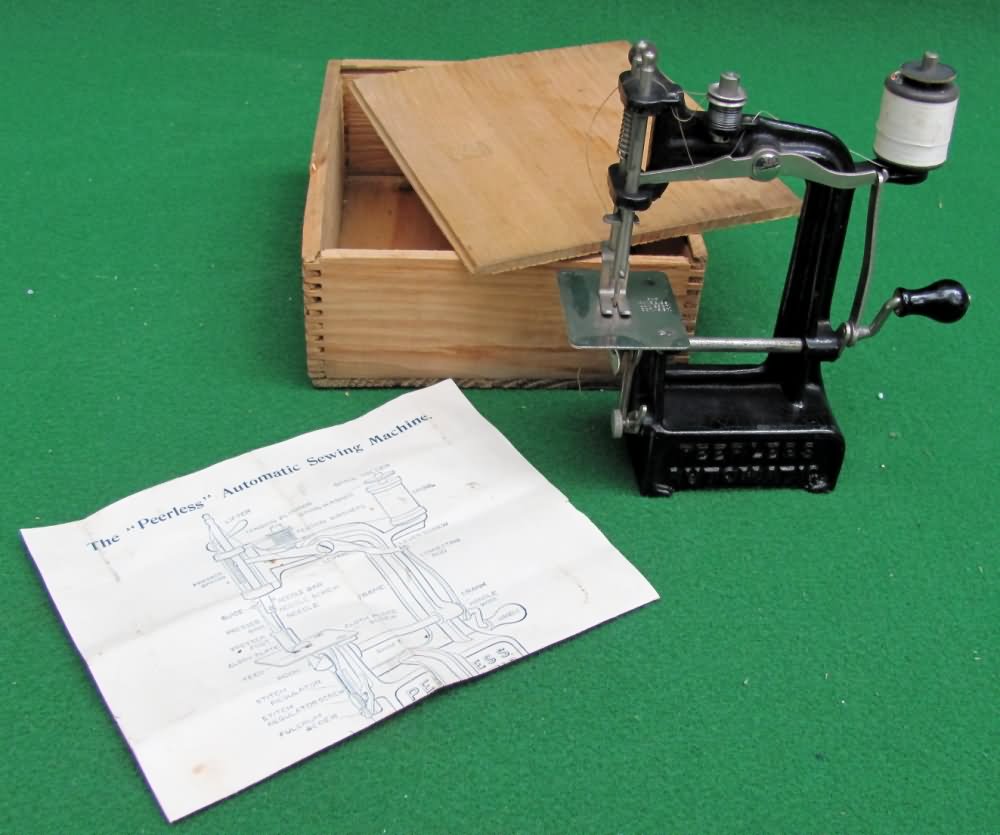 Peerless
Automatic Antique Cast Iron Sewing Machine w/ box & Instructions
This example is in really nice condition w/ wooden box
and instructions.
Not one that comes along very often!
Peerless
Automatic Antique Cast Iron Sewing Machine w/ box & Instructions
This example is in really nice condition w/ wooden box
and instructions.
Not one that comes along very often!Excellent . . . . .$375.00 SOLD
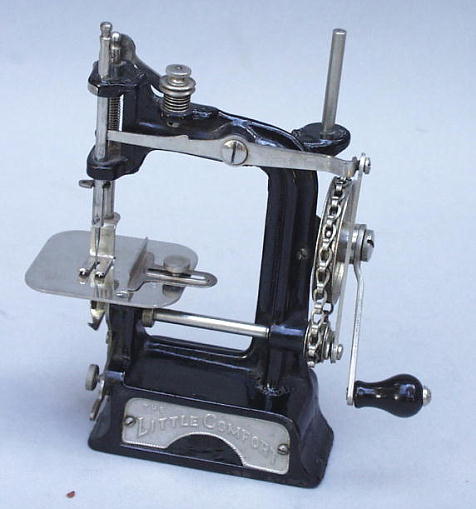 Little
Comfort Chain Drive Sewing Machine
Not a lot of these chain-driven cast iron machines were produced, as most
manufacturers of the little cast iron machines took the cheaper route of designing
simpler, less costly drive mechanisms. These small machines were marketed
as real machines to be used by adults for mending work as well as toys to inspire
young girls learning to sew. This example operates flawlessly and is in
excellent condition. The black paint is shiny and clean and the metalwork
is bright and shiny with no rust. if you are looking for an example that
is close to perfect this is it!
Little
Comfort Chain Drive Sewing Machine
Not a lot of these chain-driven cast iron machines were produced, as most
manufacturers of the little cast iron machines took the cheaper route of designing
simpler, less costly drive mechanisms. These small machines were marketed
as real machines to be used by adults for mending work as well as toys to inspire
young girls learning to sew. This example operates flawlessly and is in
excellent condition. The black paint is shiny and clean and the metalwork
is bright and shiny with no rust. if you are looking for an example that
is close to perfect this is it!
Excellent . . . . .$275.00 SOLD
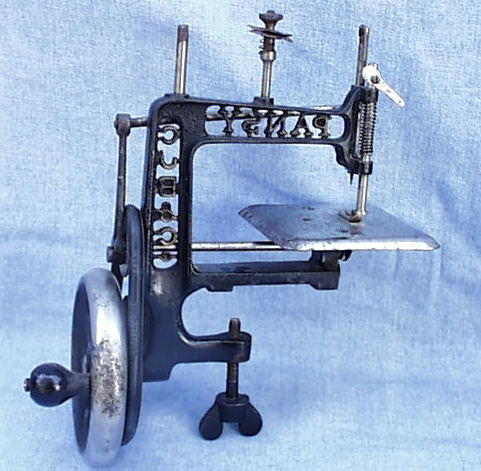 "The
Pansy" Integral Clamp Sewing Machine
This vintage sewing machine, the Pansy, is
the only type I can think of that has its name in cutout letters in the cast
iron frame work. In addition to having the built in or integral clamp, this
machine, with its cutout name in the frame, has special meaning for us because
of these two features combined. We buy all sorts of cast iron antiques
and vintage collectibles that have this "cutout" characteristic---tools, wrenches,
a sausage stuffer, latch rug machines, trivets, eggbeaters, etc. This
is an extremely rare model sewing machine and one of the few that we have ever
seen.
"The
Pansy" Integral Clamp Sewing Machine
This vintage sewing machine, the Pansy, is
the only type I can think of that has its name in cutout letters in the cast
iron frame work. In addition to having the built in or integral clamp, this
machine, with its cutout name in the frame, has special meaning for us because
of these two features combined. We buy all sorts of cast iron antiques
and vintage collectibles that have this "cutout" characteristic---tools, wrenches,
a sausage stuffer, latch rug machines, trivets, eggbeaters, etc. This
is an extremely rare model sewing machine and one of the few that we have ever
seen.
Excellent . . . . .$1275.00 SOLD
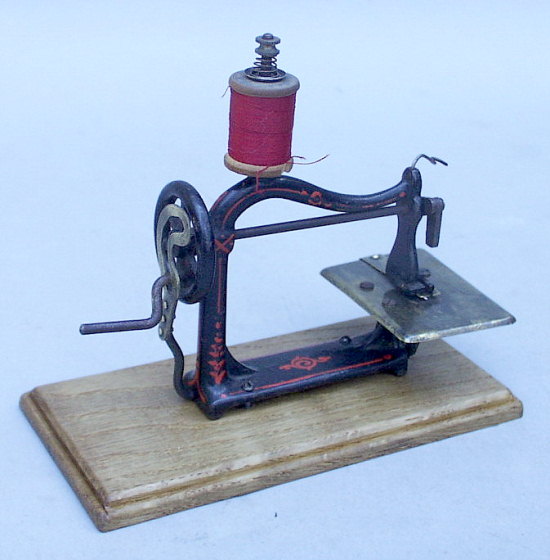 Goodes
Patent Toy Sewing Machine
On March 19, 1872 Ebenezer A. Goodes
was granted a patent on what he called "a new and useful toy sewing machine".
This is considered to be one of the very earliest American toy sewing machines
made, and old Ebenezer was rightfully proud of his accomplishment, prominently
stamping the patent date within a star-studded patriotic shield right in the
center of the stitchplate. This is a great looking sewing machine because
of its diminutive size and delicate, graceful lines. It is ingeniously
simple in mechanics, utilizing a cam and the simple revolving motion of the
handwheel to impart back-and-forth motion to the thread looper, while the "walking"
needle accomplishes the task of fabric transport. The condition of this
example is everything we could have ever hoped for!
Goodes
Patent Toy Sewing Machine
On March 19, 1872 Ebenezer A. Goodes
was granted a patent on what he called "a new and useful toy sewing machine".
This is considered to be one of the very earliest American toy sewing machines
made, and old Ebenezer was rightfully proud of his accomplishment, prominently
stamping the patent date within a star-studded patriotic shield right in the
center of the stitchplate. This is a great looking sewing machine because
of its diminutive size and delicate, graceful lines. It is ingeniously
simple in mechanics, utilizing a cam and the simple revolving motion of the
handwheel to impart back-and-forth motion to the thread looper, while the "walking"
needle accomplishes the task of fabric transport. The condition of this
example is everything we could have ever hoped for!
Excellent . . . . .$975.00 SOLD
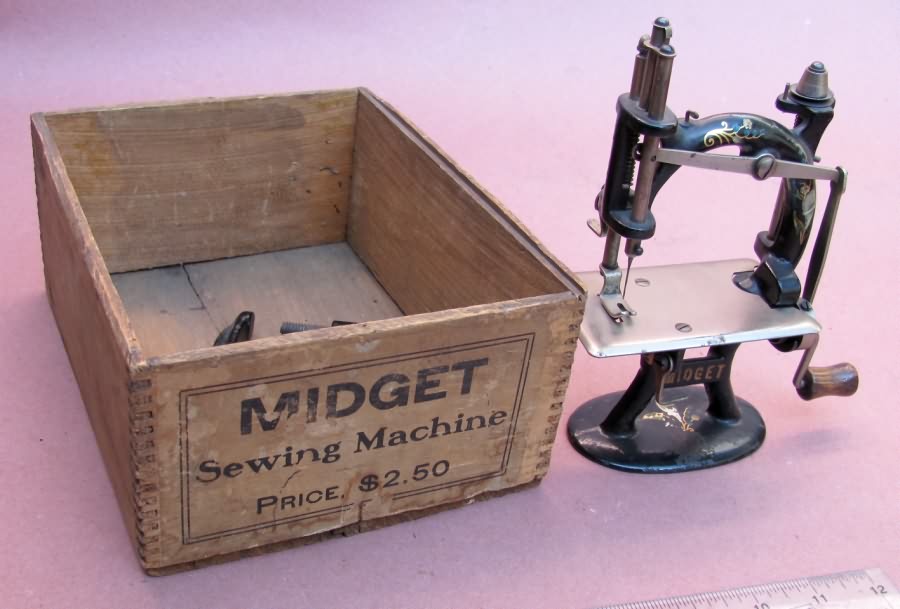 "Midget" Toy / Travel Size
/ Child-Size Antique Sewing Machine
The "Midget"
TSM is a well known early toy or travel size sewing machine.
The condition of this machine is very nice. It is hard to find them in
this nice condition, and harder again to find them in their original box. The body decoration is
Calla Lilies and this variation is very rare compared to the typical vines
and berries you usually see. I have had or seen many other
Midgets and similar machines made by Foley & Williams, but this is only the second
or third one
of these with this style decoration that I recall seeing in all those
years.
"Midget" Toy / Travel Size
/ Child-Size Antique Sewing Machine
The "Midget"
TSM is a well known early toy or travel size sewing machine.
The condition of this machine is very nice. It is hard to find them in
this nice condition, and harder again to find them in their original box. The body decoration is
Calla Lilies and this variation is very rare compared to the typical vines
and berries you usually see. I have had or seen many other
Midgets and similar machines made by Foley & Williams, but this is only the second
or third one
of these with this style decoration that I recall seeing in all those
years.
Very Good . . . . .375.00 SOLD!
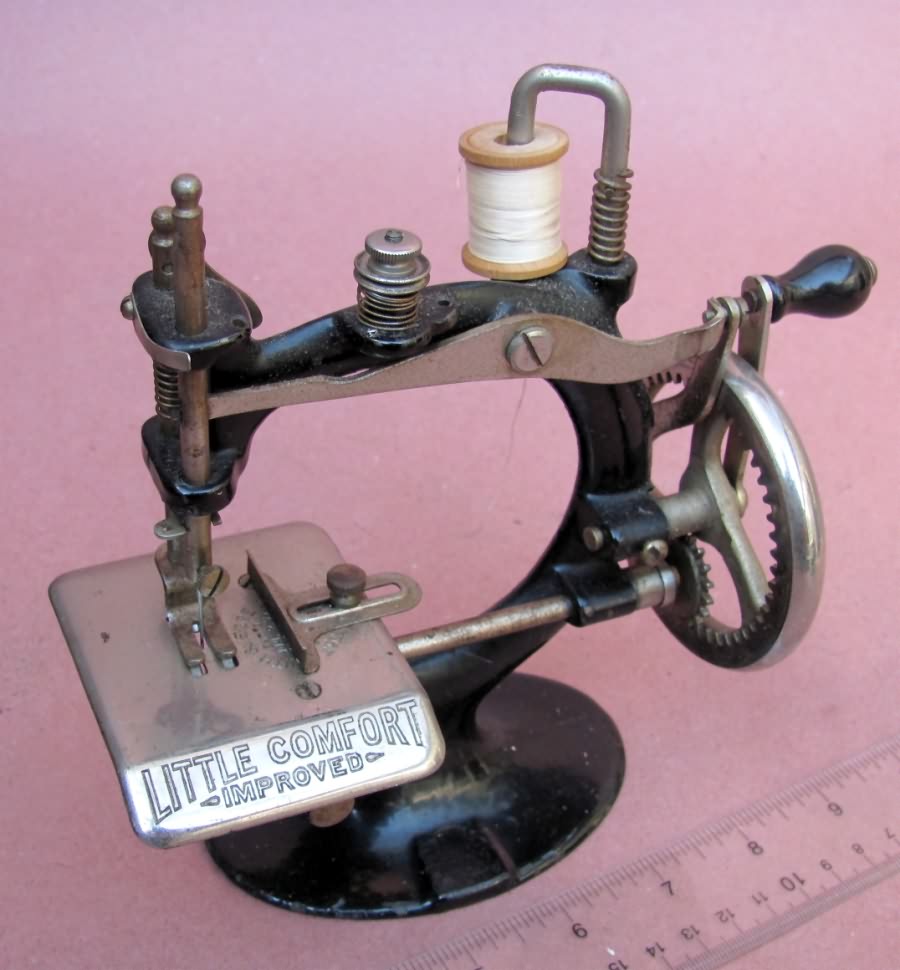 "Little
Comfort Improved" Toy / Travel Size
/ Child-Size Antique Sewing Machine
The "Little Comfort Improved"
TSM is a well known early toy or travel size sewing machine. It was made by the Smith & Egge
Co. There are several variations or versions of this machine, including a
chain drive model, one with a rounded body, the square bodied version, and more.
There is patent info on the stitch plate.
"Little
Comfort Improved" Toy / Travel Size
/ Child-Size Antique Sewing Machine
The "Little Comfort Improved"
TSM is a well known early toy or travel size sewing machine. It was made by the Smith & Egge
Co. There are several variations or versions of this machine, including a
chain drive model, one with a rounded body, the square bodied version, and more.
There is patent info on the stitch plate.The condition if this example is nice with 95% of the original finish intact. These machines can be found in lesser condition pretty regularly, but do not turn up in this condition very often. A nice example to add to the collection.
Very Good . . . . .$225.00 SOLD!
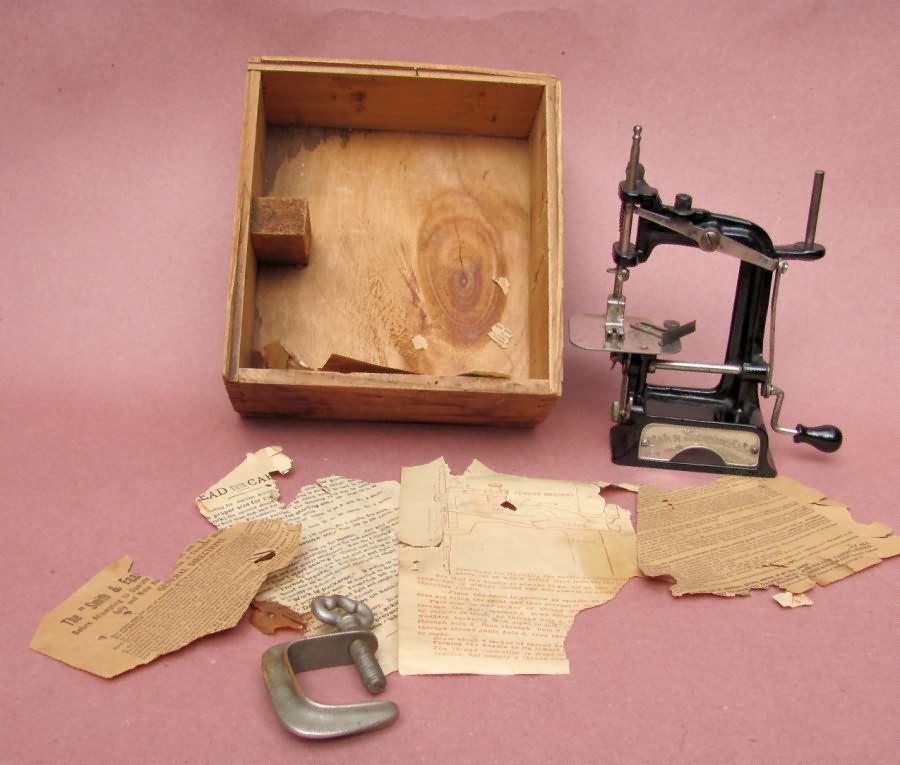 John
Wannamaker / Smith & Egge Sewing Machine w/ Original Box
John Wannamaker was the name of a large department
store with branches located in NY and Phila. They sold a complete line of goods
including toys. They were big enough a buyer that they were able to get
Smith & Egge to make them up their own name plaque for the front of an otherwise
standard Smith & Egge Sewing Machine.
John
Wannamaker / Smith & Egge Sewing Machine w/ Original Box
John Wannamaker was the name of a large department
store with branches located in NY and Phila. They sold a complete line of goods
including toys. They were big enough a buyer that they were able to get
Smith & Egge to make them up their own name plaque for the front of an otherwise
standard Smith & Egge Sewing Machine.The overall condition is very nice noting just some minor spots of rust that will clean. The box has no lid or label. The clamp is here as are the instructions that as can be seen are in a fragile state of decay. This is a pretty hard to find machine that only turns up occasionally.
Good + . . . . . . .$495.00 SOLD!
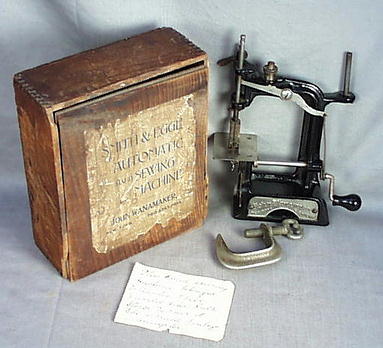 Smith & Egge
TSM Toy Sewing Machine Marked John Wannamaker w/ Original Box
John Wannamaker was the name of a large department
store with branches located in NY and Phila. They sold a complete line of goods
including toys. They were big enough a buyer that they were able to get
Smith & Egge to make them up their own name plaque for the front of an otherwise
standard Smith & Egge Sewing Machine.
Smith & Egge
TSM Toy Sewing Machine Marked John Wannamaker w/ Original Box
John Wannamaker was the name of a large department
store with branches located in NY and Phila. They sold a complete line of goods
including toys. They were big enough a buyer that they were able to get
Smith & Egge to make them up their own name plaque for the front of an otherwise
standard Smith & Egge Sewing Machine.The overall condition is very nice. The clamp is here as are the instructions. This is a pretty hard to find machine that only turns up occasionally.
Fine . . . . . . .$450.00 SOLD!
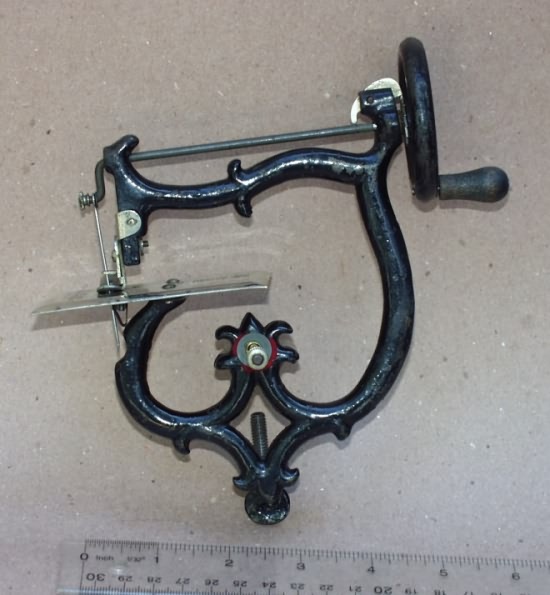 SOEZY
TSM / Toy Sewing Machine
The overall condition is very nice. This is a hard to
find and unusual integral clamp sewing machine. It looks earlier
than it is and the patent was from the teens, a time much later than
other similar looking machines. I imagine that explains their
relative scarcity.
SOEZY
TSM / Toy Sewing Machine
The overall condition is very nice. This is a hard to
find and unusual integral clamp sewing machine. It looks earlier
than it is and the patent was from the teens, a time much later than
other similar looking machines. I imagine that explains their
relative scarcity.
Fine . . . . . . .$1275.00 SOLD!
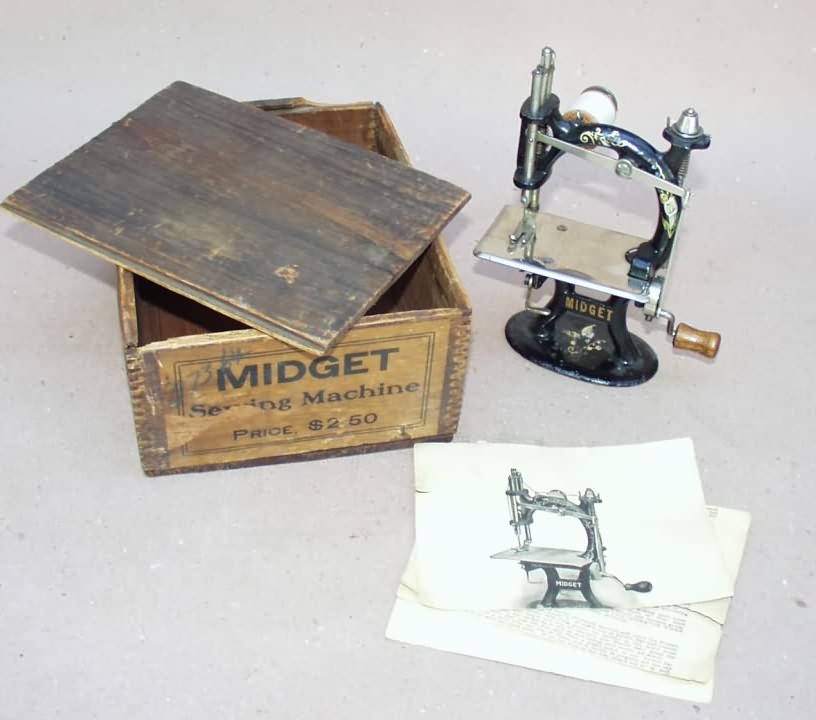 Midget
TSM / Toy Sewing Machine in Original Box
The overall condition is very nice.
Midget
TSM / Toy Sewing Machine in Original Box
The overall condition is very nice.
Fine . . . . . . .$395.00 SOLD!
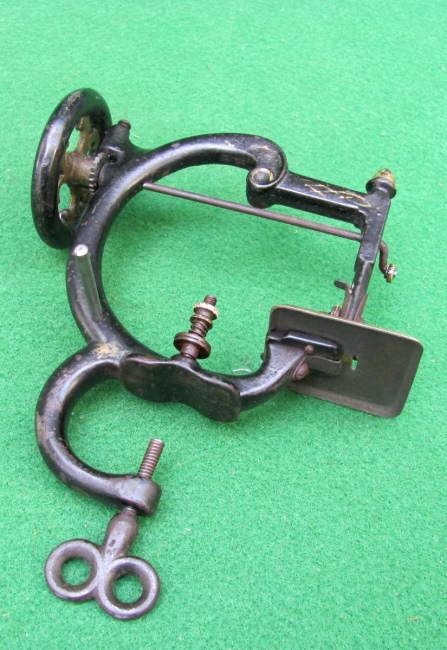 Hancock
/ Lake
Patent Cast Iron Sewing Machine / TSM
The patent for this small early and unusual integral clamp sewing machine was granted on
August 6th 1867 and that date is clearly stamped on the brass sewing plate.
It is identified in The Thomas book on TSM's as being a Hancock patent. A
quick search at Google turns up noting similar or for Hancock on that date. Jennie
Lake, a woman from New York was granted a patent for a machine of the exact
same form on August 30th 1870. That patent number is 106943 and it can be
viewed using Google Patent search.
Hancock
/ Lake
Patent Cast Iron Sewing Machine / TSM
The patent for this small early and unusual integral clamp sewing machine was granted on
August 6th 1867 and that date is clearly stamped on the brass sewing plate.
It is identified in The Thomas book on TSM's as being a Hancock patent. A
quick search at Google turns up noting similar or for Hancock on that date. Jennie
Lake, a woman from New York was granted a patent for a machine of the exact
same form on August 30th 1870. That patent number is 106943 and it can be
viewed using Google Patent search.This example is in overall nice condition retaining most of its original black finish with traces of gold highlights and decoration. The small knob on the crank wheel is a later replacement. As is typical there is no needle. It would have been one of the hooked design needles with a barb on the end. A hard to find variant and nice early sewing machine!
Fine . . . . . . .$2250.00 SOLD!
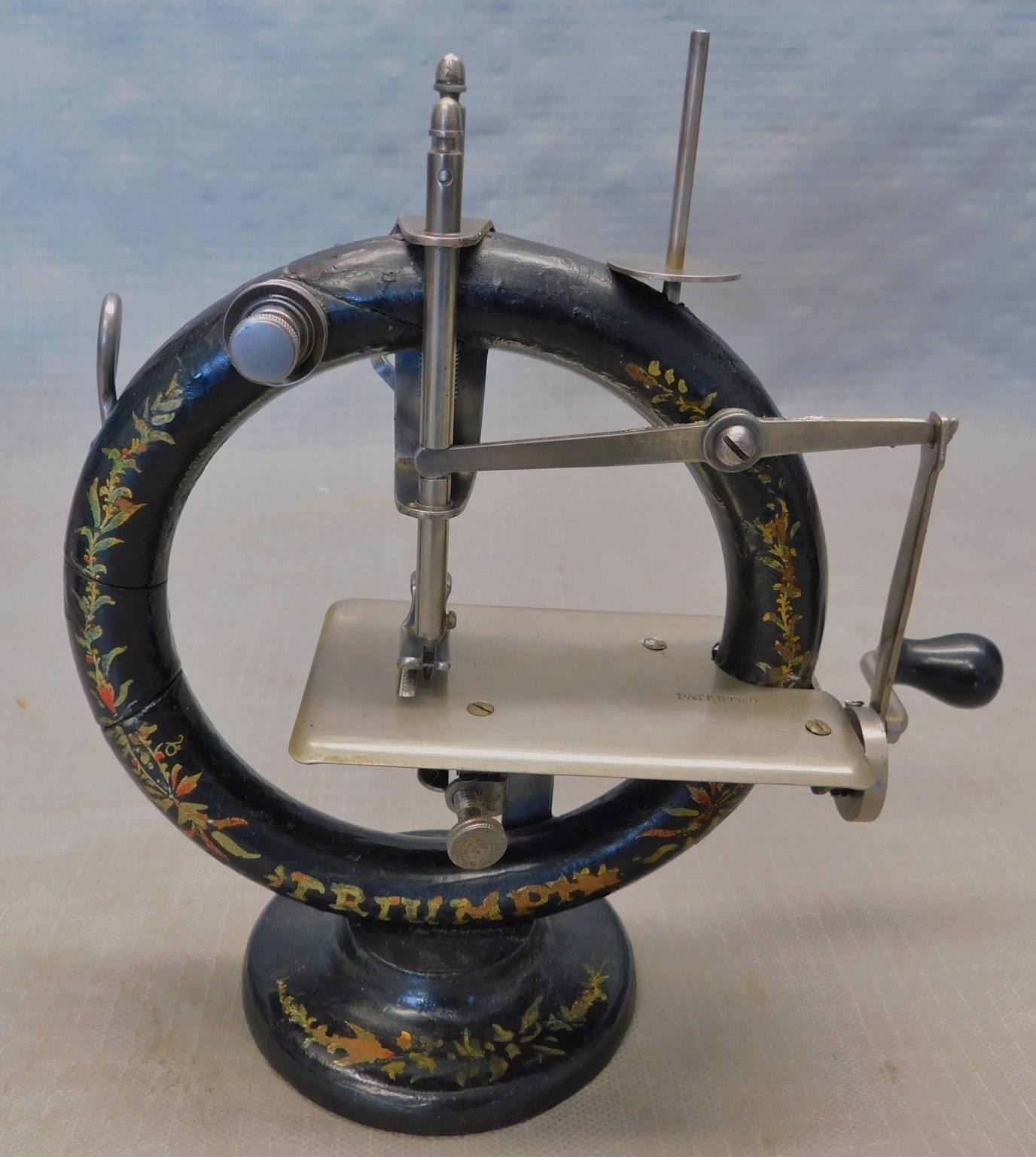 Patented
Triumph Round Wooden Sewing Machine The
Triumph is a scarce miniature sewing machines that features one of the most unusual and graphic designs
that was ever thought up for a toy sewing machine! The
round body is all wood, painted black and has applied decals for the Triumph
name and vine & berry decorations. There is a metal backing plate to
add strength and allow for the metal parts to operate. The wooden body was designed
with a small section of frame that could be removed while sewing to allow fabric to pass
through, then replaced when not in use to keep it stable. It is believed to have been manufactured by
the Foley & Williams Co. and is simply marked "Patent" on the
nickeled sew plate.
Patented
Triumph Round Wooden Sewing Machine The
Triumph is a scarce miniature sewing machines that features one of the most unusual and graphic designs
that was ever thought up for a toy sewing machine! The
round body is all wood, painted black and has applied decals for the Triumph
name and vine & berry decorations. There is a metal backing plate to
add strength and allow for the metal parts to operate. The wooden body was designed
with a small section of frame that could be removed while sewing to allow fabric to pass
through, then replaced when not in use to keep it stable. It is believed to have been manufactured by
the Foley & Williams Co. and is simply marked "Patent" on the
nickeled sew plate. This example is 100% complete with all of it's original parts, including the removable section and its retaining pin. It has a walking presser foot mechanism. The tensioner and spool pin are both present as well. It has some wear to the name and other decals as seen, but is in overall very nice condition. A "top-shelf" small TSM sewing machine for the collection.
Good + . . . . . $1150.00 SOLD!!
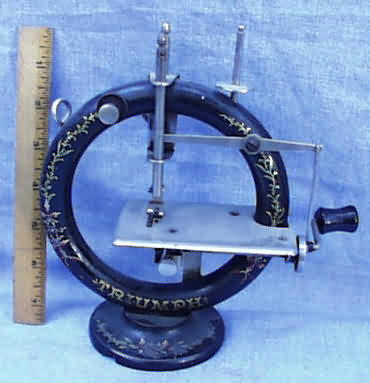 Triumph Sewing Machine
This example is 100% complete with all of it's original parts,
including the removable section and its retaining pin. Nice!!.
Triumph Sewing Machine
This example is 100% complete with all of it's original parts,
including the removable section and its retaining pin. Nice!!.
Good + . . . . . . .$1295.00 SOLD
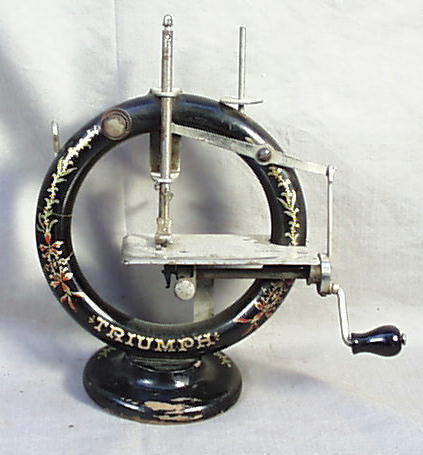 Round
Wooden Triumph Sewing Machine
This scarce sewing machines features one of the most unusual and graphic designs
that was ever thought up! It is believed to have been manufactured by
the Foley & Williams Co. and is simply marked "Patent Appld For". The unusual
round body is all wood with a metal backing plate, and the body was designed
with a small section of frame that could be removed while sewing to allow the
fabric to pass through, then replaced when not in use to keep it stable.
These machines are seldom found and rarely offered for sale, and because of
their age, design and material they are generally found incomplete and in worn
condition. This example is 100% complete with all of it's original parts,
including the removable section and its retaining pin. You will be proud to
display this example along with your other "top-shelf" small sewing machines.
Round
Wooden Triumph Sewing Machine
This scarce sewing machines features one of the most unusual and graphic designs
that was ever thought up! It is believed to have been manufactured by
the Foley & Williams Co. and is simply marked "Patent Appld For". The unusual
round body is all wood with a metal backing plate, and the body was designed
with a small section of frame that could be removed while sewing to allow the
fabric to pass through, then replaced when not in use to keep it stable.
These machines are seldom found and rarely offered for sale, and because of
their age, design and material they are generally found incomplete and in worn
condition. This example is 100% complete with all of it's original parts,
including the removable section and its retaining pin. You will be proud to
display this example along with your other "top-shelf" small sewing machines.
Good + . . . . . . .$1450.00 SOLD
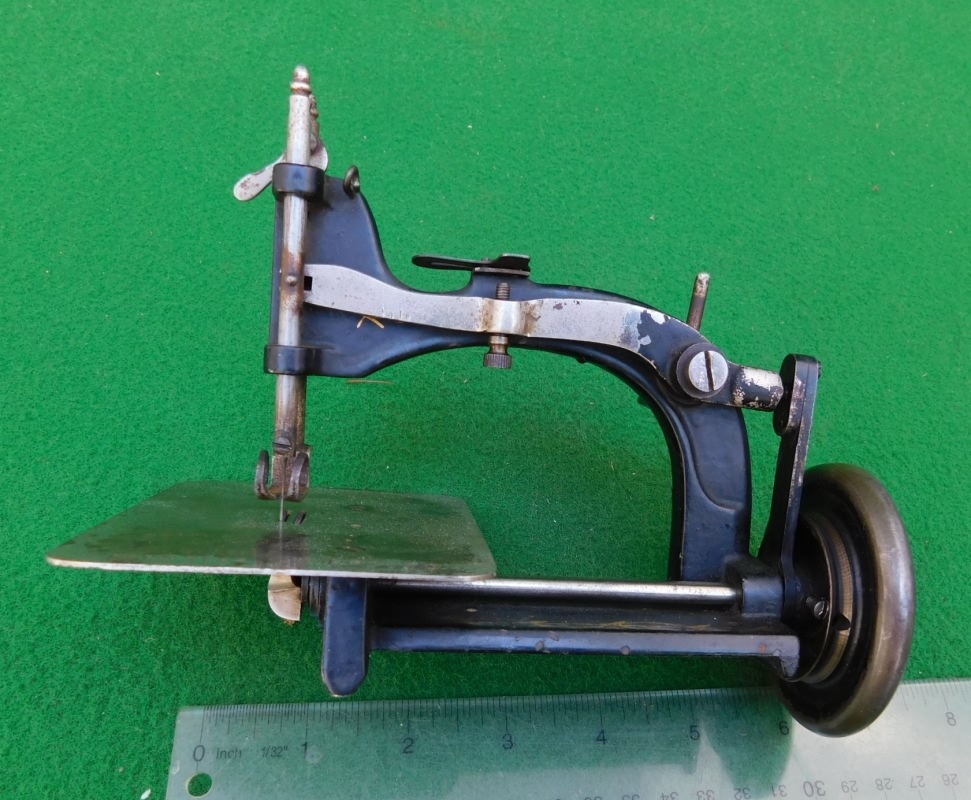 "Daisy"
Child Size Antique Sewing Machine A rare
and unusual TSM looking for its treadle base or the optional table clamp that
can be found for it. The Daisy Treadle TSM Sewing Machine is
considered the best of the toy treadles that can be found. I have
never seen the version with a removable auxiliary table clamp. A rare
thing.
"Daisy"
Child Size Antique Sewing Machine A rare
and unusual TSM looking for its treadle base or the optional table clamp that
can be found for it. The Daisy Treadle TSM Sewing Machine is
considered the best of the toy treadles that can be found. I have
never seen the version with a removable auxiliary table clamp. A rare
thing. The cosmetic condition of this unusual sewing machine is great with nearly all the original black finish & gold decoration remaining. It runs freely and smoothly. It has its original needle. The sew plate has had some nickel loss but is not rusty or pitted. It is marked with the company name, location of Cleveland Ohio, Patented July 3rd 1887 and the word Improved. The serial number is 103732.
In the treadle version the drive wheel fits through a slot cut in the table top so the machine can sit flat. With the aux clamp, the wheel sits to the outside of the table edge. This machine will look great mounted on a block of wood so that wheel is not the first thing to hit the table. Different, Rare, and Nice!!
Fine . . . . . . . $995.00 SOLD!!
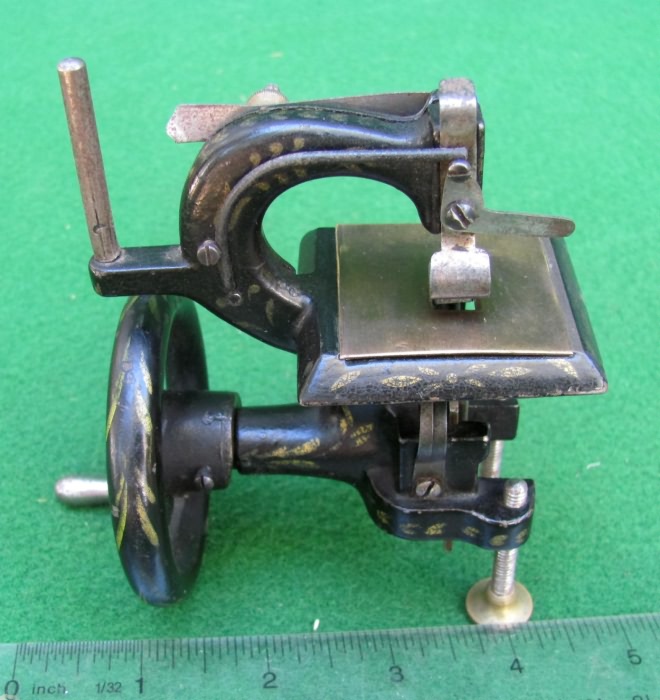 Hook Patent Sewing Machine The
cosmetic condition of this unusual sewing machine is great with nearly all the original finish and
decoration remaining. That is probably because a small spring inside
is broken and it would not operate properly. The spring is still present,
but will not attach as it was designed to due to a small break in it.
It is repairable.
Hook Patent Sewing Machine The
cosmetic condition of this unusual sewing machine is great with nearly all the original finish and
decoration remaining. That is probably because a small spring inside
is broken and it would not operate properly. The spring is still present,
but will not attach as it was designed to due to a small break in it.
It is repairable. In her Smithsonian-sponsored book on sewing machines Grace Cooper states that Albert Hook was granted the patent for this unusual machine on November 30th 1858. The machine is marked with that date. I could not find that patent using Google. In the index she calls off a number of 22179. When you run that number a reissue patent comes up, issued in 1863, as number1592. I'm not sure what that means. You can find that patent using a Google search. Hook was also granted patent number 24027 in 1859 for a similar looking machine, and that patent is also viewable on Google.
This rare antique sewing machine is incredibly small, measuring about 4" tall overall and 2" square. It has a built-in clamp to attach it to a work table. By design, it pushed a hooked needle up from below and formed a chain stitch. Very few were made, and fewer are known to exist today. Grace Cooper gives the machine a nice little write-up. The other major reference on antique sewing machines has a picture and one sentence. There are no other examples to be seen using a Google web or image search, and very little published information beyond what is found in Cooper's book.
Different, Rare, and Nice!!
Good + . . . . . . . $3950.00 SOLD!!
American
Patented Sewing Machines
This.
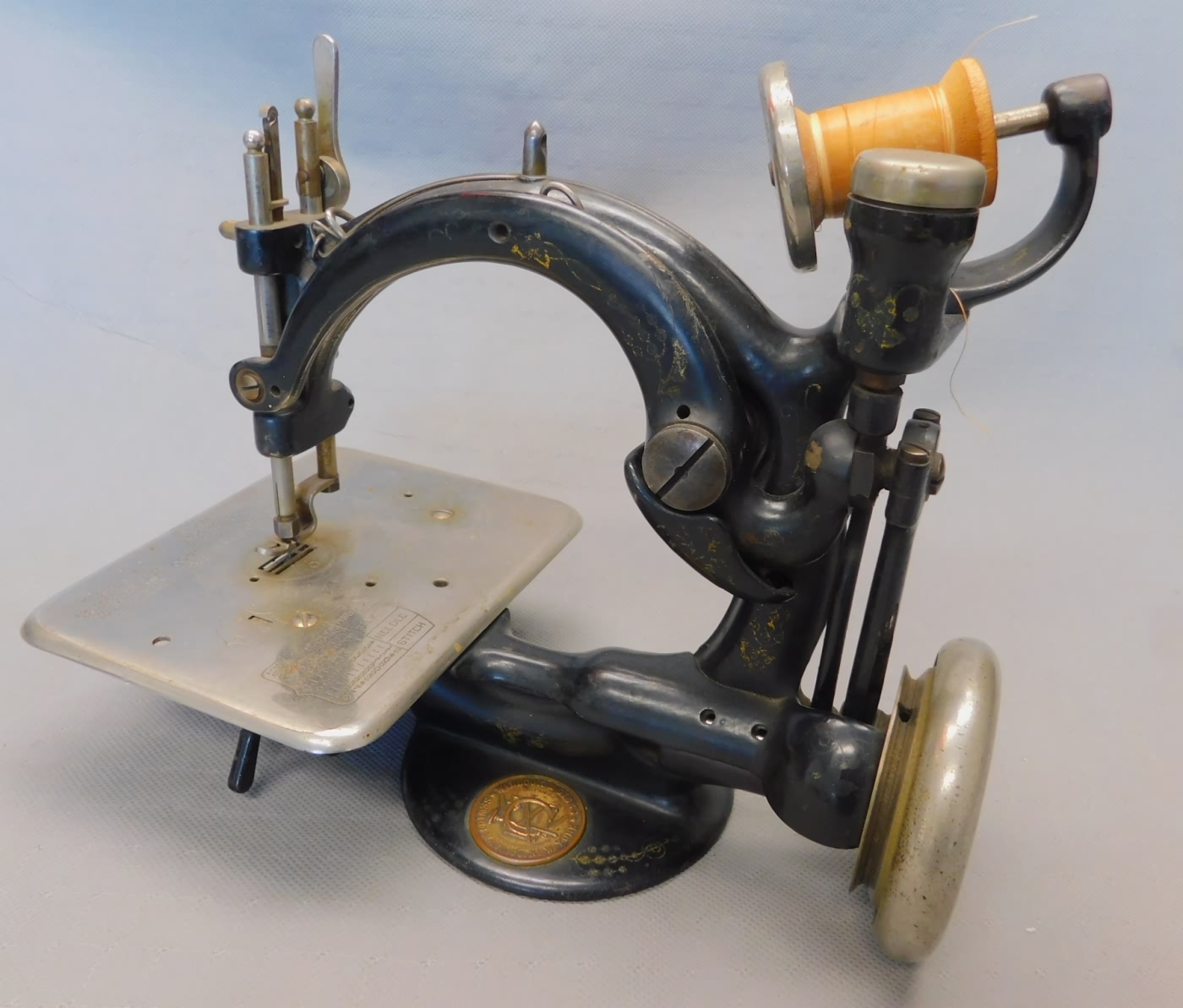 Wilcox
& Gibbs Sewing Machine This
Wilcox & Gibbs sewing machine is in overall nice condition. It has a grooved drive wheel
indicating it was on a treadle stand at one point. The Wilcox & Gibbs is an interesting looking
machine by one of the most prolific and well known makers of the 19th - 20th
century. There is lots of patent and other information on the sew
plate. Very Nice.
Wilcox
& Gibbs Sewing Machine This
Wilcox & Gibbs sewing machine is in overall nice condition. It has a grooved drive wheel
indicating it was on a treadle stand at one point. The Wilcox & Gibbs is an interesting looking
machine by one of the most prolific and well known makers of the 19th - 20th
century. There is lots of patent and other information on the sew
plate. Very Nice.Good + . . . . . $175.00 SOLD!!
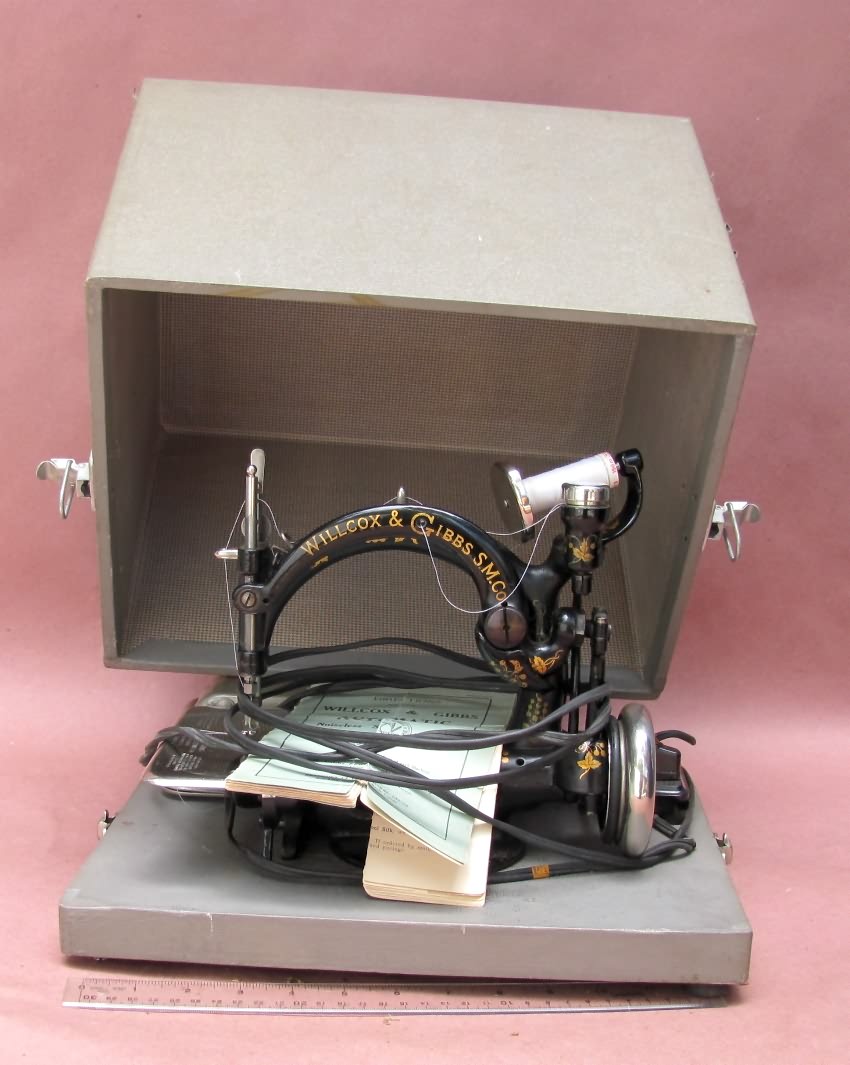 Electric Wilcox & Gibbs Sewing Machine w/
Box The
Wilcox and Gibbs is one of the best known and most commonly found of all
early patented sewing machines. They were made for well over 100 years
and offered in countless different variations. The condition of this machine is
near mint with nearly all the
original black paint gold decals and highlighting remaining. There is no
major rust or corrosion to the metal parts.
The Wilcox & Gibbs is an interesting and distinctive looking small machine that you do not find every day in this nice condition. It was first patented in
the 1850's and numerous times after that.
Electric Wilcox & Gibbs Sewing Machine w/
Box The
Wilcox and Gibbs is one of the best known and most commonly found of all
early patented sewing machines. They were made for well over 100 years
and offered in countless different variations. The condition of this machine is
near mint with nearly all the
original black paint gold decals and highlighting remaining. There is no
major rust or corrosion to the metal parts.
The Wilcox & Gibbs is an interesting and distinctive looking small machine that you do not find every day in this nice condition. It was first patented in
the 1850's and numerous times after that.This electric model looks to be made up as an aftermarket idea. The typically seen electric models came in a long rectangular box and had a special marked foot peddle. I am not sure who did this or when, but it looks to be 30's or so. It is obvious that it did not go over well with the intended user, and she probably moved on to a Singer 221 Featherweight, while this was relegated to the closet for the next 80 or so years.
A nice machine that has a great look.
Fine . . . . . . .$295.00 SOLD!
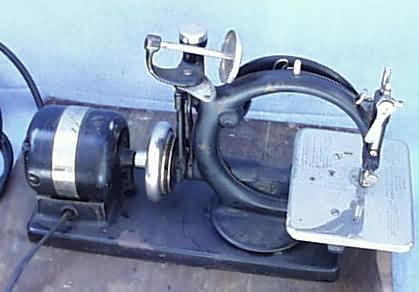 Electric Wilcox & Gibbs Sewing Machine The
Wilcox and Gibbs is one of the best known and most commonly found of all
early patented sewing machines. They were made for well over 100 years
and offered in countless different variations including electric models. A nice
later machine that has a
great look.
Electric Wilcox & Gibbs Sewing Machine The
Wilcox and Gibbs is one of the best known and most commonly found of all
early patented sewing machines. They were made for well over 100 years
and offered in countless different variations including electric models. A nice
later machine that has a
great look.
Good + . . . . . . .$295.00 SOLD!
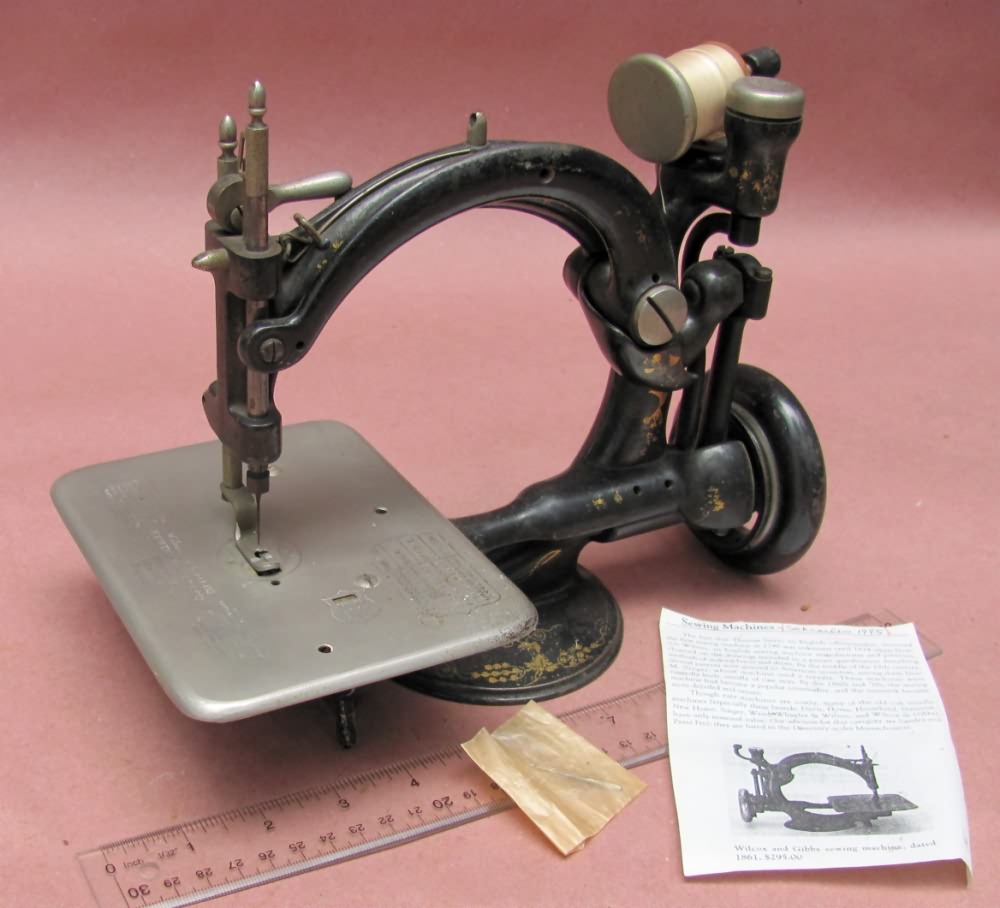 Wilcox & Gibbs Sewing Machine The
Wilcox and Gibbs is one of the best known and most commonly found of all
early patented sewing machines. They were made for well over 100 years
and offered in countless different variations. This one is off of a
treadle style. A nice
later machine that has a
great look.
Wilcox & Gibbs Sewing Machine The
Wilcox and Gibbs is one of the best known and most commonly found of all
early patented sewing machines. They were made for well over 100 years
and offered in countless different variations. This one is off of a
treadle style. A nice
later machine that has a
great look.
Good + . . . . . . .$195.00 SOLD!
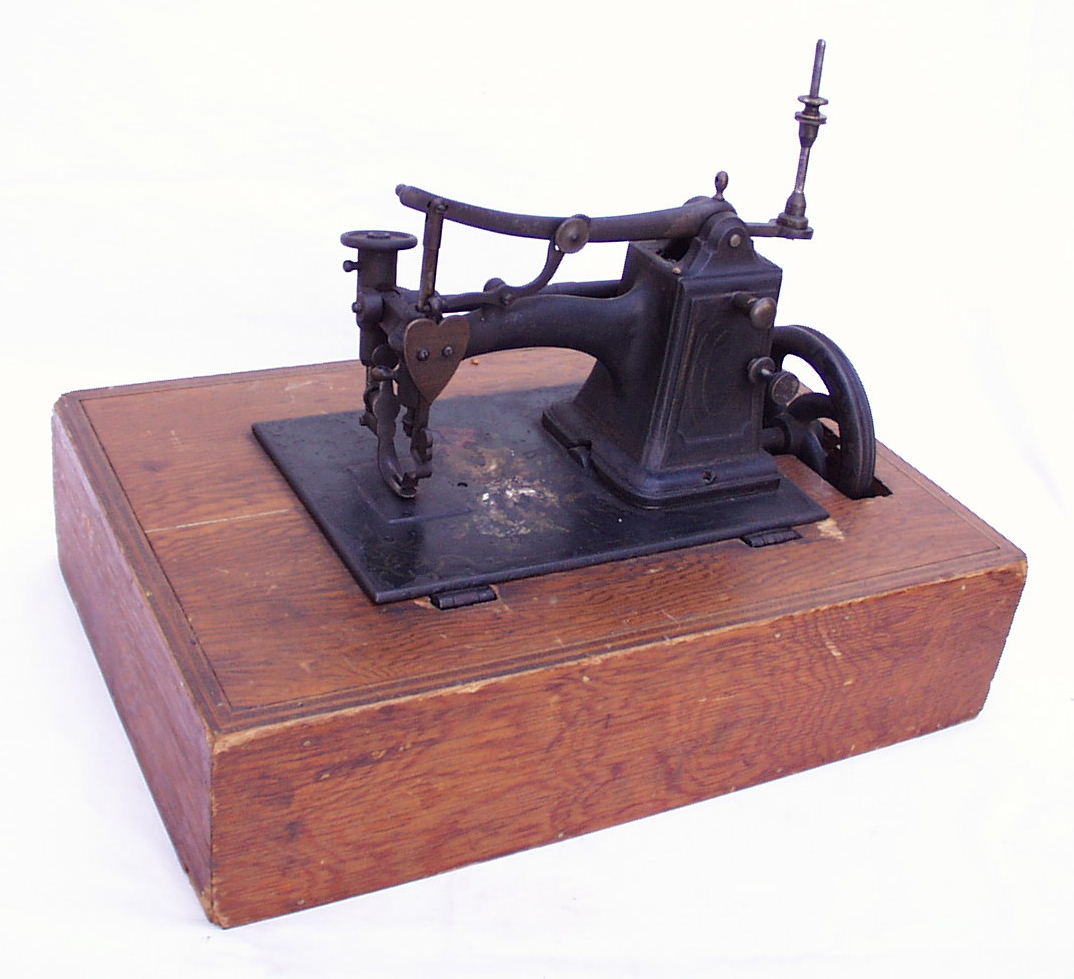 Herron's
1857 Patent Sewing Machine
This is
a rare and desirable American patent sewing machine. The patent for this
sewing machine was issued in 1857 to a Abial Herron. The only one I know
of in this country is pictured in Grace Coopers book "The Invention of the Sewing
Machine" picturing and describing the example in the Smithsonian's collection.
Herron's
1857 Patent Sewing Machine
This is
a rare and desirable American patent sewing machine. The patent for this
sewing machine was issued in 1857 to a Abial Herron. The only one I know
of in this country is pictured in Grace Coopers book "The Invention of the Sewing
Machine" picturing and describing the example in the Smithsonian's collection.
This early patented sewing machine is not mentioned or pictured in the other major book on the subject of early patented sewing machines by Carter Bays which is now in its third or fourth printing, meaning he has not been able to acquire one in all those years since his first edition came out in the early 90's. Carter is recognized by many as the top collector / expert in the US and for one of these to be missing from his collection is indicative of the scarcity of this sewing machine. In speaking with the former leading American dealer in antique sewing machines, he indicated that over the years he had one just one and that he sold it to an European collector.
The design looks somewhat like a Watson, but closer examination shows it to be quite different in setup and operation. It has several distinct differences from those also rare machines. This sewing machine is marked with the patentees name Herron and the 1857 date on a heart shaped brass plaque on the front of the machine above the needle.
The condition is OK. There is about 50-60% of the paint and decoration remaining. Cooper describes these machines as being provided with a handcrank or adapted to use as a treadle machine. A previous owner has made a small table for this one so it would display properly. It is unknown what an original set-up would look like or what the treadle looked like. There are no other examples to compare this too, and the one Cooper shows is just the head. This machine has one minor condition problem in the casting. There is a crack in the casting holding the main drive rod. It is a weak point in the casting, and the piece you see was broken loose. It was drilled and pinned and is now solid & stable although you can still see the crack. The machine turns over freely, and its operation can be observed and demonstrated.
Excellent . . . . .$2950.00 SOLD!!
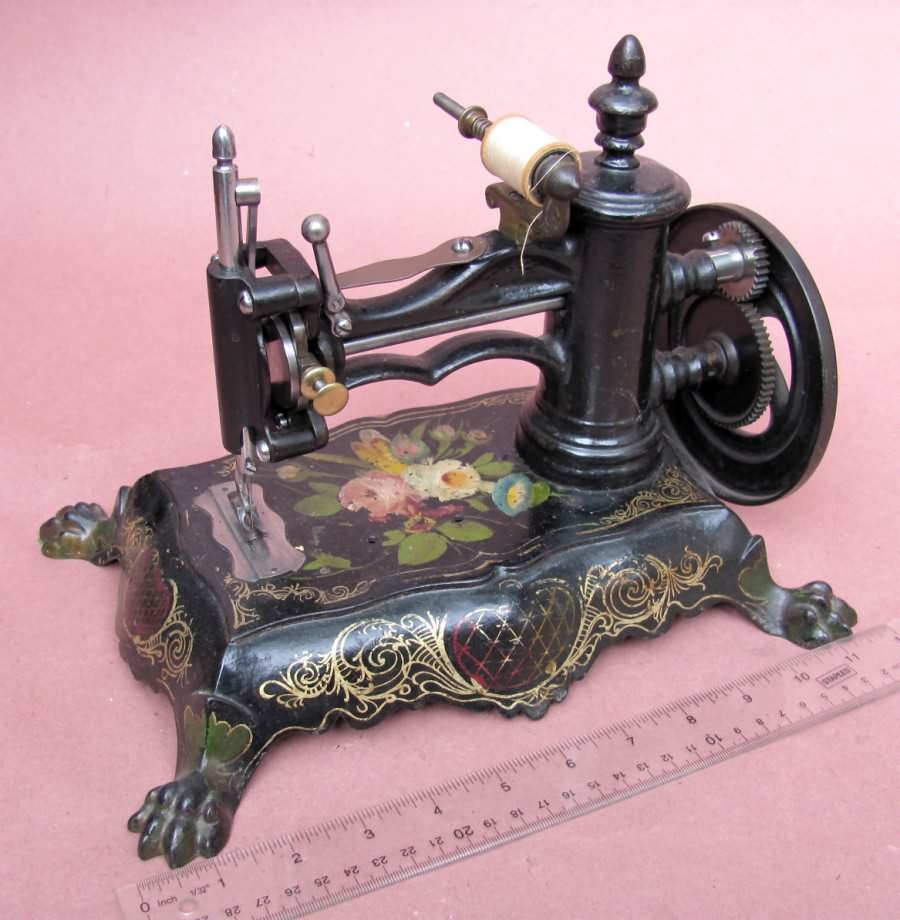 Ketchum
Patent Sewing Machine
This "paw foot" sewing machine is also a
"Ketchum's Patent" with a mid 1860's patent date on the needle plate on the
top. This patent covers the stitch mechanism, and similar sewing
machines can also be found marked "Shaw & Clark" or "Wilson", just two of
the many competitors in the early sewing machine market. The condition
of this one is super with 90% or more of the original decoration. They
are often found with little or none of this hand-painted designs on the body
and base. A nice example!!
Ketchum
Patent Sewing Machine
This "paw foot" sewing machine is also a
"Ketchum's Patent" with a mid 1860's patent date on the needle plate on the
top. This patent covers the stitch mechanism, and similar sewing
machines can also be found marked "Shaw & Clark" or "Wilson", just two of
the many competitors in the early sewing machine market. The condition
of this one is super with 90% or more of the original decoration. They
are often found with little or none of this hand-painted designs on the body
and base. A nice example!!Paw Foot Machines of this style date from the mid 1860's and were still being produced into the late 1870's before more standardized and advanced designs pushed them from the market. Many of these machines are found with no maker or patent information on them and they are most probably knockoffs trying to avoid patent infringements. Some of those machines are very nicely done. Many are unmarked, and nearly every one is done is a slightly different decoration as they were hand done back then.
Good + . . . . . . .$1250.00
SOLD!
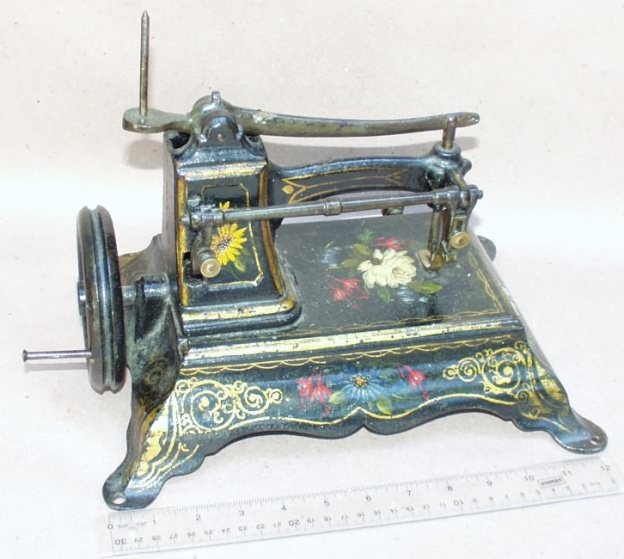 1856
Watson Patent Paw Foot Sewing Machine
The Watson patent sewing machine is a nice example
of one of the earliest patented American sewing machines having a patent
date of 1856. The machine sports a small brass plaque with the patent
info, date, and Watson name on the main cross arm. The firm was
located in Bridgeport CT according to Carter Bay's book on the subject.
1856
Watson Patent Paw Foot Sewing Machine
The Watson patent sewing machine is a nice example
of one of the earliest patented American sewing machines having a patent
date of 1856. The machine sports a small brass plaque with the patent
info, date, and Watson name on the main cross arm. The firm was
located in Bridgeport CT according to Carter Bay's book on the subject.
The condition is great with large amounts of original decoration
and finish remaining. It appears that at some point a coat of clear
gloss finish was applied, and this may be original. There are areas
where it has turned yellowish as one would expect from a finish over 100
years old. This is a rare and historically significant sewing
machine, and one which does not appear on the market very often.
It has a great look and will make for great display
Good + . . . . . .$3250.00 SOLD!
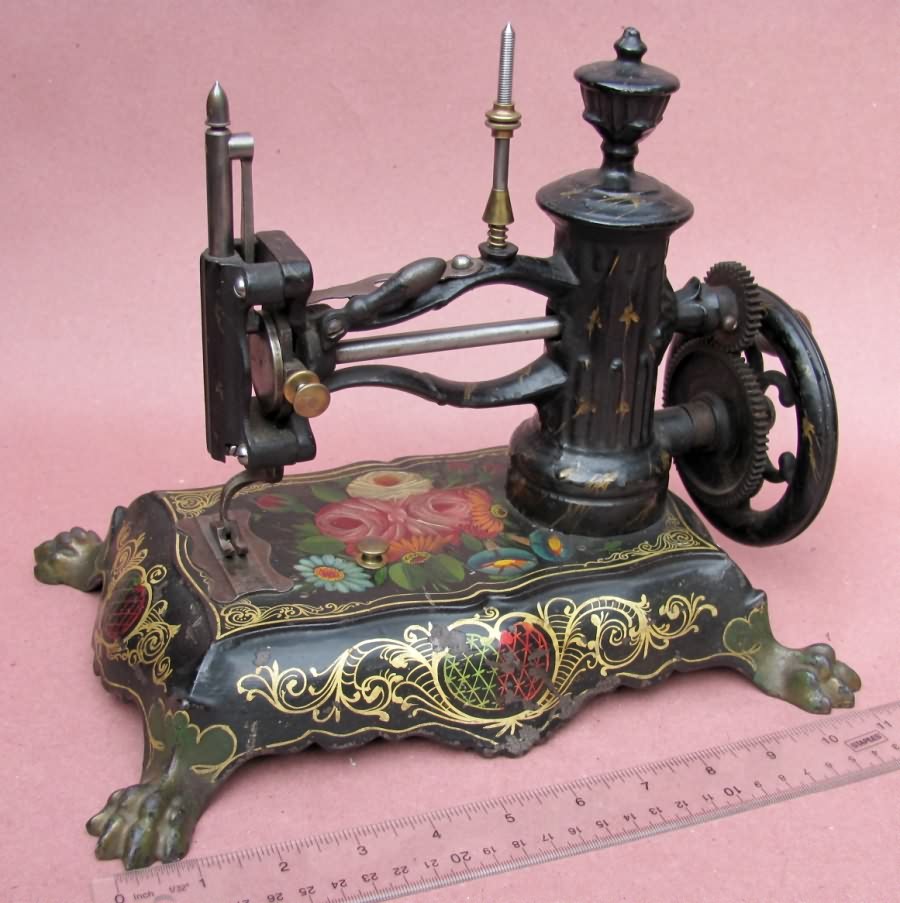 Shaw
& Clark Paw Foot / Fire Hydrant Sewing Machine
The
condition of this early patented sewing machine is very good with nearly all
the original black paint remaining and most of the hand painted colorful
decorations remaining.. There is no rust or corrosion to the exposed
metal parts. This early patented sewing machine has a lot of gold
highlighting and floral decorations that were hand painted on the bed.
This particular machine is unmarked, but that is common. They are
generally referred to as Paw foot machines, or as fire hydrant models.
They can then be further identified by terms like ribbed column, or skinny
pillar, or open pillar, and a few others. An interesting machine you
do not find every day and rarely in this condition. .
Shaw
& Clark Paw Foot / Fire Hydrant Sewing Machine
The
condition of this early patented sewing machine is very good with nearly all
the original black paint remaining and most of the hand painted colorful
decorations remaining.. There is no rust or corrosion to the exposed
metal parts. This early patented sewing machine has a lot of gold
highlighting and floral decorations that were hand painted on the bed.
This particular machine is unmarked, but that is common. They are
generally referred to as Paw foot machines, or as fire hydrant models.
They can then be further identified by terms like ribbed column, or skinny
pillar, or open pillar, and a few others. An interesting machine you
do not find every day and rarely in this condition. .
Good + . . . . . . .$950.00
SOLD!
W.G. Wilson "Paw Foot" type Sewing
Machine
There
are many variations of the antique sewing machines that are collectively referred
to as "Paw Foot" designs. The Biddeford, Maine company known as Shaw &
Clark was one of the most prolific manufacturers of paw foot machines, producing
over half a dozen different variations during the 1860's. Another lesser
known manufacturer of this style of sewing machine was the Midwestern company
referred to as W.G. Wilson, who produced machines under Ketchum's April 28,
1863 patent. This is an example of one of their machines, and it is so
marked with the patent info on the stitch plate. This early chain-stitch
sewing machine is spectacular in its design and its colorful embellishment.
It retains much of its original brightly colored floral paint and gold pinstriping.
Note the details of the fire hydrant style body topped with an elegant finial,
the ornate scalloped-edge base, and the well-defined feet. This machine
utilized the New England style "walking" presser foot to move the fabric along
instead of the more typical feeddog mechanism, and an unusual horizontal spool
pin for the thread. Oftentimes these machines are found in much lesser
condition, so if you have been waiting for one the you'll be proud to display
be sure to take a close look at this great example!
Good
. . . . .$950.00 SOLD
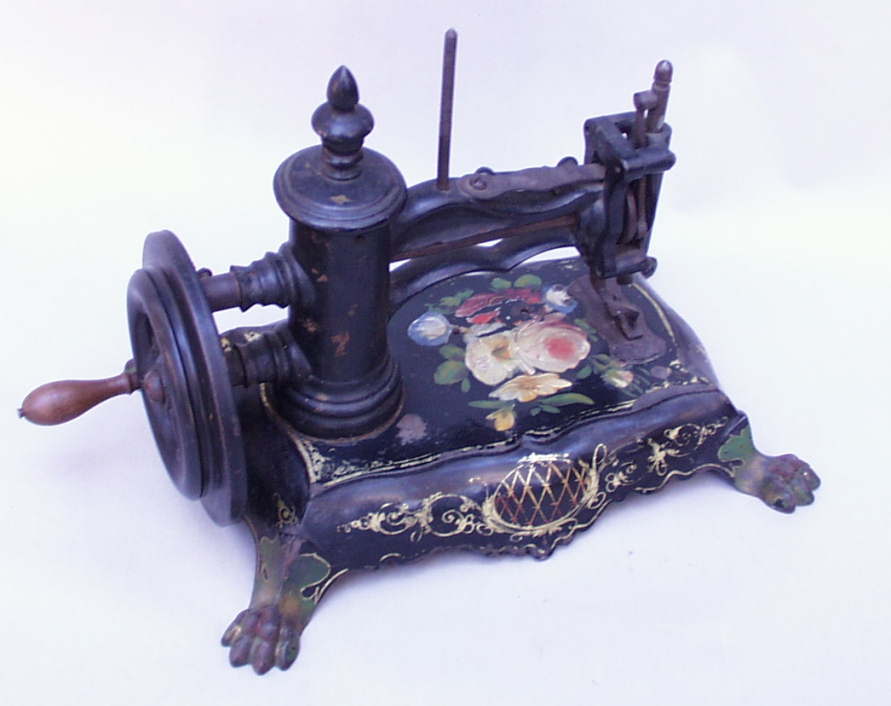 Early Paw Foot Style Sewing Machine
This style
of "paw foot" sewing machine is known by several different names and comes in
a number of different variations. They are occasionally found marked "Ketchum's
Patent", which would cover the stitch mechanism, and they can also be found
marked "Shaw & Clark" or "Wilson", just two of the many competitors in the early
sewing machine market. Machines of this style date from the mid 1860's
and were still being produced into the late 1870's before more standardized
and advanced designs pushed them from the market. Many of these machines
are found with no maker or patent information on them, and this example is one
of the unmarked ones. They are often described by the shape of the
pillar or column, and this one would be known as a fire hydrant model.
Other typically seen styles are the fluted column model, the skinny column,
the open or closed square column, and others. The operation and design
of all are pretty much the same. This type of machine forms a single thread
chain stitch utilizing no bobbin or second thread to form a lockstitch.
Their attractive designs make them highly sought after, but they are typically
found in horrible condition with little remaining paint. This example on the
other hand is quite nice with approximately 80%-90% of the original paint and
decoration remaining.
Early Paw Foot Style Sewing Machine
This style
of "paw foot" sewing machine is known by several different names and comes in
a number of different variations. They are occasionally found marked "Ketchum's
Patent", which would cover the stitch mechanism, and they can also be found
marked "Shaw & Clark" or "Wilson", just two of the many competitors in the early
sewing machine market. Machines of this style date from the mid 1860's
and were still being produced into the late 1870's before more standardized
and advanced designs pushed them from the market. Many of these machines
are found with no maker or patent information on them, and this example is one
of the unmarked ones. They are often described by the shape of the
pillar or column, and this one would be known as a fire hydrant model.
Other typically seen styles are the fluted column model, the skinny column,
the open or closed square column, and others. The operation and design
of all are pretty much the same. This type of machine forms a single thread
chain stitch utilizing no bobbin or second thread to form a lockstitch.
Their attractive designs make them highly sought after, but they are typically
found in horrible condition with little remaining paint. This example on the
other hand is quite nice with approximately 80%-90% of the original paint and
decoration remaining.
Excellent
. . . . .$950.00 SOLD
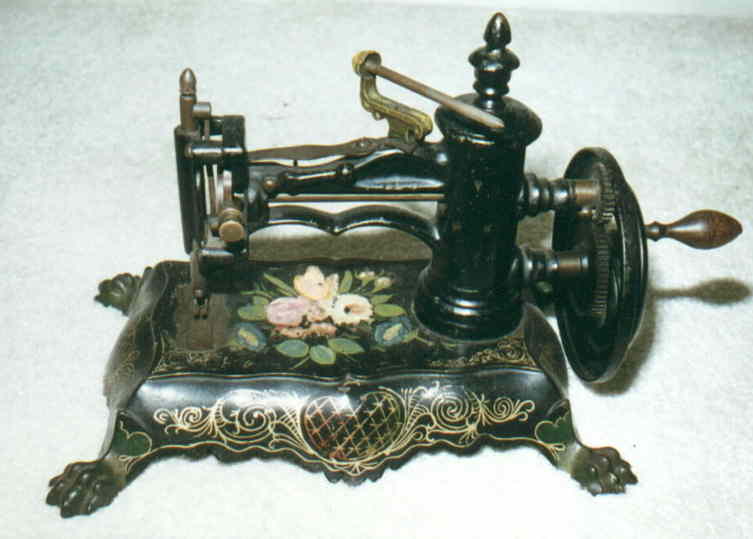 Early Paw Foot Style Sewing Machine
The condition is very nice!!
Early Paw Foot Style Sewing Machine
The condition is very nice!!
Excellent
. . . . .$1450.00 SOLD
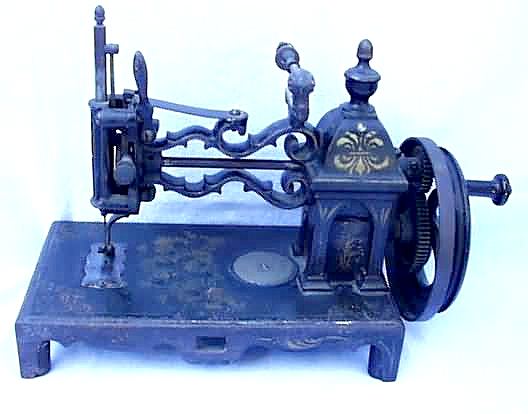 Shaw
& Clark Closed Pillar Sewing Machine from Biddeford, Maine
The several different models of vintage sewing machines
produced by this Maine company are some of the best known and most actively
sought after of all antique sewing machines from the early era of production
in the mid to late 1800's. Shaw & Clark put out a half dozen or so different
models over the years, and they have come to be referred to by nicknames that
attempt to describe their distinguishing feature. This example is known
as Shaw & Clark's "closed pillar" model. (As an aside, there are also
the "open pillar", the "fire hydrant", the "skinny pillar", and a few more variations.)
There are also a large number of early knockoffs that are often referred to
as " Shaw & Clarks", but which really not---they were manufactured in competition
during this era in violation of this company's patents, thus partially explaining
their being unmarked. This one is clearly marked with the Shaw & Clark
name boldly cast into the bottom of the base as well as on the brass medallion
where the patent information can be found next to the pillar. The
condition of this antique sewing machine is very good---many it seems are found
with virtually no paint remaining and only occasionally are they found
in near pristine condition. This one, thought not pristine, is very good
with most of the decorative and colorful floral design remaining.
Shaw
& Clark Closed Pillar Sewing Machine from Biddeford, Maine
The several different models of vintage sewing machines
produced by this Maine company are some of the best known and most actively
sought after of all antique sewing machines from the early era of production
in the mid to late 1800's. Shaw & Clark put out a half dozen or so different
models over the years, and they have come to be referred to by nicknames that
attempt to describe their distinguishing feature. This example is known
as Shaw & Clark's "closed pillar" model. (As an aside, there are also
the "open pillar", the "fire hydrant", the "skinny pillar", and a few more variations.)
There are also a large number of early knockoffs that are often referred to
as " Shaw & Clarks", but which really not---they were manufactured in competition
during this era in violation of this company's patents, thus partially explaining
their being unmarked. This one is clearly marked with the Shaw & Clark
name boldly cast into the bottom of the base as well as on the brass medallion
where the patent information can be found next to the pillar. The
condition of this antique sewing machine is very good---many it seems are found
with virtually no paint remaining and only occasionally are they found
in near pristine condition. This one, thought not pristine, is very good
with most of the decorative and colorful floral design remaining.
Very Good
. . . . .$1650.00 SOLD
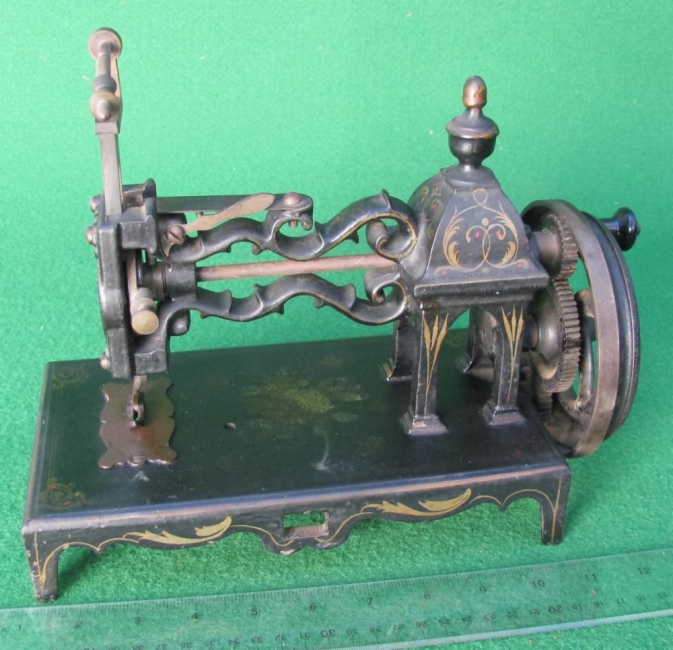 Shaw
& Clark Open Pillar Sewing Machine / Biddeford, Maine
The several different models of vintage sewing machines
produced by this Maine company are some of the best known and most actively
sought after of all antique sewing machines from the early era of production
in the mid to late 1800's. Shaw & Clark put out a half dozen or so different
models over the years, and they have come to be referred to by nicknames that
attempt to describe their distinguishing feature. This example is known
as Shaw & Clark's "closed pillar" model. (As an aside, there are also
the "open pillar", the "fire hydrant", the "skinny pillar", and a few more variations.)
This is the hard to find Open Pillar.
Shaw
& Clark Open Pillar Sewing Machine / Biddeford, Maine
The several different models of vintage sewing machines
produced by this Maine company are some of the best known and most actively
sought after of all antique sewing machines from the early era of production
in the mid to late 1800's. Shaw & Clark put out a half dozen or so different
models over the years, and they have come to be referred to by nicknames that
attempt to describe their distinguishing feature. This example is known
as Shaw & Clark's "closed pillar" model. (As an aside, there are also
the "open pillar", the "fire hydrant", the "skinny pillar", and a few more variations.)
This is the hard to find Open Pillar.
Very Good
. . . . .$2495.00 SOLD
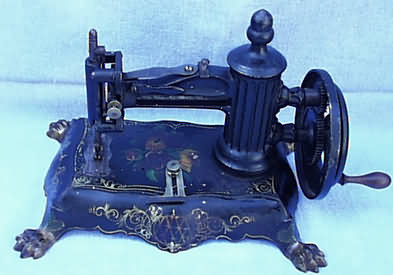 Paw
Foot Cast Iron Sewing Machine by Shaw & Clark
This style
of sewing machine, circa 1860-70, is generally attributed to the Shaw
& Clark Co. of Biddeford, Maine or assorted other New England manufacturers.
There are many interesting variations in the design of these machines that exist,
but all utilize a revolving hook chain-stitch mechanism and a walking presser
foot. This example features a ribbed fire hydrant style body topped with
an acorn-shaped finial. There is still a good amount of original black
paint and colorful floral / gold scroll decoration remaining, although the base
does show some minor areas of surface rust. The spool holder on this example
is missing, but still a good one to add to the collection.
Paw
Foot Cast Iron Sewing Machine by Shaw & Clark
This style
of sewing machine, circa 1860-70, is generally attributed to the Shaw
& Clark Co. of Biddeford, Maine or assorted other New England manufacturers.
There are many interesting variations in the design of these machines that exist,
but all utilize a revolving hook chain-stitch mechanism and a walking presser
foot. This example features a ribbed fire hydrant style body topped with
an acorn-shaped finial. There is still a good amount of original black
paint and colorful floral / gold scroll decoration remaining, although the base
does show some minor areas of surface rust. The spool holder on this example
is missing, but still a good one to add to the collection.
Good+
. . . . .$750.00 SOLD
Foley & Williams
"Practical" Round Wooden Sewing Machine
This is a rare variation of
the more commonly seen Triumph Sewing Machine that was made by the same manufacturer
Foley & Williams back near the turn of the century. That is not, by any
means, to say that the Triumph is a common machine, but over the years, if we
have seen 50 or owned a handful of those, this is only the second one of the
Practical we have ever had the opportunity to buy or offer for sale.
If you are not familiar with the design, the entire body and base are made of
wood, and this is typically referred to as the doughnut machine. There
is a metal frame on the backside to reinforce this.
The missing
paint and finish on the base is simply honest wear from where this machine was
clamped to the table during use. At different periods, machines like this
were marketed as either toys for the child to learn and practice on, or they
were also marketed as travel machines for use in the summer home or on trips
to do simple mending. This machine is in very nice condition noting the
base . The removable piece of the circle, on the left, and pin to hold
it, are present and original. A difficult to find machine!
Very Good
. . . . .$1450.00 SOLD
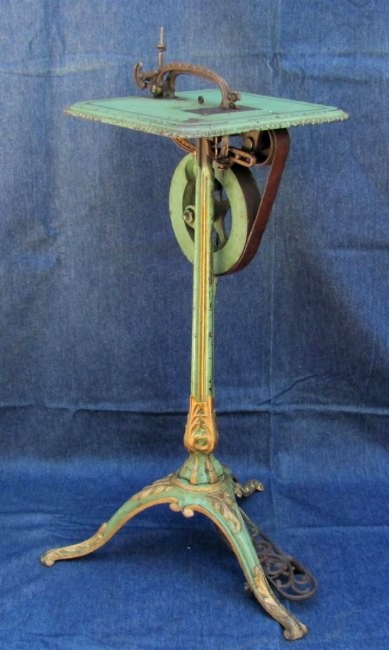 Pratt Patent
"Ladies Companion" Patent 1857 Sewing Machine Samuel
F. Pratt of Massachusetts was granted 2 different patents in 1857 - 1858 for
machines of this type.The serial # on this exceptional condition
example is 110. The sew plate is
stamped with just the earlier Feb 3 1857 date. Both patents are easily found on
Google.
In her Smithsonian-sponsored book on sewing machines Grace Cooper has a
section on the historical significance of this machine and its inventor
Samuel F. Pratt of Massachusetts.
Pratt Patent
"Ladies Companion" Patent 1857 Sewing Machine Samuel
F. Pratt of Massachusetts was granted 2 different patents in 1857 - 1858 for
machines of this type.The serial # on this exceptional condition
example is 110. The sew plate is
stamped with just the earlier Feb 3 1857 date. Both patents are easily found on
Google.
In her Smithsonian-sponsored book on sewing machines Grace Cooper has a
section on the historical significance of this machine and its inventor
Samuel F. Pratt of Massachusetts.
It has been suggested that this machine was
only marketed for a couple of years, and there are just a handful known,
including one in the Ford Museum in Dearborn, Michigan. Most sewing
machine collectors have
never seen one much less had an opportunity to purchase one.
This rare antique sewing
machine is in exceptional all-original condition with no breaks, cracks or
condition issues. It stands approx. 28" tall, and the table is 12"
square. The original green finish is well over 90% and the gold
highlights are super. It still has its original leather drive belt,
and the operation is flawless.
An opportunity to own one of
the rarest of all American Patented Sewing Machines, a piece of American
history and true
Americana that may well never be available again. Rare and Nice!!
Good + . . . . . . . SOLD!!
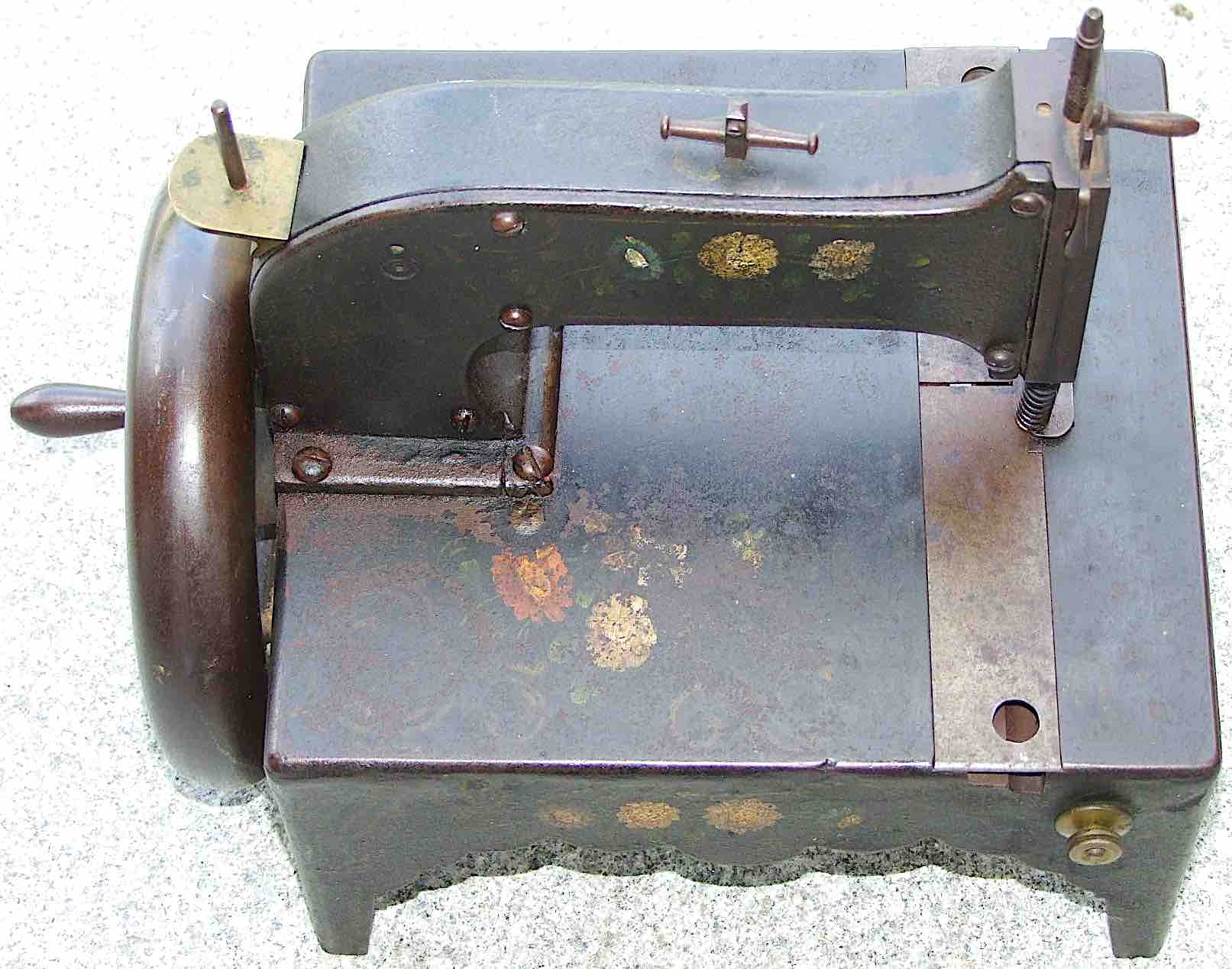 Charles A. Durgin Patent Sewing Machine This
is a very rare, and probably unique, pre Civil War era sewing machine.
It incorporates a shuttle mechanism to make a two thread stitch that was a very advanced idea for a
sewing machine patented this early. Charles A. Durgin was granted his patent
on May 22 1855. The patent # is 12902. The patent shows a later
looking two arm sewing machine, but does mention the use of a shuttle to
create a two thread stitch. Charles Durgin was from New York, New York
when the patent was first issued. According to Google
Patents the patent was reissued on June 15th 1858 and again gives the
location as New York.
Charles A. Durgin Patent Sewing Machine This
is a very rare, and probably unique, pre Civil War era sewing machine.
It incorporates a shuttle mechanism to make a two thread stitch that was a very advanced idea for a
sewing machine patented this early. Charles A. Durgin was granted his patent
on May 22 1855. The patent # is 12902. The patent shows a later
looking two arm sewing machine, but does mention the use of a shuttle to
create a two thread stitch. Charles Durgin was from New York, New York
when the patent was first issued. According to Google
Patents the patent was reissued on June 15th 1858 and again gives the
location as New York. The ID plate on this machine gives Lowell Mass as the location. It is not known if this sewing machine was an earlier model or later attempt, but given the look and similarities to early Grover & Baker machines I think it is a first model of his idea and that he went to the 2 arm design for the patent application. It is a large, heavy and graphic looking sewing machine. The table measures almost 10 1/2" x 11 1/2" and the wheel dia. is approx 8" It weighs in at close to 50 lbs. Its outward look is very similar to early model Grover & Baker sewing machines from the same era. The finish is original and in overall nice condition noting minor losses. The hand painted decorations of flowers and other highlights are nicely done.
Different, RARE, and very nice!!
Good + . . . . . . . $ SOLD!!
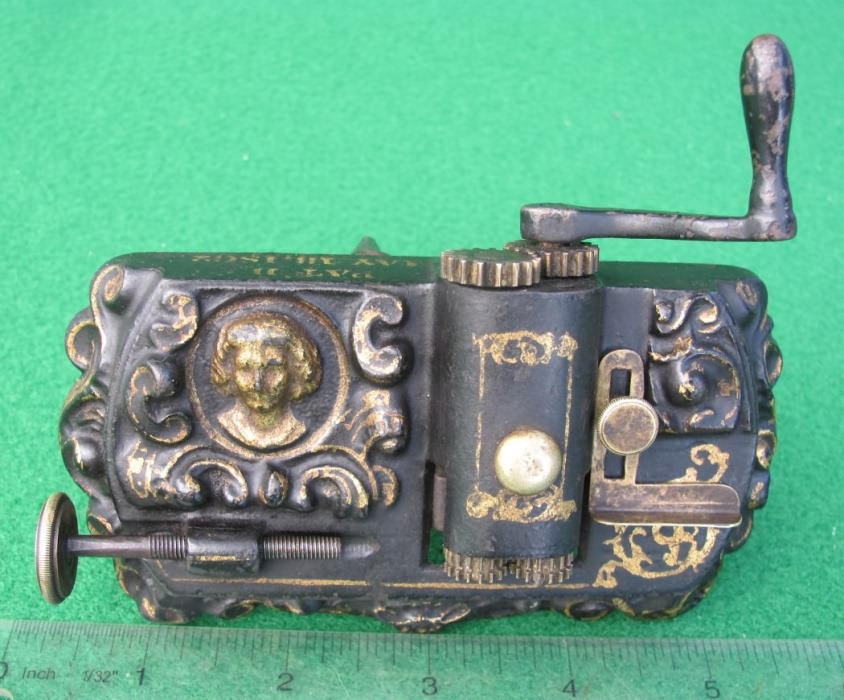 Madame Demorest
Sewing Machine Patented May 18th 1862 This interesting and early patented device was one of the first
machines to earn the title
of sewing machine, even though all it did was gather up the material and run the needle through it.
That effort would form what is known as a running stitch,
like that used for basting. There is a history of the Demorest Manufacturing Company that can be found on the internet.
That history claims the company was in business from the mid 1840's.
This machine is clearly marked with a patent drawn in 1862.
Madame Demorest
Sewing Machine Patented May 18th 1862 This interesting and early patented device was one of the first
machines to earn the title
of sewing machine, even though all it did was gather up the material and run the needle through it.
That effort would form what is known as a running stitch,
like that used for basting. There is a history of the Demorest Manufacturing Company that can be found on the internet.
That history claims the company was in business from the mid 1840's.
This machine is clearly marked with a patent drawn in 1862.
This example is in near mint condition, still exhibiting most of its original gold gilding. It is complete with its edge guide, screw feed,
and the cast
iron screw clamp that fits underneath and was used to attach it to a table edge The
patent info is along the edge. This example is slightly different than those pictured in Carter Bays' book
and there were several different variations produced.
The idea or novelty of this machine must have been appealing, as there are several other varieties of this style machine that are known. They were produced
during the same early 1860's pre-Civil War period. The copied models were probably bootleg models to try and horn in on this fellow's "wonderful"
idea and profit margin. The most commonly seen is the "Family Gem", which is pretty much an exact copy minus the lady head cast into the body.
It does carry the same patent dates.
It is amazing that one could find anybody to buy one of these as they are such a silly idea. I would bet that I could beat this machine's output with a
needle and thread in hand, and I cannot sew, but that is the sort of thing that makes for great collectibles. This "sewing machine" is an important
link in the development of the early American sewing machine and they are very graphic and beautiful in form. These are not offered very often, and
are quite hard to find in this nice condition these days. Highly recommend!
Fine + . . . . . . .$1250.00 SOLD!!
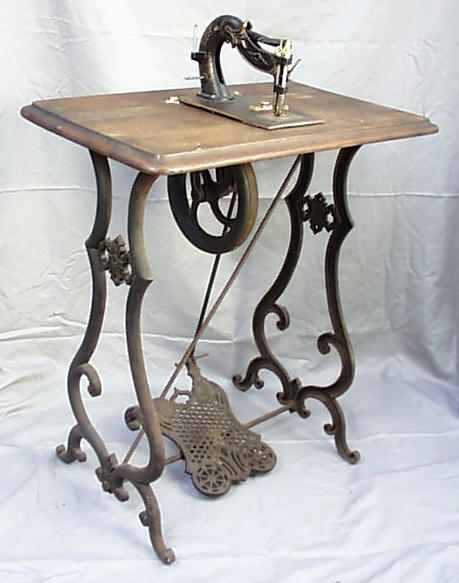 Rare
1860's Patent Williams & Orvis Treadle Sewing Machine Williams & Orvis
was a Boston-based company that manufactured sewing machines for just a few
short years from 1858 to the mid 1860's, according to the Smithsonian book on
antique sewing machines by Grace Rogers Cooper. Examples of this machine
are few and far between and this example is the first one we have ever owned
or offered. This version is known as the second model, and it features
a wonderful figural head design that resembles a dolphin or other such graceful
creature. The elegant form is especially striking because of it's petite
size. This treadle machine is unusual in that it is friction-driven, utilizing
a large flywheel that is mounted underneath. Rather than being attached
to the machine with a belt, the flywheel presses against a rubber ring that
is fastened directly to the machine's drive-wheel. This example still
retains much of the gilt decoration that is so often worn off of these early
machines. And if you look closely you can still make out the manufacturer's
name and location in the gold lettering that appears at the base of the arm.
The stitchplate is clearly marked "Patent Applied For". The finish is
no doubt in such nice condition due to the fact that the wooden hood or cover
has remained intact with the machine. The decorative cast iron treadle
stand is in excellent condition as well, with no cracks or breaks in the casting.
The pin that attaches the rod to the treadle plate has been replaced with a
nail which could easily be changed out if wanted. This is a hard-to-find
early patented sewing machine in outstanding condition.
Rare
1860's Patent Williams & Orvis Treadle Sewing Machine Williams & Orvis
was a Boston-based company that manufactured sewing machines for just a few
short years from 1858 to the mid 1860's, according to the Smithsonian book on
antique sewing machines by Grace Rogers Cooper. Examples of this machine
are few and far between and this example is the first one we have ever owned
or offered. This version is known as the second model, and it features
a wonderful figural head design that resembles a dolphin or other such graceful
creature. The elegant form is especially striking because of it's petite
size. This treadle machine is unusual in that it is friction-driven, utilizing
a large flywheel that is mounted underneath. Rather than being attached
to the machine with a belt, the flywheel presses against a rubber ring that
is fastened directly to the machine's drive-wheel. This example still
retains much of the gilt decoration that is so often worn off of these early
machines. And if you look closely you can still make out the manufacturer's
name and location in the gold lettering that appears at the base of the arm.
The stitchplate is clearly marked "Patent Applied For". The finish is
no doubt in such nice condition due to the fact that the wooden hood or cover
has remained intact with the machine. The decorative cast iron treadle
stand is in excellent condition as well, with no cracks or breaks in the casting.
The pin that attaches the rod to the treadle plate has been replaced with a
nail which could easily be changed out if wanted. This is a hard-to-find
early patented sewing machine in outstanding condition.
Excellent . . . . .$2450.00 SOLD
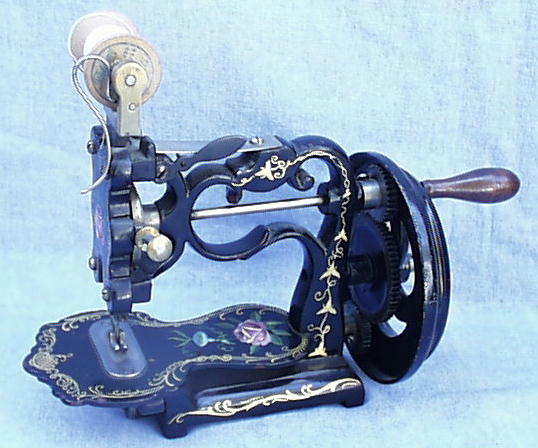 New England Style
Patented Antique Sewing Machine
These are a very early design. They are also very common and were made
for a long time under a number of names. What is uncommon is to
find them in nice condition. It is one of the nicest
we have seen!
New England Style
Patented Antique Sewing Machine
These are a very early design. They are also very common and were made
for a long time under a number of names. What is uncommon is to
find them in nice condition. It is one of the nicest
we have seen!
Excellent . . . . .$650.00 SOLD
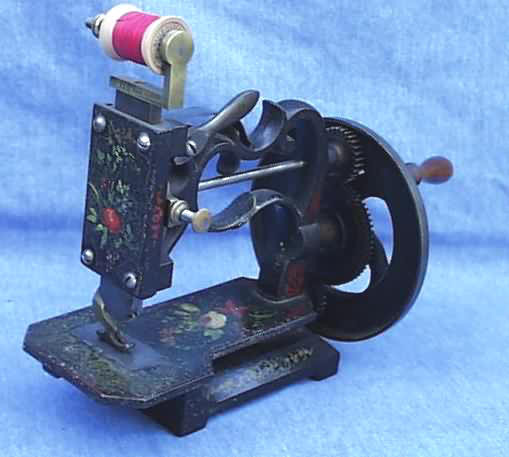 1858
Patent New England Style Sewing Machine
These antique sewing machines
are commonly referred to as New England-styles, and were actually made
by many different manufacturers both here in the US, Canada and in England,
where they were known as the Weir. These machines feature an unusual "walking"
presser foot to move the fabric along from above, rather than the more typical
underneath feed-dog mechanism. This particular example has been in our
collection for some time, as we were intrigued by the design and decoration.
Generally they are done in floral designs, and this one is also on the base,
but the end plate has what appears to be a tomato, grapes, and cherries.
The condition of the paint is super. So many of these machines are worn
almost completely bare, but not this example. It is one of the nicest
we have seen!
1858
Patent New England Style Sewing Machine
These antique sewing machines
are commonly referred to as New England-styles, and were actually made
by many different manufacturers both here in the US, Canada and in England,
where they were known as the Weir. These machines feature an unusual "walking"
presser foot to move the fabric along from above, rather than the more typical
underneath feed-dog mechanism. This particular example has been in our
collection for some time, as we were intrigued by the design and decoration.
Generally they are done in floral designs, and this one is also on the base,
but the end plate has what appears to be a tomato, grapes, and cherries.
The condition of the paint is super. So many of these machines are worn
almost completely bare, but not this example. It is one of the nicest
we have seen!
Excellent . . . . .$450.00 SOLD
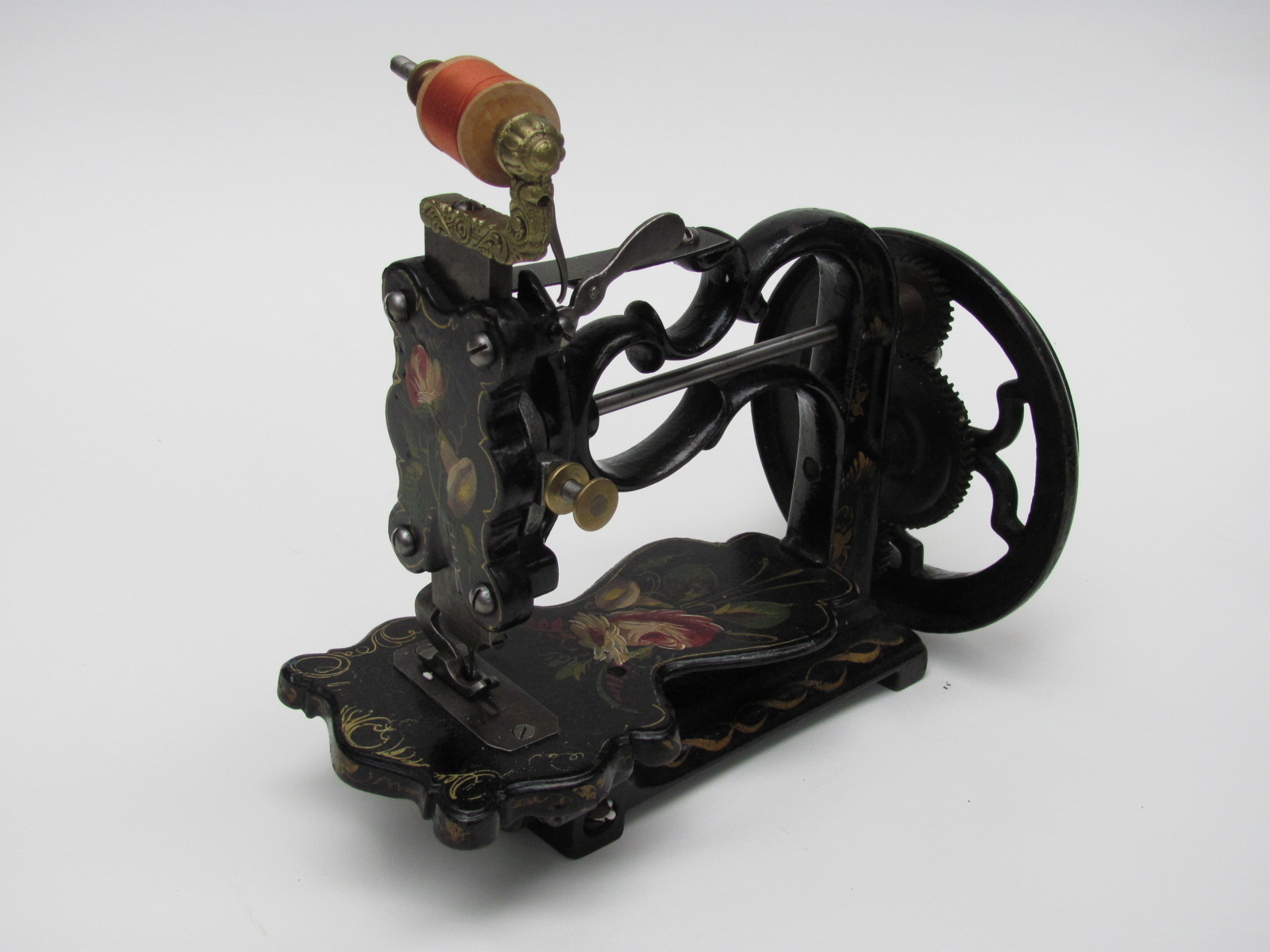 New England Style
Patented Sewing Machine The condition of this machine is very good with nearly all the
original black paint remaining. There is no rust or corrosion to the metal parts.
It has a lot of gold highlighting and floral decorations on the end plate and
bed. An interesting machine you do not find every day and certainly
not in this nice condition.
New England Style
Patented Sewing Machine The condition of this machine is very good with nearly all the
original black paint remaining. There is no rust or corrosion to the metal parts.
It has a lot of gold highlighting and floral decorations on the end plate and
bed. An interesting machine you do not find every day and certainly
not in this nice condition. Good + . . . . . . .$595.00 SOLD!
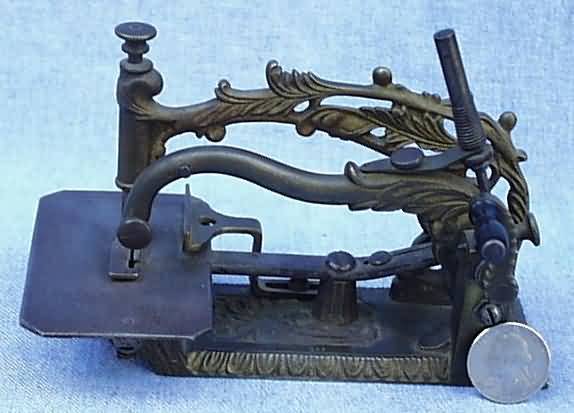 Rare
"Foliage" Figural Sewing Machine
This rare and unusual antique
sewing machine was manufactured by D. W. Clark of Bridgeport, CT. It was
patented in 1858 and produced for just a few short years, which explains why
so very few of them are ever seen except in long-time collections. (Several
years ago one came up for sale at a German auction house and brought just over
$7K.) Although often referred to as being cast brass it is actually made
of a material known as gunmetal, a harder and stronger brass-type alloy.
With its diminutive size---it measures only about 6" across and 4" high---and
its appealing foliage-like casting design, it is undoubtedly one of the most
graphic and beautifully designed of all antique sewing machines ever produced,
large or small. This example is in excellent condition and completely
original. The patent information is clearly stamped on the underside.
An early and historically significant American patented sewing machine!
Rare
"Foliage" Figural Sewing Machine
This rare and unusual antique
sewing machine was manufactured by D. W. Clark of Bridgeport, CT. It was
patented in 1858 and produced for just a few short years, which explains why
so very few of them are ever seen except in long-time collections. (Several
years ago one came up for sale at a German auction house and brought just over
$7K.) Although often referred to as being cast brass it is actually made
of a material known as gunmetal, a harder and stronger brass-type alloy.
With its diminutive size---it measures only about 6" across and 4" high---and
its appealing foliage-like casting design, it is undoubtedly one of the most
graphic and beautifully designed of all antique sewing machines ever produced,
large or small. This example is in excellent condition and completely
original. The patent information is clearly stamped on the underside.
An early and historically significant American patented sewing machine!
Excellent . . . . . SOLD
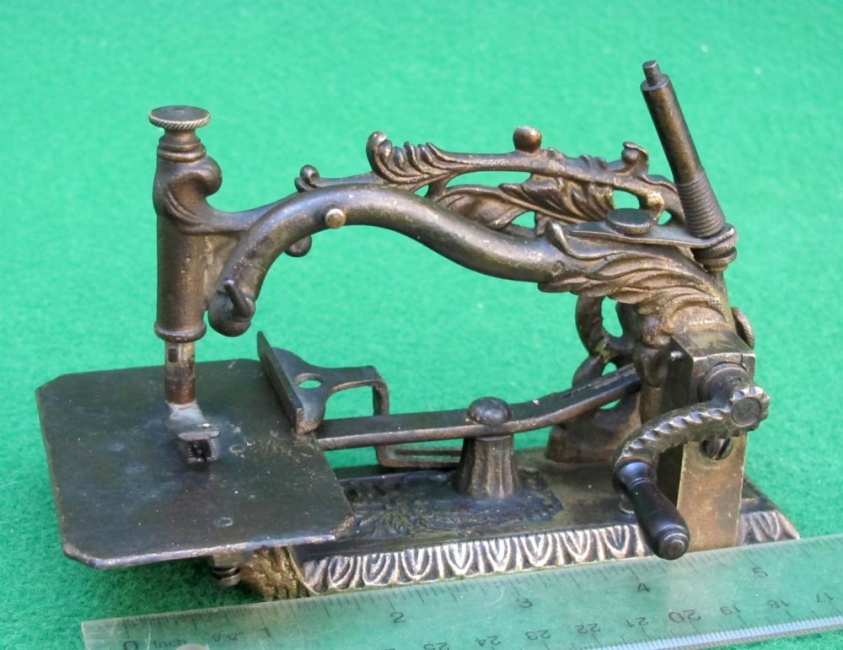 Rare
"Foliage" Figural Sewing Machine This is the third one of these I have had and sold in 30 some years.
They were the only 3 I had ever seen or heard of.
The first and least expensive was bought on eBay
and sold to a collector who never bothers to go there for a number of
reasons. The other two were consigned to me by the owners after
they had found reference on this site to the first one I had sold.
I can help you sell your as well.
Rare
"Foliage" Figural Sewing Machine This is the third one of these I have had and sold in 30 some years.
They were the only 3 I had ever seen or heard of.
The first and least expensive was bought on eBay
and sold to a collector who never bothers to go there for a number of
reasons. The other two were consigned to me by the owners after
they had found reference on this site to the first one I had sold.
I can help you sell your as well. Excellent . . . . . SOLD
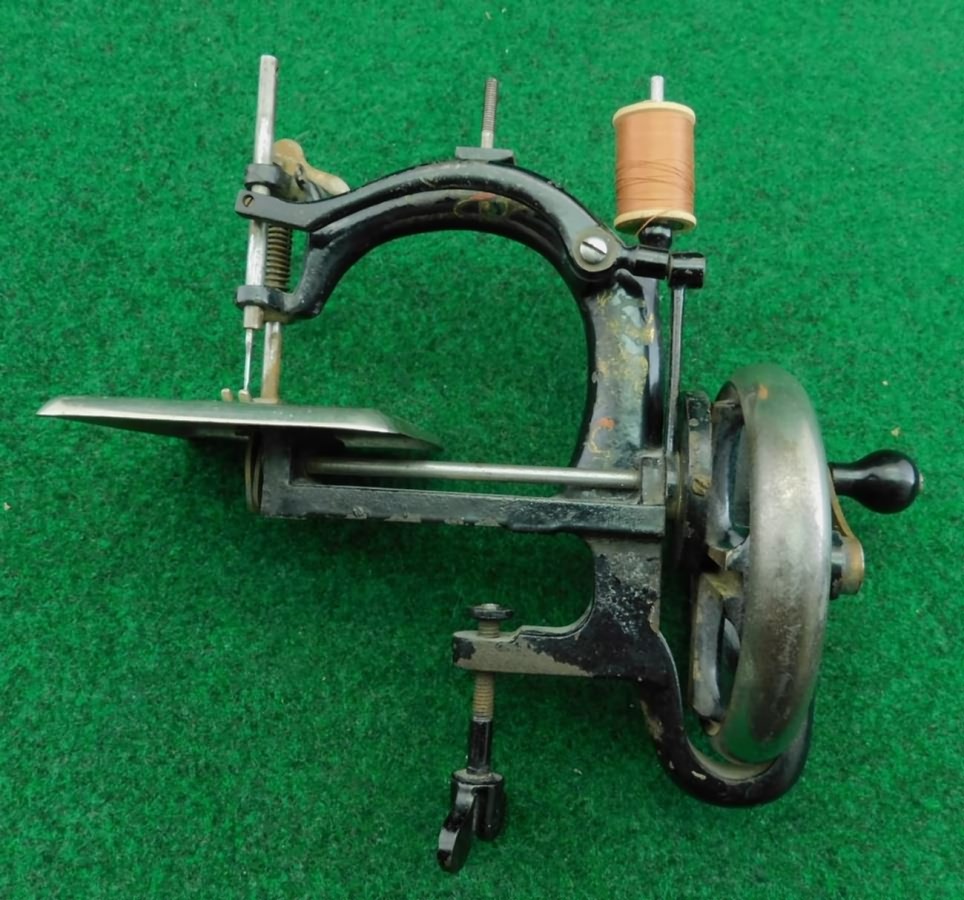 "Cute" Integral Clamp Sewing Machine Patented March 10 & 11 1886
This
small integral clamp sewing machine dates from the 1880's. It was a
short lived idea and it is thought no more than a couple - few thousand were made
and sold. They are a hard to find sewing machine and not many appear on the market. There is one pictured in Vol. II of Glenda Thomas' book on
sewing machines. That one is from a sewing machine museum in Texas. Carter Bays
pictures one in his book on sewing machines as well. This is only the second or third one
I have had or seen in 30 some years. I was able to find one old eBay
result for over $1500 for a lesser condition example.
"Cute" Integral Clamp Sewing Machine Patented March 10 & 11 1886
This
small integral clamp sewing machine dates from the 1880's. It was a
short lived idea and it is thought no more than a couple - few thousand were made
and sold. They are a hard to find sewing machine and not many appear on the market. There is one pictured in Vol. II of Glenda Thomas' book on
sewing machines. That one is from a sewing machine museum in Texas. Carter Bays
pictures one in his book on sewing machines as well. This is only the second or third one
I have had or seen in 30 some years. I was able to find one old eBay
result for over $1500 for a lesser condition example.The sew plate is marked with patent info / date of March 10 & 11 1886. Those are what are known as "bad dates" being March 10 & 11 1866 were a Wednesday and Thursday and patents were only granted on Tuesdays. I could not make any patent come up just using 1886 and sewing machine. Little other info on this machine known as the "Cute" comes up using Google and its given name. The drive mechanism is very unique with a cross design on the back of the large crank wheel and not gears typically used to drive early sewing machines like this.
Minor losses to the paint, but overall very nice condition with lots of original decoration and highlights as well. Hard to find!!
Fine . . . . . . . $1250.00 SOLD!!
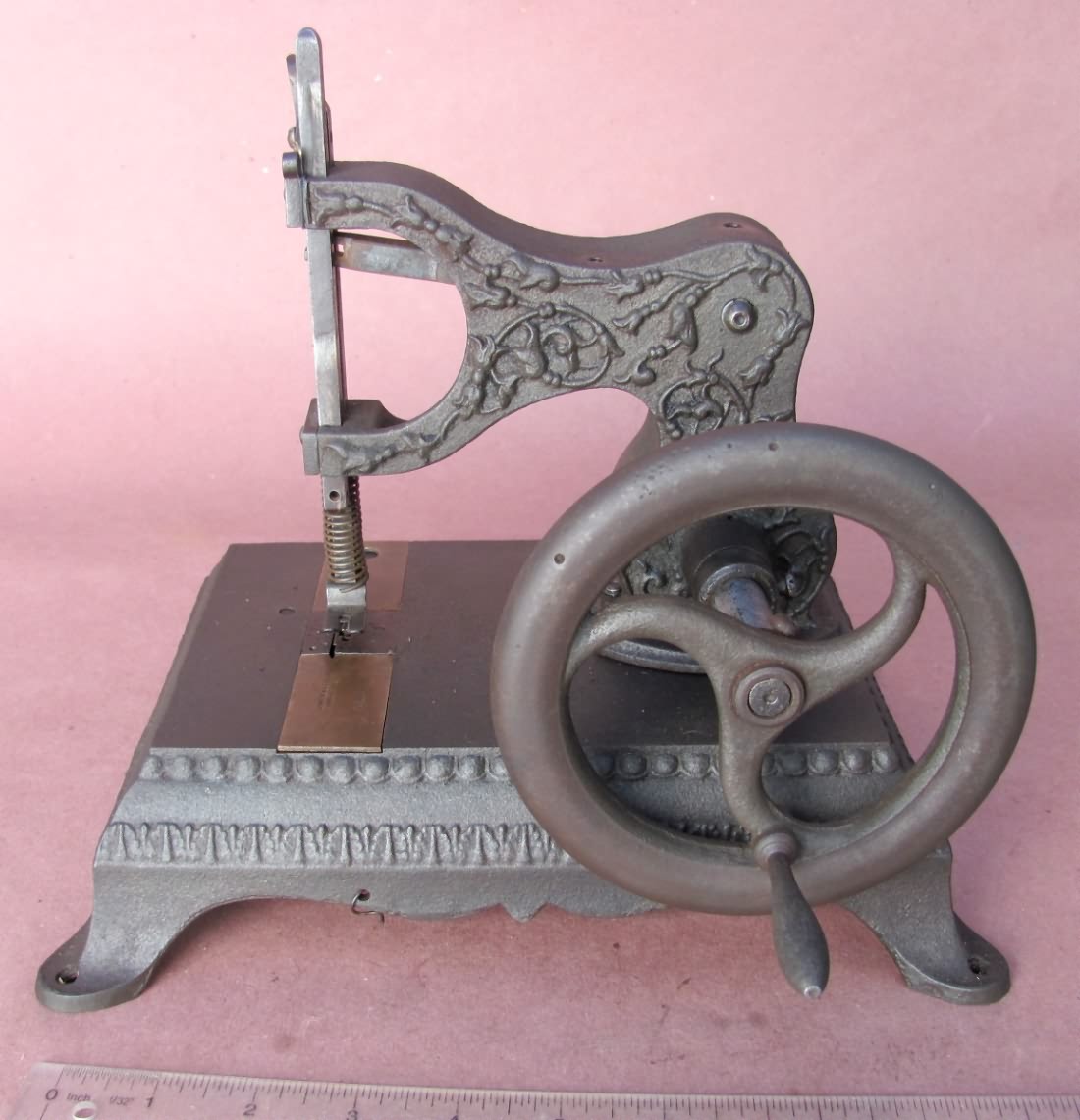 Grey Patent 1857
"Ne Plus Ultra" Sewing Machine This
is the rarest sewing machine listed on these pages. It was patented in
1857 by Joshua Grey of Boston Mass.
The 1857 patent # 16566 can be
seen at Google. That information is found on the baster plate
along with the name John Gault.
Grey Patent 1857
"Ne Plus Ultra" Sewing Machine This
is the rarest sewing machine listed on these pages. It was patented in
1857 by Joshua Grey of Boston Mass.
The 1857 patent # 16566 can be
seen at Google. That information is found on the baster plate
along with the name John Gault.Carter Bays has two later versions of this type sewing machine pictured in his book on early American sewing machines, but fails to identify the patentee or date on this earlier machine. Or give much other useful information about it.
In Grace Coopers book on early sewing machines there is a bit more info, but again speaks about later sewing machines and mis-identifies the patent holder of the early machine she pictures as having been patented by O. L. Reynolds. This is because her machine is missing the brass baster plate that this sewing machine has with the correct patent info with Grey's name and the date on it in front of the needle. The sewing machine shown in her book is serial # 26 and has the same body casting as this one. She gives information from a later machine with serial #110 she had access to that carries a later March 30th 1858 patent date. The 1858 patent shows machines w/ a different style base, similar to those machines pictured in Bays' book.
This machine is serial #21, and has the earlier, and correct patent info on the baster plate that the sewing machine Cooper pictures is missing. The patentees name, Grey, and 1857 date are earlier and different from any of the info she gives. Mr. Grey, the patent holder of this machine, is not mentioned in either Bays or Cooper's book. I assume Mr. Grey ran out of money and sold the rights to O. L. Reynolds, who re-submitted a later machine for a patent with some small change or "improvement" . You can read his 1858 patent # 19793 using a Google search. That, I believe, makes this the earliest known and one of but a handful of this rare patented sewing machine that has ever turned up.
The machine has almost no finish on it, but is not heavily rusted or pitted. It actually looks quite nice. One small piece of one paw foot has some damage as shown in the pics. The main arm driving the needle bar in the rear has a proper and period looking repair along the length of that. The rear of the machine is open by design with the inner workings exposed, and is correct as shown. It has a great action and sound to it as it click clacks away when the crank is turned. The thread catch and looper mechanism below the base are all present and operate as they should. It is a very simple but elegant design solution to picking up and sewing a chain stitch. The spool pin is missing, and every machine I have seen has a different style one, so replacing that will be an easy fix.
A rare opportunity!! Highly recommended!!
Good . . . . . . . . $ SOLD!!
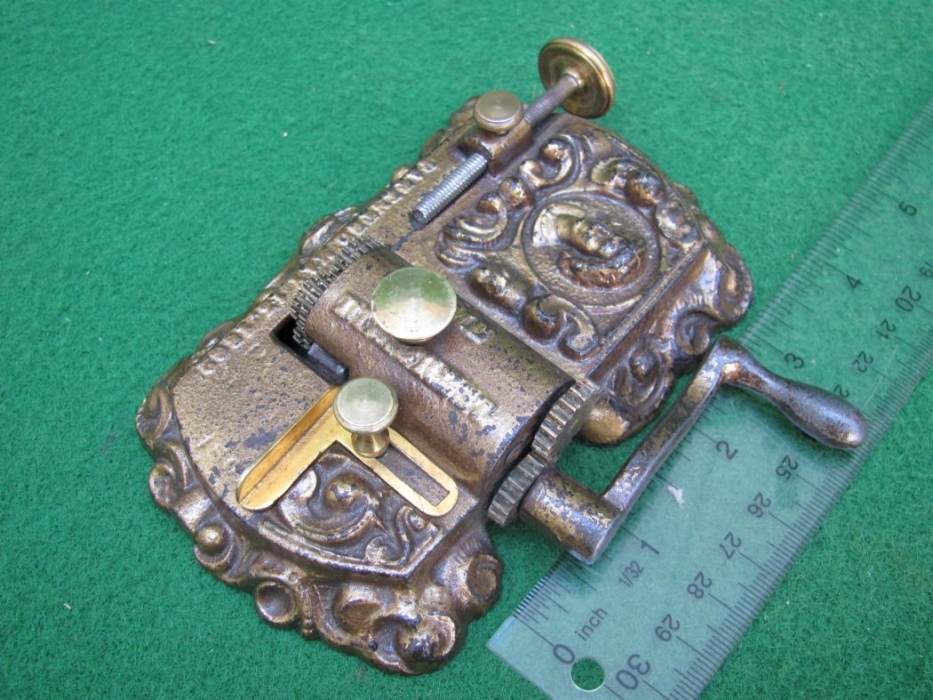 Madame Demorest Sewing Machine
This interesting and early patented device was one of the first
machines to earn the title of sewing machine, even though all they did was gather up the material and run the needle through it, thus
forming what is known as a running stitch, like that used for basting. There is a history of the
Demorest Manufacturing Company that can be
found on the internet. That history claims the company was in business
from the mid 1840's.
Madame Demorest Sewing Machine
This interesting and early patented device was one of the first
machines to earn the title of sewing machine, even though all they did was gather up the material and run the needle through it, thus
forming what is known as a running stitch, like that used for basting. There is a history of the
Demorest Manufacturing Company that can be
found on the internet. That history claims the company was in business
from the mid 1840's. This example is in near mint condition, still exhibiting most of its original gold gilding. It is complete with its edge guide, screw feed, a small package marked needle that contains a broken needle, and the top of the original box with instructions on the inside of the lid. The cast iron screw clamp that fits underneath is damaged but present. It can be repaired. There is info cast into the body in a couple locations. It is hard to make out because the original gold paint is applied so heavily, but it is marked "Patented May 13, 1862" along the edge and "Mme. Demorest" on the center top. This example is slightly different than those pictured in Carter Bays' book.
The idea behind this machine must have been appealing, as there are several other varieties of this style machine that are known. They were produced during the same early 1860's pre-Civil War period. The copied models were probably bootleg models to try and horn in on this fellow's "wonderful" idea and profit margin. The most commonly seen is the "Family Gem", which is pretty much an exact copy minus the lady head cast into the body. It does carry the same patent dates.
It is amazing that one could find anybody to buy one of these as they are such a silly idea. I would bet that I could beat this machine's output with a needle and thread in hand, and I cannot sew, but that is the sort of thing that makes for great collectibles. This "sewing machine" is an important link in the development of the early American sewing machine and they are very graphic and beautiful in form. These are not offered very often, and are quite hard to find these days. Highly recommend!
Fine . . . . . . .$1750.00 SOLD!!
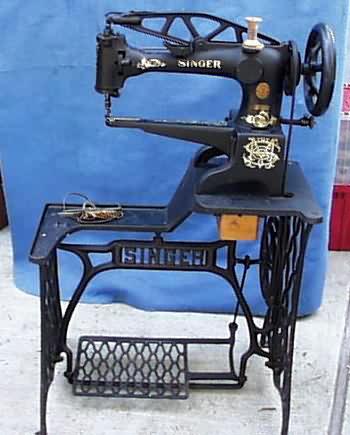 Singer
29-4 Leatherworkers Treadle Sewing Machine
The
Singer 29-4 was designed and developed for a host of trades dealing with leather
or other heavy material. With its freearm design and rotating head it had the
ability to do a myriad of tasks put in front of it. This machine is in as nice
condition as you could want. After a thorough inspection and light cleaning
I found no casting problems in the base, body or head. And I believe this machine
to be 100% ready to go. It operates effortlessly and flawlessly, even for a
novice sewer like me. The range of speeds with simple foot action on the treadle
is amazing. Also included is an auxiliary table for flatwork that the previous
owner made, and a drawer which I believe is original, full of spools and other
misc. Shipping will be at cost and I will break it down as far as you want or
ship it via Craters and Freighters, or however you want. The condition of this
workhorse of a sewing machine is superb, and it will be a long time before you
see one as nice as this one again.
Singer
29-4 Leatherworkers Treadle Sewing Machine
The
Singer 29-4 was designed and developed for a host of trades dealing with leather
or other heavy material. With its freearm design and rotating head it had the
ability to do a myriad of tasks put in front of it. This machine is in as nice
condition as you could want. After a thorough inspection and light cleaning
I found no casting problems in the base, body or head. And I believe this machine
to be 100% ready to go. It operates effortlessly and flawlessly, even for a
novice sewer like me. The range of speeds with simple foot action on the treadle
is amazing. Also included is an auxiliary table for flatwork that the previous
owner made, and a drawer which I believe is original, full of spools and other
misc. Shipping will be at cost and I will break it down as far as you want or
ship it via Craters and Freighters, or however you want. The condition of this
workhorse of a sewing machine is superb, and it will be a long time before you
see one as nice as this one again.
Good+ . . . . . . .$495.00 SOLD
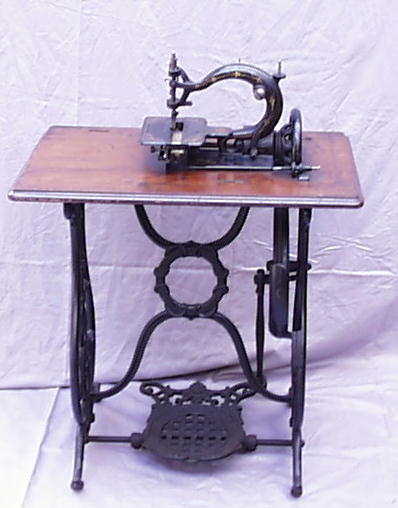 Secor
Treadle Sewing Machine
This early and unusual treadle sewing
machine was produced during the 1870's. According to Grace Cooper's book
The Invention of the Sewing Machine she has found entries for this company
only from 1870-1876 before their entries disappeared from the directories. Carter
Bays estimates that this company only produced 10,000 or so of this style of
machine. There are some different variations known in the table styles,
but the machine and the treadle base are usually as seen here. Carter
Bays says in his book that this company was from Bridgeport, Connecticut, but
the basket weave design foot pedal on this treadle says the "Secor S.M. Co.
New York" around the border. The overall condition of this piece is very nice.
There is a lot of original finish and decoration left on the machine itself.
There is one sliding plate over the shuttle that is missing but this minor to
the overall effect. The base is nice and there are no breaks or repairs
in the ironwork in this area. The wooden cover is proper and has
had a positive effect in maintaining the nice condition of the rest of the machine.
Secor
Treadle Sewing Machine
This early and unusual treadle sewing
machine was produced during the 1870's. According to Grace Cooper's book
The Invention of the Sewing Machine she has found entries for this company
only from 1870-1876 before their entries disappeared from the directories. Carter
Bays estimates that this company only produced 10,000 or so of this style of
machine. There are some different variations known in the table styles,
but the machine and the treadle base are usually as seen here. Carter
Bays says in his book that this company was from Bridgeport, Connecticut, but
the basket weave design foot pedal on this treadle says the "Secor S.M. Co.
New York" around the border. The overall condition of this piece is very nice.
There is a lot of original finish and decoration left on the machine itself.
There is one sliding plate over the shuttle that is missing but this minor to
the overall effect. The base is nice and there are no breaks or repairs
in the ironwork in this area. The wooden cover is proper and has
had a positive effect in maintaining the nice condition of the rest of the machine.
This is the same company that is so well known for producing the small integral clamp Fairy Sewing Machine from a slightly later era. (You can see one of these small sewing machines pictured on our collection pages.) This is a rare and seldom seen machine. The condition of this machine is great given that they were designed to be used day in and day out, and oftentimes were. This is the first of this style machine we have ever had the pleasure to own or to offer for sale. An opportunity that well might not present itself again anytime soon.
Excellent . . . . . . . SOLD
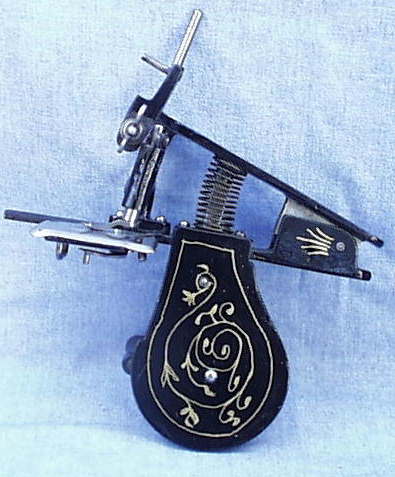 Early
Patented Beckwith Clamp-On Sewing Machine
Patented in 1871 by the American inventor
William G. Beckwith, this extremely hard-to-find antique sewing machine is on
top of the "wish list" of many avid sewing machine collectors, and it is no
wonder. The design of this sewing machine is unlike that of any other,
and its period of manufacture was only a few short years. It was marketed
as an actual home sewing and mending machine, not as a toy, but its diminutive
size of approximately 7" x 7" x 5" and its unusual looks make it a favorite
among toy sewing machine collectors as well. This example is in excellent
mechanical condition with a restored paint job. There are a couple of
minor dings on the metal stitchplate, but given the rarity of this machine these
notations on condition are of little consequence and do not detract nor take
away from the historical significance of this machine.
Early
Patented Beckwith Clamp-On Sewing Machine
Patented in 1871 by the American inventor
William G. Beckwith, this extremely hard-to-find antique sewing machine is on
top of the "wish list" of many avid sewing machine collectors, and it is no
wonder. The design of this sewing machine is unlike that of any other,
and its period of manufacture was only a few short years. It was marketed
as an actual home sewing and mending machine, not as a toy, but its diminutive
size of approximately 7" x 7" x 5" and its unusual looks make it a favorite
among toy sewing machine collectors as well. This example is in excellent
mechanical condition with a restored paint job. There are a couple of
minor dings on the metal stitchplate, but given the rarity of this machine these
notations on condition are of little consequence and do not detract nor take
away from the historical significance of this machine.
Very Good . . . . . . .$495.00 SOLD
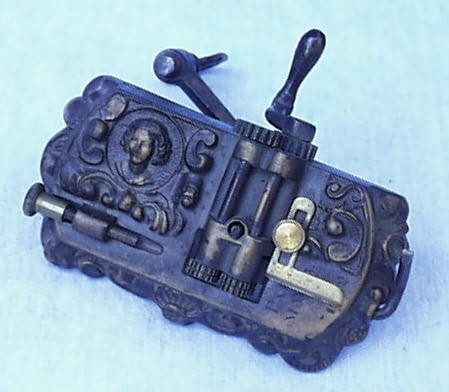 The
Madame Demorest Sewing Machine
These interesting and early patented sewing machines
or devices were one of the first to earn the title of sewing machine even
though all they did was to gather up the material and run the needle through
it thus forming what is known as a running stitch, like that used for basting.
The idea must have been appealing, as there are several other varieties of these
that are known which were produced during the same period, and these were probably
bootleg models to try and horn in on this fellow's "wonderful" idea and profit
margin. It is amazing that he could find anybody to buy them as they are
such a silly idea. I would bet that I could beat this thing's output,
and I cannot sew, but that is the sort of thing that makes for great collectibles.
In any case they are an important link in the development of the early American
sewing machine story and they are very graphic and beautiful in form.
This one is in near mint condition still exhibiting most of its gilding.
It is complete with its edge guide, screw feed and the clamp underneath that
is oftentimes missing. These are not offered very often, and are quite
hard to find these days. We are letting it go to make room for a couple
of new acquisitions to our collection we have managed to turn up. Can't
keep them all. Now its your turn to take care of it.
The
Madame Demorest Sewing Machine
These interesting and early patented sewing machines
or devices were one of the first to earn the title of sewing machine even
though all they did was to gather up the material and run the needle through
it thus forming what is known as a running stitch, like that used for basting.
The idea must have been appealing, as there are several other varieties of these
that are known which were produced during the same period, and these were probably
bootleg models to try and horn in on this fellow's "wonderful" idea and profit
margin. It is amazing that he could find anybody to buy them as they are
such a silly idea. I would bet that I could beat this thing's output,
and I cannot sew, but that is the sort of thing that makes for great collectibles.
In any case they are an important link in the development of the early American
sewing machine story and they are very graphic and beautiful in form.
This one is in near mint condition still exhibiting most of its gilding.
It is complete with its edge guide, screw feed and the clamp underneath that
is oftentimes missing. These are not offered very often, and are quite
hard to find these days. We are letting it go to make room for a couple
of new acquisitions to our collection we have managed to turn up. Can't
keep them all. Now its your turn to take care of it.
Good . . . . .$1295.00 SOLD
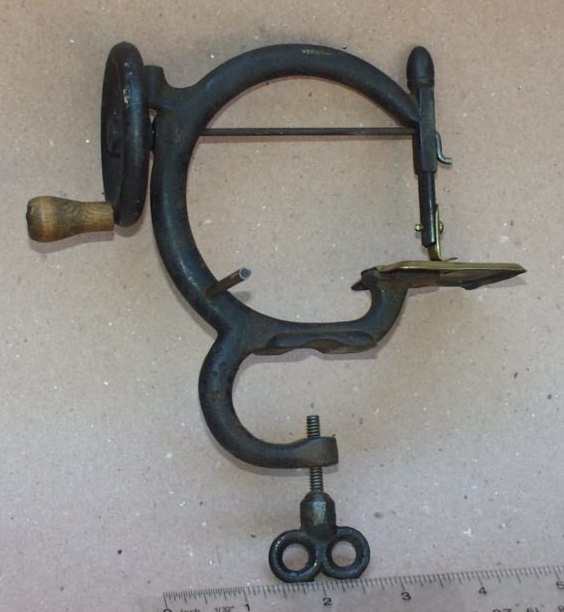 Early
Hancock Style / Lake Patent Integral-Clamp Antique Sewing Machine
The first sewing machines had barely been invented when Henry J. Hancock received his 1867 patent
for this unusual chain stitch machine. The design of this early sewing
machine, with its very delicate open-frame "skeleton" body and integral clamp,
is incredibly appealing. Examples of this unusual sewing machine are extremely
scarce. Hancock and Lake Patent sewing machines were only produced for 10 or so years, which explains
why they are seldom found and rarely offered for sale. For those antique
sewing machine collectors who seek out examples of the very earliest patents,
this type of sewing machine is always at the top of their "want list". There are no casting flaws or cracks in the delicate casting,
but there is considerable paint loss and the surface exhibits a dark rich
patina that one would expect from a 130-year-old antique. Likewise the brass
parts have not been polished and retain a deep mellow tone. As is generally
the case in machines the needle is missing.
Early
Hancock Style / Lake Patent Integral-Clamp Antique Sewing Machine
The first sewing machines had barely been invented when Henry J. Hancock received his 1867 patent
for this unusual chain stitch machine. The design of this early sewing
machine, with its very delicate open-frame "skeleton" body and integral clamp,
is incredibly appealing. Examples of this unusual sewing machine are extremely
scarce. Hancock and Lake Patent sewing machines were only produced for 10 or so years, which explains
why they are seldom found and rarely offered for sale. For those antique
sewing machine collectors who seek out examples of the very earliest patents,
this type of sewing machine is always at the top of their "want list". There are no casting flaws or cracks in the delicate casting,
but there is considerable paint loss and the surface exhibits a dark rich
patina that one would expect from a 130-year-old antique. Likewise the brass
parts have not been polished and retain a deep mellow tone. As is generally
the case in machines the needle is missing. Good + . . . . . . . .$950.00 SOLD
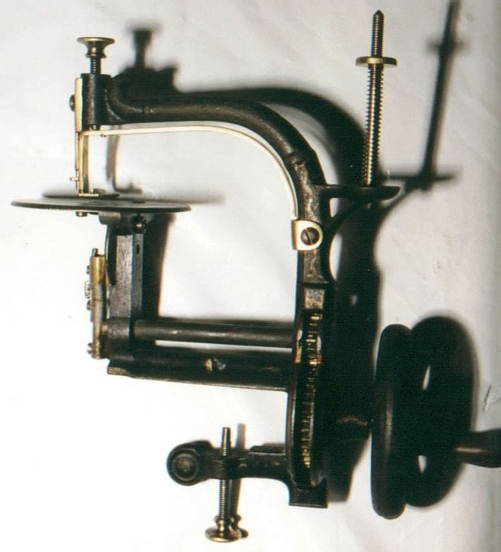 Charles
Parker Patented Integral-Clamp Sewing Machine
This is a rare sewing machine. Charles Parker
is most famous for the line of firearms and shotguns that he produced in
Meriden CT. In addition to the famous gun line he also made a
great coffee mill, and they, like the guns are much favored amongst
collectors. In addition to that he also tried his hand in the
sewing machine business. His idea literally turned the known world
on its head. The patent for his sewing machine has the needle
coming at the work from below. What a strange idea. In
addition it is a integral clamp model, another unusual feature. We
traded this for an apple peeler, and before the day was out had traded
it off again for a Patent model, and some other consideration.
Charles
Parker Patented Integral-Clamp Sewing Machine
This is a rare sewing machine. Charles Parker
is most famous for the line of firearms and shotguns that he produced in
Meriden CT. In addition to the famous gun line he also made a
great coffee mill, and they, like the guns are much favored amongst
collectors. In addition to that he also tried his hand in the
sewing machine business. His idea literally turned the known world
on its head. The patent for his sewing machine has the needle
coming at the work from below. What a strange idea. In
addition it is a integral clamp model, another unusual feature. We
traded this for an apple peeler, and before the day was out had traded
it off again for a Patent model, and some other consideration. Good + . . . . . . . TRADED AWAY
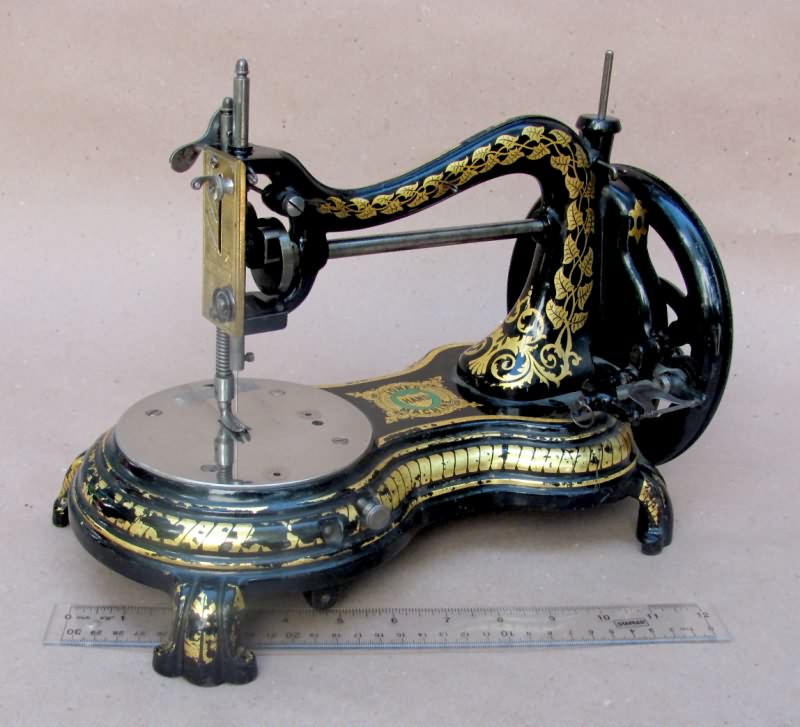 The
Jones Hand Machine / Sewing Machine
The condition of this early English sewing machine is
stunning with nearly all the
original black paint remaining and no rust or corrosion to the metal parts at
all.. It has a lot of gold highlighting and other decorations all over the body
as well. It is in like new condition and is one of the nicest examples I
have ever seen.
There has been some
minor flaking of this gold highlighting on the round portion of the sewing bed,
and the feet but it looks great..
The
Jones Hand Machine / Sewing Machine
The condition of this early English sewing machine is
stunning with nearly all the
original black paint remaining and no rust or corrosion to the metal parts at
all.. It has a lot of gold highlighting and other decorations all over the body
as well. It is in like new condition and is one of the nicest examples I
have ever seen.
There has been some
minor flaking of this gold highlighting on the round portion of the sewing bed,
and the feet but it looks great..This sewing machine known as the Hand dates from the 1870's - 1880's and was the first model produced by this firm before they changed over to a more standard looking machine with a "modern" looking head. It is typically referred to as a Serpentine or cat back with its arched style main arm. It has a great design appeal and is an interesting machine you do not find every day. This machine weighs over 20lbs, and is pretty massive. It will make a great display piece. The shuttle and bobbin are in place as well, and it could be put back into use for reenactments or other historical applications. It runs like a clock, smooth and almost effortlessly. A Super piece!!
Excellent . . . . . . .$595.00 SOLD!
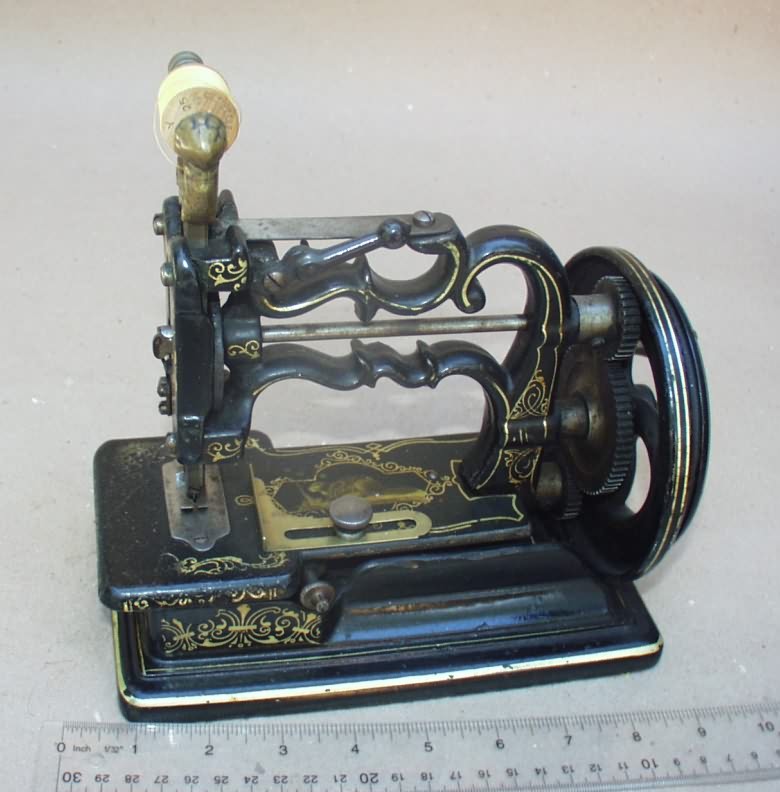 Raymond
New England Style Sewing Machine
This sewing machine has a picture decal of a
beaver and the name Raymond. There are a lot of different machines
that are generally known as "New England's" There were a series of makers
in the New England area that were known makers of the design. Raymond, and
Raymond and Nettleton were two of them. Most, or many of this style machine are
not marked in any way. Carter Bays in his book identifies machines like
this with a double curl in the lower arm and being Weir machines which are
actually from England.
Raymond
New England Style Sewing Machine
This sewing machine has a picture decal of a
beaver and the name Raymond. There are a lot of different machines
that are generally known as "New England's" There were a series of makers
in the New England area that were known makers of the design. Raymond, and
Raymond and Nettleton were two of them. Most, or many of this style machine are
not marked in any way. Carter Bays in his book identifies machines like
this with a double curl in the lower arm and being Weir machines which are
actually from England.The condition of this machine is excellent with nearly all the original black paint remaining and no rust or corrosion to the metal parts. It has a lot of gold highlighting and other decorations. An interesting machine you do not find every day.
Good + .. . . . . . .$750.00 SOLD!!
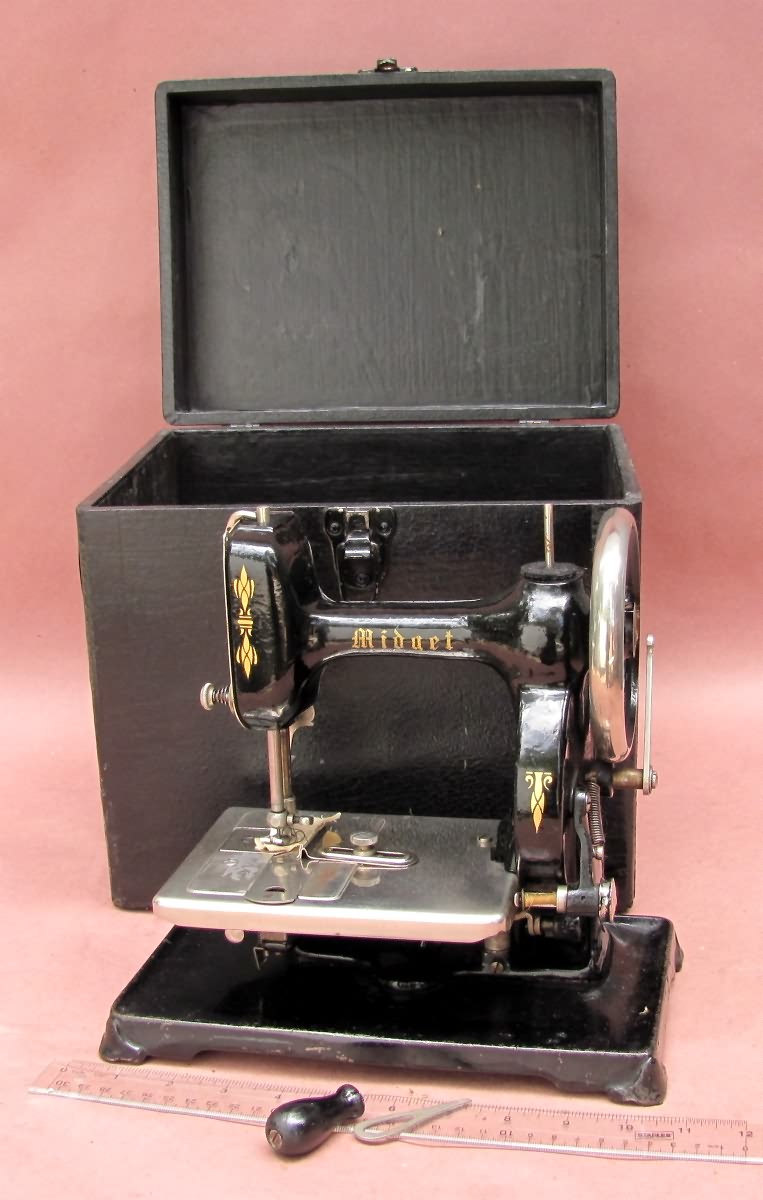 New Home "Midget" Sewing Machine The condition of this machine is very good with nearly all the
original black paint gold decals and highlighting remaining. There is no rust or corrosion to the metal parts.
The Midget is an interesting small machine that you do not find every day and certainly
not in this nice condition. It can be found with several other names
as well. It was first patented in 1911. It has a bobbin and sews
a lock stitch unlike many other toy machines, and was marketed as a full size machine despite its small size.
The box looks to be original, and is in very nice condition as well.
New Home "Midget" Sewing Machine The condition of this machine is very good with nearly all the
original black paint gold decals and highlighting remaining. There is no rust or corrosion to the metal parts.
The Midget is an interesting small machine that you do not find every day and certainly
not in this nice condition. It can be found with several other names
as well. It was first patented in 1911. It has a bobbin and sews
a lock stitch unlike many other toy machines, and was marketed as a full size machine despite its small size.
The box looks to be original, and is in very nice condition as well.
Fine . . . . . . .$250.00 SOLD!
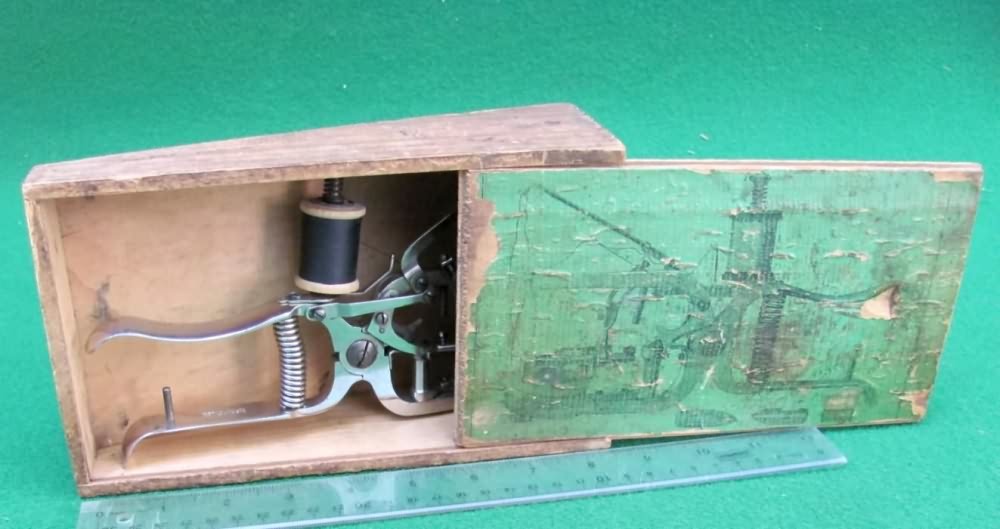 American
Hand Sewing Machine in Original Box The
condition of this machine and its original box is incredible. The
original box is pie shaped with a sliding lid and has a picture of the machine on one side and
the instructions on the other.The picture is bold and clear, and the
instructions are easily readable. Although there are minor losses the
condition of the box, being so rare and unusual, would rate as fine.
American
Hand Sewing Machine in Original Box The
condition of this machine and its original box is incredible. The
original box is pie shaped with a sliding lid and has a picture of the machine on one side and
the instructions on the other.The picture is bold and clear, and the
instructions are easily readable. Although there are minor losses the
condition of the box, being so rare and unusual, would rate as fine. In close to 30 years of dealing in Antique sewing machines I have only seen a couple of these in their boxes. One of them was mine and is pictured on our site www.AntiqBuyer.com in the information section on early machines at that site. We sold that machine a number of years ago to an advanced collector in Europe. The other was in a Christies auction about 15 years ago. The boxes for those was a rectangle and not nearly as nice as this one.
These sewing machines were patented in the late 19th century and sold primarily as travel machines. The design was patented in 1884 by Adin Barber, under 2 different numbers, 306996, and 306713. A third patent, 330195 utilized a lot of the ideas and added a clamp was granted a year later to the same inventor. There were other similar designs of this scissor / shear design sewing machine produced by Hendricks and Goodbody. I do not know if there was any connection, or if they were just competitors.
The name American Hand Sewing Machine Co. and one patent date is stamped into the inside of the handle. The design is very complex, and even includes a bobbin. It is also very fragile, another reason so few have survived. Carter Bays in his book on the subject surmises that just a couple thousand were produced over about a 10 year period and i would bet few survived in this nice condition.
A nice machine that has a great look.
Fine . . . . . . .$2450.00 SOLD!!
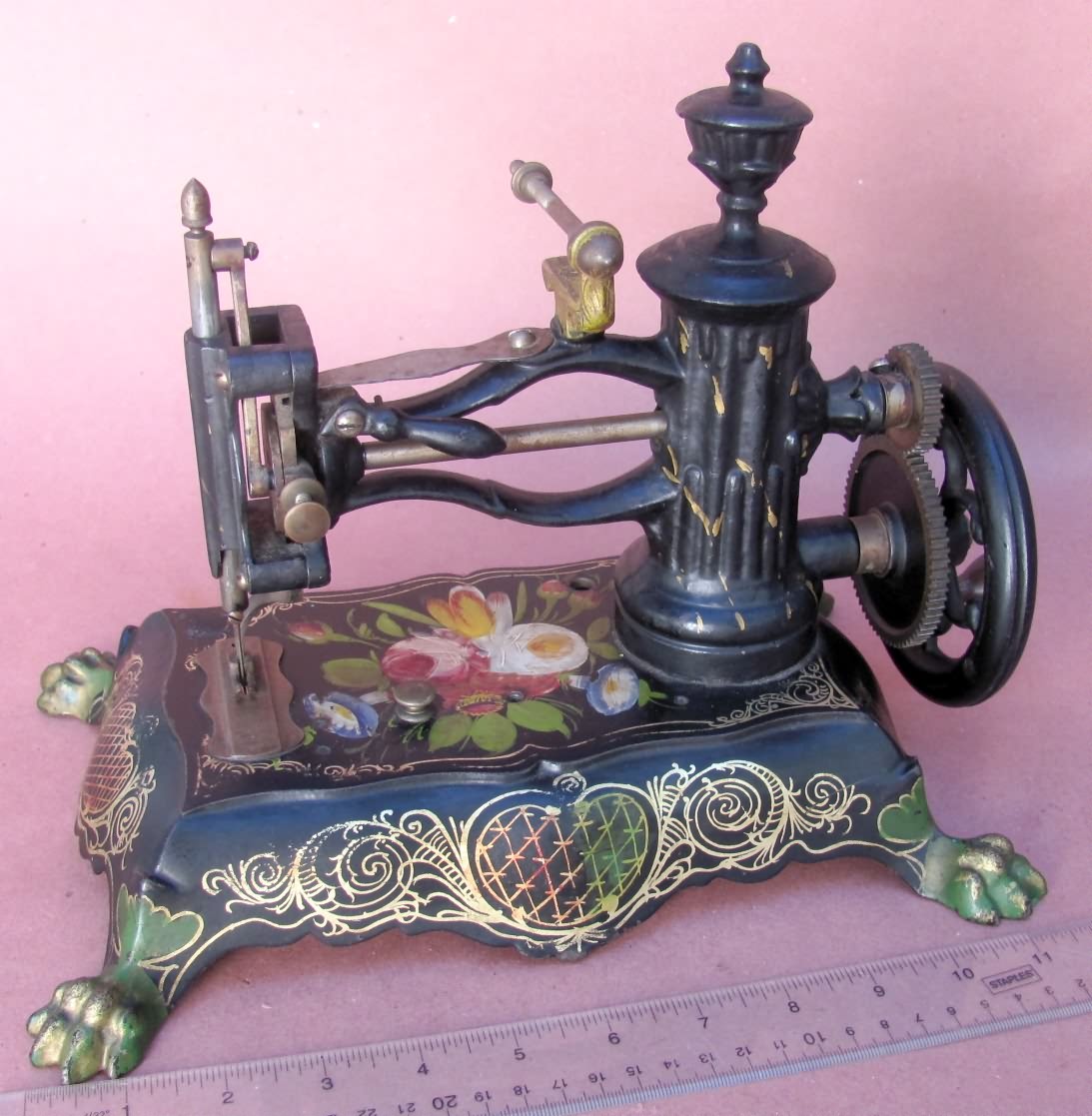 Antique Pawfoot Sewing Machine The condition of
this machine is incredible. The paint and decoration are all original
and near 100%. This style machine is generically called the Paw Foot,
or Fire Hydrant. This type of early sewing machine forms a single thread chain stitch, utilizing no bobbin or second thread
to form a lockstitch.
Antique Pawfoot Sewing Machine The condition of
this machine is incredible. The paint and decoration are all original
and near 100%. This style machine is generically called the Paw Foot,
or Fire Hydrant. This type of early sewing machine forms a single thread chain stitch, utilizing no bobbin or second thread
to form a lockstitch. These sewing machines can be found marked "Ketchum's Patent", which would cover the stitch mechanism, or they can also be found marked "Shaw & Clark" or "Wilson", just two of the many competitors in the early sewing machine market. Antique Sewing Machines of this style date from the mid 1860's / 1870's and were still being produced into the late 1870's before more standardized and advanced designs pushed them from the market. Many of these machines are found with no maker or patent information on them, and this example is one of the unmarked ones. They are often described by the shape of the pillar or column, and this one would be known as a fire hydrant model. It was a popular design, and there are several other variations of it that can be found. Other typically seen styles are the fluted column model, the skinny column, the open or closed square column, and others. The operation and design of all are pretty much the same.
Their attractive designs make them highly sought after, but they are typically found in horrible condition with little remaining paint. This example on the other hand is quite nice with approximately nearly all of the original paint and decoration remaining. A nice machine that has a great look.
Fine. . . . . . .$950.00 SOLD!!
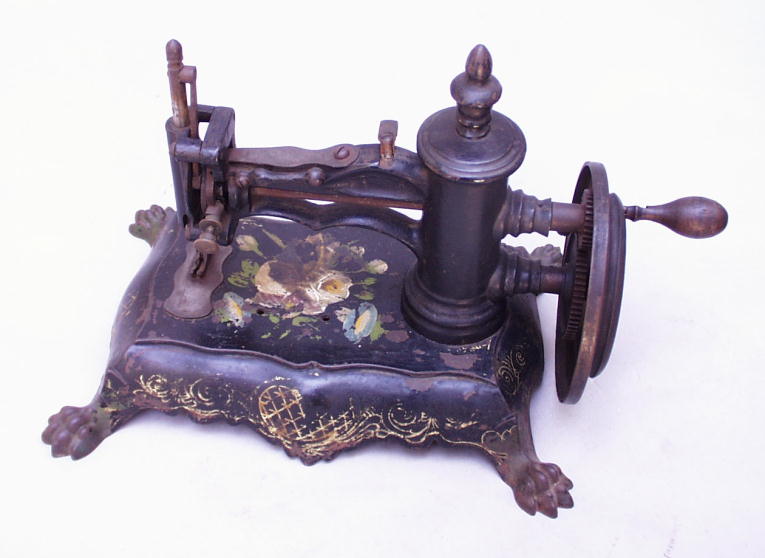 Antique Pawfoot Sewing Machine This early sewing machine
is marked "Ketchum's Patent".
Antique Pawfoot Sewing Machine This early sewing machine
is marked "Ketchum's Patent". Fine. . . . . . .$950.00 SOLD!!
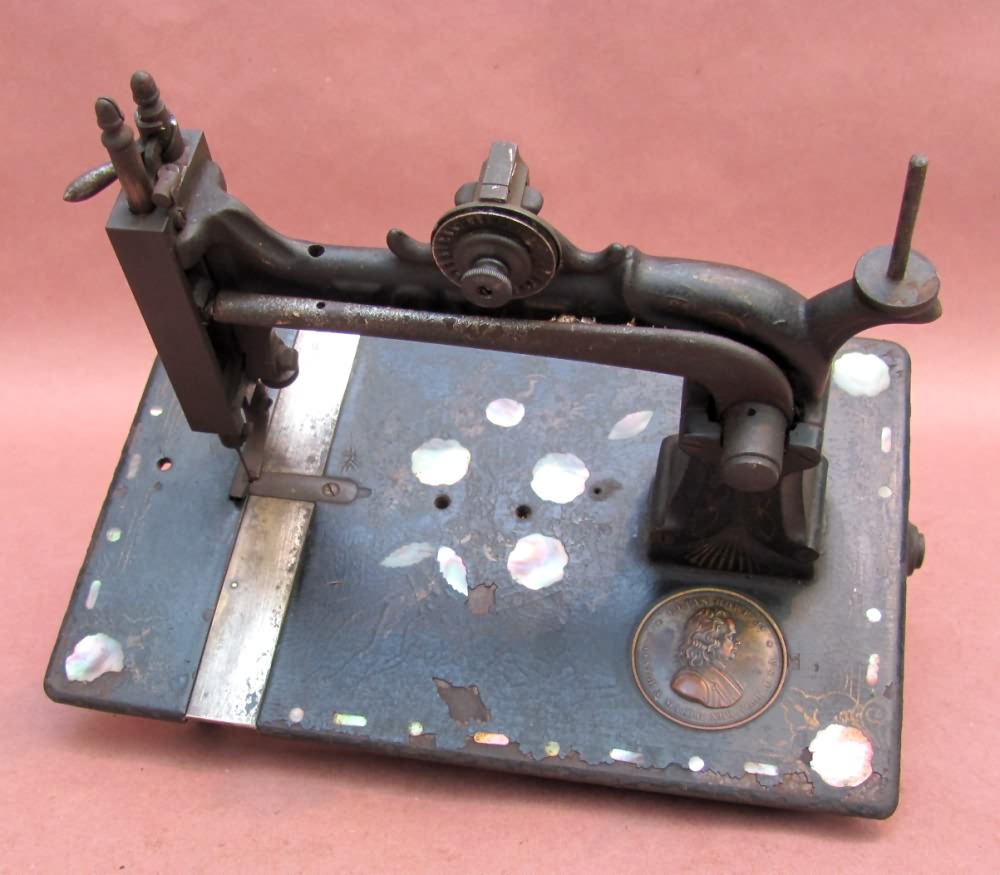 Howe
1860's - 1870's Mother of Pearl Decorated Sewing Machine
Elias Howe is one of the three big names in the early development of and
granting of patents to, for sewing machines. There are numerous
bio's about him and his accomplishments to be found on the internet and in
other research that has been done on him.
Howe
1860's - 1870's Mother of Pearl Decorated Sewing Machine
Elias Howe is one of the three big names in the early development of and
granting of patents to, for sewing machines. There are numerous
bio's about him and his accomplishments to be found on the internet and in
other research that has been done on him.This machine dates from the late 1860's / 1870's and is a transitional piece, different from his earliest ideas, but also different from the later 1800's machines that were produced in huge numbers. The sliding shuttle plate is marked with 3 patents dates from the 1850's through the 1860's. The large bronze plaque with his likeness on it is very nice and graphic. The machine turns over easily, and is in overall nice condition with losses to the paint and decoration as one would expect. A nice machine that has a great look.
Good +. . . . . . .$250.00 SOLD!!
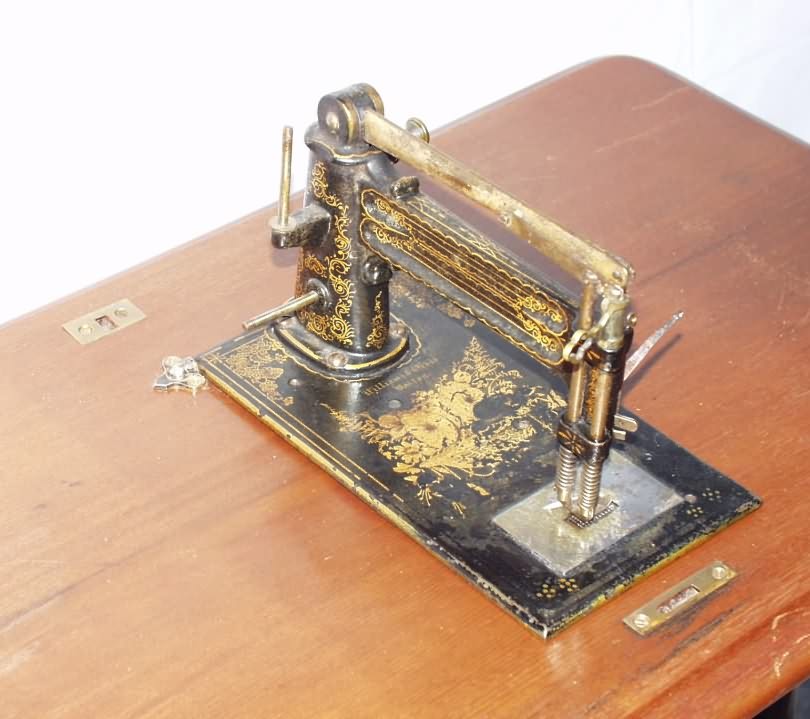 1858 Patent
Williams & Orvis Treadle Sewing Machine
This Williams and Orvis antique
treadle
sewing machine was first patented in 1858. Williams & Orvis was a Boston-based
company that manufactured sewing machines for just a few short years from 1858
to the mid 1860's. The machine was produced in two models with this being
the first model.
1858 Patent
Williams & Orvis Treadle Sewing Machine
This Williams and Orvis antique
treadle
sewing machine was first patented in 1858. Williams & Orvis was a Boston-based
company that manufactured sewing machines for just a few short years from 1858
to the mid 1860's. The machine was produced in two models with this being
the first model.A patent from 1858 would date this machine as one of the first generation of sewing machine patented and produced in the US. This information can be found in the book on antique sewing machines by Grace Rogers Cooper published by the Smithsonian in the 70's. Additional info can be found in the book on antique sewing machines by Carter Bays.
Very few examples of this machine have survived and I would venture few in as nice condition as this one. This example has a serial # 2912. Carter bays in his book postulates that no more than 7,000 or so of both models were made and that fewer of the first model appear or have survived. This sewing machine body and bed still retains much of the gold gilt decoration that is so often worn off of these early
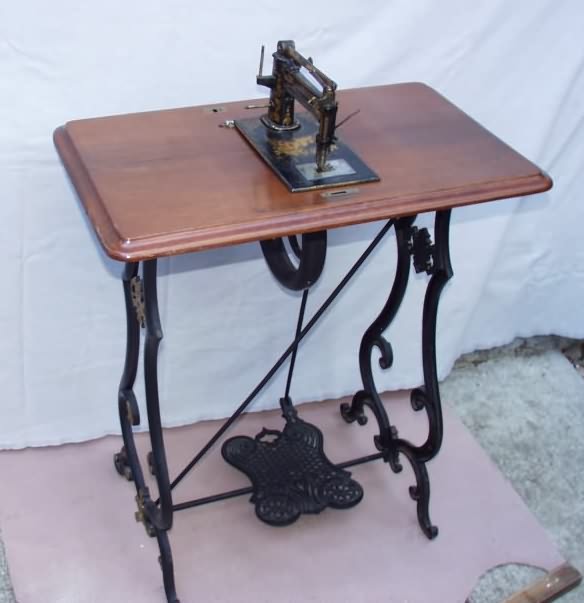
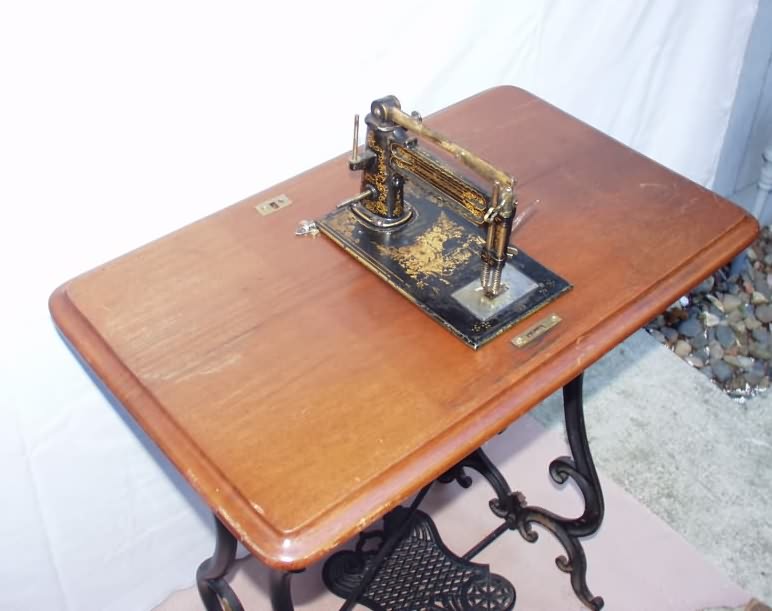
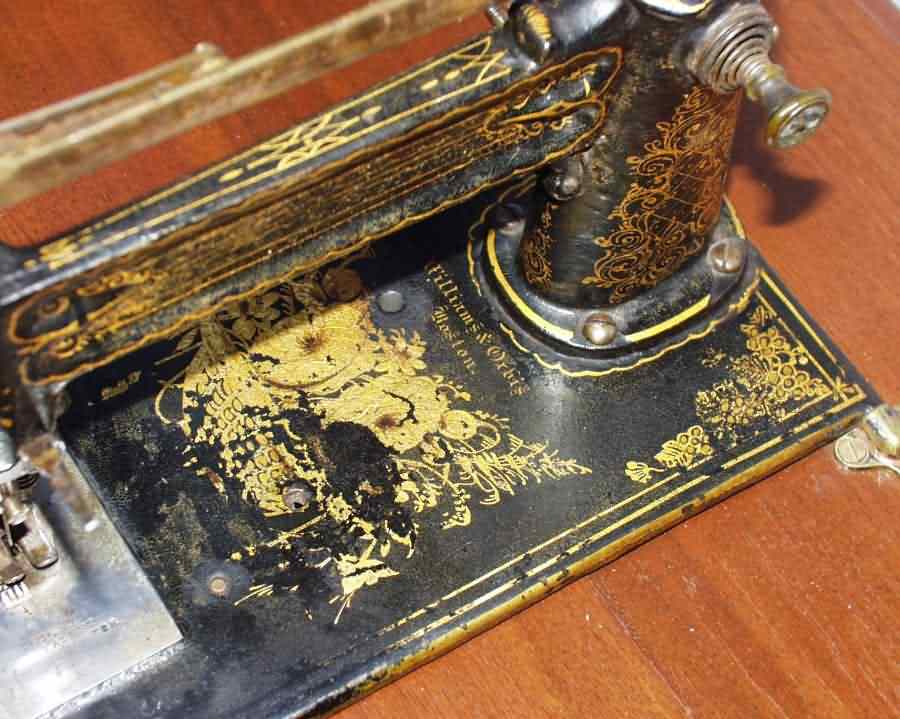 sewing machines. The black japanned finish is near 100%. The
manufacturer's name and location in the gold lettering are near complete on
the top of the bed. The stitch plate is clearly marked "Patent Applied
For" which I believe would date this from very early in the production period.
sewing machines. The black japanned finish is near 100%. The
manufacturer's name and location in the gold lettering are near complete on
the top of the bed. The stitch plate is clearly marked "Patent Applied
For" which I believe would date this from very early in the production period.
Click for Pic Click for Pic Click for Pic Click for Pic
The machines finish is in such nice condition due to the fact that the wooden hood or cover has remained intact with the machine. The cover and table are in original finish which is overall very nice. There are some scuffs and a cosmetic crack in the walnut top cover, but it is minor. There are also some minor scratches in the table top. This sewing machine has spent its life in a controlled climate, and not in an old barn in New England like so many machines that are found. This sewing machine features a fairly unique design that sews a chain stitch using two threads. Most other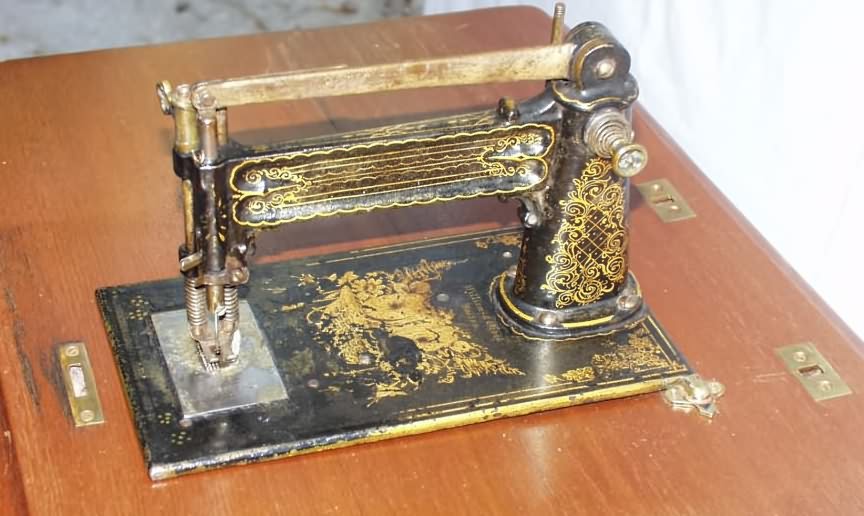
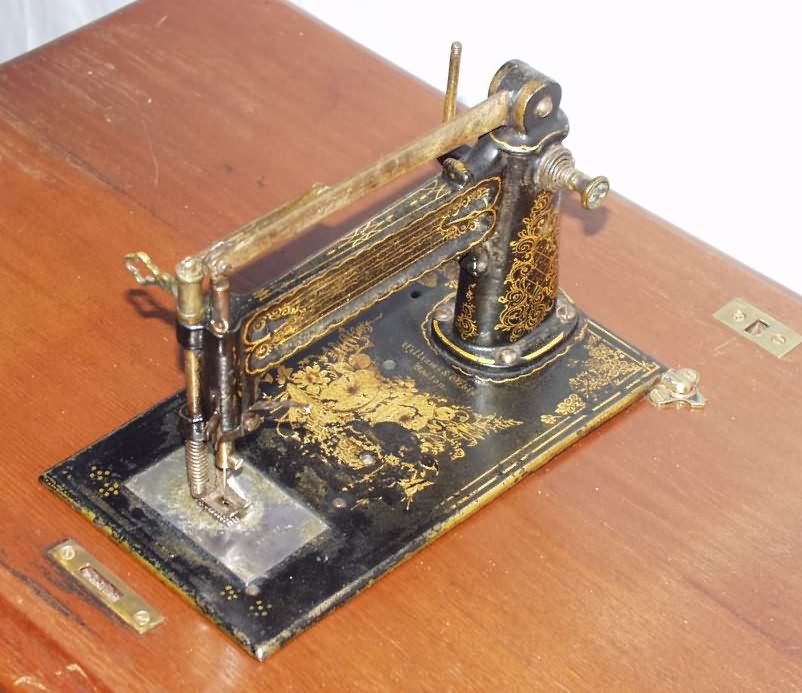
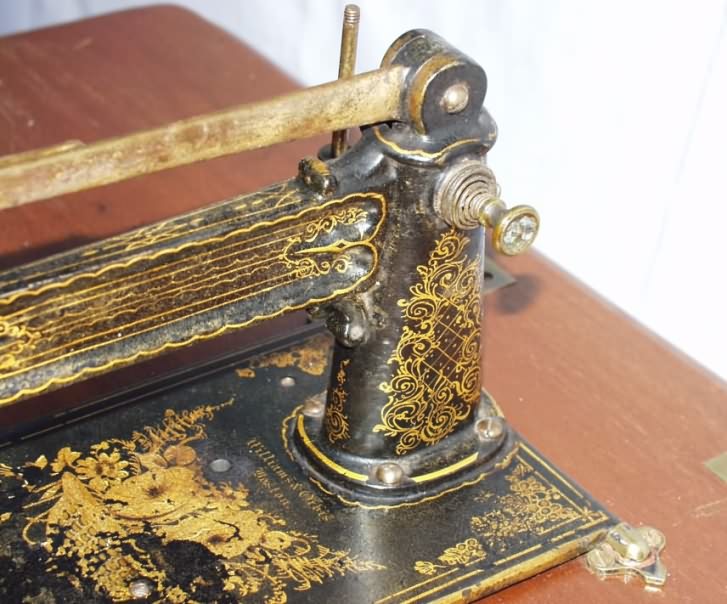
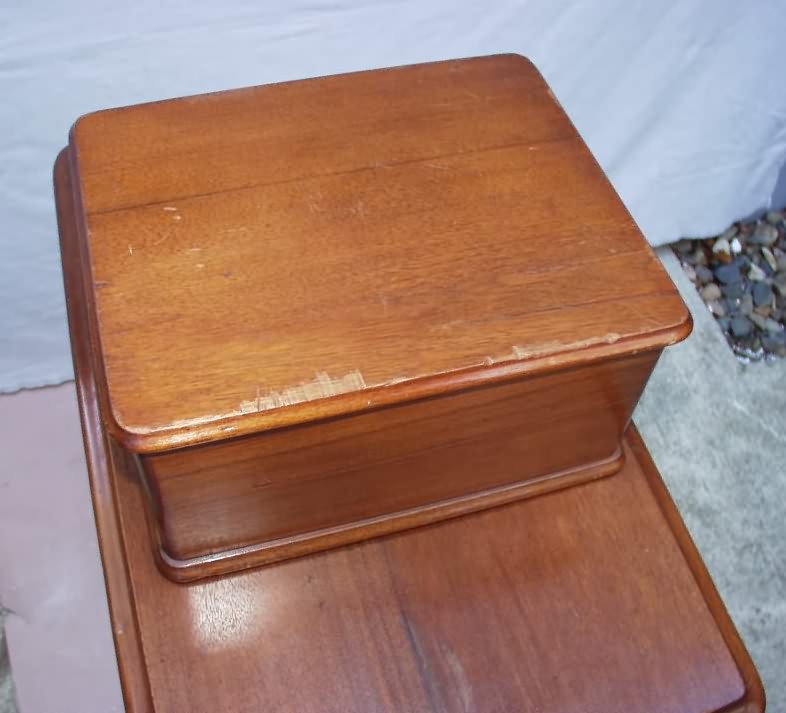
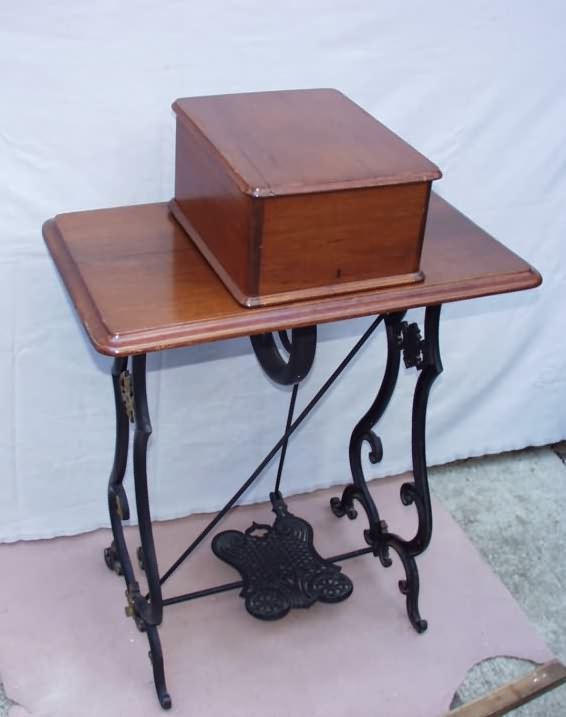 machines
from this era sewed a single thread chain stitch, and machines that utilized
a bobbin and sewed a lock stitch had not yet been introduced. The
form is especially striking because of it's petite size.
machines
from this era sewed a single thread chain stitch, and machines that utilized
a bobbin and sewed a lock stitch had not yet been introduced. The
form is especially striking because of it's petite size.
Click for Pic Click for Pic Click for Pic
This antique treadle sewing machine is also unusual in that it is friction-driven, utilizing a large flywheel that is mounted underneath the table to drive the smaller wheel at the bottom of the machine. The flywheel presses against a rubber 0 ring that is fastened directly to the machine's small drive-wheel. (rubber 0 ring missing) Most other and later sewing machines were driven with a belt to a small flywheel above the table and attached to the end of the sewing machine.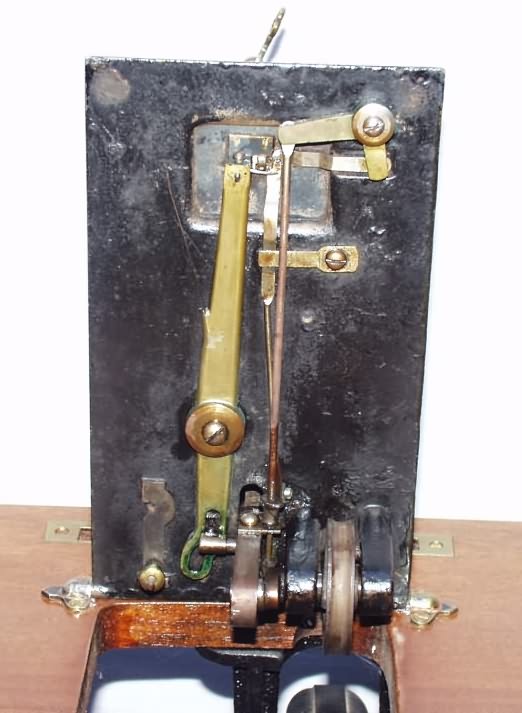
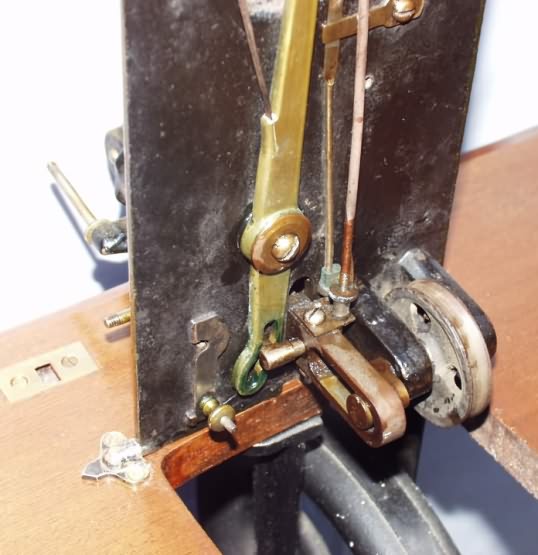
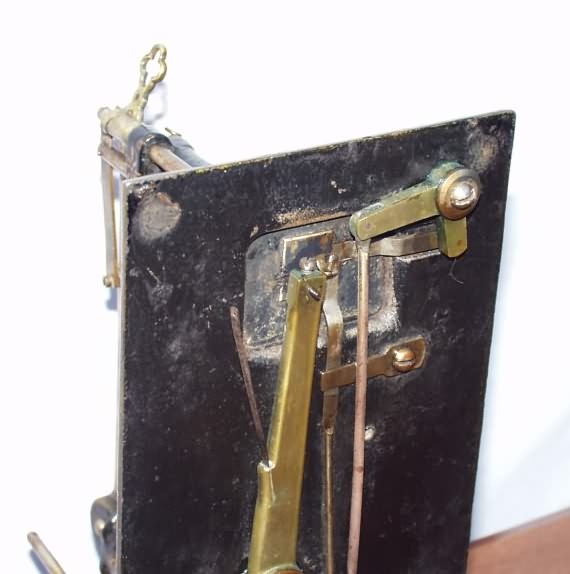
The decorative cast iron treadle looks good, but has been refinished at some point in time. There is a casting crack in one lower leg that has been welded / braised and then was repainted. It looks great from the outside, but upon inspection the inside of this leg shows where the repair was made.
Click for Pic Click for Pic Click for Pic Click for Pic
This is a very rare and hard-to-find early American patented sewing machine in outstanding condition. Highly recommended and this opportunity will knock but once!!!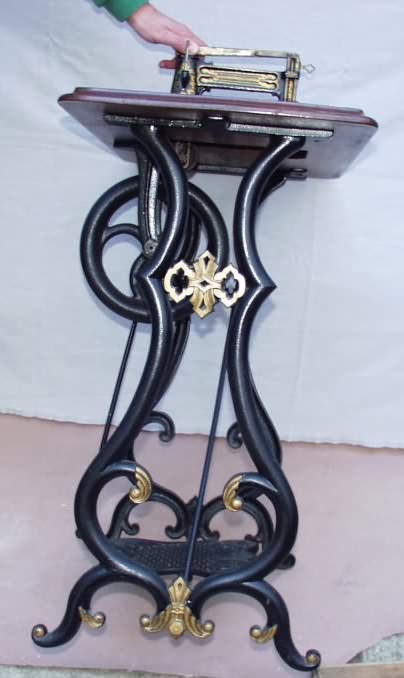
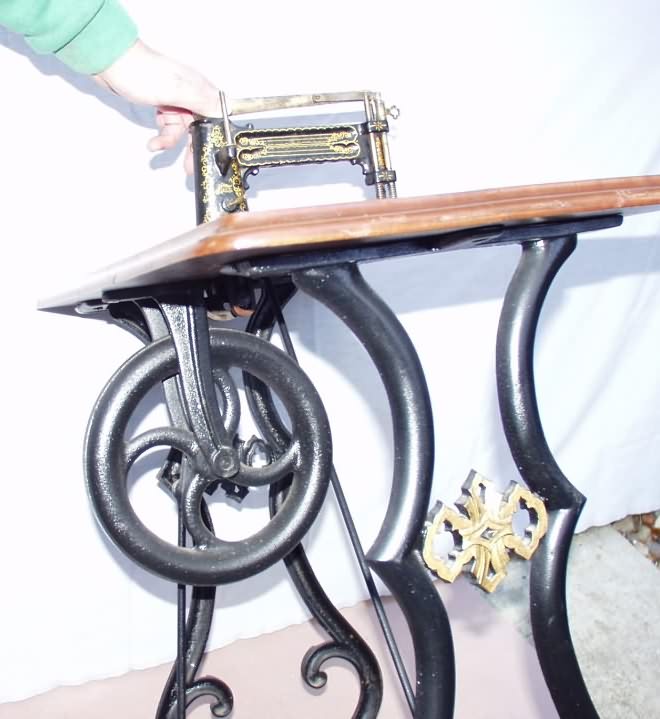
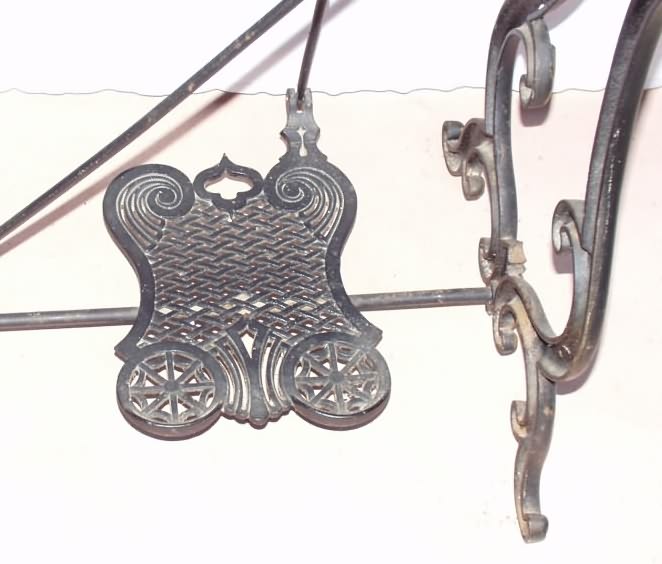
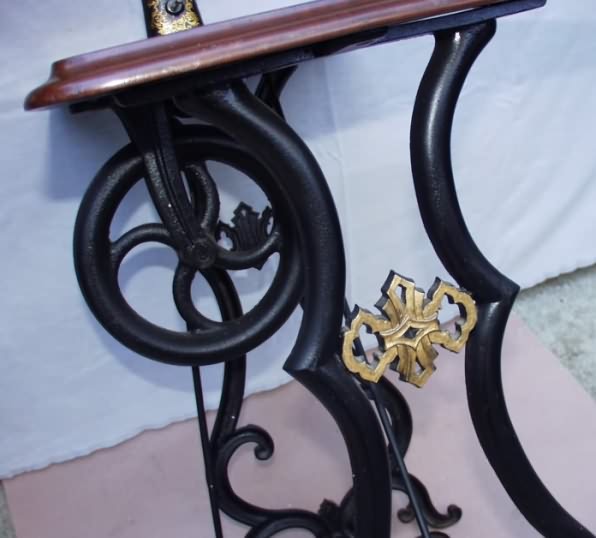
Excellent . . . . . . SOLD!!
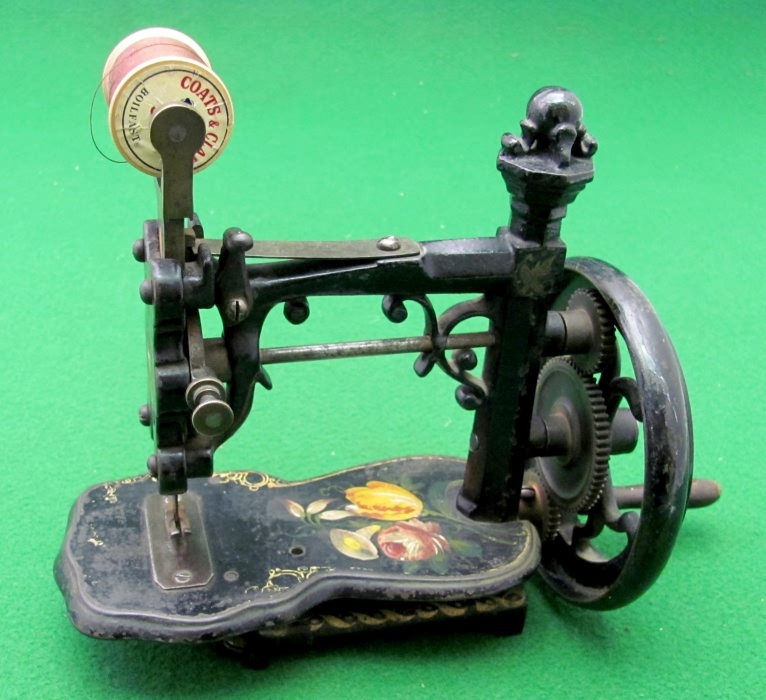 Skinny
Pillar New England Style Sewing Machine / c. 1860 - 1870
This is one of the hardest to find and rare variants of a New
England style sewing machine one might encounter. This super
condition sewing machine is a variation I have only seen a couple of times in
over 30 years of looking for and dealing in antique sewing machines.
The main difference between this and the more typical New England style machines is that
this machine has an 8-sided pillar capped with a decorative cannon ball-like
embellishment at the top, making it somewhat akin to the design of the Shaw
& Clark "skinny pillar". Most New England style machines are unmarked
as to maker as is this one. In Grace Cooper's book on patented American
sewing machines she lists off a number of early firms from the New England
area as the likely makers of this style machine. The only marking
found on this machine is the #10 stamped on the sole. That could
well be the serial number of this rare style sewing machine, as if it were an
assembly number other parts would also be marked 10.
Skinny
Pillar New England Style Sewing Machine / c. 1860 - 1870
This is one of the hardest to find and rare variants of a New
England style sewing machine one might encounter. This super
condition sewing machine is a variation I have only seen a couple of times in
over 30 years of looking for and dealing in antique sewing machines.
The main difference between this and the more typical New England style machines is that
this machine has an 8-sided pillar capped with a decorative cannon ball-like
embellishment at the top, making it somewhat akin to the design of the Shaw
& Clark "skinny pillar". Most New England style machines are unmarked
as to maker as is this one. In Grace Cooper's book on patented American
sewing machines she lists off a number of early firms from the New England
area as the likely makers of this style machine. The only marking
found on this machine is the #10 stamped on the sole. That could
well be the serial number of this rare style sewing machine, as if it were an
assembly number other parts would also be marked 10.The machine is approx. 9" long from table to outside of the crank wheel. The overall condition is very nice. It operates very smoothly. All screws and motions operate. It is designed so that the presser foot acts as the feed. These machines sewed a single chain stitch and the looper mechanism underneath is all there and operable. There is just minor wear to some of the paint and gold decoration. The main groups of flowers on the bed and end plate are near perfect. All in all a beautiful machine!! Complete the collection!!
Fine . . . . . . . $1095.00 SOLD!!
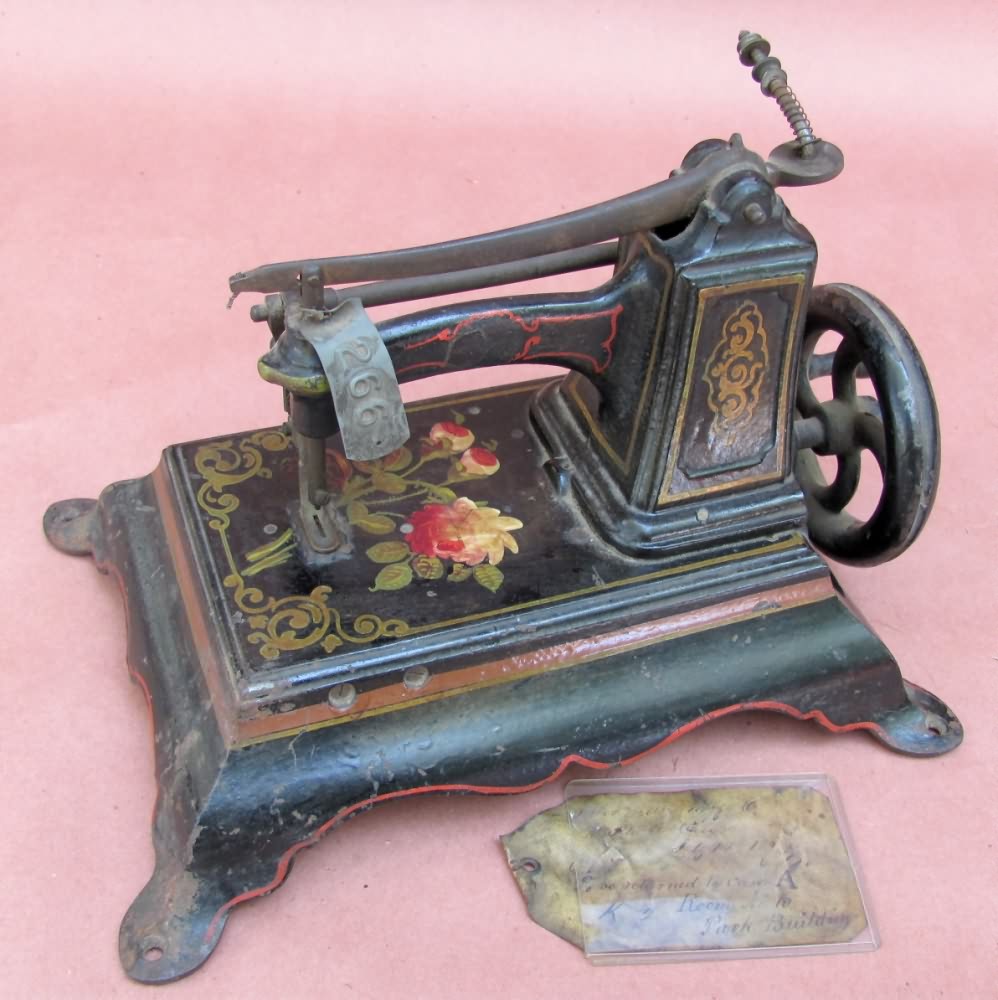 c.
1852 Paw Foot Sewing Machine
This early sewing machine looks like a Watson Patent Sewing Machine or a
couple other early patented designs from the 1850's - 1860's, but the
mechanism below is different from any of those. It is unmarked as to
maker or any patent info. It is not pictured in
either of the main references on sewing machines by Grace Cooper of the
Smithsonian or the other author who has put out several books on the subject.
c.
1852 Paw Foot Sewing Machine
This early sewing machine looks like a Watson Patent Sewing Machine or a
couple other early patented designs from the 1850's - 1860's, but the
mechanism below is different from any of those. It is unmarked as to
maker or any patent info. It is not pictured in
either of the main references on sewing machines by Grace Cooper of the
Smithsonian or the other author who has put out several books on the subject.This unusual and early machine came from a clean-out of an old factory building in CT and was found with other machines spanning a long period of time. The parchment / oil skin tag is hard to read, but says the machine is to be returned to the store room after use and is dated 1852. The theory is that an early manufacturer of sewing machines had gathered up examples of competitors machines to study them, so as to not infringe on others patents, or to subtly copy ideas from those other machines in their quest to produce their own better sewing machine. All screws and motions operate. It operates very smoothly and like most other machines from this era is designed to form a simple chain stitch. Comparing the mechanism below there are subtle differences to other machines known and illustrated.
The machine is approx. 10" long from foot to foot. The overall condition is very nice and much of the original decoration and paint remain.The main groups of flower decoration on the bed are near perfect as are the gold highlights on the column. All in all a beautiful machine and piece of true Americana!! Complete the collection!!
Fine . . . . . . . $2995.00 SOLD!!
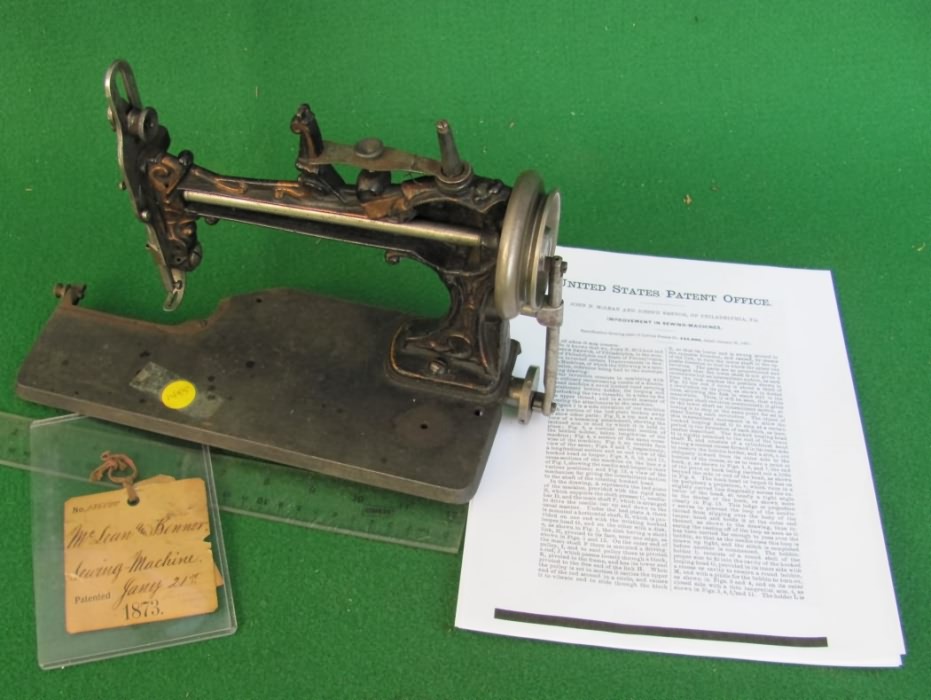 McLean & Bennor 1873 Patent Model Sewing Machine The
patent for this unusual machine was granted on January 21 1873. The
patent number is 135,000. It comes up with a Google search. I
have never seen or had a sewing machine produced by this partnership. The
partnership between McLean & Bennor lasted just 3 years from 1873 -
1876.
McLean & Bennor 1873 Patent Model Sewing Machine The
patent for this unusual machine was granted on January 21 1873. The
patent number is 135,000. It comes up with a Google search. I
have never seen or had a sewing machine produced by this partnership. The
partnership between McLean & Bennor lasted just 3 years from 1873 -
1876.This sewing machine is similar looking to a McLean & Hopper sewing machine who was also McLean's partner during the same period.What the relationship between the three was is unknown. There is info to be found on the internet and at the Smithsonian site about them and the parent company The Centennial Sewing Machine Co. The last listing for that company was also 1876.
The patent mentions the machine bed being "broken away" to better show the working parts. That has been done. Problem is some of those parts below the bed are missing. Most notably the bobbin case and hook assembly which is described in the patent. Different and nice!!
Good . . . . . . . $1250.00 SOLD!!
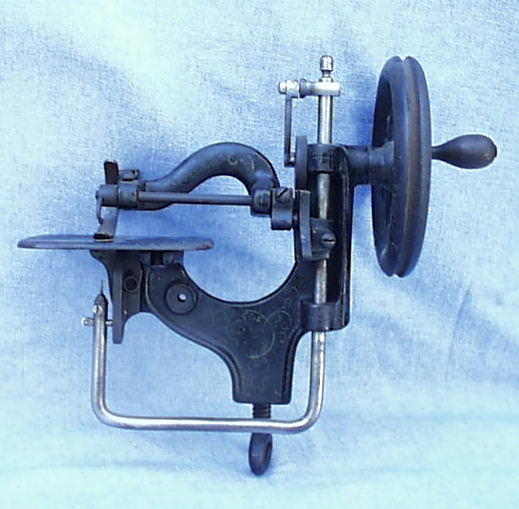 Novelty Integral-Clamp Antique Sewing Machine Not sure how they picked the name for this machine, but it is kind of a
novel idea with the needle coming up from below. It
was worth a patent and it is a difficult machine to find.
Novelty Integral-Clamp Antique Sewing Machine Not sure how they picked the name for this machine, but it is kind of a
novel idea with the needle coming up from below. It
was worth a patent and it is a difficult machine to find. Good + . . . . .$1295.00 SOLD
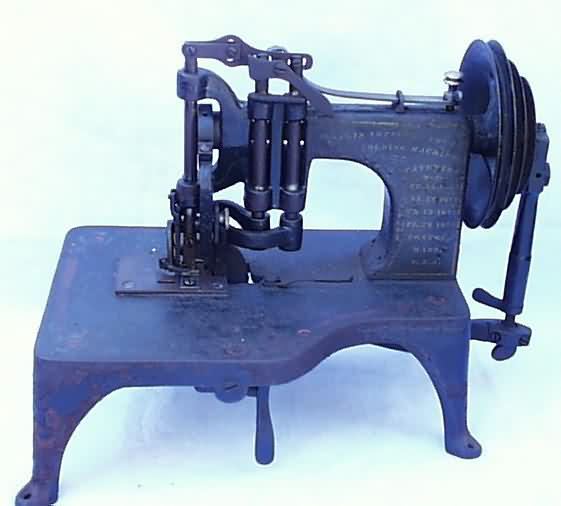 Patented
Leather Folding / Sewing Machine
This unusual device has about a half dozen patents. It was meant
for the shoe making industry and while it looks like a sewing machine it
has no needle. It was designed to cut, fold and make seams.
Like many patents from this era they make for difficult reading.
Patented
Leather Folding / Sewing Machine
This unusual device has about a half dozen patents. It was meant
for the shoe making industry and while it looks like a sewing machine it
has no needle. It was designed to cut, fold and make seams.
Like many patents from this era they make for difficult reading.
Good . . . . .$450.00 SOLD
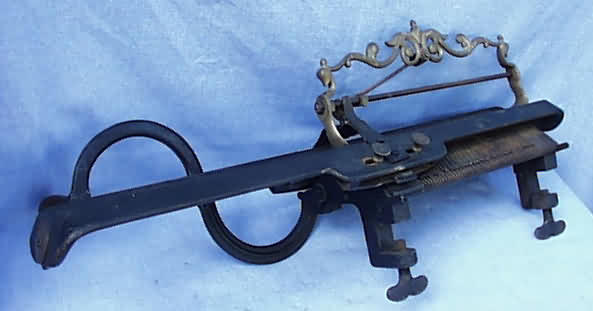 Early
Patented Lamb Knitter I do believe
you could whip out a sweater or pair of mittens just as quick as you can turn
the crank on this antique knitting machine, assuming you could figure it out!
Marked on a brass medallion on the end is "The Lamb Knitting Machine Manf'g
Co. Rochester, NY" as well as the very early patent dates of Oct. 10, 1865 and
Sept. 15, 1868. It is also marked with the number 1815, which I assume
is the serial number.
Early
Patented Lamb Knitter I do believe
you could whip out a sweater or pair of mittens just as quick as you can turn
the crank on this antique knitting machine, assuming you could figure it out!
Marked on a brass medallion on the end is "The Lamb Knitting Machine Manf'g
Co. Rochester, NY" as well as the very early patent dates of Oct. 10, 1865 and
Sept. 15, 1868. It is also marked with the number 1815, which I assume
is the serial number.This antique knitting device is very graphic and very mechanical, and there are several extras to go with it. Just in case you need help figuring out how it works the original 30-page instruction booklet is included. It is in the condition you would expect for a booklet that is over 100 years old---the pages are very readable, although they are rather brittle with tears here and there, and the cover as well as some istlets, undershirts, nubias, tidies, stockings, sweaters, mittens and gloves. Also included is a 24-page 1884 catalog and price list of assorted models of Lamb Knitting Machines and accessories. The amazing thing is that this machine cost well over $100 back then at the same time that Sears Roebuck was selling treadle sewing machines for just $15 or so. Finally several of the accessories themselves are included and they are pictured.
Good + . . . . .$650.00 SOLD
This is just a sample of the many
antiques & collectibles we have sold
Click link to see other
Sales Archive Pages on this Site.
We Buy Quality Antiques
Contact Us at
AntiqBuyer@gmail.com
Our current offering of Antiques for sale are at our sister Website Patented-Antiques.com.
This website is Copyrighted
Larry & Carole Meeker