This is just a sample of the many
antique surveying instruments we have sold.
Click link to see other
Past Sales Archive Pages on this Site.
We Buy Quality Surveying Related Antiques
Contact Us at
AntiqBuyer@gmail.com
Special Note Concerning Prices Seen Below:
Most prices seen reflect actual sale results from this website.
Prices seen
span a long period of time and may not reflect current values. Some
are selling for more, many now sell for less.
On some pieces you will see no price, or a price range,
with or without an explanation. The reasons for that are discussed on the
FAQ page.
Our current offering of Antiques for sale are at our sister Website Patented-Antiques.com.
Antique & Collectible
Solar Compasses
The
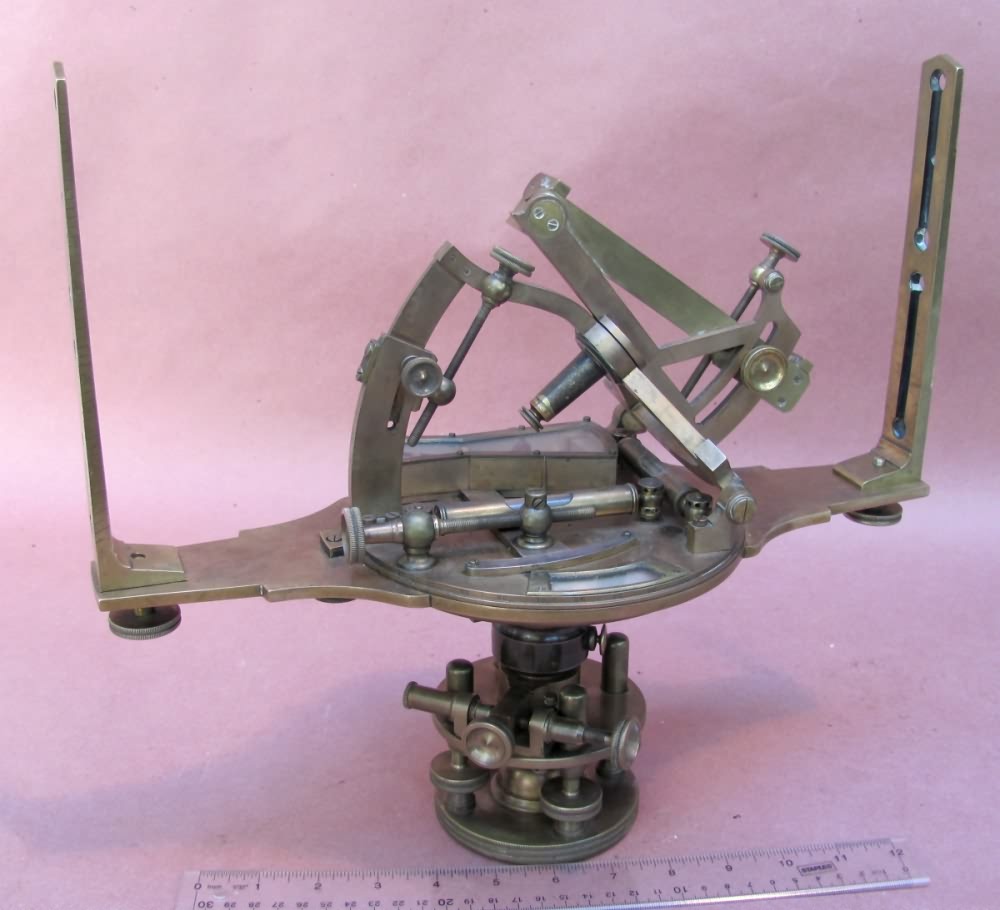 Gurley
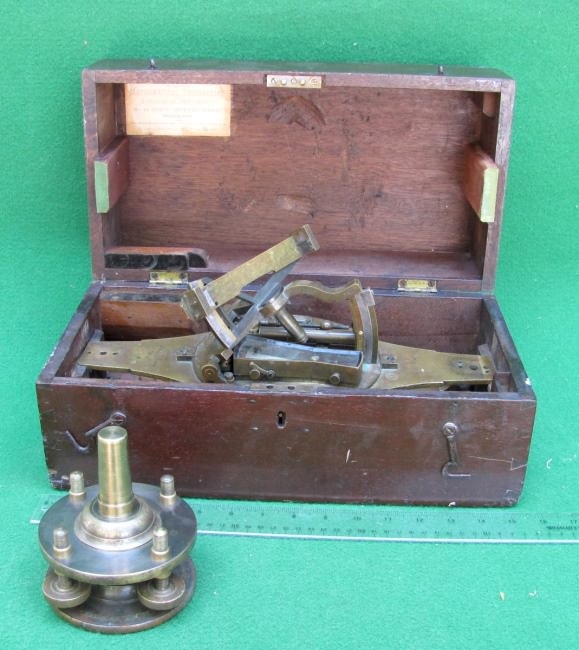
Solar Compass w/ Auxiliary Scope & Original Box
This c.1880 Gurley Solar Compass has a graphic and commanding look that will
be the highlight of any surveying collection. Solar compasses are among the rarest and most desirable of all surveying
instruments that can be found. Such instruments were widely used to
survey and lay out the west because of their ability to use the suns
location to help determine the exact location in areas where standard
compasses would be adversely affected by the ore deposits found here.
Gurley
Solar Compass w/ Auxiliary Scope & Original Box
This c.1880 Gurley Solar Compass has a graphic and commanding look that will
be the highlight of any surveying collection. Solar compasses are among the rarest and most desirable of all surveying
instruments that can be found. Such instruments were widely used to
survey and lay out the west because of their ability to use the suns
location to help determine the exact location in areas where standard
compasses would be adversely affected by the ore deposits found here.
This compass is marked under the glass of the small directional compass needle with the W. L & E Gurley name and Troy New York location. The original owner was a county surveyor in central Oregon who was also a well known gunsmith. The current owner is the second owner and it came directly from the family of the original purchaser. In addition to the compass w/ sight vanes and solar attachment seen in the pic to the left, this instrument also includes an auxiliary scope that the owner made up using a Gurley scope that he attached a tapered fitting to to fit the leveling head when the solar compass was not mounted. Please look at the pics to see all the details of this second piece.
The mahogany box is proper and its condition is very nice noting an early repaired crack in the top. It is fitted to hold the compass, its sight vanes, and the separate leveling base. The condition of the solar instrument is very nice as well. All motions are free and turn properly. The leveling base is nice as well. The tripod mount is the old style male 1 1/2 x 12 TPI center mount. The inside dia of the plate is 3 7/16. There is some residue at corners and evidence that this instrument was lightly cleaned in the past. The original patina remains on the brass and the silver scales and the instrument looks very nice.
This Gurley solar compass is being offered at an attractive price as the owner would like it to sell to a party that will appreciate and enjoy it as much as he has over the years.
I have a early proper Gurley tripod to fit this instrument. It is square stock Gurley marked collapsible leg example in very nice condition. The price for it is $200.00 additional.
Fine . . . . .$10,000.00 - 20,000.00 SOLD!
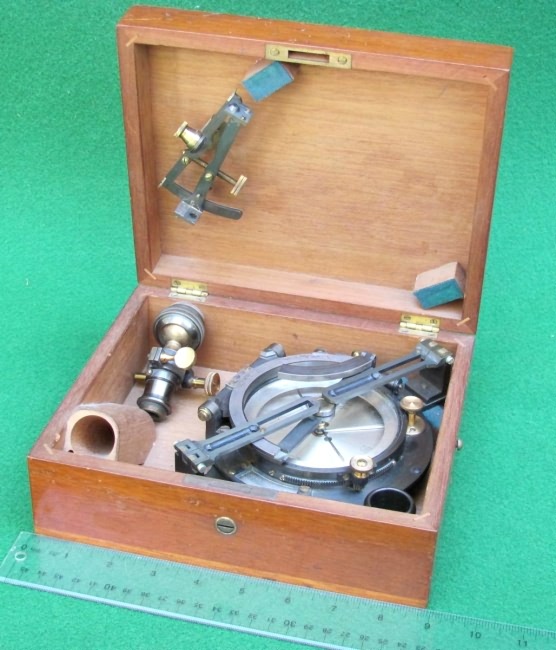
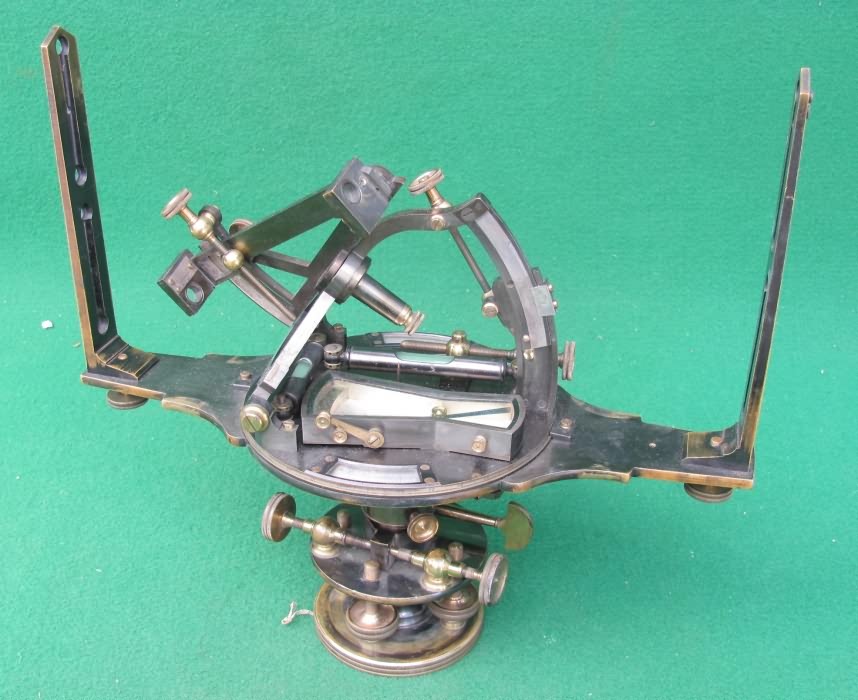 Gurley Solar Compass w/ Auxiliary Scope, Original Box
& Tripod This rare & unusual Gurley Solar Compass
w/ auxiliary scope has a graphic
and commanding look that will be the highlight of any surveying collection.
The original condition is exceptional, being the most complete and finest
condition solar instrument we have ever handled or seen.
Gurley Solar Compass w/ Auxiliary Scope, Original Box
& Tripod This rare & unusual Gurley Solar Compass
w/ auxiliary scope has a graphic
and commanding look that will be the highlight of any surveying collection.
The original condition is exceptional, being the most complete and finest
condition solar instrument we have ever handled or seen.
Solar compasses are among the rarest and most desirable of all antique American surveying instruments that can be found. These unusual instruments were first developed in the early to mid 19th century and were used to survey and lay out the western areas of the US because of their ability to use the suns location & horizon to determine the exact location in areas where standard compasses would be adversely affected by the high levels of ore deposits found here and the magnetic deviations caused by them.
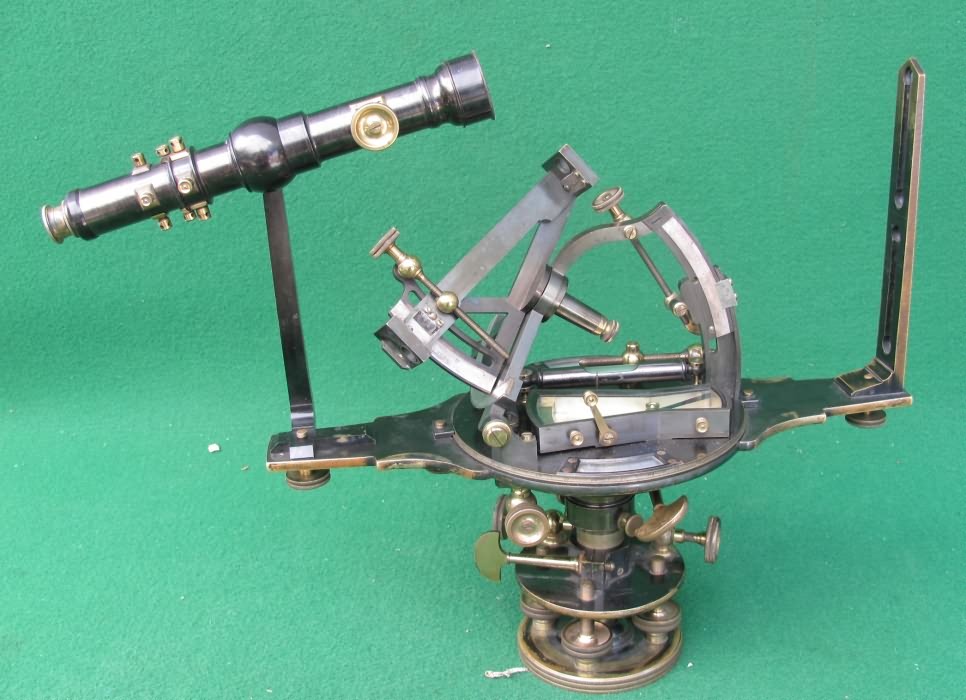
This Gurley solar compass is marked under the glass of the small directional compass w/ needle with the W. L & E Gurley name and Troy New York location. The label inside the lid of the box most closely resembles those from the 1870's, and that is when I believe this dates from, but it is hard to determine the exact date this and most other early Gurley instruments were manufactured.
There are two different means provided to attach the instrument to the original stiff leg tripod, (see pic 5982). The tripod itself is not pictured. Additional accessories include those shown in pic 5987. These include the counterweight, used when the auxiliary scope is mounted. It would mount in the second sight vanes place. A jointed magnifier, an aux eyepiece, the adjusting bar, and other fitted pieces found in the box. Please be sure to view all the pics to see all that is included.
The mahogany box is proper and its condition is very nice noting the missing lock. The box is fitted to hold the compass with its sight vanes attached. The scope, housed in a special compartment in the lid of the box is designed to be used instead of one of the sight vanes. Later examples have a scope that attaches to either sight vane. The separate leveling base has a holder built for it on the side. The second tripod mount has 2 fitted spaces built into the bottom of the box. All motions are free and turn properly. The tripod mount is the old style male 1 1/2 x 12 TPI center mount. The inside dia. of the mounting plate is 3 7/16. One leg of the tripod has an early tape and string wrapped repair. It looks a though a whole new leg end has been spliced onto the original leg. This is stable and just adds to the character of the piece. The original green oxidized finish on the compass itself is 95% or better with most wear at the points on the plate where it is held in the box.
An historically important and beautiful piece of antique surveying equipment that is highly recommended!!
Fine . . . . . .$10,000.00 - 20,000.00 SOLD!
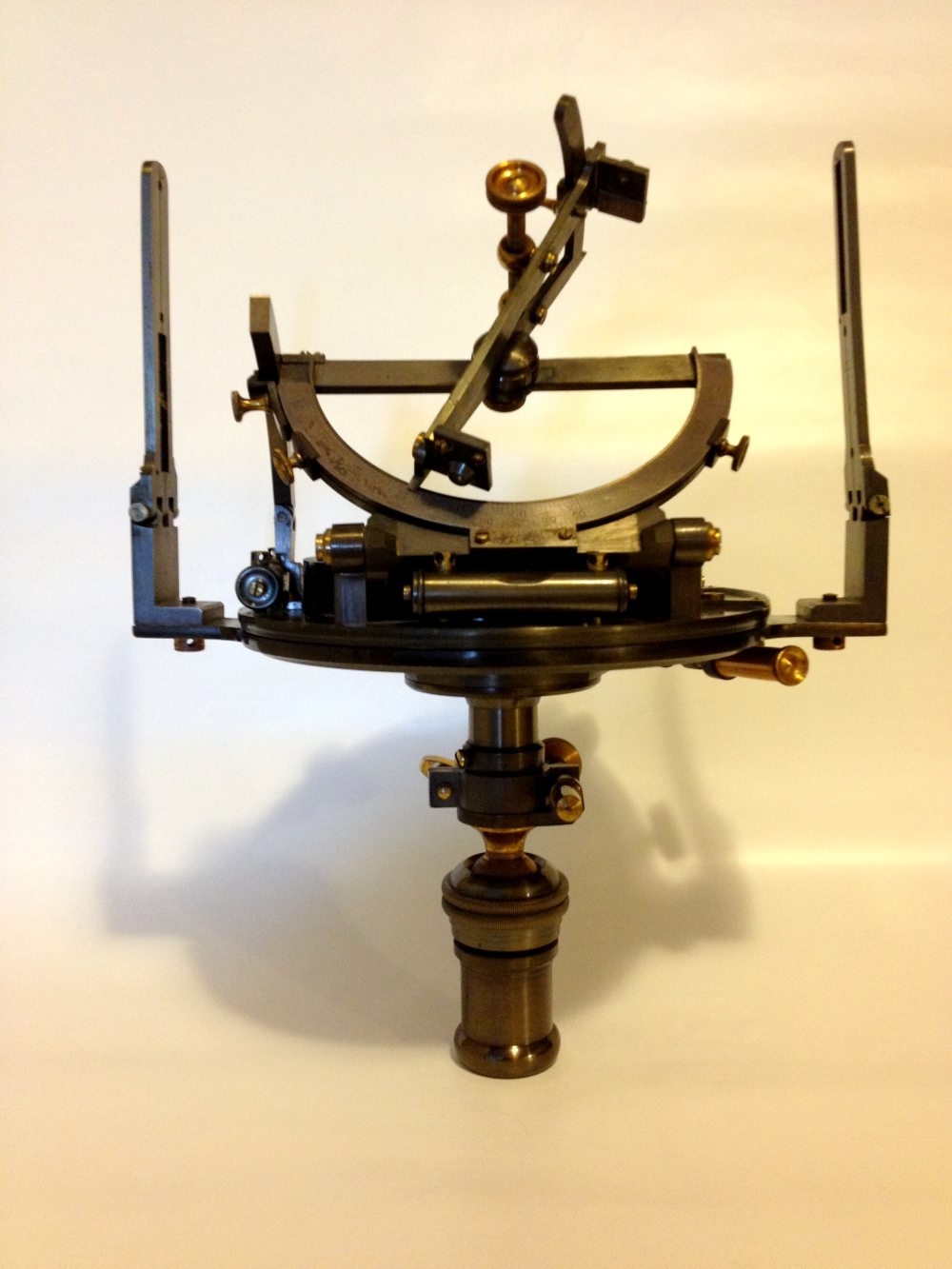
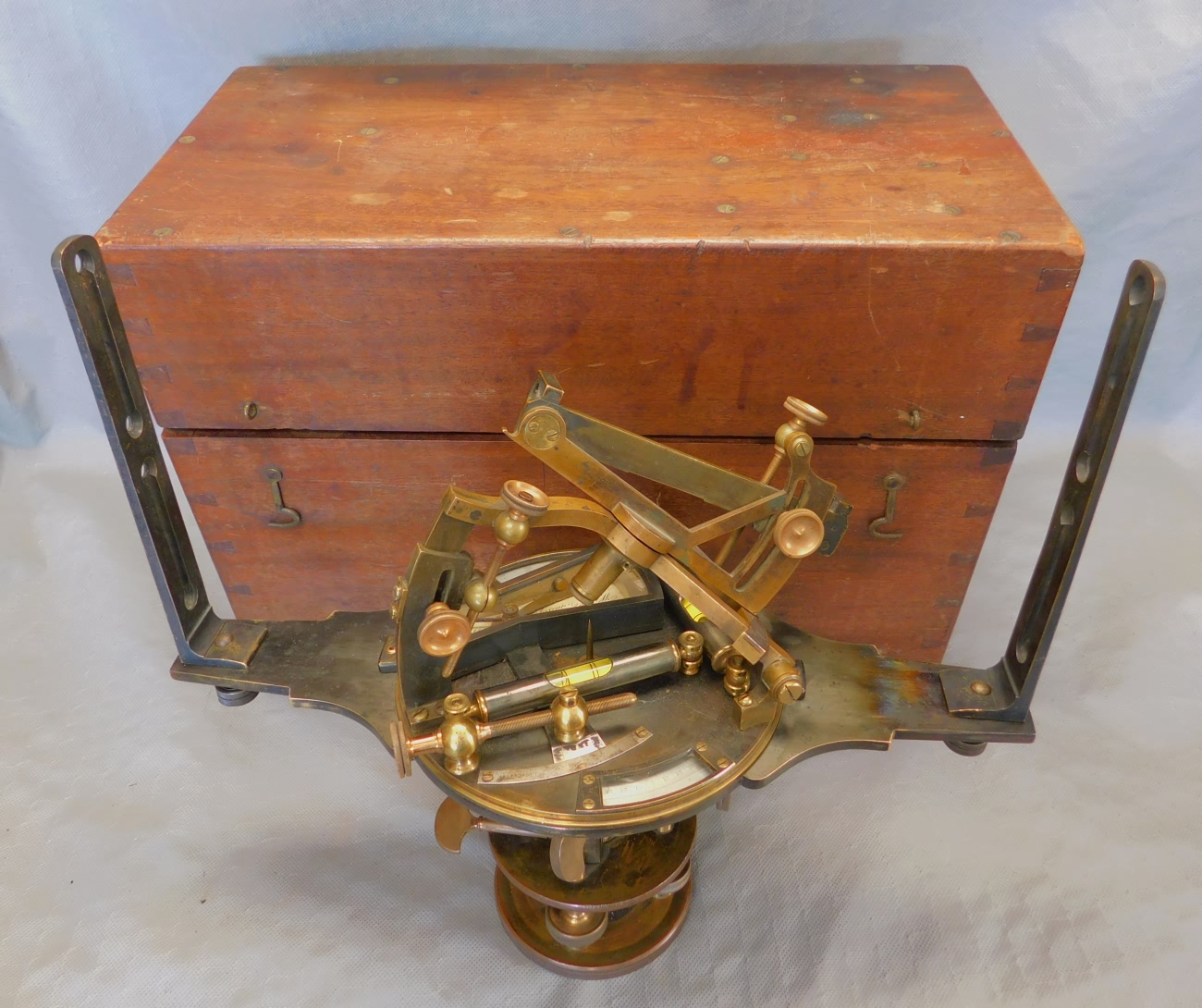 W.
& L. E. Gurley Solar Compass Gurley
Solar Compasses are amongst the rarest and most sought after of all antique surveying instruments. Gurley
made solar compasses after obtaining the patents from Burt. They were developed
for use in locations where the iron deposits in the earth were liable to
render the use of magnetic compasses inaccurate. A solar compass uses
the sun, the horizon, and time of day to determine the exact location one is at without
the use of a magnetic compass.
W.
& L. E. Gurley Solar Compass Gurley
Solar Compasses are amongst the rarest and most sought after of all antique surveying instruments. Gurley
made solar compasses after obtaining the patents from Burt. They were developed
for use in locations where the iron deposits in the earth were liable to
render the use of magnetic compasses inaccurate. A solar compass uses
the sun, the horizon, and time of day to determine the exact location one is at without
the use of a magnetic compass.I went inside looking for a date or maker info and saw no date info. The number 5 was stamped under the plate. The Burt Solar Attachment is also stamped # 5. It could be a serial # or have another explanation. There were some other marks and scratches inside, but they appeared to be reference marks related to assembly.
The overall condition of this Gurley Solar Compass is nice. It has been worked on in the past. Both level vials were replaced and are good. The trough compass is good. The Gurley name inside that is good. All motions and adjustments turn freely. The brass leveling head is for use with a tripod.
Inside the original fitted box the top compartment is laid out for a auxiliary scope that is not present. There are also two small sight vane attachments with a fitted spot in the box. The brass sight vanes have new thumbscrews to attach them to the plate. The holes through the plate have been slightly enlarged and the sight vanes rethreaded for the larger diameter of the new thumscrews. This Gurley Solar Compass is a very graphic and impressive looking surveying instrument that will display nicely and fit into many different collections. A rare opportunity.
Good + . . . . . . $7,400.00 SOLD!!
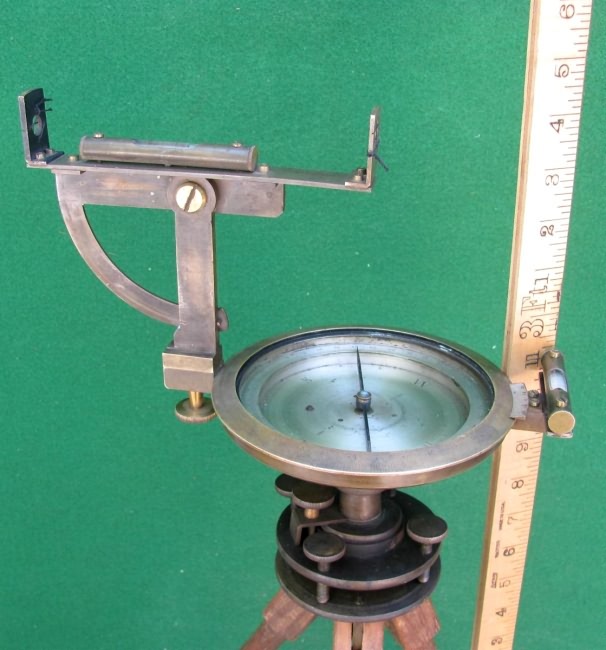 John Roach Mining Compass w/
Vernier & Clinometer
Sighting Feature This is an interesting
and unusual surveying instrument. John Roach was
originally from Scotland and relocated to NY in the 1830's. He opened up a scientific
instrument shop there first as a sole operator and later in partnership with a fellow named Warner.
Shortly after the California Gold rush of 1849 began he pulled up his
stakes and moved to California setting up shop in SF by 1855. He was soon
the largest and most prolific maker of surveying and scientific instruments there. He died in 1891.
John Roach Mining Compass w/
Vernier & Clinometer
Sighting Feature This is an interesting
and unusual surveying instrument. John Roach was
originally from Scotland and relocated to NY in the 1830's. He opened up a scientific
instrument shop there first as a sole operator and later in partnership with a fellow named Warner.
Shortly after the California Gold rush of 1849 began he pulled up his
stakes and moved to California setting up shop in SF by 1855. He was soon
the largest and most prolific maker of surveying and scientific instruments there. He died in 1891. This is a very unusual form and size surveying instrument. I do not have access to any of Roach's catalogs and so can only guess that it was intended for use in mining situations or other close in situations. It stands just a mere 39" tall on its original tripod to the top of the auxiliary sight. Joseph Sala who was Roaches assistant, and then successor after Roach's death offered a somewhat similar looking instrument and called it a Clinometer Compass.
The needle is original and approx 4". The maker name and location are on the silvered face of the compass. The needle swings freely and points north. There is a needle hold feature, but the arm to actuate it is missing. The Clinometer sighting feature is graduated to 90 degrees and has the ability to look over the edge of the compass for mining applications. The level vial is full.
There is a box which is not shown. It is missing a section of the lid and one side, and is in need of restoration. The tripod legs are a mere 30" long and have a great taper design. One of the legs is missing the bottom foot. The leveling head looks OK, and is all here, but the screw holding the two halves together is stripped and so if adjusted too much it tends to come apart. It is set up now with tape to take up the slack, and is stable, but not really useable. Instruments by Roach are pretty unusual and this is a form mining compass I have never seen before. It was made by California's premier instrument maker during it glory days of the mid to late 1800's. An important surveying / mining piece ready for inclusion in the finest collection.
Good . . . . . .$800.00 - $1500.00 SOLD!
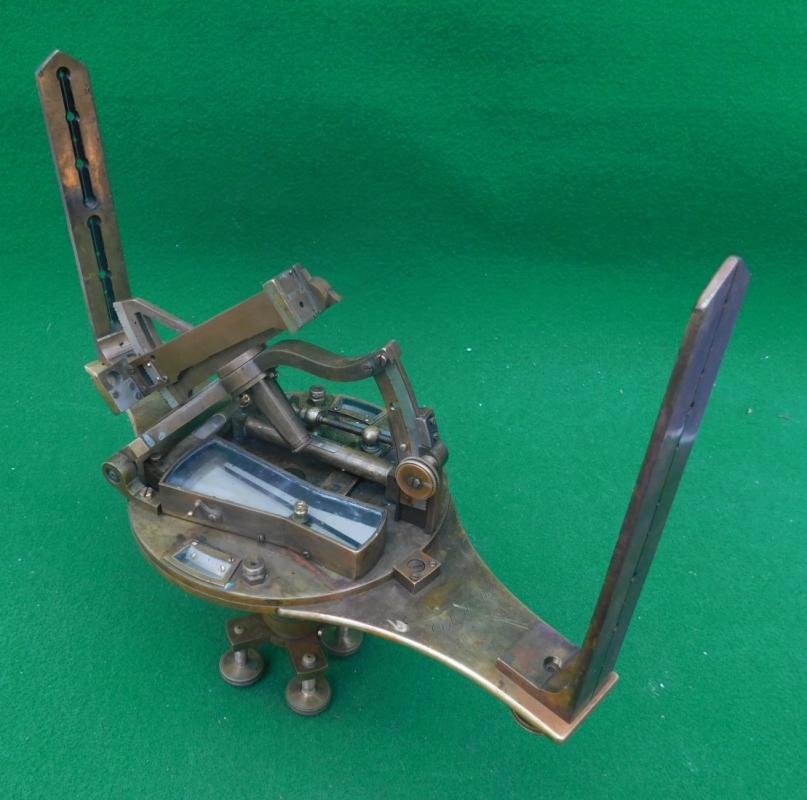
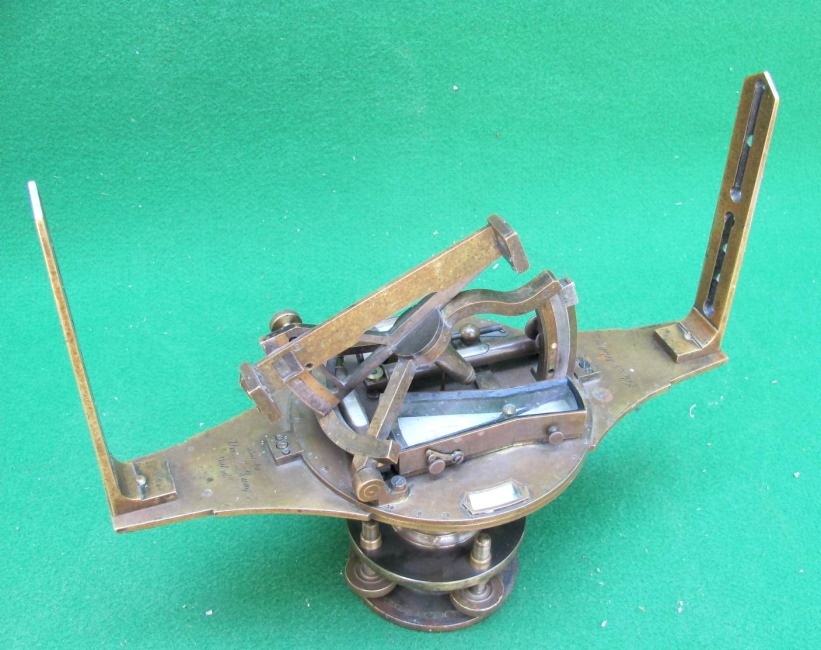
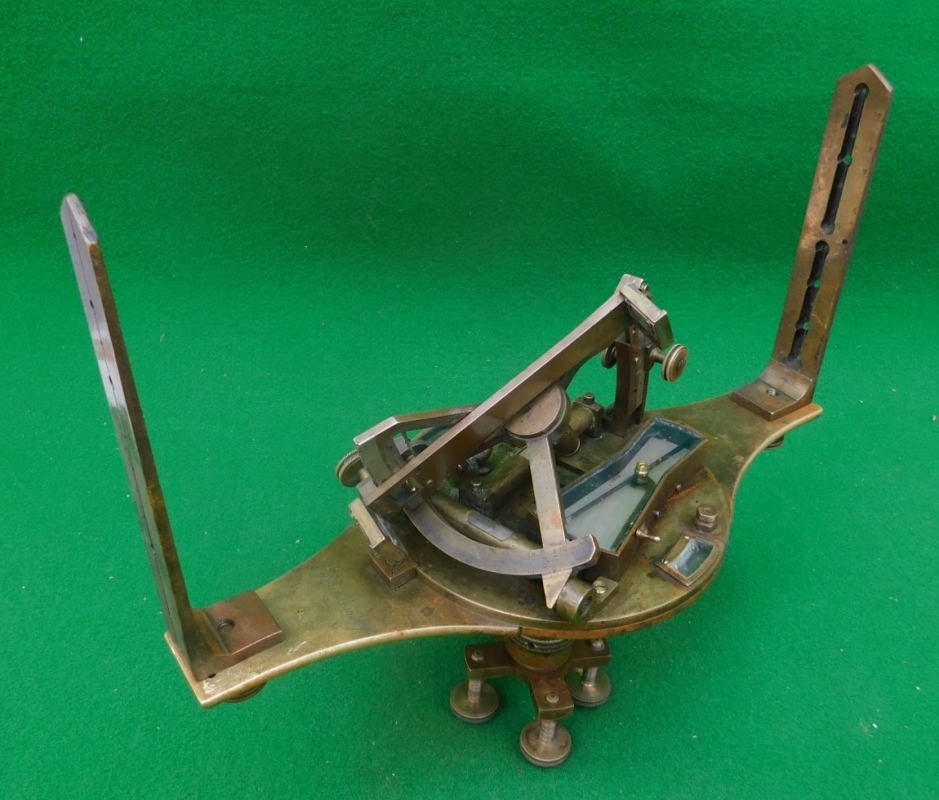 Burt
& Bailey / Detroit Michigan c. 1853 - 1855 Solar Compass in Original Box
This Burt & Bailey Solar Compass is a rare and desirable 19th Century American Surveying Instrument. This
rare Solar Compass was produced by Burt & Bailey a short lived partnership based in
Detroit MI and is an important piece of American history and
Americana.
Burt
& Bailey / Detroit Michigan c. 1853 - 1855 Solar Compass in Original Box
This Burt & Bailey Solar Compass is a rare and desirable 19th Century American Surveying Instrument. This
rare Solar Compass was produced by Burt & Bailey a short lived partnership based in
Detroit MI and is an important piece of American history and
Americana.William Burt was first granted a patent for his idea of a solar compass in 1836. There are several in depth and detailed histories that can be found online about William Burt, his solar compass invention and his 1836 patent for a solar compass. Informative links can be found below this write-up and pictures.
William Young, the famous instrument maker from PA made the first example for Burt which was submitted for the patent. Burt displayed his idea at several exhibitions and was awarded several medals for the innovative nature of the idea, but large scale production never really took off during that period. In the early 1850's production was moved to the Detroit area for a time, but with the elder Burts death, his heirs lost interest and production there came to an end shortly after.
This example was made between 1853 and 1855 by William Burt Sr.son's John and William Burt in partnership with a fellow named John Aylesworth Bailey who at that time owned the rights to manufacture them. The partnership of Burt and Bailey was in existence for 2 years or less from 1853 - 1855. It is not known how many solar compasses they produced, but it is sure not many given how few have ever been found.
The company was reformed and renamed J & W Burt after Bailey left in 1855. That partnership was also short lived. One year later the company was again renamed Burt & Watson. Watson had previously worked for William Young in PA and was taken in as a new partner by the Burt brothers. That incarnation also lasted about 1 year.
This compass measures approx. 15 inches long.It is complete with original box, sight vanes, and leveling base. All motions work smoothly. The compass needle swings. The level bubble is good. It is in very nice overall condition with a great patina and does not look to have ever been fiddled with. It is housed in its original box which is also in nice condition. The plate is marked at one end with the partners names Burt & Bailey, and with the location, Detroit Mich. on the other. I see no other markings or serial # other than the Young label inside the top of the box.
A rare and important surveying instrument and near unique piece of Americana for the discriminating collector history buff.
Good + . . . . . . $9,500.00 SOLD!!
Further Info on Burt Solar Compass
Wikipedia has a wealth of overall information concerning solar compasses and their history that can be found at this link. https://en.wikipedia.org/wiki/Solar_compassThe original patent was hand written, and a copy can be viewed at the Survey History site https://www.surveyhistory.org/1836_solar_compass_patent1.htm
The Survey History site has a detailed history on the Burt family and the several partnerships that they were involved in http://www.surveyhistory.org/j__&_w__burt.htm
Another essay concerning Burt Solar Compasses can be found at the Wisconsin History site.
Probably the most concise and clear history of the Burt solar compass makers and partnerships can be found on the remains of Bud Uzes old surveying related site where he describes a Burt Solar Compass he owned and was being sold after his death.
I found one more short write-up on Burt Solar Compasses in an ebay ad for another Burt Solar Compass that I have included here.
William Austin Burt Solar Compass
The solar compass, an astronomical instrument, was first invented and made by William Austin Burt. He patented it on February 25, 1836, in the United States Patent Office as No 9428X. The first solar compasses are believed to have been made in the late 1830’s by Henry Ware and Leonard Nutz in Cincinnati, OH. William Young was contracted to make improved solar compasses beginning in 1841.
It received a medal at the Great Exhibition of 1851. Burt, a United States Deputy Surveyor, began surveying government lands in Michigan in 1833. While working in Wisconsin, where there were large deposits of iron ore, Burt experienced great difficulty in using his standard vernier scale compass. This motivated him to find a solution that was not dependent on magnetism and would not be influenced by earth's ore materials. With his mechanical abilities, he then devised and built the solar compass. Burt made a model of his instrument in 1835 to test its validity. The instrument was then submitted to a committee at the Franklin Institute in Philadelphia. They examined its principles and merits and ultimately awarded Burt twenty dollars in gold and the John Legacy Medal. He improved on his surveying instrument and in 1840 re-submitted it to the Franklin Institute. The instrument was further improved over the years and in 1851 he exhibited that version at the Great Exhibition in London, where he was awarded another prize medal. He then received another medal by jurors of Astronomical Instruments.
Burt’s solar compass is a precision instrument made of brass with a solar attachment that allows surveyors to determine the true north direction by reference to the sun rather than by reference to the magnetic north pole. It allowed surveyors to locate true north through viewing the sun and other astronomical observations and was not influenced by magnetism or iron ore or other ore materials. The United States government required land surveys to be done by Burt's Solar compass; as in many cases the cost to accurately survey lands with heavy mineral deposits that interfered with normal instrumentation would have exceeded the value of the land.
 Wm.
J. Young Solar Compass w/ Leveling Head & Tripod William Young
hailed from Pennsylvania. He was born in 1800 and died in 1870.
He was Pennsylvania's most famous maker of scientific and surveying related
instruments. Young originally apprenticed to Thomas Whitney at the age of
13. He went into business for himself in the 1820's. There
is an extensive Bio on him at the Smithsonian site, as well as examples of
two similar solar compasses in the collection there. Here is a link
http://amhistory.si.edu/surveying/maker.cfm?makerid=38. Young is
credited by many to be the first to develop and introduce the concept of a
transit in America and made the first dividing engine used in America.
Wm.
J. Young Solar Compass w/ Leveling Head & Tripod William Young
hailed from Pennsylvania. He was born in 1800 and died in 1870.
He was Pennsylvania's most famous maker of scientific and surveying related
instruments. Young originally apprenticed to Thomas Whitney at the age of
13. He went into business for himself in the 1820's. There
is an extensive Bio on him at the Smithsonian site, as well as examples of
two similar solar compasses in the collection there. Here is a link
http://amhistory.si.edu/surveying/maker.cfm?makerid=38. Young is
credited by many to be the first to develop and introduce the concept of a
transit in America and made the first dividing engine used in America. This solar compass is an early and significant type of surveying instrument. The idea was first developed by William Burt in the 1830's. They were developed to be used in place of regular compasses that were subject to error due to large deposits of iron that would adversely affect a regular compass. The idea was to use the sun and horizon to accurately find ones position. Young made the first example for Burt to submit to the Patent Office. The Smithsonian has information on this story at the link below http://amhistory.si.edu/surveying/ype.cfm?typeid=17 Young first started producing them for sale in 1840 and went on to refine the idea adding features and perfecting the design for this specialized form instrument. There is a serial number inside the glass compass of 3554 which would date it from approx. 1853. Young first started using serial numbers in 1850
 starting the numbering at 3000.
The box is mahogany box has a later label in it from Young and Sons. It was probably affixed after a repair or adjustment. There are 2 adjusting bars still present inside the box. There is a space in the box for what may have been a scope but that space is empty The compass plate has extra holes under one sight vane that may have been for mounting a scope.A similar instrument w/ scope sold for approx. 30,000 a few years ago on eBay.
The overall condition is very nice with original patina. All motions operate, and the plate moves freely. The vernier scale has 2 windows covering the silver scale there. Both level vials are good. The plate on one end is marked "Made by Wm. J. Young Philada". The plate at the other end is Marked Burt's Patent. The tripod and leveling head are in very nice condition, fit well and seem to be original. An important surveying related instrument ready for inclusion in the finest collection.
Fine . . . . . .$10,000.00 - $25,000.00 SOLD!! < 2019 > More like 6K - 10K these days
 W.
& L. E. Gurley # 276 Pocket Solar Compass Gurley pocket solar compasses are a rare
and unusual surveying instrument. The condition of this
example is second to none. It is near mint!!
W.
& L. E. Gurley # 276 Pocket Solar Compass Gurley pocket solar compasses are a rare
and unusual surveying instrument. The condition of this
example is second to none. It is near mint!!The basic idea behind solar attachments and their use in surveying was first developed by William Burt in the 1830's. Gurley bought the rights to use his idea and incorporated it into both their transits and their line of compasses. Gurley first introduced this near miniature solar size compass in 1880. It was discontinued in about 1918 when it no longer appeared in their catalogs.In their catalog description Gurley claimed that this style compass was nearly as accurate as their larger models, far lighter and easier to carry into the field. It weighs in at under 5 lbs, while the standard size compass was closer to 15 lbs.
Solar compasses were developed to be used in place of regular compasses that were subject to error due to large deposits of iron that would adversely affect a regular compass. The idea was to use the sun and horizon to accurately find ones position. Much as sea faring adventures had done, and did with instruments like sextants and octants.
The overall condition is near mint with original patina. The lacquer finish is near perfect with just minor losses, i.e.. scratches on the bottom. It has never been cleaned, and when you move the hour arc you can see the original polished silver scales under the clamps. This points to just how little this instrument was ever used. All motions operate freely, and the plate and both verniers move freely. The 3" needle swings freely. The compass face is inscribed with the Gurley name and Troy NY location. There is no serial # which would indicate this dates from before 1908. There is an example of one of these pictured in the Skerritt book that illustrates Charles Smart's collection of surveying instruments. In it he states that Smart's Pocket Solar Compass was Smarts favorite instrument in the collection.
This style instrument was designed to be used on either a staff or tripod. There is no leveling head other than the swivel ball joint stored in the box. I do have a small light weight tripod that will fit the mount that can be purchased separately. I also have NOS staffs that will work well with this instrument listed on another page.
An important surveying related instrument ready for inclusion in the finest collection of surveying instruments, Scientific instruments, or significant Americana. Highly recommended.
Fine . . . . . .$2,500.00 - $4,500.00 SOLD!!
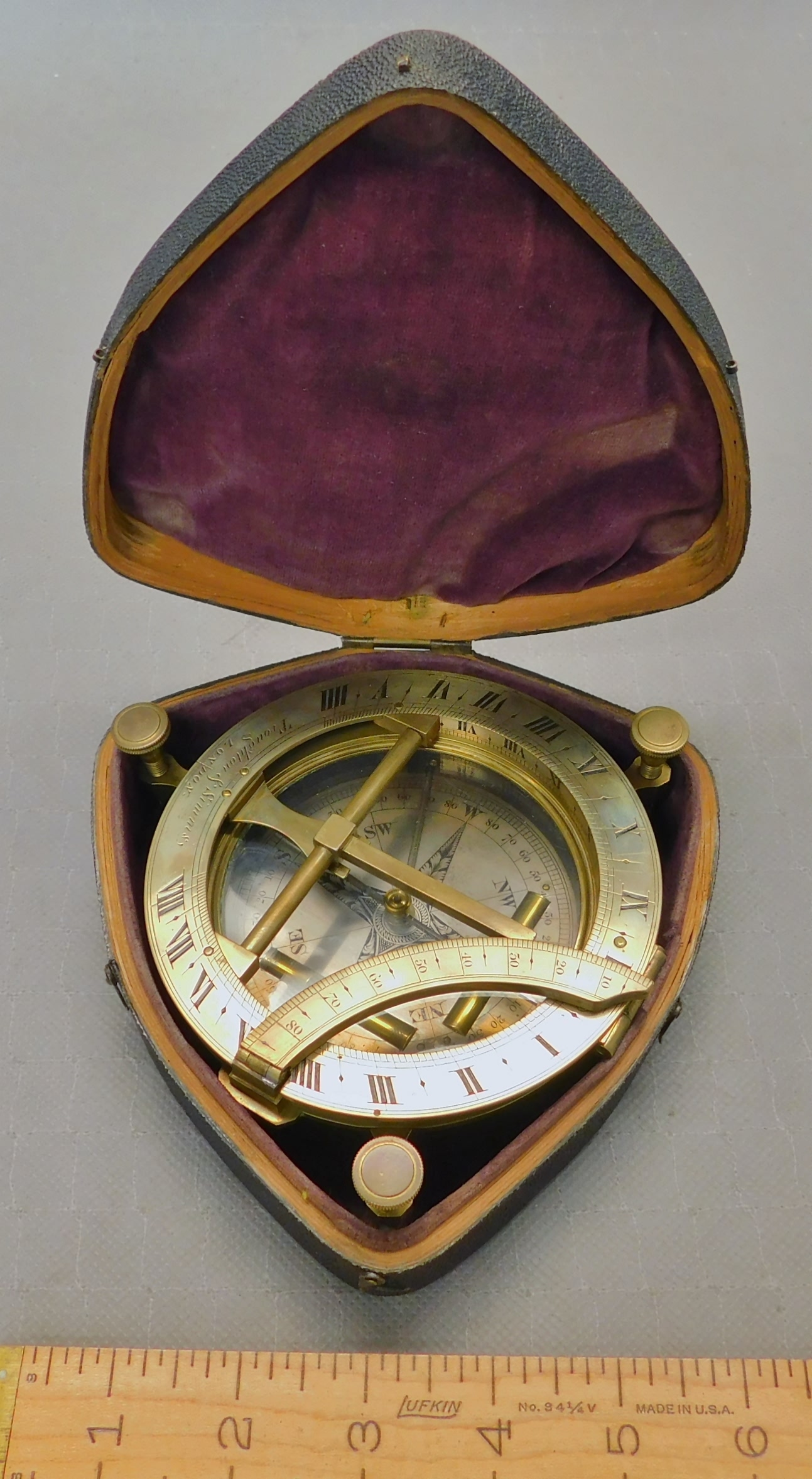 Troughton & Simms / London Compass & Sundial
A very interesting
surveying / navigation device that dates from the 19th century. This
is a genuine antique and not to be confused with new fake versions offered as
antiques.
Troughton & Simms / London Compass & Sundial
A very interesting
surveying / navigation device that dates from the 19th century. This
is a genuine antique and not to be confused with new fake versions offered as
antiques.The Leatherette / Sharkskin covered wooden box is nice as well. This combination sundial and compass is such an iconic design that it has been copied numerous times and those copies and fake versions are now being offered all over the internet as "antiques and "vintage" whatever those words have come to mean today, or better put, how they have lost their true meaning.
The compass face is nicely engraved and is in fine condition. The compass is functioning. All bubbles are good. No issues or problems. Has a nice even patina and will display nicely.
Fine . . . . . . $895.00 SOLD!!
Antique & Collectible
Solar Transits
The
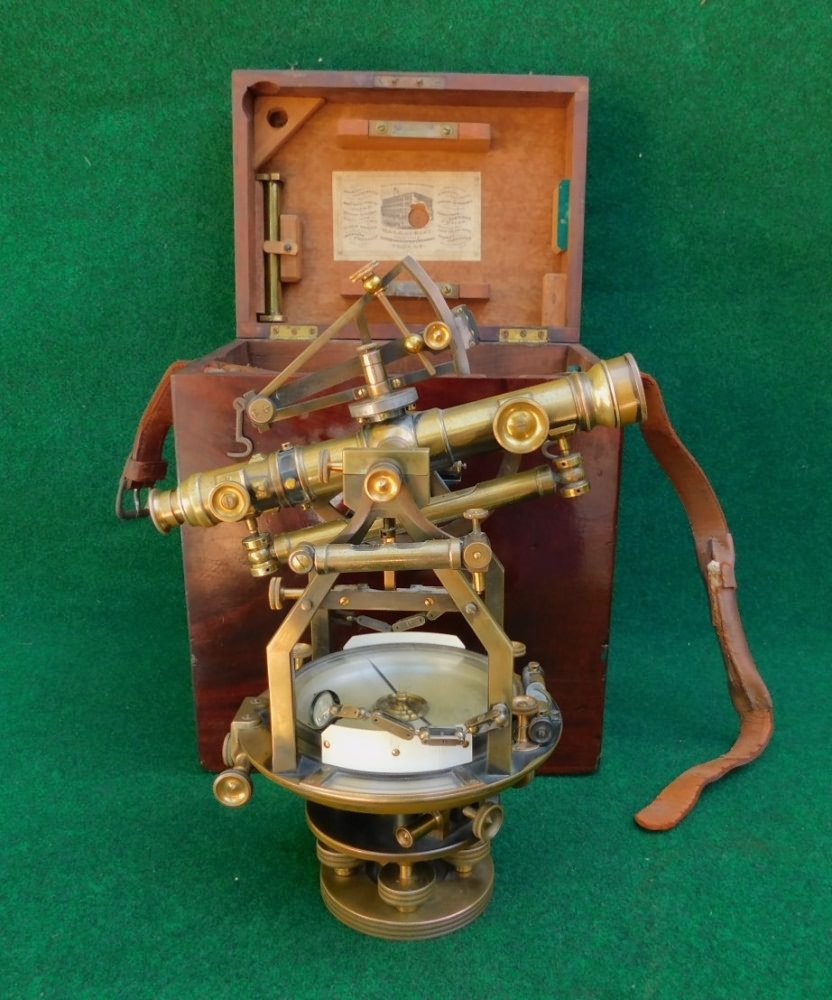 Gurley
#17 Engineer's Solar Transit w/ Burt Attachment This Gurley
#17 engineers solar transit is equipped with a factory and
properly marked Burt Patent Solar Attachment. Solar transits are one of
the most desirable and sought after of all surveying instruments to be
found. They are graphic, historically important, rare, and represent
an important aspect of surveying history.
Gurley
#17 Engineer's Solar Transit w/ Burt Attachment This Gurley
#17 engineers solar transit is equipped with a factory and
properly marked Burt Patent Solar Attachment. Solar transits are one of
the most desirable and sought after of all surveying instruments to be
found. They are graphic, historically important, rare, and represent
an important aspect of surveying history.This example is a #17 Engineers transit with a 11" scope and has a large and commanding presence that will make for a great display piece. This transit has a 5" needle, and a 6" half vernier circle that reads to 20 degrees. It weighs close to 18 lbs. or almost twice what a similar looking but smaller light mountain or recon transit would weigh. The picture below on the right gives you an idea of just how large and commanding this transit is compared to a recon size Gurley transit.
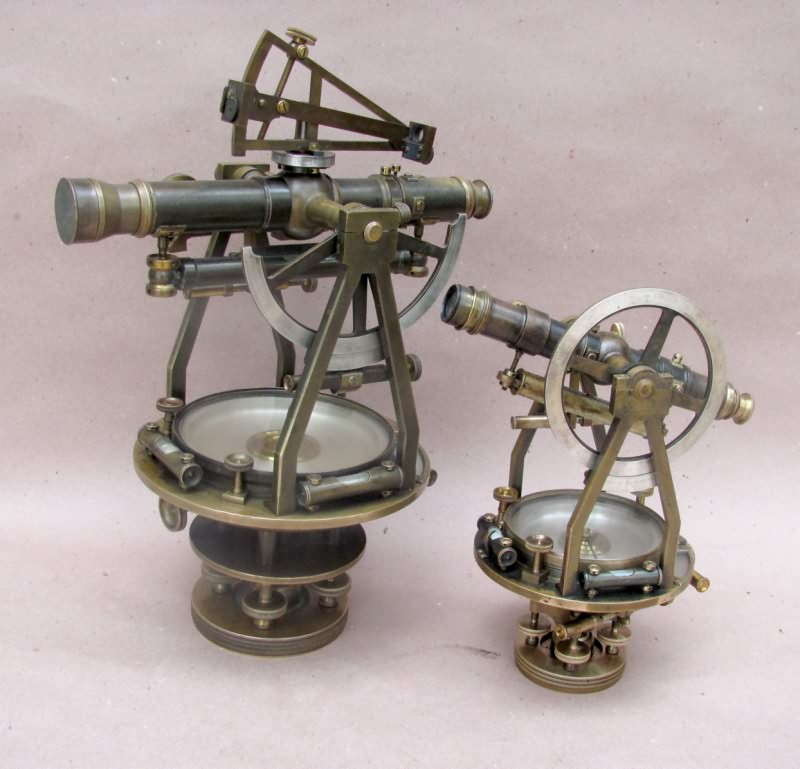 This instrument is in very nice overall condition. It dates from before 1908 as there is no serial number when Gurley started to use them. It has a wonderful mellow patina. The box is nice
as well noting just some scuffing on the exterior.All motions and the
screw are
free. The compass works, and the silvered compass face is very nice. The optional / auxiliary side mount
level is present.The adjusting tool and striding level are present
and stored in the box. All bubbles are good. Also note that there are optional jointed
magnifiers on each side to aid in reading the vernier scales.
This instrument is in very nice overall condition. It dates from before 1908 as there is no serial number when Gurley started to use them. It has a wonderful mellow patina. The box is nice
as well noting just some scuffing on the exterior.All motions and the
screw are
free. The compass works, and the silvered compass face is very nice. The optional / auxiliary side mount
level is present.The adjusting tool and striding level are present
and stored in the box. All bubbles are good. Also note that there are optional jointed
magnifiers on each side to aid in reading the vernier scales. The idea behind solar instruments, either transits or compasses, was that in certain areas the magnetic deviation was so great, and the errors it could cause so great, that these unusual and significant devices were developed as a way to compensate for this effect. The Burt Solar attachment was first Patented in the 1830's to be used on solar compasses. Gurley later bought the rights and offered this style attachment with their instruments. A solar instrument enabled the user to find a true reference or location using the horizon and the position of the sun instead of the standard method employing the compass. Even though the concept had been around and employed in seafaring navigation for centuries, very few of them were actually made for use in the field w/ transits or compasses.They are rare.
Each major surveying instrument maker made a transit that came equipped with one form or another of these devices. The best known names in the surveying instrument field were Gurley and Keuffel & Esser, but Berger, Buff, Dietzgen, Lietz, Sala, and others offered versions of a solar transit. Different attachments are typically known by the name of the inventor, and the examples designed and developed by Saegmuller, Smith, & Burt being the best known solar attachments. The Saegmuller and the Smith utilized secondary small scopes, while the Burt design more closely resembled a octant or sextant in design and used a peep site.
Gurley was located in Troy New York at this time, and their reputation for the manufacture of quality instruments was unsurpassed. This Solar Transit is surely one of the most striking and graphic of forms of surveying instrument that are available not to mention one of the most avidly sought by collectors. Rarely seen or offered for sale in this large size, this transit is the piece that will move your collection to the head of the line. A super piece.
Good + . . . . . . . $2750.00 SOLD!!
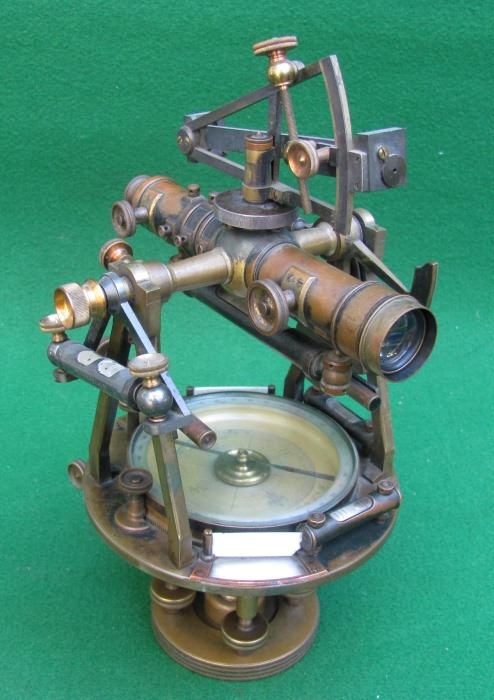 Gurley Solar Transit w/ Burt Patent Solar Attachment in Original Box This
Gurley Solar Transit is in very nice overall condition and dates from the early part
of the last century. This form of surveying instrument, a
light mountain transit equipped
with a factory Burt Patent Solar Attachment is one of the most
desirable and sought after of all surveying related devices ever developed
or offered. The serial number on it indicates the date of manufacture
as being 1913. It has never been cleaned and the brass has a wonderful
mellow patina. Gurley was located in Troy New York at this time, and their
reputation for the manufacture of quality surveying related instruments was
unsurpassed.
Gurley Solar Transit w/ Burt Patent Solar Attachment in Original Box This
Gurley Solar Transit is in very nice overall condition and dates from the early part
of the last century. This form of surveying instrument, a
light mountain transit equipped
with a factory Burt Patent Solar Attachment is one of the most
desirable and sought after of all surveying related devices ever developed
or offered. The serial number on it indicates the date of manufacture
as being 1913. It has never been cleaned and the brass has a wonderful
mellow patina. Gurley was located in Troy New York at this time, and their
reputation for the manufacture of quality surveying related instruments was
unsurpassed. Solar instruments were developed for use in the field to facilitate finding ones location using the sun and horizon much as seamen would do with sextants or octants. Their use was made necessary where ore deposits would adversely affect the accuracy of a regular compass. Even though the concept has been around for many years very few of them were actually made for use in the field. The idea behind solar instruments was that in certain areas the magnetic deviation was so great and the errors it could cause so great that these unusual and significant devices were developed as a way to compensate for this effect. Their use enabled the user to find a true reference or location using the horizon and the position of the sun instead of the standard methods employing just the compass.
Each surveying instrument maker developed or adapted one or more different designs for use on their instruments. K & E primarily used the Saegmuller a small telescope like affair named after the inventor. Gurley used the Burt Patent attachment. Other patented versions of solar attachments were named after the inventor of each, such as Burt, Smith, Pearson, and others.
All motions operate smoothly. The compass face is nice and the compass swings north. Cross hairs are present. This rare & desirable surveying instrument will display very nicely in any number of settings. The box and leather covering are nice as well noting some of the sewn seams coming undone and the small straps showing wear. This Solar Transit is surely one of the most striking and graphic of forms of surveying instrument that are available not to mention one of the most avidly sought. Rarely seen or offered for sale one of these instruments will move your collection to the head of the line.
Fine . . . . . . $3295.00 SOLD!
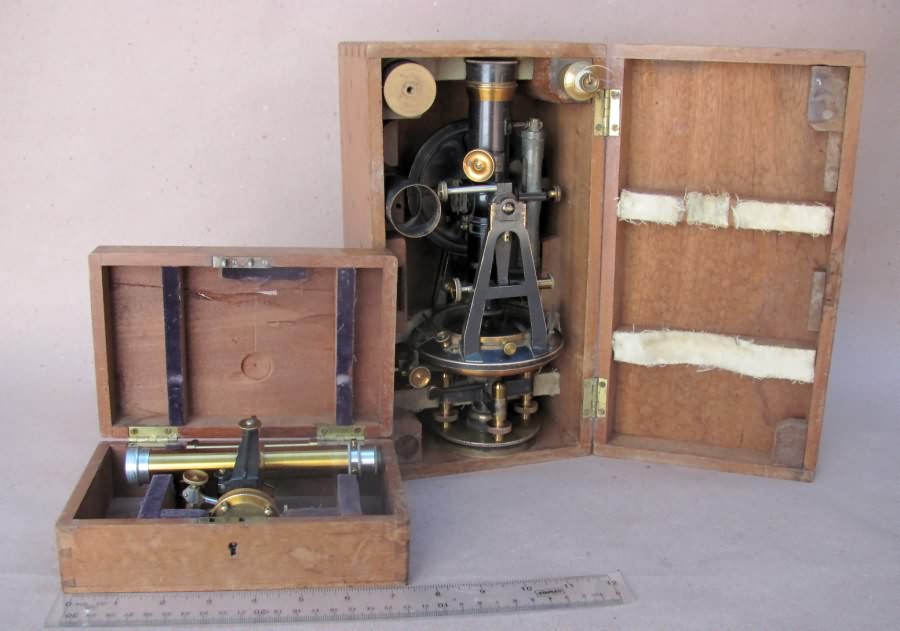
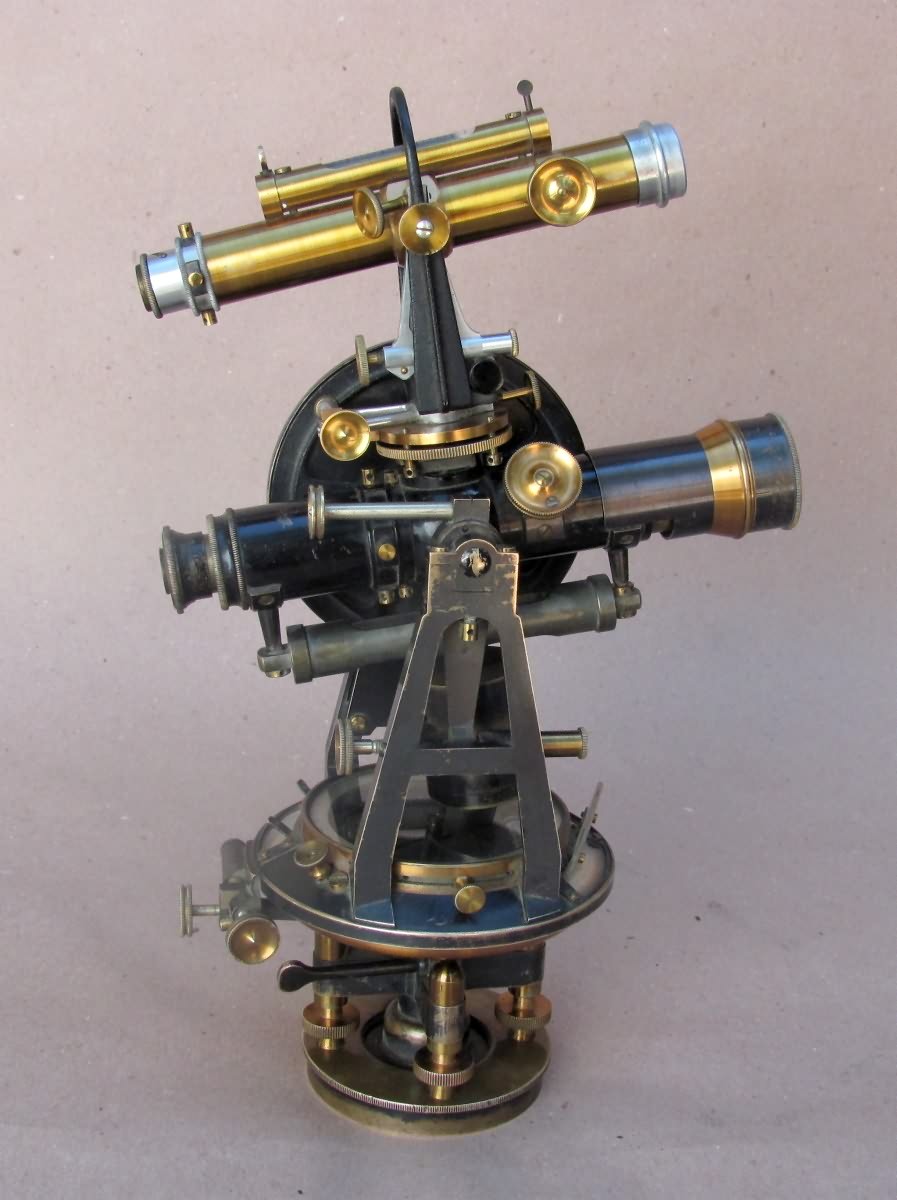 Fauth
&
Co. Solar Transit
w/ George Saegmuller Solar Attachment
This is a rare and unusual solar transit. It is an
expedition size instrument with its main scope just about 7" long. The transit is
double marked with both maker & company names. Under the glass is the name
Fauth & Co. This company was formed in the 1870's between George Saegmuller
and his two brothers in law, Camille Fauth and Henry Lockwood. On the
beveled plate, next to the vernier, it is marked George N. Saegmuller Wash.
DC. This is an unusual feature to be found on any transit, and was very
hard to manufacture and keep in working order.
Fauth
&
Co. Solar Transit
w/ George Saegmuller Solar Attachment
This is a rare and unusual solar transit. It is an
expedition size instrument with its main scope just about 7" long. The transit is
double marked with both maker & company names. Under the glass is the name
Fauth & Co. This company was formed in the 1870's between George Saegmuller
and his two brothers in law, Camille Fauth and Henry Lockwood. On the
beveled plate, next to the vernier, it is marked George N. Saegmuller Wash.
DC. This is an unusual feature to be found on any transit, and was very
hard to manufacture and keep in working order.In later years Saegmuller bought out both partners, first Mr. Lockwood, and
 around the turn of the
century Fauth. Shortly afterward he renamed the company George N.
Saegmuller. I am not sure if this is a transition piece made right near the
turn of the century after he renamed the company, or an earlier instrument made
for Fauth and signed by Saegmuller when he worked as part of Fauth & Co.
around the turn of the
century Fauth. Shortly afterward he renamed the company George N.
Saegmuller. I am not sure if this is a transition piece made right near the
turn of the century after he renamed the company, or an earlier instrument made
for Fauth and signed by Saegmuller when he worked as part of Fauth & Co. George Saegmuller is most famous for his design and patent of the solar attachment you see. He was granted the patent for this idea in the 1870's. The one pictured came with this instrument, but is housed in its own box. The box has some damage to the lid, but looks OK. The optics of the solar attachment are crisp and clear. The eyepiece cap or right angle piece is missing as can be seen. The overall condition is like new.
The transit has an 7" scope and would be designated as a Expedition model. The box for the transit is a study in compactness, and there is no way you could have ever fit the solar attachment in the same box. Being an expedition size they tried to keep everything as small and compact as possible to be easier to transport in the field. The transit is factory fitted with a mount on the top of the scope to accept the solar attachment. Solar attachments gave the user a very exact way to determine their exact location using the sun and the horizon. They were especially useful here in the west or in places where large deposits of minerals or ore could affect the magnetic compass readings allowing for mistakes in the work being performed.
The mahogany box for the transit shows just a few minor scuffs from storage. All motions are free and turn as they should. The optics are perfect and exhibit no cloudiness or other problems. The crosshairs 1 vertical, 3 horizontal, and 2 crossed in the middle are present. The compass needle works, and measures 2 1/2" long . This is a very rare example of a desirable solar transit and one I have not seen offered for sale before. It is an opportunity that will not likely present itself again for a long time.
Excellent . . . . . . .$4750.00 SOLD!!
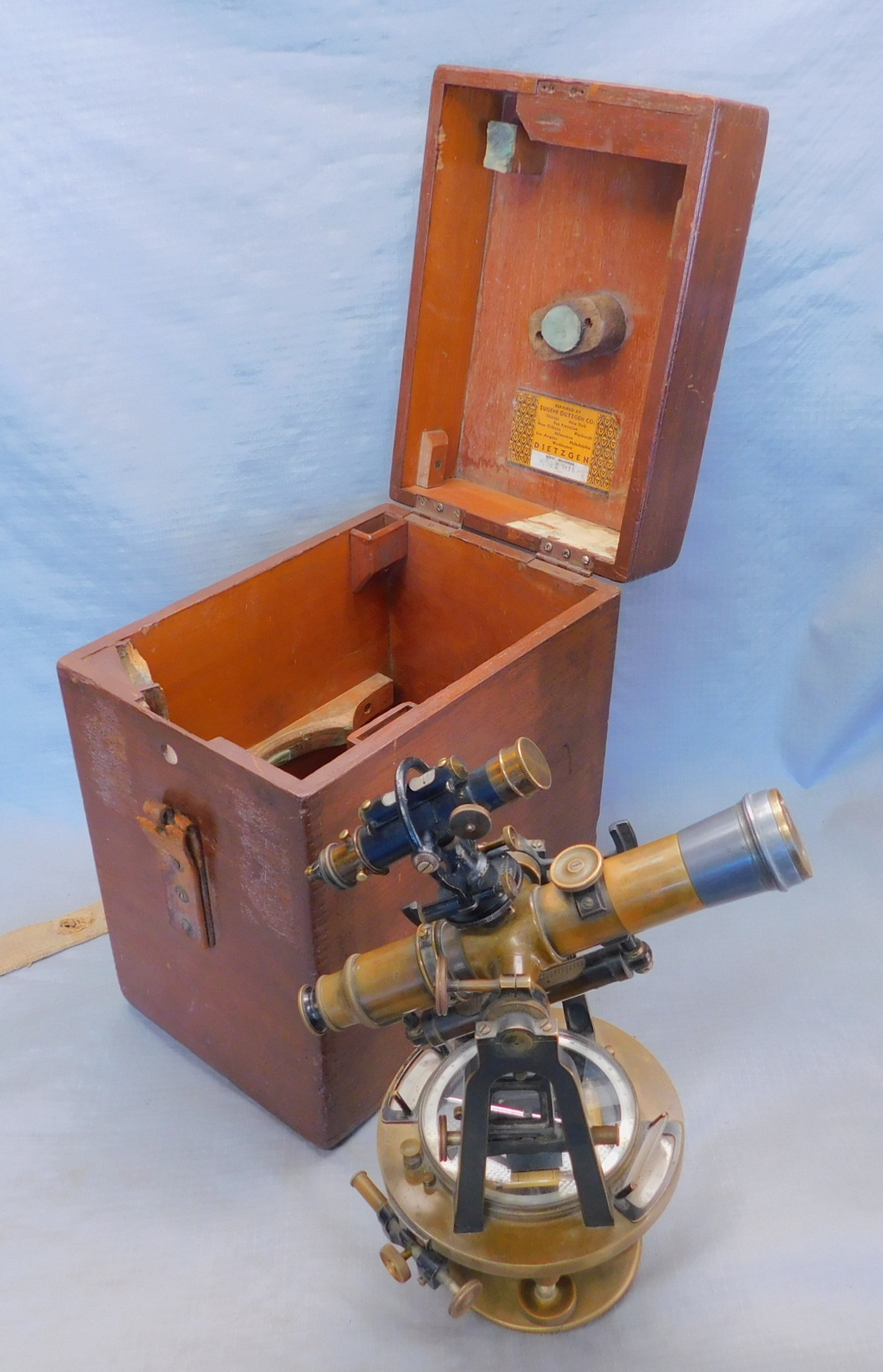 Bausch
& Lomb Transit w/ Saegmuller Solar Attachment Bausch & Lomb
is most famous for their line of binoculars
and other optics but ventured in to the surveying instrument field after George N. Saegmuller joined the company in 1905.
They stopped making things for the general public during WWI so they were
not in the surveying instrument business for long. There is a nice history
on the company at the
SurveyHistory.org
site. This solar transit has the logo the company adopted after 1907 and dates
from right around that time period. Both the transit, and its Saegmuller
Attachment comes in their proper, well worn, original boxes.
Bausch
& Lomb Transit w/ Saegmuller Solar Attachment Bausch & Lomb
is most famous for their line of binoculars
and other optics but ventured in to the surveying instrument field after George N. Saegmuller joined the company in 1905.
They stopped making things for the general public during WWI so they were
not in the surveying instrument business for long. There is a nice history
on the company at the
SurveyHistory.org
site. This solar transit has the logo the company adopted after 1907 and dates
from right around that time period. Both the transit, and its Saegmuller
Attachment comes in their proper, well worn, original boxes. Solar transits were introduced or developed because of issues using magnetic compasses that could be thrown off by mineral deposits where they were being used. The basic idea is to allow the user to find his location using the horizon and sun, much as mariners use a sextant to find their location out on the open seas with no other reference points. This instrument has a Saegmuller design solar attachment that is marked Lietz, the well known California maker from the same general era. It comes in its proper, well worn original box.
The transit is in overall very nice condition with original patina. The compass works as it should. Note the design feature where the plate level bubbles are under the glass w/ the compass. All level bubbles are good. All motions are smooth. The transit optics and crosshairs are good. So are the multiple cross hairs in the attachment. An unusual and nice instrument along with a rare and desirable Saegmuller solar attachment. Both by seldom seen makers. It will make for a nice addition to any collection.
Fine . . . . . . $3295.00 SOLD!!
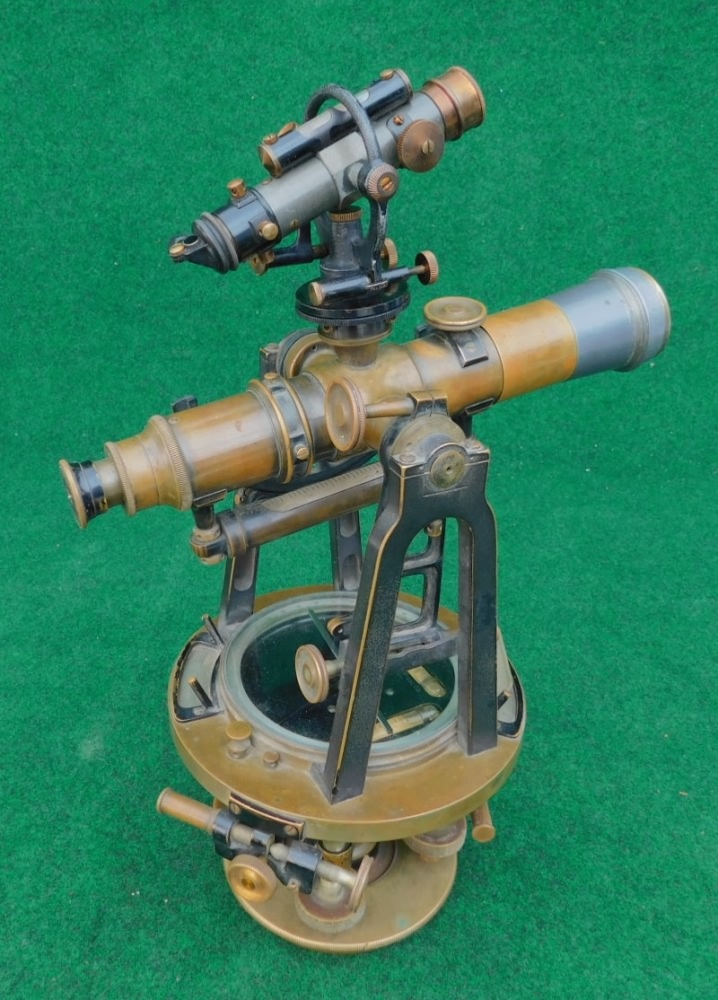 Bausch
& Lomb Solar Transit Solar
transits are a an unusual form of surveying transit.They were introduced or developed because of
issues using compasses that could be thrown off by mineral deposits
where they were being used. The basic
idea is to allow the user to find his location using the horizon and sun,
much as mariners use a sextant to find their location out on the open
seas with no other reference points.
Bausch
& Lomb Solar Transit Solar
transits are a an unusual form of surveying transit.They were introduced or developed because of
issues using compasses that could be thrown off by mineral deposits
where they were being used. The basic
idea is to allow the user to find his location using the horizon and sun,
much as mariners use a sextant to find their location out on the open
seas with no other reference points.Bausch & Lomb are most famous for their line of binoculars and other optics but ventured in to the surveying instrument field after George N. Saegmuller joined the company in 1905. This solar transit has the logo the company adopted after 1907 and dates from right around there. They stopped making things for the general public during WWI so they were not in the surveying instrument business for long. There is a nice history on the company at the SurveyHistory.org site.
The transit is in overall very nice condition. All level bubbles are good, and motions are smooth. The transit optics are good. A nice instrument by a maker seldom seen on the market.
Fine . . . . . . $2795.00
SOLD!!
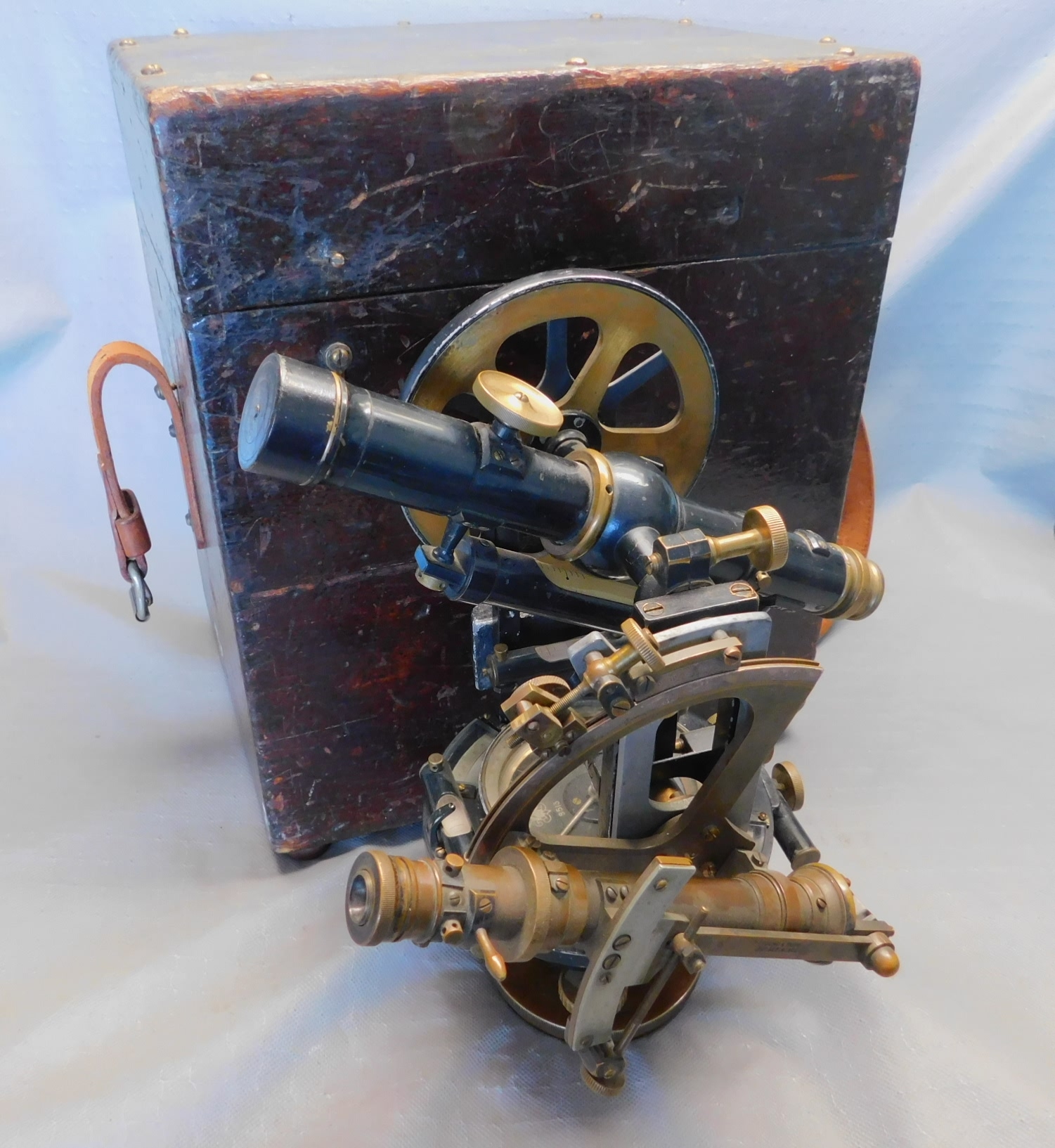 Young
& Sons No. 10 Aluminum Transit w/ Smith Solar Attachment This is a rare Young solar transit with an unusual
Smith Patent Telescopic Solar attachment. This transit is called off as No. 10 in an early Young catalogs. The patent for the solar attachment was
first granted in 1880. This example is an improved model that was patented in 1902. The
8513 serial number on the compass face indicates it dates from shortly after the turn of the century.
Young
& Sons No. 10 Aluminum Transit w/ Smith Solar Attachment This is a rare Young solar transit with an unusual
Smith Patent Telescopic Solar attachment. This transit is called off as No. 10 in an early Young catalogs. The patent for the solar attachment was
first granted in 1880. This example is an improved model that was patented in 1902. The
8513 serial number on the compass face indicates it dates from shortly after the turn of the century.
It has a 4½" horizontal circle, a 4" silvered vertical circle, a 3.3" needle, and a 10" main telescope. The
brass telescope on the Smith solar unit is 7" long,
and is inscribed "Pat Sep 16, 1902." There is a counterweight that mounts on the standard opposite the side with the solar unit. All motions are free
and move smoothly. The compass works as it should. Note that there is a vernier scale on the outside plate, and another under the glass.
Young's
use of Aluminum for many of the different parts of the transit is very
unusual for an instrument from this time period. Although quite a bit
lighter than Brass it was also quite brittle and prone to crack. Its
formulation had not yet been perfected to alleviate that problem. There has been a repair done to an aluminum part of the leveling head that can be seen from the
bottom. A brass ring has been epoxied to the aluminum bell shaped housing
part of the leveling head as it was cracked. That seems to have fixed
the problem and it mounts to a tripod with no issues. The transit fits into the lift top box with the solar
attachment in place. The box shows age but is OK. The proper tripod is
available for an additional $200.00.
Good + . . . . . . $ SOLD!!
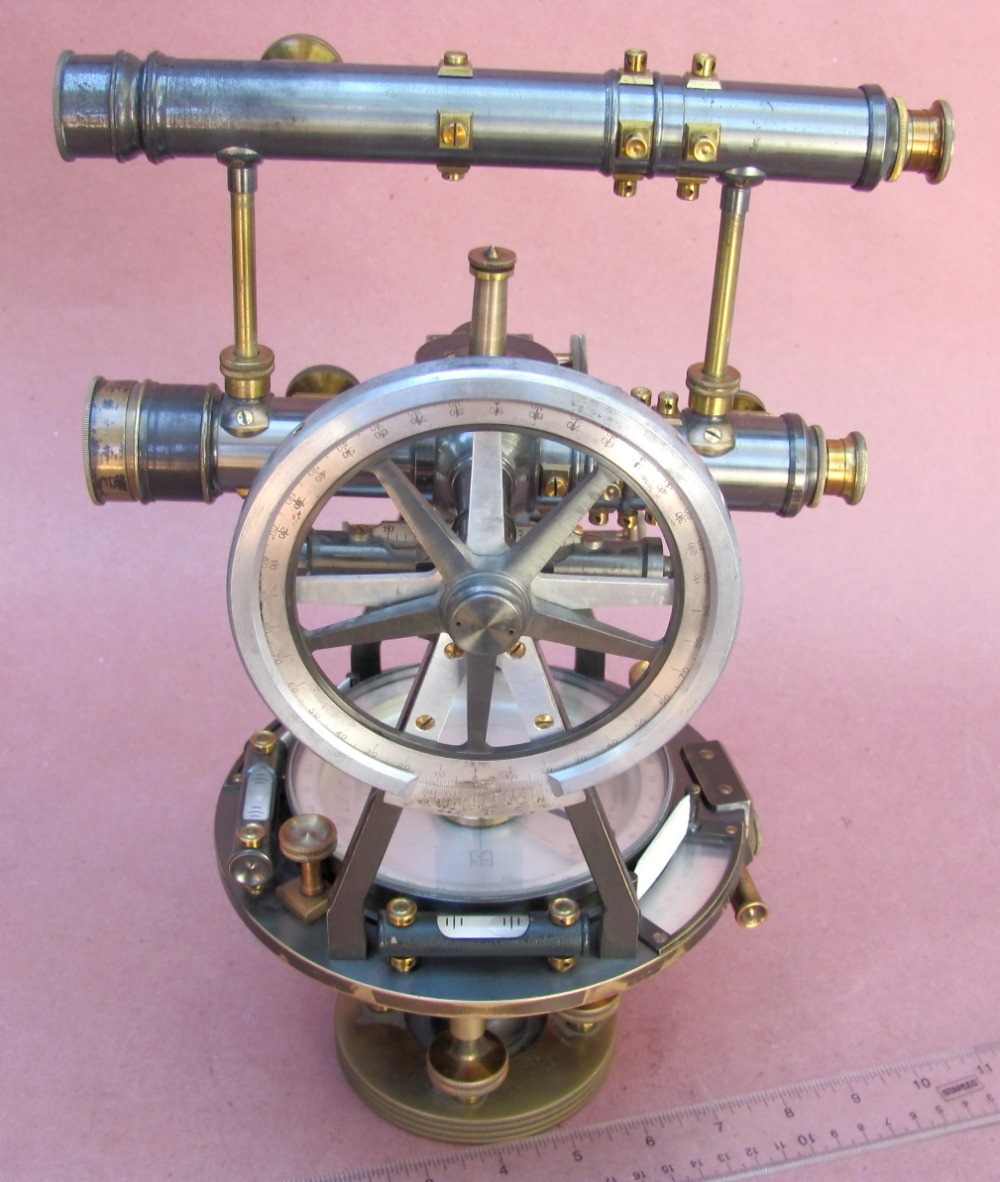 W. & L. E. Gurley #30 Light Mountain Transit Equipped w/ Burt Solar Attachment
& #161 Top Mount Auxiliary Mining Scope
This
Gurley Light Mountain Transit is set up to be used as either a Solar Transit
or Mining transit. It is in like new, hardly ever used condition. It is
obvious that this instrument was not carried into or used in the the
field. The finish on the box, and the condition of the outer leather
carrying case are the nicest I have ever seen. The bronzed finish on the
instrument itself, the scopes and other pieces is near flawless with just
minor losses to high points and edges.
W. & L. E. Gurley #30 Light Mountain Transit Equipped w/ Burt Solar Attachment
& #161 Top Mount Auxiliary Mining Scope
This
Gurley Light Mountain Transit is set up to be used as either a Solar Transit
or Mining transit. It is in like new, hardly ever used condition. It is
obvious that this instrument was not carried into or used in the the
field. The finish on the box, and the condition of the outer leather
carrying case are the nicest I have ever seen. The bronzed finish on the
instrument itself, the scopes and other pieces is near flawless with just
minor losses to high points and edges.The serial number is 12987 which would date it from 1912. The original purchaser ordered bells and whistles for this transit that are rarely seen on one transit and make it a very rare and unusual instrument. The upper tangent lock plate is marked with the name Richard Marsh who I assume was the original purchaser. A Google search for that name turned up no historical info but references to several other people currently associated with surveying . A relative perhaps? Inside the top of the box is a tag with the name Victor M. Vang of Idaho who was associated with the Merger Mines also in that state. Google found several references to him.
In addition to the Burt Solar Attachment & #161 Auxiliary Mining Scope this transit is also equipped with a 4" full circle vertical vernier. It
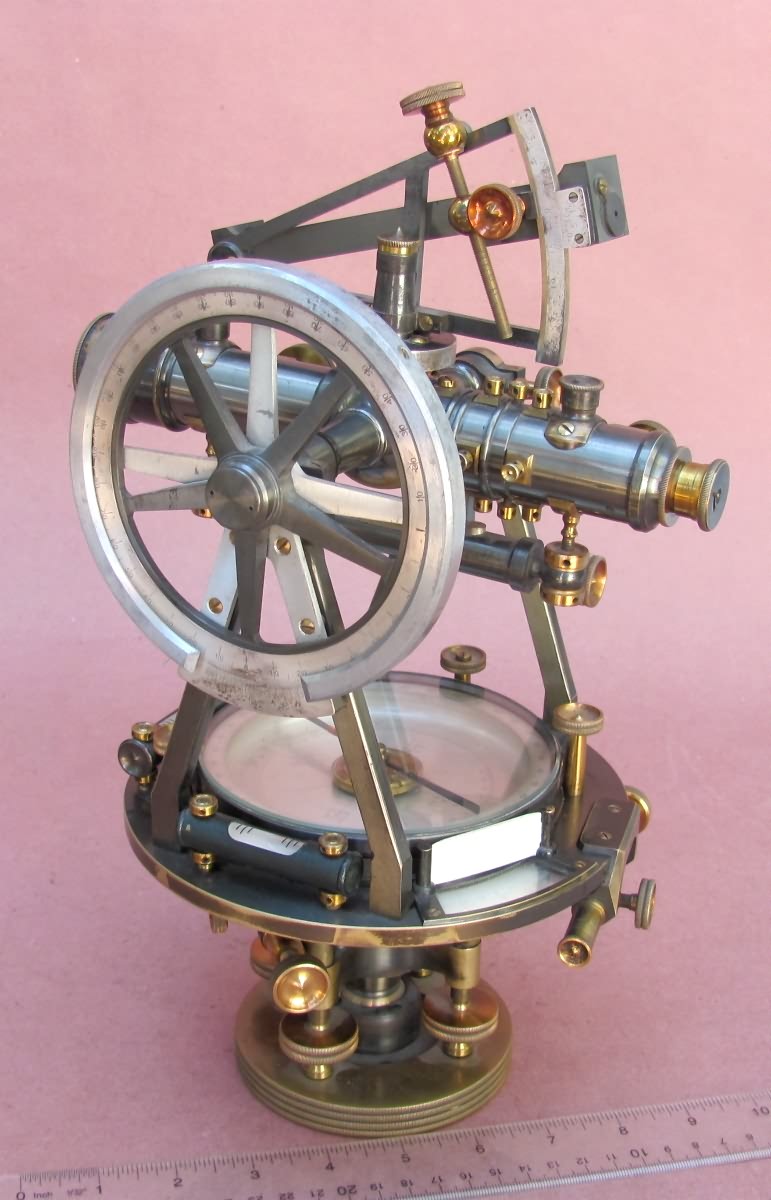 is
protected buy the special order Aluminum cover illustrated in Gurley
catalogs from the era.. The compass needle is 4" and operates properly.
The silvered face of the compass is near perfect. All level vials are full
and original although the small one under the standard is in a different
finish for some reason . The opaque sun shields are present nice. The
brass plumb bob is marked K & E.
is
protected buy the special order Aluminum cover illustrated in Gurley
catalogs from the era.. The compass needle is 4" and operates properly.
The silvered face of the compass is near perfect. All level vials are full
and original although the small one under the standard is in a different
finish for some reason . The opaque sun shields are present nice. The
brass plumb bob is marked K & E. The vernier on the main plate is tight from near 100 years of sitting, but all other motions are free and operate properly. The auxiliary mining scope attaches by means of two coupling nuts designed to mount it over, and precisely in line w/ the scope below. The Burt solar attachment is complete, and marked with the Gurley name as well. The auxiliary level that mounts to the left side of the main frame is present, and also has a fitted place in the box to mount. There is also another auxiliary striding level with a fitted place in the box for use when setting up the instrument. The optics are good and the crosshairs in the main scope are 3 horizontal and one vertical. The crosshairs in the mining scope are a simple cross.
The extendable leg tripod looks like new with the brass fittings still retaining their bright shine and protective lacquer coating. I have provided numerous pics of both the transit and the tripod, so please be sure to look over all of them
This unusual form Gurley transit and accessories are a rare variation. With its original finish and patina this instrument will display very nicely and be the highlight of any instrument collection related to surveying and or mining. A super piece in super condition. Highly Recommended!!
Fine + . . . . . . .$4750.00 SOLD!
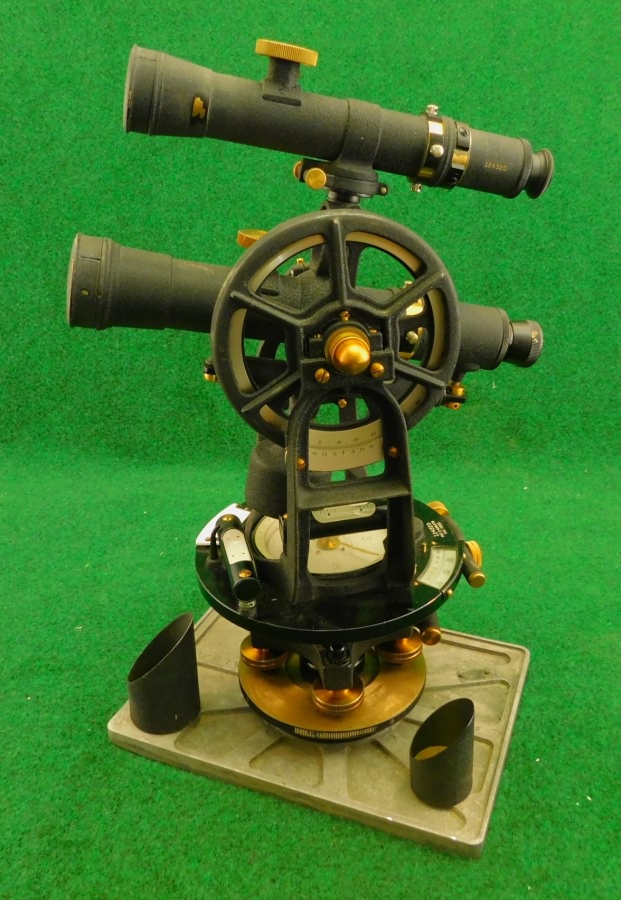 K
& E / Keuffel & Esser # 5081 1/2 Engineers Mining Transit w/ Aux Scope & Attachments in Original Box This
is a very nice condition Engineer's Mining Transit. It is in near
mint original condition. The black crinkle finish is 95% or better
and near pristine noting just a few minor scuffs. It looks to have
seen little use. All motions operate smoothly. The silvered compass
face is flawless, and the 3 1/2" Gold compass needle swings north.
Cross hairs are present in both scopes. 1 white plastic vernier
scale cover is missing. NO other apologies.
K
& E / Keuffel & Esser # 5081 1/2 Engineers Mining Transit w/ Aux Scope & Attachments in Original Box This
is a very nice condition Engineer's Mining Transit. It is in near
mint original condition. The black crinkle finish is 95% or better
and near pristine noting just a few minor scuffs. It looks to have
seen little use. All motions operate smoothly. The silvered compass
face is flawless, and the 3 1/2" Gold compass needle swings north.
Cross hairs are present in both scopes. 1 white plastic vernier
scale cover is missing. NO other apologies.The serial # 124,320 is found on the box, the horizontal plate of the instrument and is on the second scope as well. That dates this mining transit from 1952 according to the charts available at www.surveyhistory.org.The K & E marked loupe, plumb bob, oiler and more are all present. Note how the plumb bob comes apart and is made to hold a second tip. An unusual feature that is not seen very often.
Mining transits were developed for use in mines or places where the user would need to shoot a line where the plate would be in the way. The scope could be mounted on either the top over the main scope, or on the outboard side. The counterweight is also present.
This graphic, rare & desirable Mining related surveying instrument will display very nicely in a mining collection or a number of other collections. Very Nice!!
Fine + . . . . . . $1250.00 SOLD!!
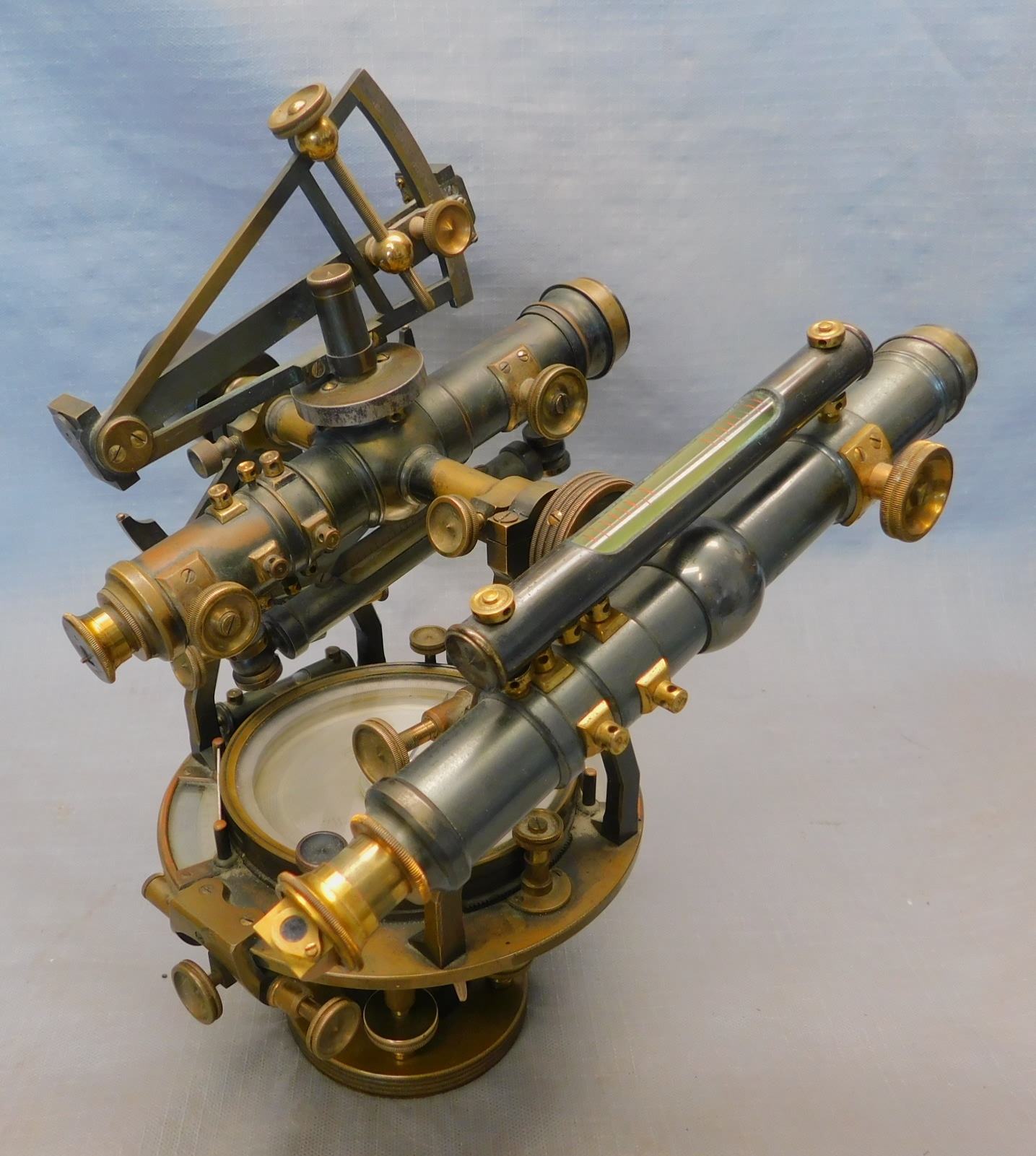 W. & L. E. Gurley #30 Light Mountain Transit Equipped w/ Burt Solar Attachment
& Auxiliary Side Mount Mining Scope This
Gurley Light Mountain Transit is set up to be used as both a Solar and Mining transit. It is in
nice used condition with the instrument and solar showing more wear than the
aux. mining scope which looks to have seen little use at all.
W. & L. E. Gurley #30 Light Mountain Transit Equipped w/ Burt Solar Attachment
& Auxiliary Side Mount Mining Scope This
Gurley Light Mountain Transit is set up to be used as both a Solar and Mining transit. It is in
nice used condition with the instrument and solar showing more wear than the
aux. mining scope which looks to have seen little use at all.There is no serial # dating it from prior to 1908. It is dated 1889 under the plate. It also has the makers initials and other info there. (see pics). The original purchaser ordered bells and whistles for this transit that are rarely seen on one transit and make it a very rare and unusual instrument. In addition to the Burt Solar Attachment & #161 Auxiliary Mining Scope this transit is also equipped with a 4" half circle vernier scale. The compass needle is 4" and operates properly. The silvered face of the compass is nice. All level vials are full. The opaque sun shields is present.
The auxiliary mining scope attaches using the large knurled thumbscrew on one side. On the opposite side the scope axle is threaded to accept a solid brass counterweight. The Burt solar attachment is marked Gurley. The optics are good and the crosshairs in the main scope are 3 horizontal and one vertical. The crosshairs in the mining scope are a simple cross. The extendable leg tripod looks good with a repair to one clamp.
This unusual form Gurley transit is a rare variation. This unusual instrument will display very nicely and be the highlight of any instrument collection related to surveying, mining or engineering. An unusual and super piece in nice overall condition. Recommended!!
Good + . . . . . $3495.00 SOLD!!
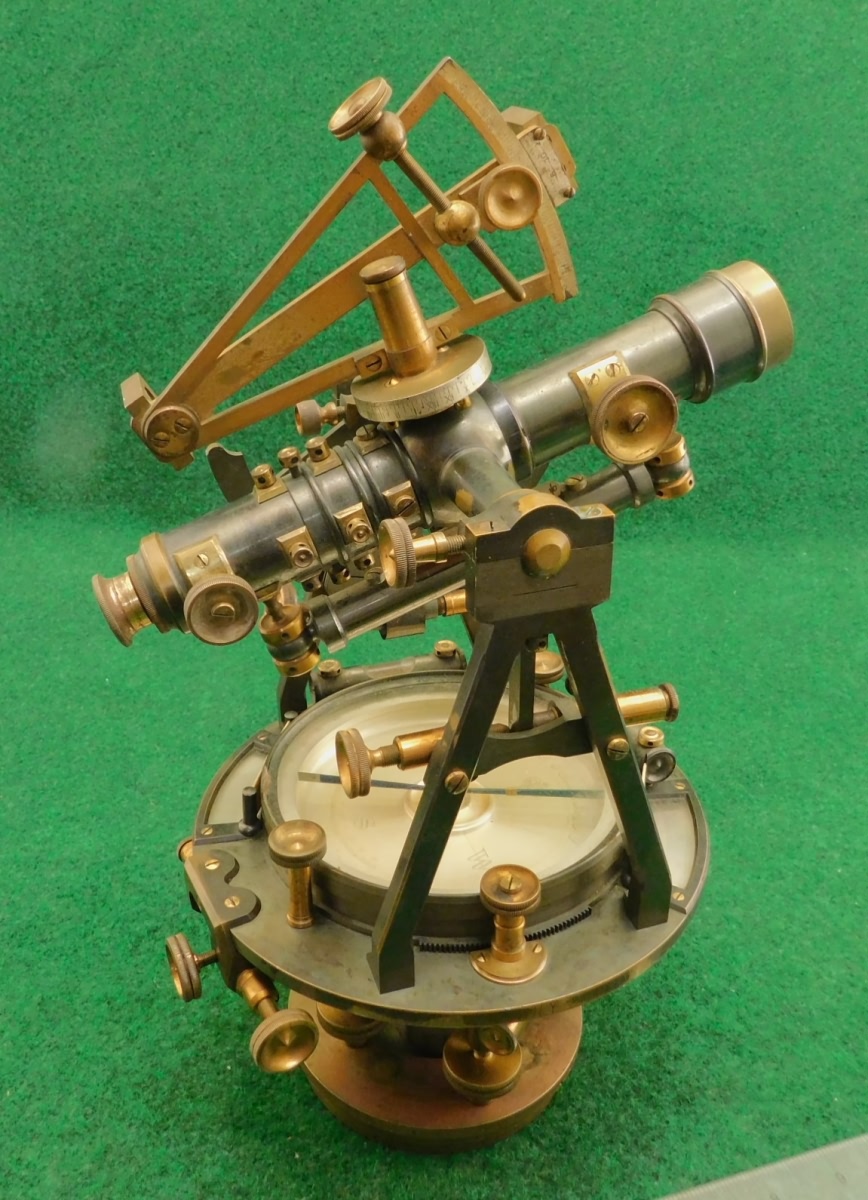 W. & L. E. Gurley
Light Mountain Solar Transit w/ Burt Patent Solar Attachment in Original Box This
W. & L. E. Gurley Solar Transit is in nice overall condition. W.
& L. E. Gurley was located in Troy New York and their reputation for the
manufacture of quality surveying related instruments was unsurpassed. Having no
serial # dates from before 1908. The bent standards indicate it dates
from after 1880. Solar Transits are one of the most
sought after and desirable of all surveying related devices ever developed
or offered.They are very graphic and make for great display pieces.
W. & L. E. Gurley
Light Mountain Solar Transit w/ Burt Patent Solar Attachment in Original Box This
W. & L. E. Gurley Solar Transit is in nice overall condition. W.
& L. E. Gurley was located in Troy New York and their reputation for the
manufacture of quality surveying related instruments was unsurpassed. Having no
serial # dates from before 1908. The bent standards indicate it dates
from after 1880. Solar Transits are one of the most
sought after and desirable of all surveying related devices ever developed
or offered.They are very graphic and make for great display pieces. Solar instruments were developed for use in the field to facilitate finding ones location using the sun and horizon much as seamen would do with sextants or octants. Their use was made necessary where ore deposits would adversely affect the accuracy of a regular compass. Even though the concept has been around for many years very few of them were actually made for use in the field. The idea behind solar instruments was that in certain areas the magnetic deviation was so great and the errors it could cause so great that these unusual and significant devices were developed as a way to compensate for this effect. Their use enabled the user to find a true reference or location using the horizon and the position of the sun instead of the standard methods employing just the compass.
All motions operate smoothly. The compass face is nice and the compass swings north. Cross hairs are present. There is no attachment point in the box for the attachment. Nor is there a striding level or the adjustment bar. The Burt attachment is clearly marked W. & L. E. Gurley. A metal carrying handle has been added to the box. It operates as intended and looks good. This W. & L. E. Gurley Solar Transit is one of the most striking and graphic of forms of surveying instrument that are available not to mention one of the most avidly sought. Rarely seen or offered for sale one of these instruments will move your collection to the head of the line.
Good . . . . . . . $2250.00 w attachment SOLD!!
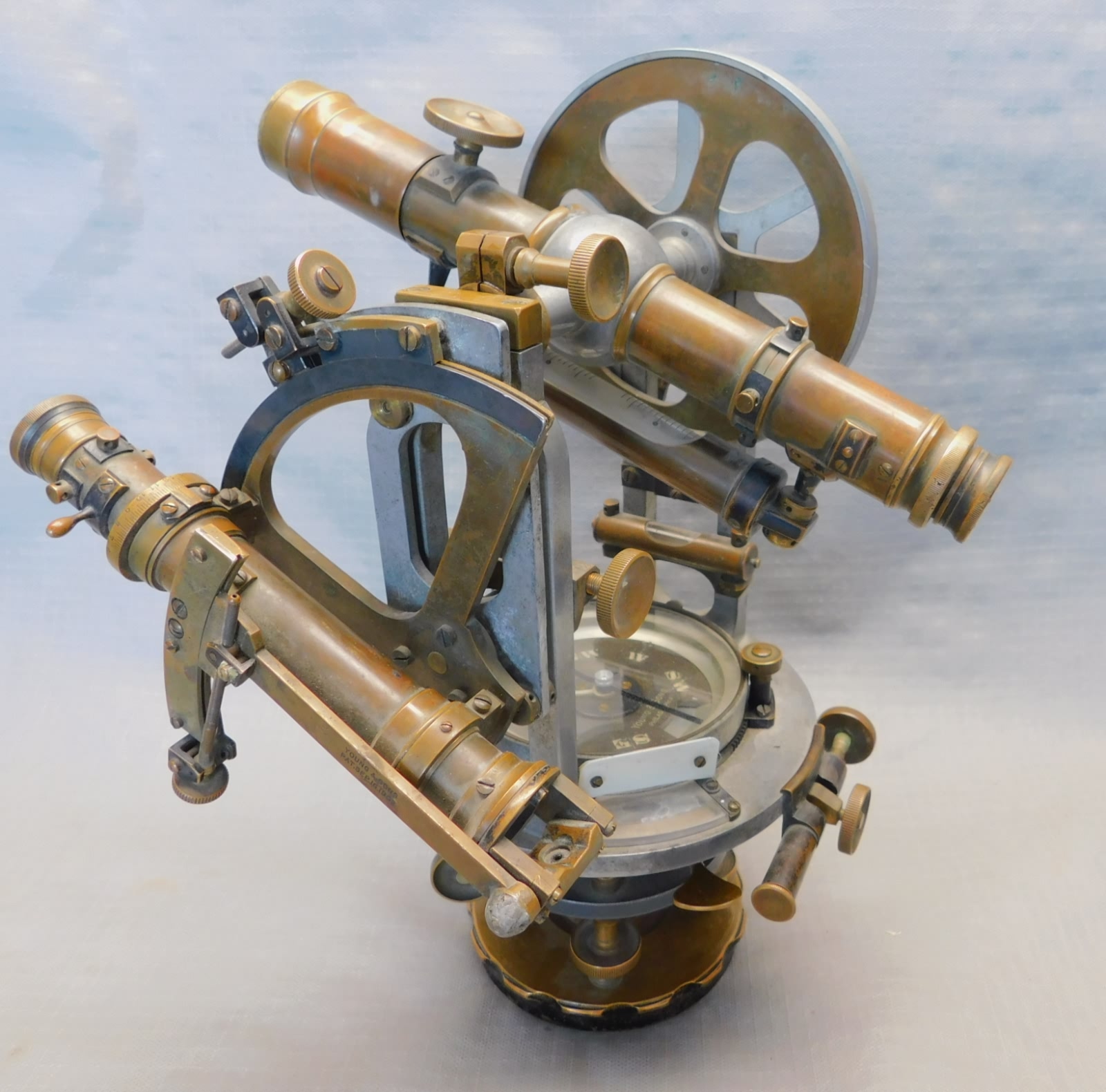 Young
& Sons # 10 Solar Transit with Smith Patent Telescopic Solar Attachment in
Original Box This rare c. 1913 Young Solar
Transit with an unusual Smith Patent Telescopic Solar Attachment is in very nice
overall condition. It includes the box and a nicely refinished tripod. A
graphic and commanding piece for display or addition to many collections.
Young
& Sons # 10 Solar Transit with Smith Patent Telescopic Solar Attachment in
Original Box This rare c. 1913 Young Solar
Transit with an unusual Smith Patent Telescopic Solar Attachment is in very nice
overall condition. It includes the box and a nicely refinished tripod. A
graphic and commanding piece for display or addition to many collections.Young solar transits are called off as model No. 10 in early Young catalogs. The patent for the Smith solar attachment was first granted in 1880. This solar transit carries an improved model solar attachment that was re-issued a patent in 1902 and is so stamped. The 8484 serial number on the face of the compass on the transit dates it from shortly after the turn of the century.
Young's use of Aluminum for many of the different parts of the solar transit is very unusual for an instrument from this time period. The transit has a 4½" horizontal circle, a 4" silvered vertical circle, a 3.3" needle, and a 10" main telescope. The telescope on the Smith solar unit is 7" long, and is inscribed "Pat Sep 16, 1902." All motions are free and move smoothly. The optics are clean and clear and it has 3 horizontal and 1 vertical crosshair. The compass swings to north, and the needle lock works as it should. Note that there is a vernier scale on the outside plate, and another under the glass. The different scales are all silvered w/ tarnish. The transit fits into the lift top box with the solar attachment in place. The box shows its age but is OK. The tripod is included in the price.
Fine . . . . . . $2850.00 SOLD!!
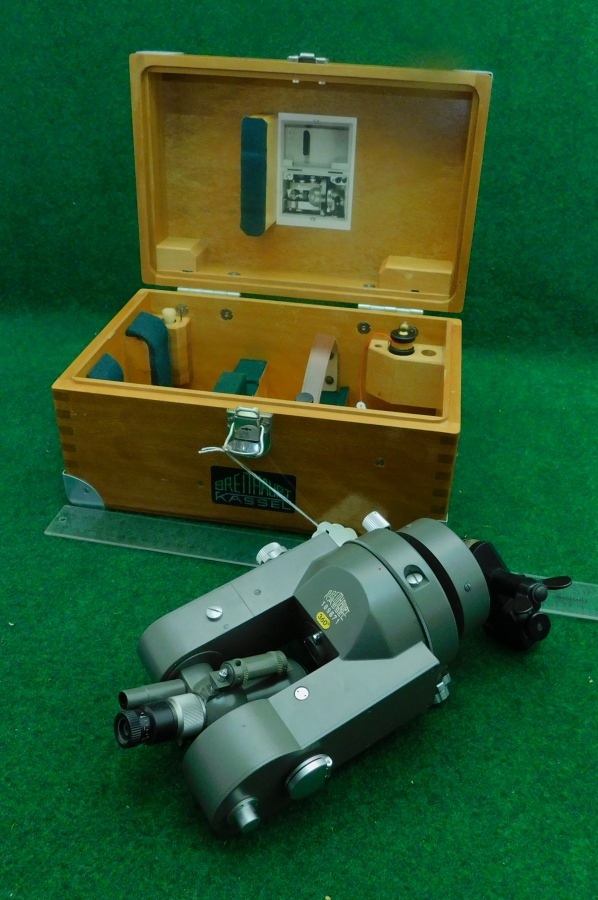 Breithaupt
/ Kassel Mining Suspension Theodolite in Box
This unusual instrument is NOS never been used. It appears it was sold
through K & E and dates from the 70's. There is a translated set of
instructions for use and a K & E bulletin announcing their carrying the
product is included. Basically it
is a theodolite designed to be hung upside down from preset points installed
in mines or tunnels.
Breithaupt
/ Kassel Mining Suspension Theodolite in Box
This unusual instrument is NOS never been used. It appears it was sold
through K & E and dates from the 70's. There is a translated set of
instructions for use and a K & E bulletin announcing their carrying the
product is included. Basically it
is a theodolite designed to be hung upside down from preset points installed
in mines or tunnels.
I found another in a collection with a good
description
http://www.sage.unsw.edu.au/currentstudents/ug/projects/f_pall/html/t11.html.
I did not do a good job of showing the knuckle joint like attachment on the
bottom that one would use to mount it from the ceiling of the mine or
tunnel. Different, Unusual, and Very Nice!!
Fine . . . . . . $495.00 SOLD!!
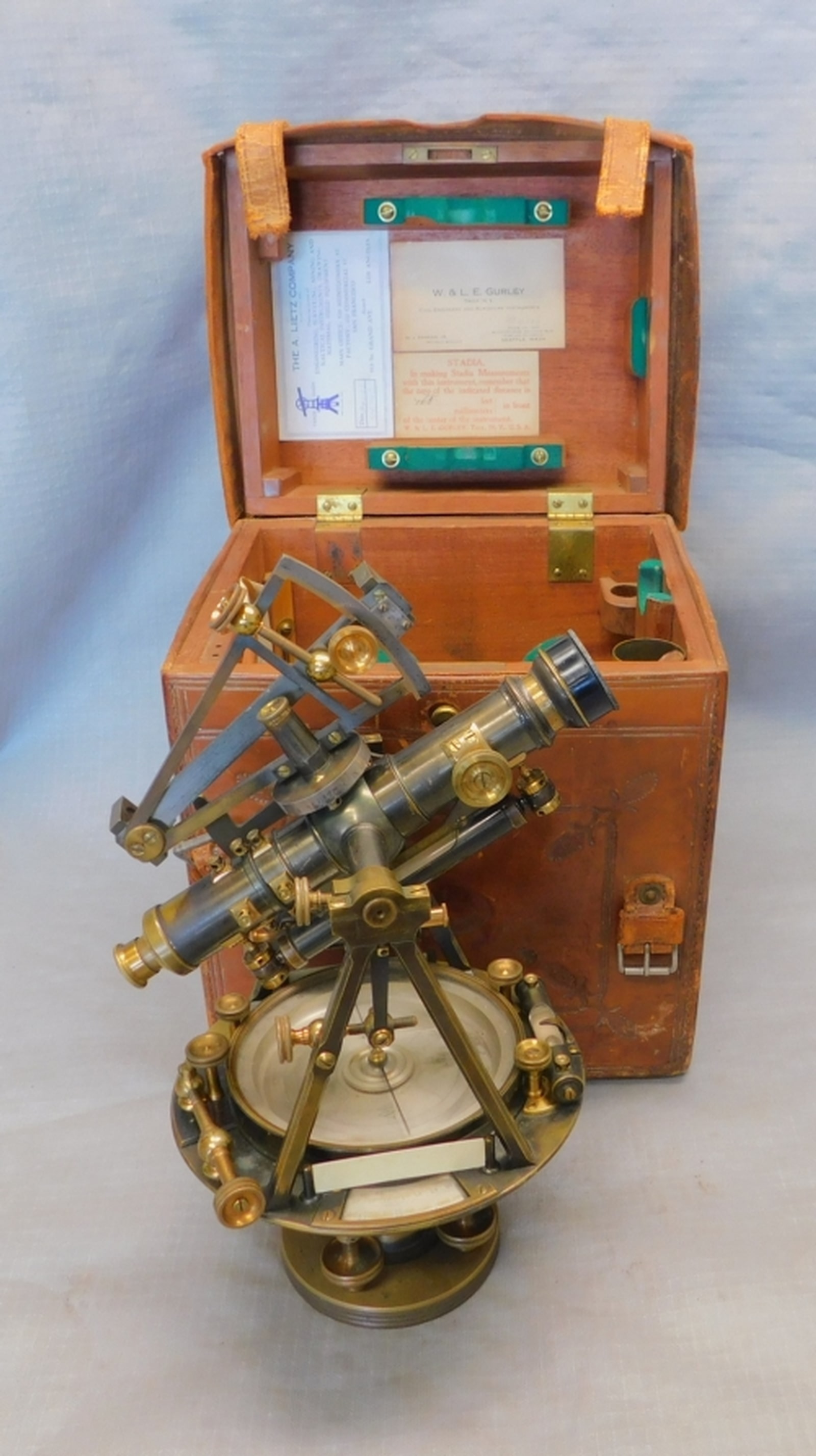 W. & L. E. Gurley
Light Mountain Solar Transit w/ Burt Patent Solar Attachment in Original Box This
c. 1880s W. & L. E. Gurley Solar Transit is in fine overall condition. W.
& L. E. Gurley was located in Troy New York and their reputation for the
manufacture of quality surveying related instruments was unsurpassed. Having no
serial # dates it from before 1908. The straight leg A standards indicate it dates
from the 1880s. The design of the Burt Attachment confirms that as well.
W. & L. E. Gurley
Light Mountain Solar Transit w/ Burt Patent Solar Attachment in Original Box This
c. 1880s W. & L. E. Gurley Solar Transit is in fine overall condition. W.
& L. E. Gurley was located in Troy New York and their reputation for the
manufacture of quality surveying related instruments was unsurpassed. Having no
serial # dates it from before 1908. The straight leg A standards indicate it dates
from the 1880s. The design of the Burt Attachment confirms that as well. Solar Transits are one of the most sought after and desirable of all surveying related instruments developed or offered. They are very graphic and make for great display pieces.
Solar instruments were developed for use in the field to facilitate finding ones location using the sun and horizon much as seamen would do with sextants or octants. Their use was made necessary where ore deposits would adversely affect the accuracy of a regular compass. Their use enabled the user to find a true reference or location using the horizon and the position of the sun instead of the standard methods employing just the compass.
All motions operate smoothly. The compass face is nice and the compass needle swings north. Cross hairs are present. The Burt attachment is clearly marked W. & L. E. Gurley and the 1867 patent date. Also includes is the original leather covered box and collapsible leg tripod. There is a Lietz repair tag from 1946 outlining the minor repairs and adjustments performed. It looks to have seen little or no use after that.
This W. & L. E. Gurley Solar Transit is one of the most striking and graphic of forms of surveying instrument that are available not to mention one of the most avidly sought. Rarely seen or offered for sale one of these instruments will move your collection to the head of the line.
Fine . . . . . . . $3275.00 SOLD!!
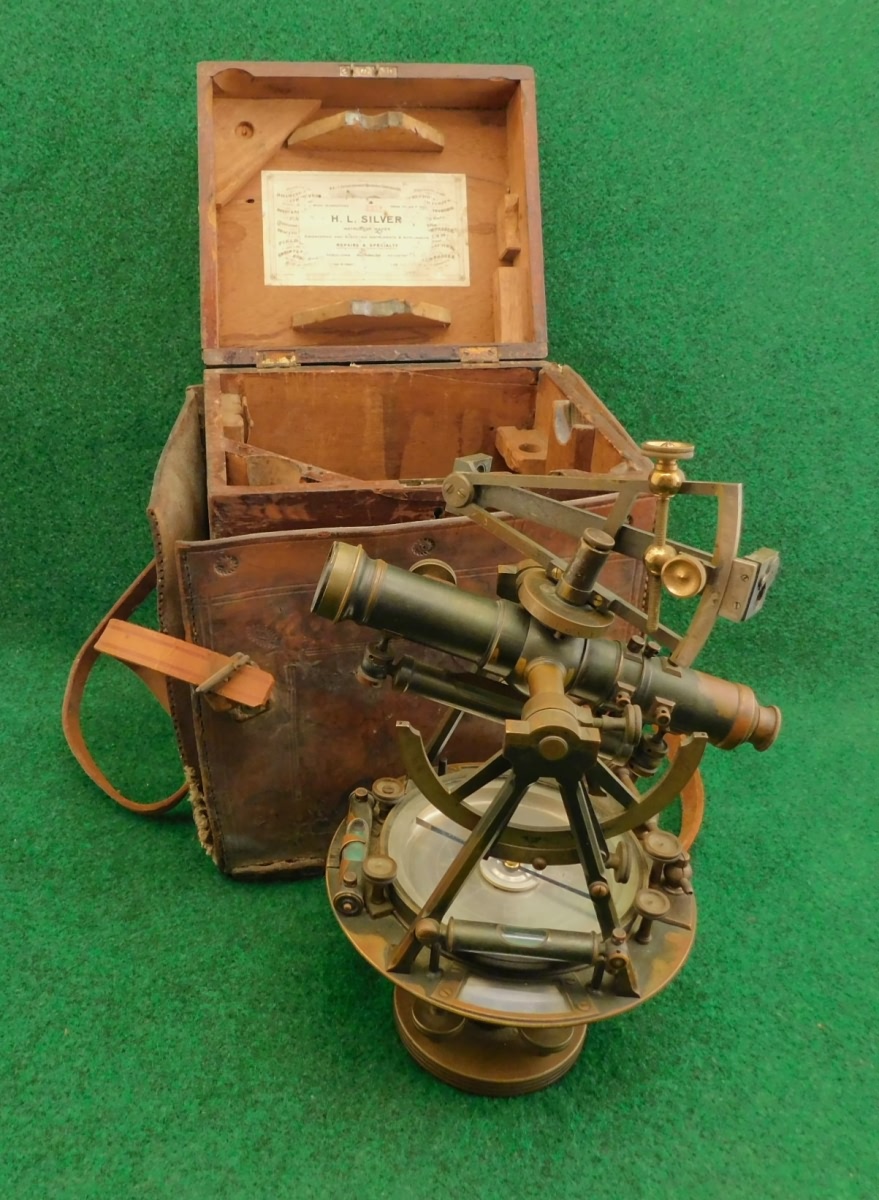 W. & L. E. Gurley
Light Mountain Transit w/ Burt Patent Solar Attachment in Original Box Solar Transits are one of the most
sought after and desirable of all surveying instruments as they are so graphic and make
for great display pieces. This
W. & L. E. Gurley Transit w/ Burt Solar Attachment is in nice overall condition. Having no
serial # dates this transit from before 1908 and the straight leg A standards
further indicates it dates
from before 1880. Beyond that it is difficult to accurately pinpoint the
exact date of manufacture.
W. & L. E. Gurley
Light Mountain Transit w/ Burt Patent Solar Attachment in Original Box Solar Transits are one of the most
sought after and desirable of all surveying instruments as they are so graphic and make
for great display pieces. This
W. & L. E. Gurley Transit w/ Burt Solar Attachment is in nice overall condition. Having no
serial # dates this transit from before 1908 and the straight leg A standards
further indicates it dates
from before 1880. Beyond that it is difficult to accurately pinpoint the
exact date of manufacture. Solar instruments were developed for use in the field to facilitate finding ones location using the sun and horizon much as seamen would do with sextants or octants on the open sea.Their use on land was made necessary where ore deposits would adversely affect the accuracy of a regular compass. The idea behind solar instruments was that in certain areas the magnetic deviation was so great and the errors it could cause so great that these unusual devices were developed as a way to compensate for this effect. Their use enabled the user to find a true reference or location using the horizon and the position of the sun instead of the standard methods employing the compass.
All motions operate smoothly. The compass swings north. Cross hairs are present. There is an attachment point in the box for the attachment. There is no striding level or adjustment bar. The Burt solar attachment is clearly marked W. & L. E. Gurley. The leather cover for the box has seen better days with the top potion missing entirely. Rarely seen or offered for sale one of these instruments will move your collection to the head of the line.
Good . . . . . . . $2250.00 w attachment SOLD!!
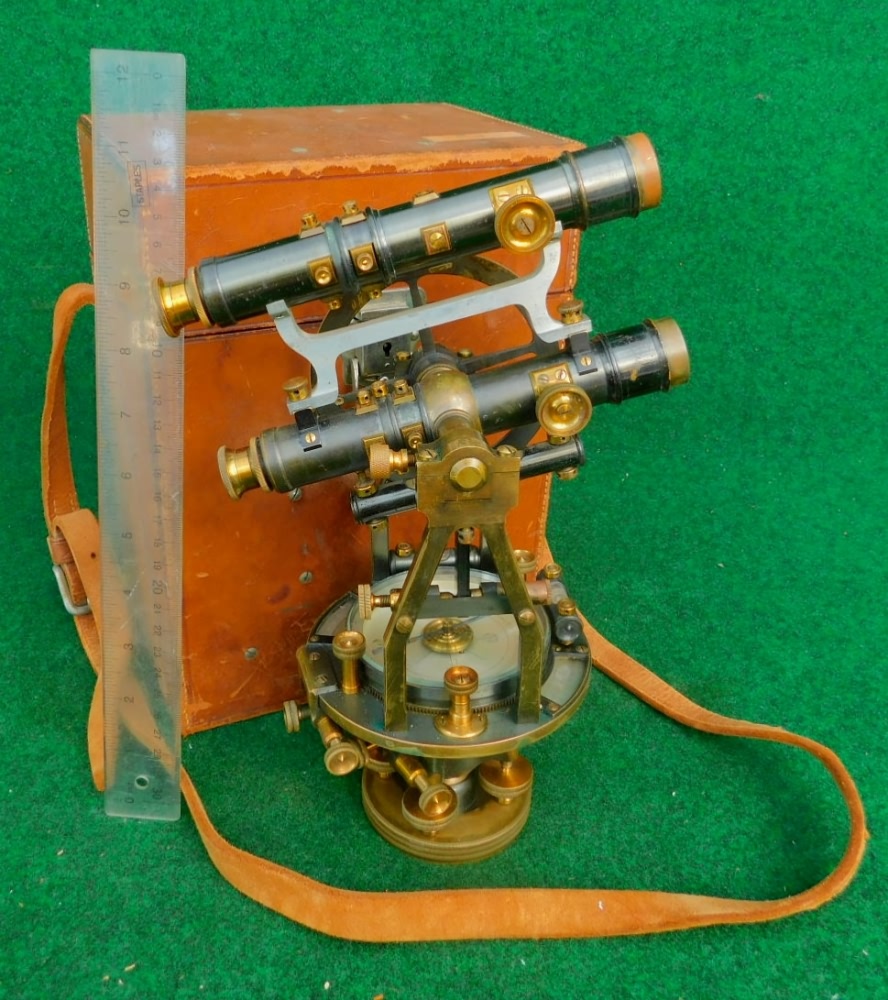 Gurley
Explorer / Expedition Size Mining Transit w/ 2nd Auxiliary Scope
A
fabulous piece of rare surveying / mining equipment in Fine + condition. Even the leather covering on the
box is still nice.This unusual and probably unique explorer size
mining transit was obviously special ordered from the Gurley
factory in Troy New York as this set-up, on this small an instrument, is not
described or offered in any Gurley catalog I have ever seen. The 2
point mounting for the second scope is different from anything Gurley
typically offered. The
serial # of 13376 would date it from 1913.
Gurley
Explorer / Expedition Size Mining Transit w/ 2nd Auxiliary Scope
A
fabulous piece of rare surveying / mining equipment in Fine + condition. Even the leather covering on the
box is still nice.This unusual and probably unique explorer size
mining transit was obviously special ordered from the Gurley
factory in Troy New York as this set-up, on this small an instrument, is not
described or offered in any Gurley catalog I have ever seen. The 2
point mounting for the second scope is different from anything Gurley
typically offered. The
serial # of 13376 would date it from 1913.Everything works properly and the crosshairs are present in both scopes. All motions are free and smooth and the optics are crisp and clear. It also includes the aux. pieces as seen in the pics. The rare near miniature tripod is also included, noting the leg extensions are gone and one clamp is broken,. i have another one of this tripods listed that would make this complete. If this instrument is sold I will sell that tripod to the buyer for 1/2 price. It is in fine condition with the exception of several broken leg clamps.
Good + . . . . . . . $3950.00 SOLD!!
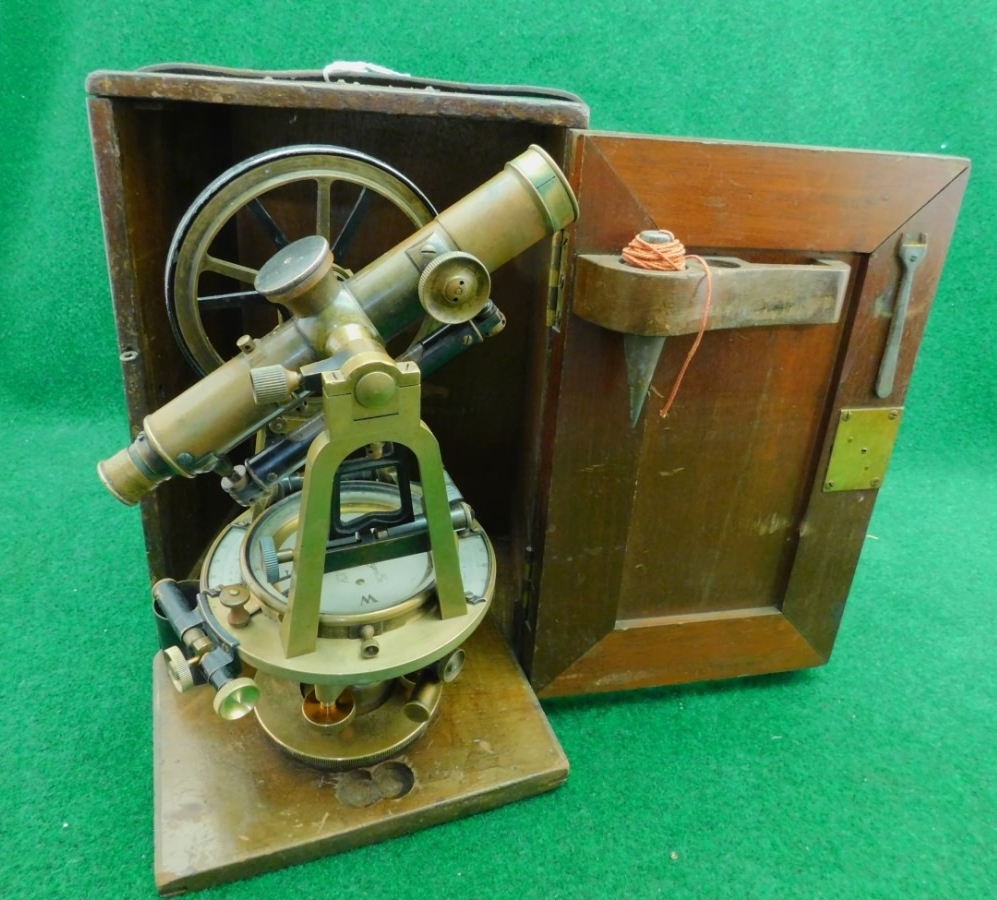 Dietzgen Solar
Transit This c. 1900 Dietzgen Solar
transit is in nice condition. It is a light mountain or preliminary survey
size instrument and has a 9" scope. It has a female threaded mounting point
on the top of the scope for a solar attachment. It is being sold w/o the attachment. All motions are free and smooth.
Good optics w/ crosshairs. Compass points north. Nice even
patina. An overall nice piece in nice condition.
Dietzgen Solar
Transit This c. 1900 Dietzgen Solar
transit is in nice condition. It is a light mountain or preliminary survey
size instrument and has a 9" scope. It has a female threaded mounting point
on the top of the scope for a solar attachment. It is being sold w/o the attachment. All motions are free and smooth.
Good optics w/ crosshairs. Compass points north. Nice even
patina. An overall nice piece in nice condition.
Good + . . . . . . . $495.00 w/o attachment SOLD!!
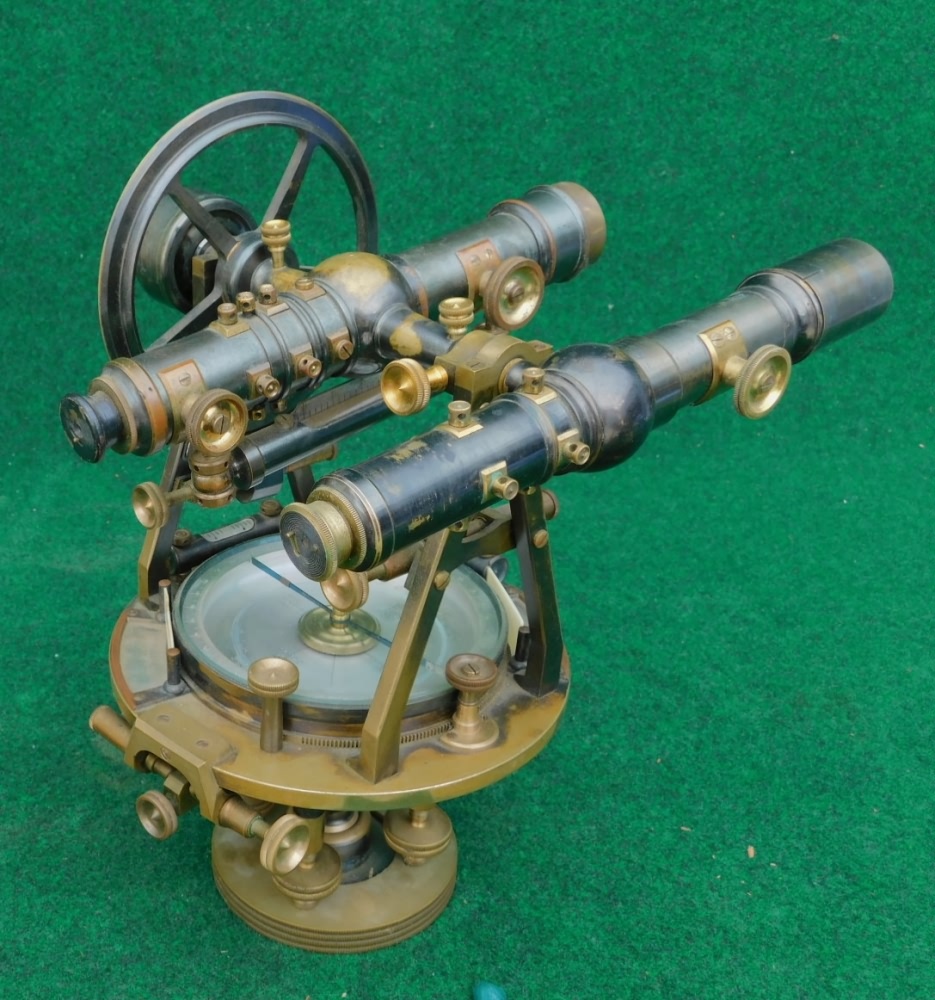 Gurley Light Mountain Mining Transit
This is a rare Gurley Mining Transit on a Light Mountain size
transit frame and different from what is typically seen.
Gurley Light Mountain Mining Transit
This is a rare Gurley Mining Transit on a Light Mountain size
transit frame and different from what is typically seen.
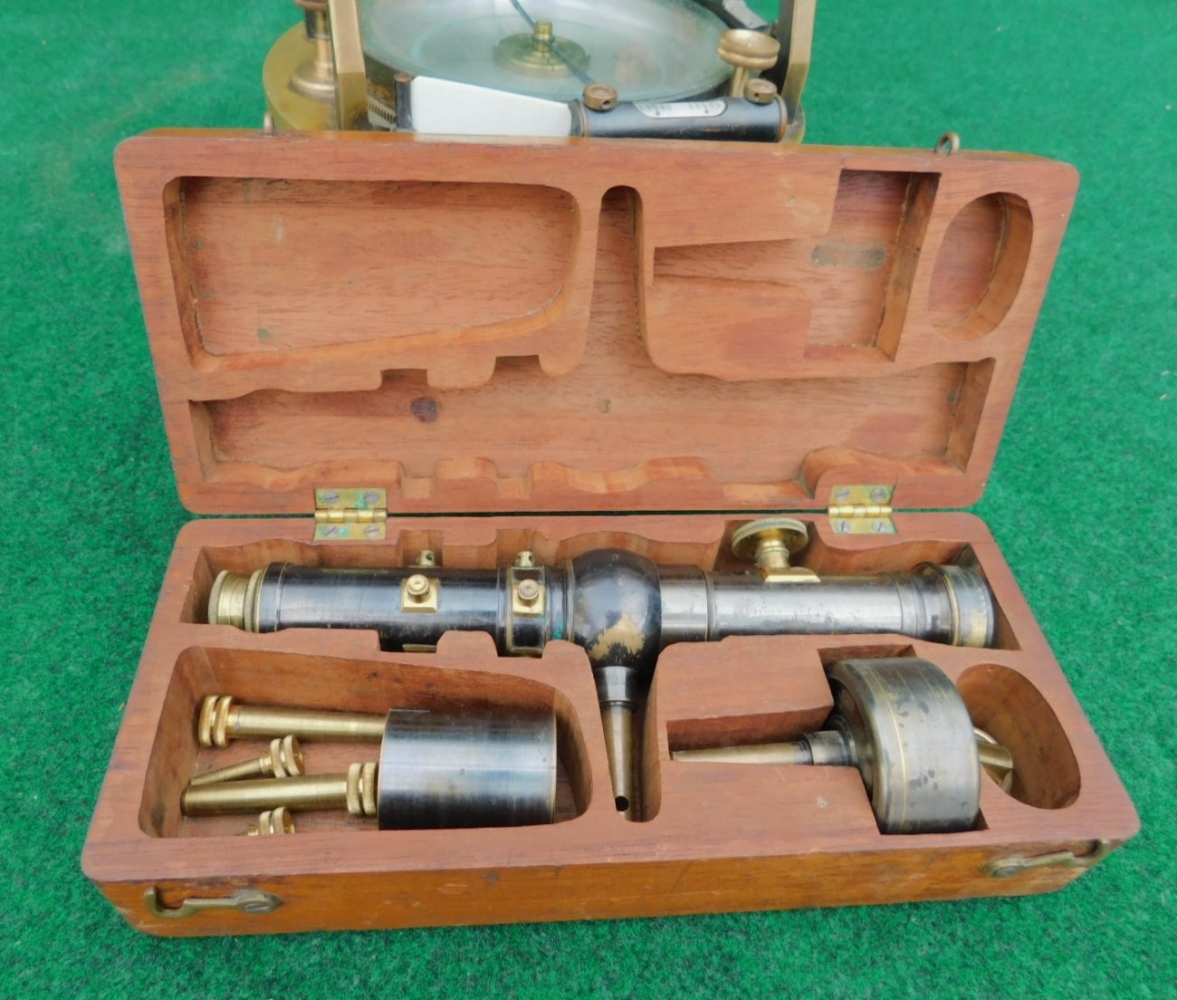
Brian Aregood shows a similar but slightly different version of this mining transit in his book on Gurley surveying instruments and transits. His book states this design was first offered in 1878. The serial # on this transit is 121178 indicating it dates from 1912.
The distinctive feature is that the mining scope and counterweight have tapered posts that fit into the instrument at the axle ends. Once in place there are pins provided to lock them in place. Argood's book shows the same style box as seen on the right, but there is no mention of the pins, and they can not be seen in the pics he used. It is unknown whether this pin in place feature is a later improvement, or a first model of the idea.
The transit is in overall very nice condition. All level bubbles are good, and motions are smooth with the vernier plate adjustment a bit stiff. Nothing a lube will not remedy. The compass points north. The transit optics are good as are the optics in the second scope. The box and its leather covering are in fine condition with good seams. A rare piece for the advanced collection.
Fine . . . . . . $3750.00 w/ Attachment SOLD!!
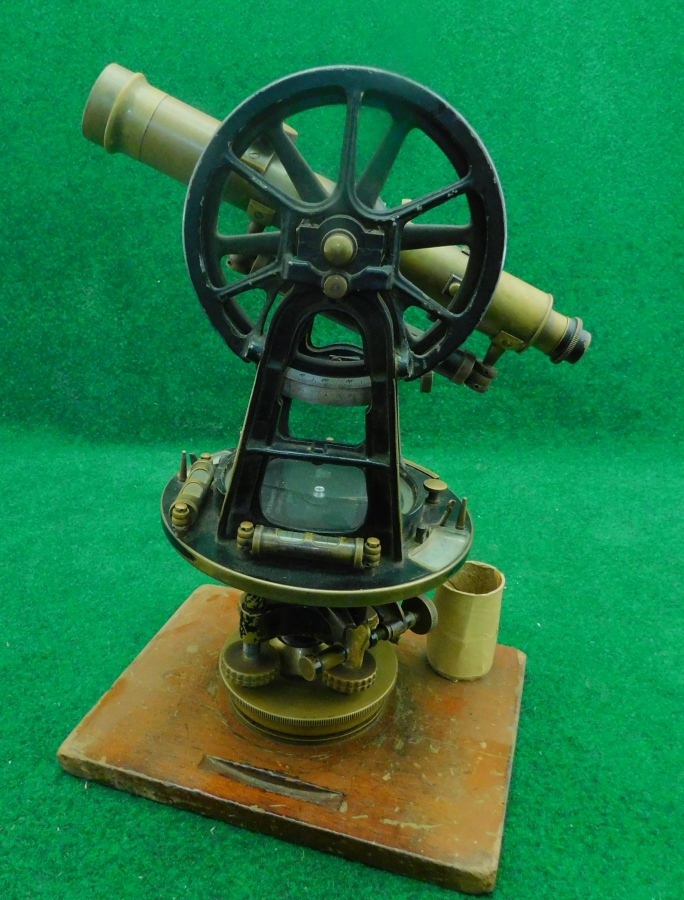
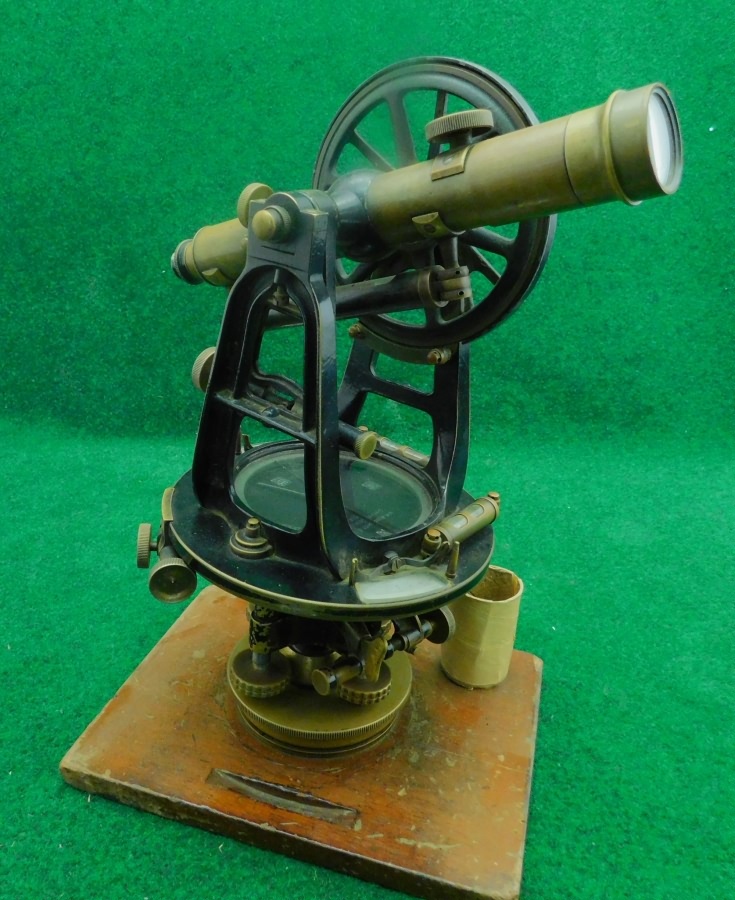
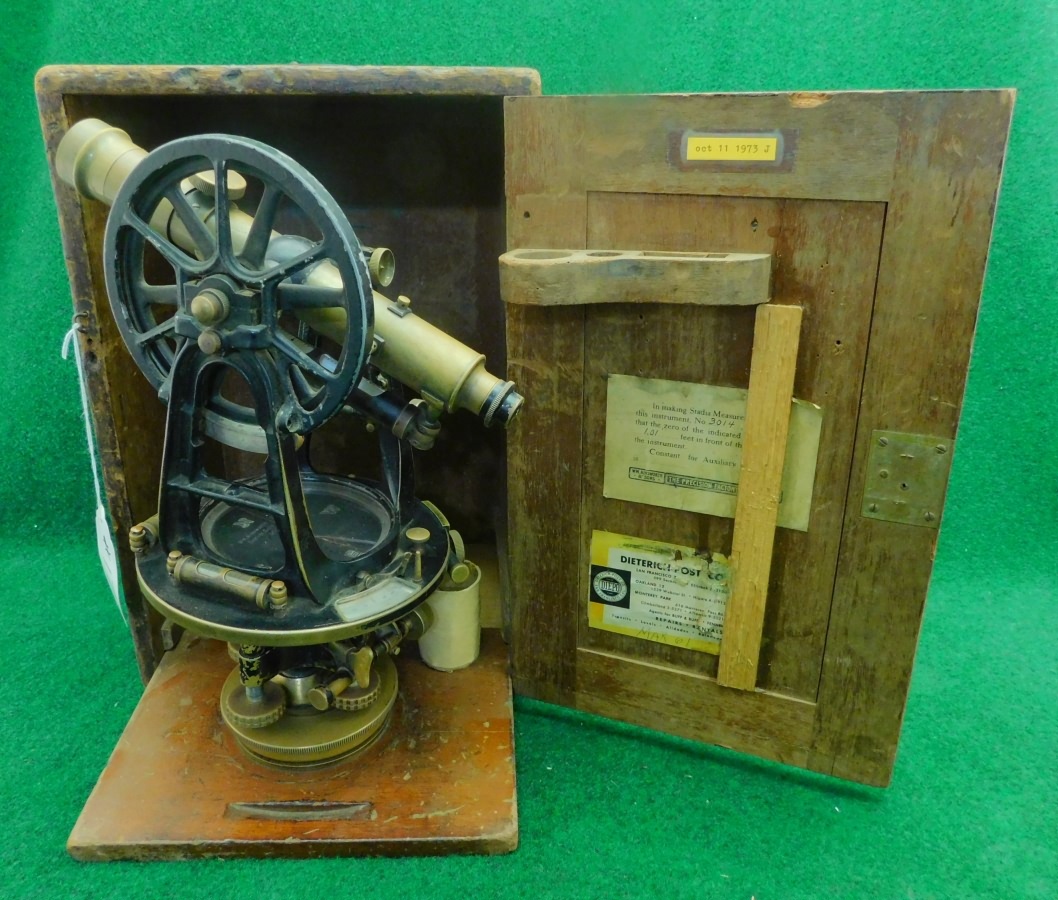 Ainsworth Light Mountain Mining Transit in Box
This is a nice looking light mountain size transit by Ainsworth of Denver
Colorado.Ainsworth was a major western maker and supplier for the
mining industry in the western states, The axle for the main 9" scope is threaded
on both sides to take a second mining scope and counterweight. That scope and
counterweight are missing.
Ainsworth Light Mountain Mining Transit in Box
This is a nice looking light mountain size transit by Ainsworth of Denver
Colorado.Ainsworth was a major western maker and supplier for the
mining industry in the western states, The axle for the main 9" scope is threaded
on both sides to take a second mining scope and counterweight. That scope and
counterweight are missing.The overall condition is nice. Cross hairs are present, and the optics are good. All bubbles are full. All motions are free and smooth. The compass points north. A pretty rare instrument that would be a standout if the missing scope could be found. Different, and Nice!!
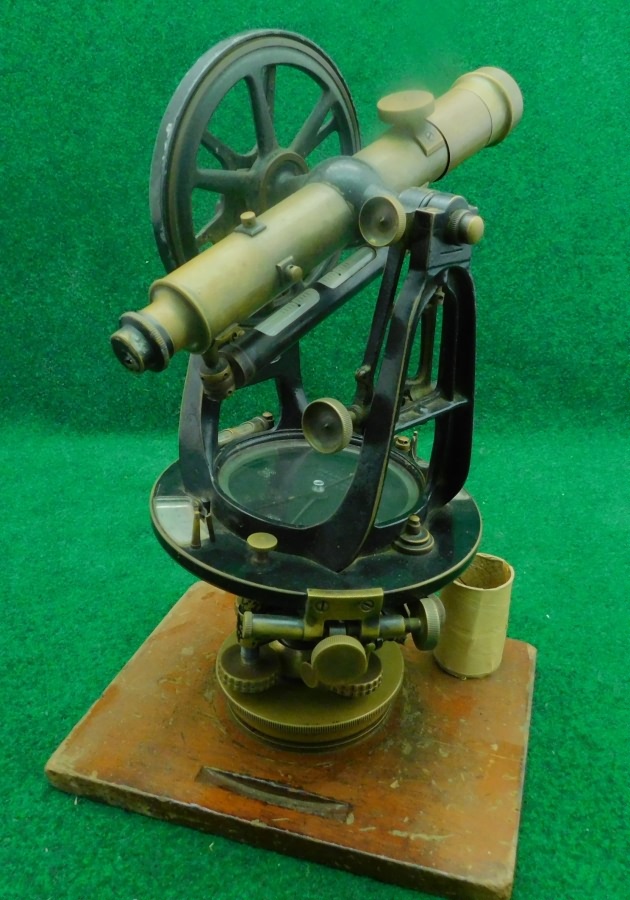
Good + . . . . . . $550.00 SOLD!!
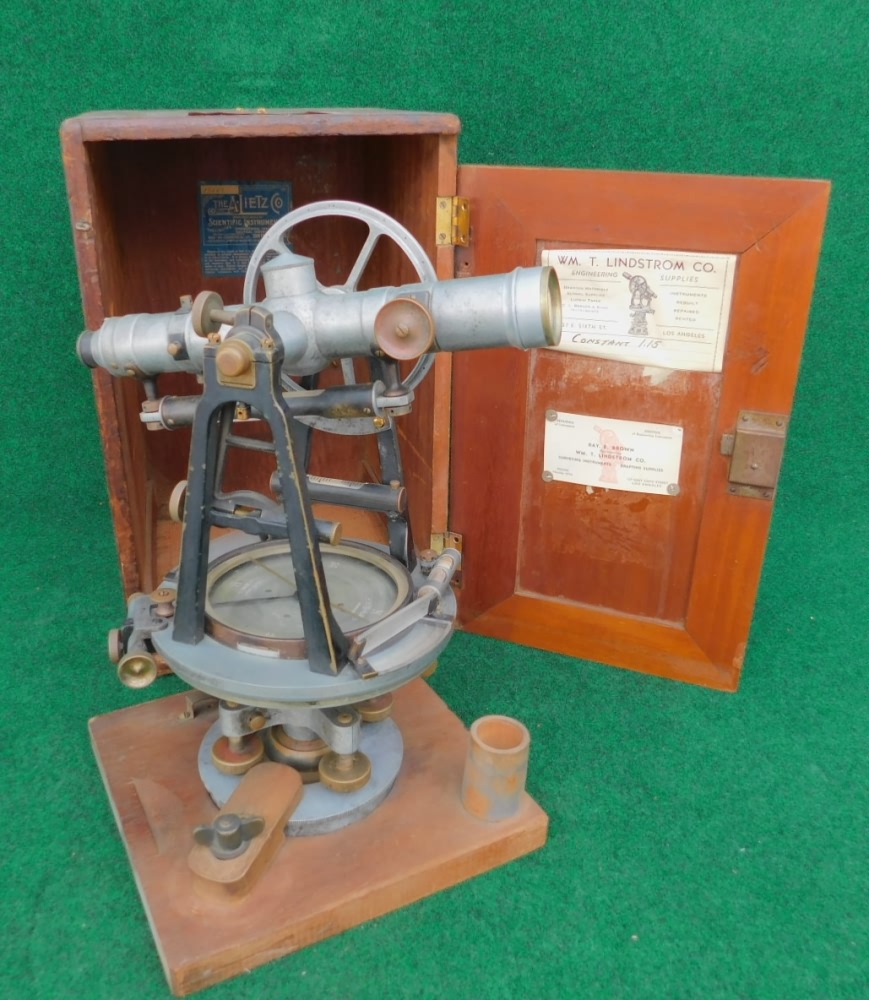 Lietz
Aluminum Solar Transit This is a rare
transit form
in a rare material for surveying instruments from this period. Lietz
was the premier maker of instruments in California and the west coast.
They first opened for business in the early 1890s. This solar transit has
a serial # 1690
Lietz
Aluminum Solar Transit This is a rare
transit form
in a rare material for surveying instruments from this period. Lietz
was the premier maker of instruments in California and the west coast.
They first opened for business in the early 1890s. This solar transit has
a serial # 1690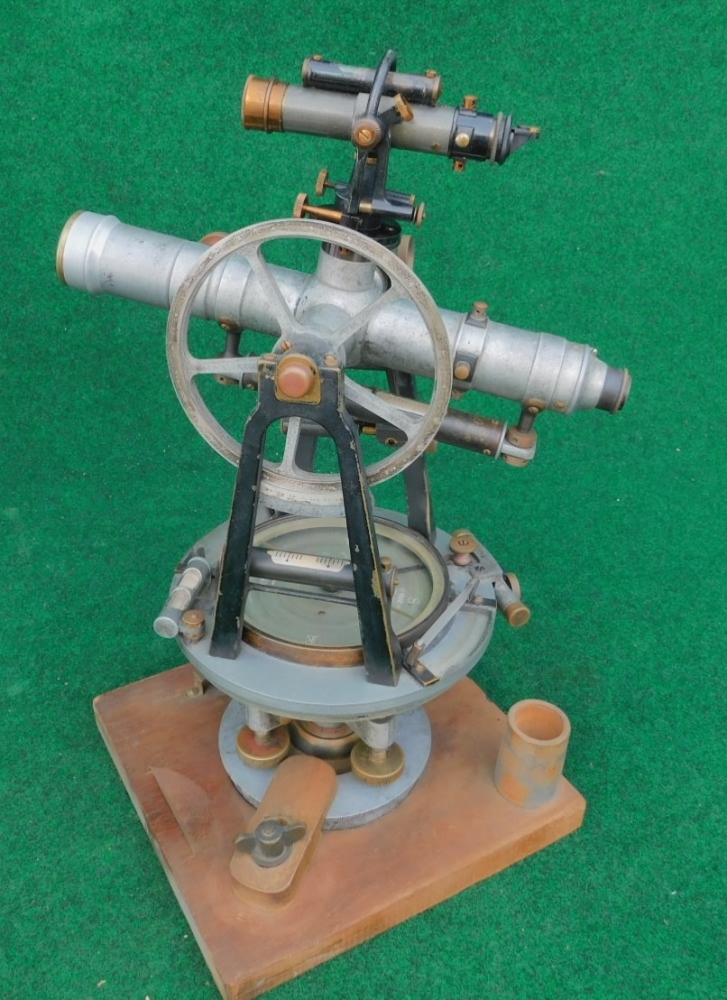 which according to Uzes's
book on surveying instruments would date it from pre 1906 Earthquake era in
San Francisco.
Lietz first opened their doors in the 1890s in San Francisco CA and offered
some innovative instrument designs to compete with other more established makers
and satisfy their customer base on the West Coast.
which according to Uzes's
book on surveying instruments would date it from pre 1906 Earthquake era in
San Francisco.
Lietz first opened their doors in the 1890s in San Francisco CA and offered
some innovative instrument designs to compete with other more established makers
and satisfy their customer base on the West Coast. The solar transit is shown on the left w/o the attachment, and on the right with it in place. It is being sold either way as I also have a Bausch & Lomb Solar Transit that this attachment fits on. The Saegmuller type solar attachment is unmarked as to maker and is housed in a separate box. (see last few pics) There is no provision in either transit box for an attachment so it would be proper to go with either instrument as it would be something special ordered according to the users preference.
The transit is in overall very nice condition. Some of the motions are a bit stiff from sitting for so long, and it needs to be lubed and cleaned. The transit optics are good and so are the solar attachments. A rare instrument that will display nicely in a number of collection themes. Very Nice!!
Fine . . . . . . $2250.00 w/ Attachment SOLD!!
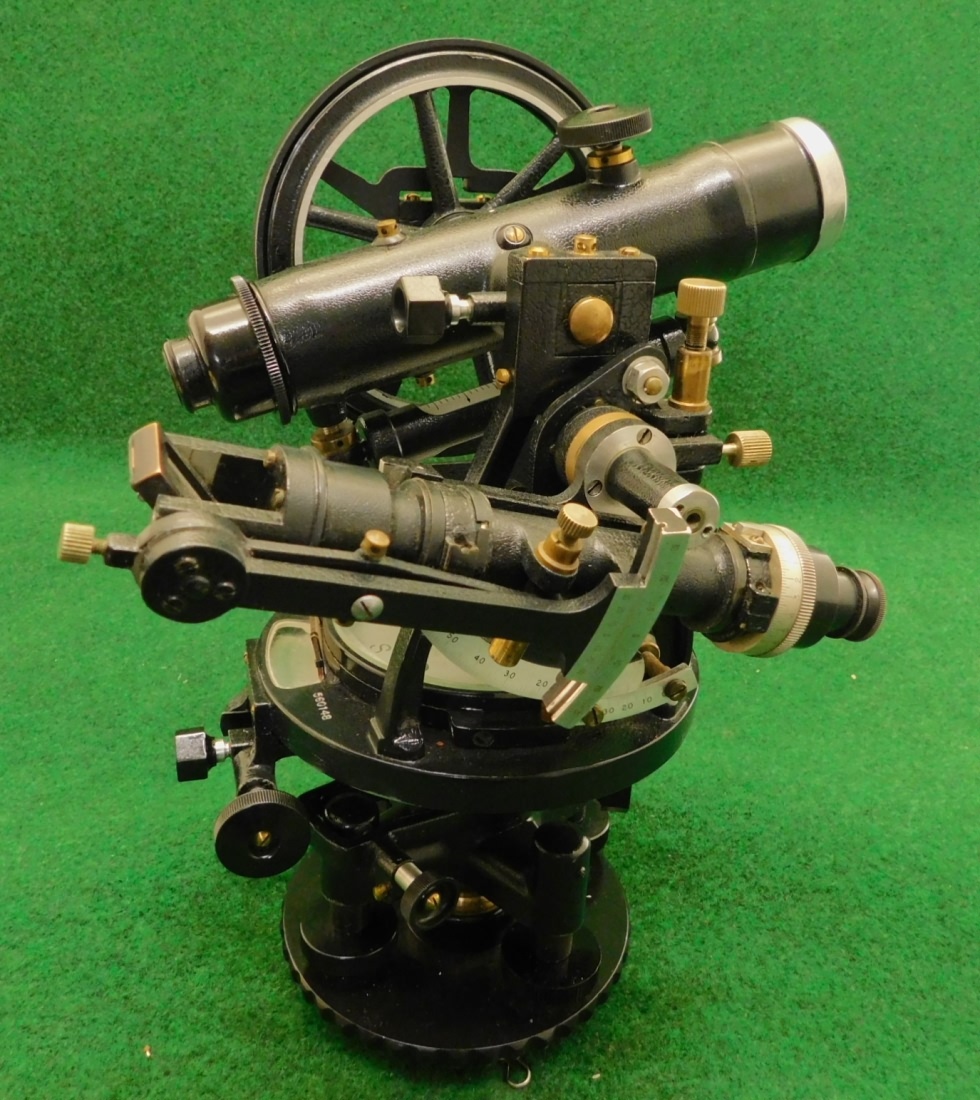 W. & L. E. Gurley
Transit w/ Smith Solar Attachment This W. & L. E. Gurley
transit is equipped with an unusual form solar attachment known as the
Smith Solar Attachment named after the inventor who was issued his patent in
1881. Solar transits are one of the most desirable and sought after of all
surveying instruments to be found. They are graphic, historically important,
rare, and represent an important aspect of surveying history. This
example dates from the 1950s and the end of the era for this design or style instrument
before GPS and electronic instruments took their place.
W. & L. E. Gurley
Transit w/ Smith Solar Attachment This W. & L. E. Gurley
transit is equipped with an unusual form solar attachment known as the
Smith Solar Attachment named after the inventor who was issued his patent in
1881. Solar transits are one of the most desirable and sought after of all
surveying instruments to be found. They are graphic, historically important,
rare, and represent an important aspect of surveying history. This
example dates from the 1950s and the end of the era for this design or style instrument
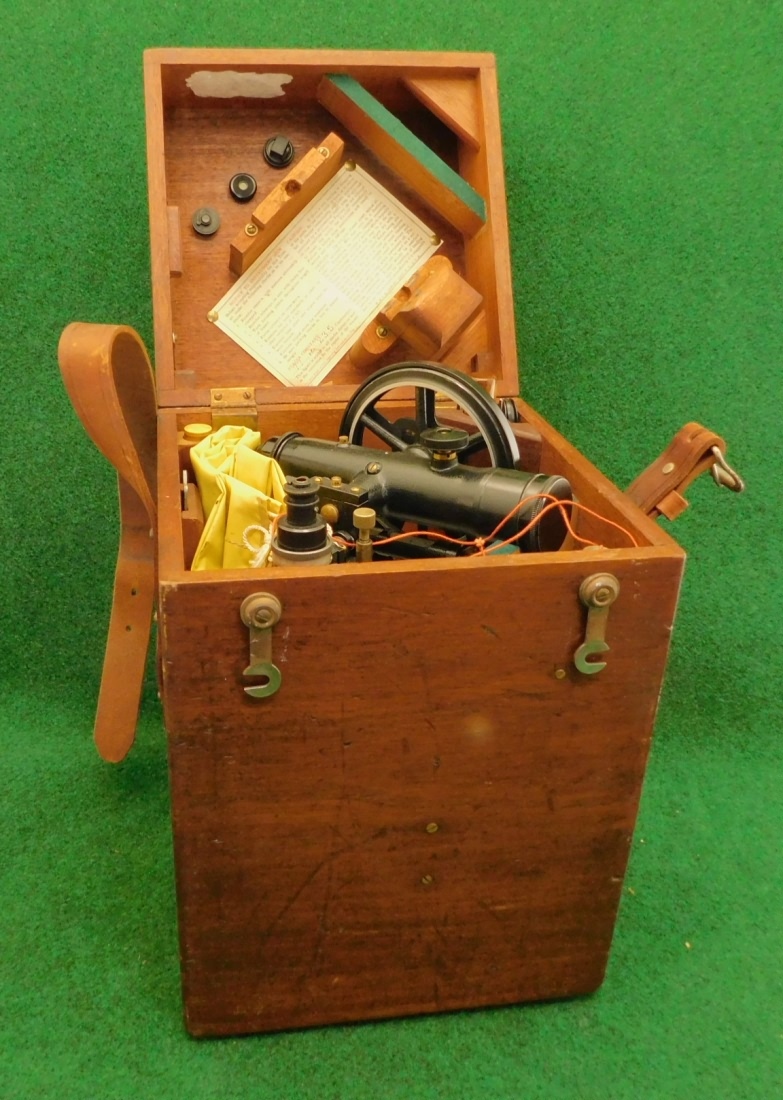
before GPS and electronic instruments took their place. This instrument and the Smith Solar attachment are in like new near mint condition. The serial # on the transit indicates a manufacture date of 1956. The box is very nice as well. All motions and the screws are free. The compass works and the compass face is very nice. Also included is a brochure and an additional print out on the instruments use and proper setting up of it. Also included is a Cox Stadia rule put out by Gurley. This instrument once belonged to Bud Uzes, the well known surveying instrument collector and author of the book Chaining the Land. There are two pictures of him using this transit on a job in 1989 in New Mexico.
The idea behind solar instruments, either transits or compasses, was that in certain areas the magnetic deviation was so great, and the errors it could cause so great, that these unusual and significant devices were developed as a way to compensate for or alleviate this effect. The Burt Solar attachment was first Patented in the 1830's to be used on solar compasses. Gurley later bought the rights and offered this style attachment with their instruments. Later on they also offered the Smith Patent version. A solar instrument enabled the user to find a true reference or location using the horizon and the position of the sun instead of the standard method employing the compass. Even though the concept had been around and employed in seafaring navigation for centuries,
 very few of them were actually made for use in the field w/
transits or compasses.They are rare.
very few of them were actually made for use in the field w/
transits or compasses.They are rare.Each major surveying instrument maker made a transit that could be equipped with one form or another of these devices. The best known names in the surveying instrument field were Gurley and Keuffel & Esser, but Berger, Buff, Dietzgen, Lietz, Warren Knight, Sala, and others offered versions solar transits. Different attachments are typically known by the name of the inventor, and the examples designed and developed by Saegmuller, Smith, Pearson & Burt being the best known solar attachments. The Saegmuller, Smith and Pearson utilized small secondary scopes, while the Burt design more closely resembled a octant or sextant in design and used a peep site.
Rarely seen or offered for sale this transit will move your collection to the head of the line. A super piece.
Fine . . . . . . . $2750.00 SOLD!!
 Buff
& Buff Mfg. Co. Solar Transit w/ Smith Patent Solar Attachment / Box &
Tripod
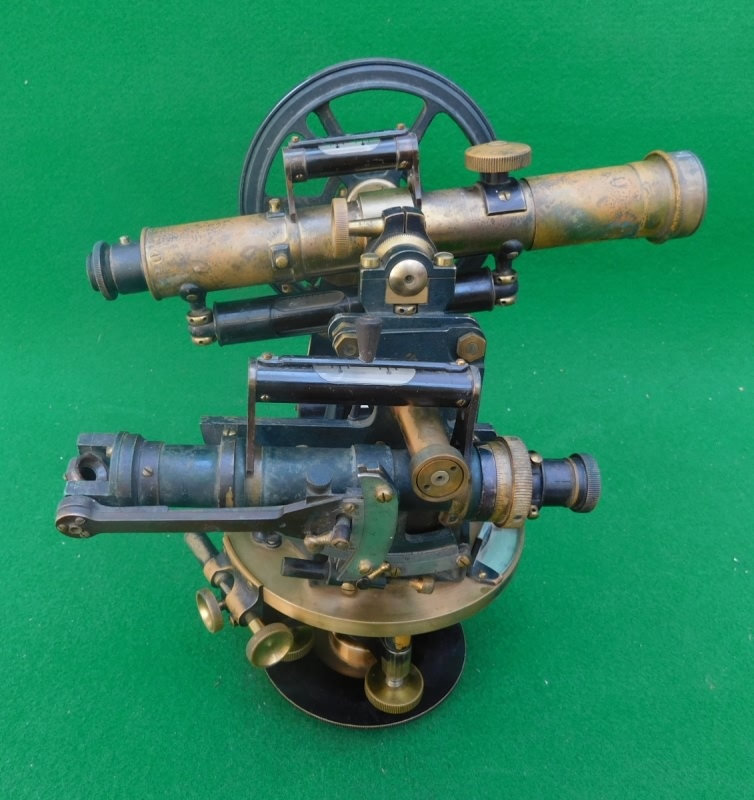
This Buff
& Buff solar transit is in exceptional condition. From the serial #28294 we can surmise this solar transit was manufactured in the 1920's - 1930's.
The Buff & Buff MFG. Co was formed after the breakup of the Buff and Berger company back near the turn of the century. The original firm
of Buff & Berger split into two companies with each principal
going into business with family members of the same name, hence the company names, Buff & Buff, and Berger & Sons
found on those later instruments.
Buff
& Buff Mfg. Co. Solar Transit w/ Smith Patent Solar Attachment / Box &
Tripod
This Buff
& Buff solar transit is in exceptional condition. From the serial #28294 we can surmise this solar transit was manufactured in the 1920's - 1930's.
The Buff & Buff MFG. Co was formed after the breakup of the Buff and Berger company back near the turn of the century. The original firm
of Buff & Berger split into two companies with each principal
going into business with family members of the same name, hence the company names, Buff & Buff, and Berger & Sons
found on those later instruments. The transit has developed a nice even patina on the brass portions. The transits main scope is 9" long which would make this a light mountain size transit. It has an image erect and the optics are good and clear. Crosshairs are present. The 4" silvered compass works properly. The silvered vertical circle is 4" and has an aux Stadia scale as shown. All level bubbles are good, and there are 2 striding levels as well. All motions operate as they should but this instrument should be gone through and lubed as some thumbscrews are "gummy" tight from sitting unused for nearly 100 years. The solar attachment has an inverted image, and 4 crosshairs. 3 in one orientation and one intersecting. The serial # on the box and instrument match. Even the leather strap is original and stamped with the serial # 28294. The box is very nice and has nearly all of its original finish. The counterweight is a molded piece of lead that is fitted between the standards on the opposite side in such a way as to save space and allowing the box to be smaller and easier to transport in the field.
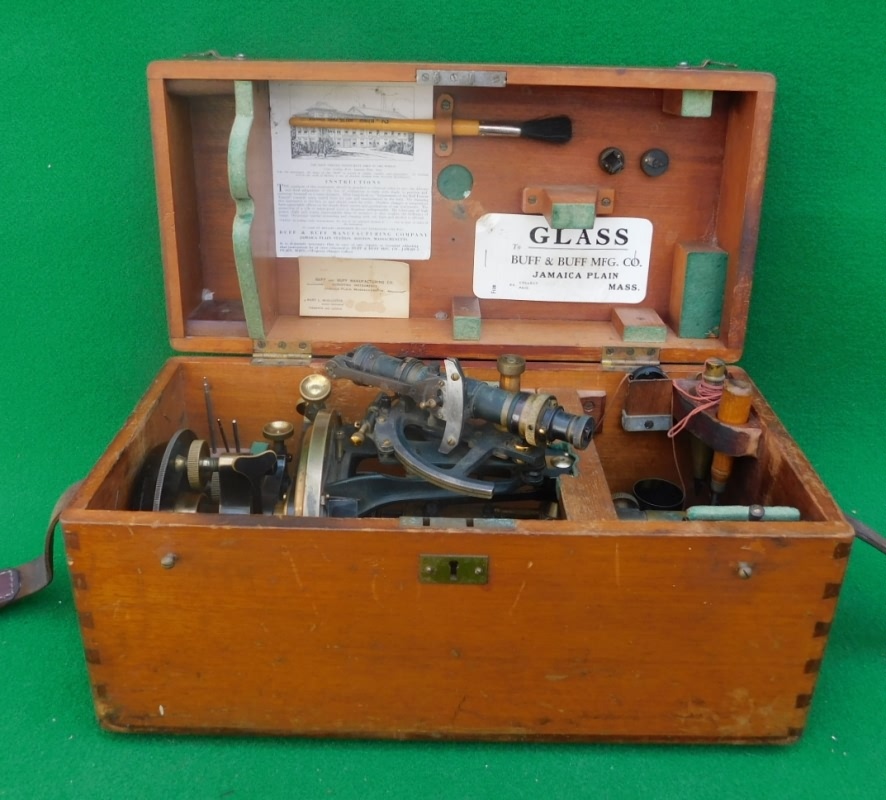
Solar transits were developed so that the user could accurately determine his location in the field without relying on the magnetic compass. Magnetic deviations would adversely affect a magnetic compass and so they were not an accurate means to determine ones location in many areas. The idea with solar transits was to use the position of the sun and the horizon to determine ones location, much as a sextant or octant would be used to determine ones true location on a boat in open water with no visible reference points. The first patent for a solar transit was granted to Burt in the 1830's but many other variants were developed and patented afterward.
There are a number of different versions of solar attachments that were patented and used on surveying instruments. The Burt solar attachment was used on Gurley, Roach and other instruments. K & E, Buff, Warren Knight, Fauth and others used the Saegmuller patent attachment. Saegmuller Solar Attachments were a top mounted scope. (see below) The Smith Patent Solar Attachment and the Pearson Solar Attachment mounted on the side of instruments and are both more unusual.
This is is a rare instrument that will display very nicely and be a highlight of any collection of surveying or engineering related instruments.
Fine . . . . . $1995.00 SOLD!!
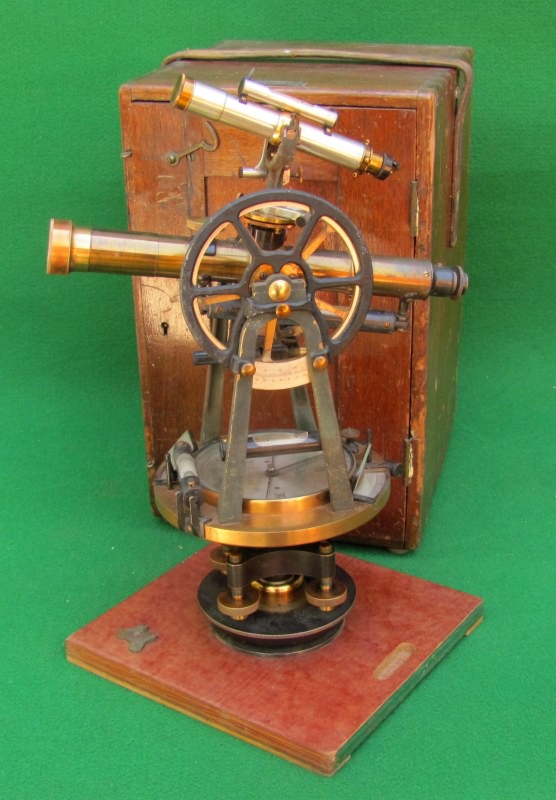 Buff & Buff Mfg. Co. Solar Transit w/ Saegmuller Solar Attachment This Buff & Buff solar transit is in exceptional condition. From the serial #6625 we can surmise this
transit was manufactured shortly after the turn of the century. The
Buff & Buff MFG. Co was formed after the breakup of the Buff and Berger
company back near the turn of the century. The new company began their
serial # at 4000.
Buff & Buff Mfg. Co. Solar Transit w/ Saegmuller Solar Attachment This Buff & Buff solar transit is in exceptional condition. From the serial #6625 we can surmise this
transit was manufactured shortly after the turn of the century. The
Buff & Buff MFG. Co was formed after the breakup of the Buff and Berger
company back near the turn of the century. The new company began their
serial # at 4000. The instrument has a near perfect lacquered finish on the brass portions. The original solar attachment is nickel plated and has a great contrasting look. The transits main scope is 12" long which would make this an engineer's transit. It has an image erect and the optics are crisp and clear. The 4" silvered compass works properly. The silvered vertical circle is 4". All level bubbles are good. All motions operate as they should. The serial # on the box and instrument match. The box is very nice.
Solar transits were developed so that the user could accurately determine his location in the field without relying on the magnetic compass. Magnetic deviations would adversely affect magnetic compasses and so were not an accurate means to determine ones location in many areas. The idea was to use the position of the sun and the horizon to determine ones location, much as a sextant or octant would be used to determine ones true location on a boat in open water with no visible reference points. The first patent for a solar transit was granted to Burt in the 830's but many other variants were developed shortly afterward.
There are a number of different versions of solar attachments that were patented and used on surveying instruments. The Burt solar attachment was used on Gurley, Roach and a few other instruments. K & E, Buff, Fauth, Warren Knight and others used the Saegmuller patent attachment. As evidenced by the other Buff Solar listed, a buyer could order different style solar attachments of his choice.
This is is a rare surveying instrument that will display very nicely and be a highlight of any collection of engineering related instruments.
Fine . . . . . $2550.00 SOLD!!
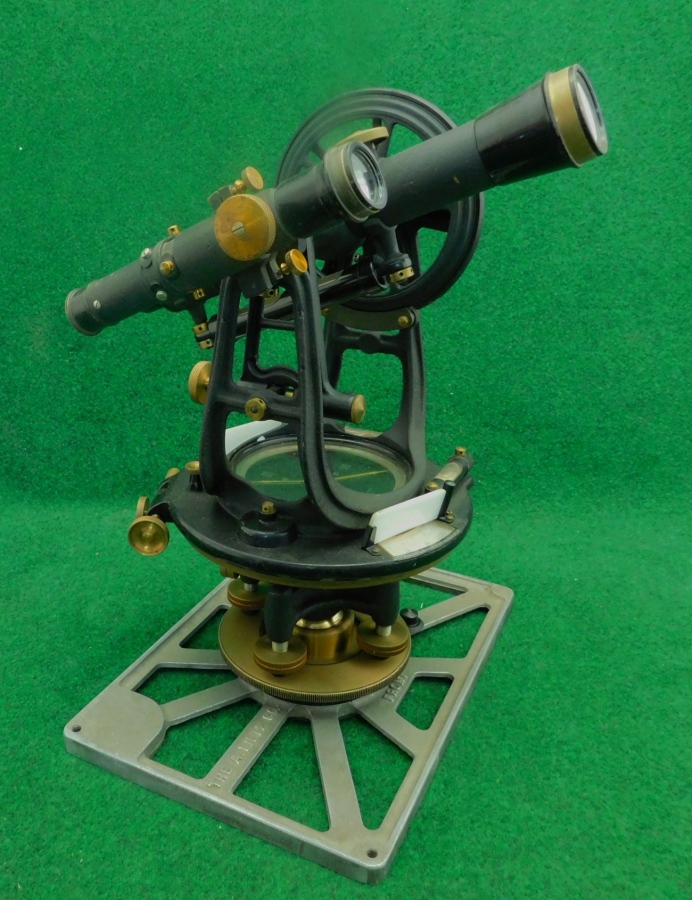 A. Lietz San Francisco Mining Transit w/ Secondary Scope
in Box A large graphic antique
mining related surveying instrument
with a 11 inch main scope and 7" secondary scope. This good condition
antique mining transit
is in its original box and was made by A. Lietz California's premier surveying
instrument maker and dealer.The black finish is very nice overall.The
compass needle is 3 1/2.
The optics in both scopes is nice. Lietz instruments are hard to date,
but I would think this dates from after the turn of the century and pre
WWII. The box is solid. Very Nice!!
A. Lietz San Francisco Mining Transit w/ Secondary Scope
in Box A large graphic antique
mining related surveying instrument
with a 11 inch main scope and 7" secondary scope. This good condition
antique mining transit
is in its original box and was made by A. Lietz California's premier surveying
instrument maker and dealer.The black finish is very nice overall.The
compass needle is 3 1/2.
The optics in both scopes is nice. Lietz instruments are hard to date,
but I would think this dates from after the turn of the century and pre
WWII. The box is solid. Very Nice!!Mining transits were used in situations where the operator had to shoot down vertical shafts or odd angles. When mounted on the side it projected past the plate to allow the user to shoot along that line. Different manufacturers used different approaches to solve the problem. Gurley's number for the secondary scope was #160. Catalogs of the era show that it could be ordered to mount over the scope as well. Other manufactures used the same means or slight variations on the theme. Buff offered a rare version where the main scope could be released and moved into another position further out on the standards above the plate. There is also a version with a leaning frame to allow for the same effect. They are much harder to find than a standard instrument and make a great display when set up.
Fine . . . . . . $1495.00 SOLD!!
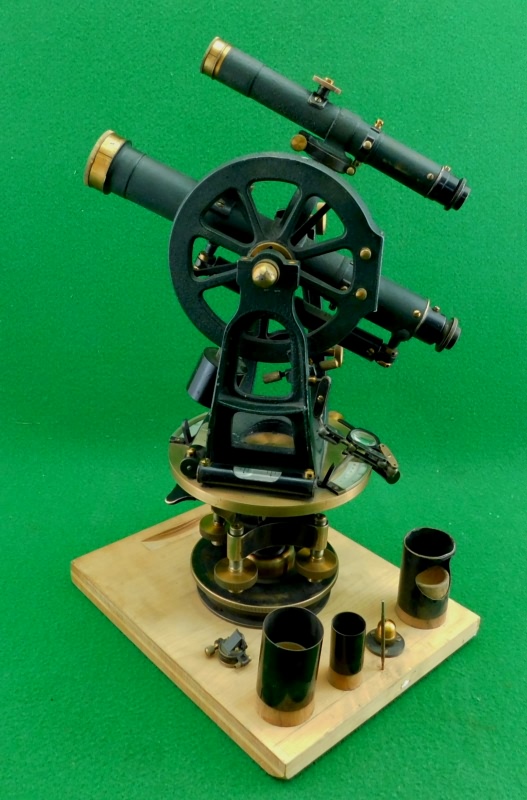 Buff
& Buff Mfg. Co. Mining Transit w/ Box &
Tripod
This Buff
& Buff mining transit is in exceptional condition. From the serial #9842
on the plate we can surmise this
transit was manufactured in the first quarter of the 1900's.Mining transits were developed so that the user could
shoot past the plate when sighting down a mine shaft. The second scope could
be mounted on the top, or off one or the other side.
Buff
& Buff Mfg. Co. Mining Transit w/ Box &
Tripod
This Buff
& Buff mining transit is in exceptional condition. From the serial #9842
on the plate we can surmise this
transit was manufactured in the first quarter of the 1900's.Mining transits were developed so that the user could
shoot past the plate when sighting down a mine shaft. The second scope could
be mounted on the top, or off one or the other side.The Buff & Buff MFG. Co was formed after the breakup of the Buff and Berger company back near the turn of the century. The original firm of Buff & Berger split into two companies in 1898 with each principal going into business with family members of the same name, hence the company names, Buff & Buff, and Berger & Sons found on those later instruments.
The transit has has a matte green finish showing just minimal scuffs & wear at some high spots. The transits main scope is 9" long which would make this a light mountain size transit. It has an erect image and the optics are crisp and clear. The main scope has 6 crosshairs. One vertical, 3 horizontal, and an X. The smaller scope has a simple cross. The silvered vertical circle is enclosed and read from the side window facing the operator. All level bubbles are good. All motions operate as they should with some stiffness from sitting for nearly 100 years. They could use a lube. The serial # on the box and instrument do not match. The leather strap is original and stamped with a serial #. It has a break or tear in it. The box is very nice and has nearly all of its original finish with minor scuffs. There is a counterweight and several sunshades mounted on the base board. The base board has the same number as the strap, which is different from the # on the instrument. The original Buff marked collapsible leg tripod is in fine condition and is included in the price.
This is is a rare instrument that will display very nicely and be a highlight of any mining, surveying, or related collection.
Fine . . . . . $2200.00 SOLD!!
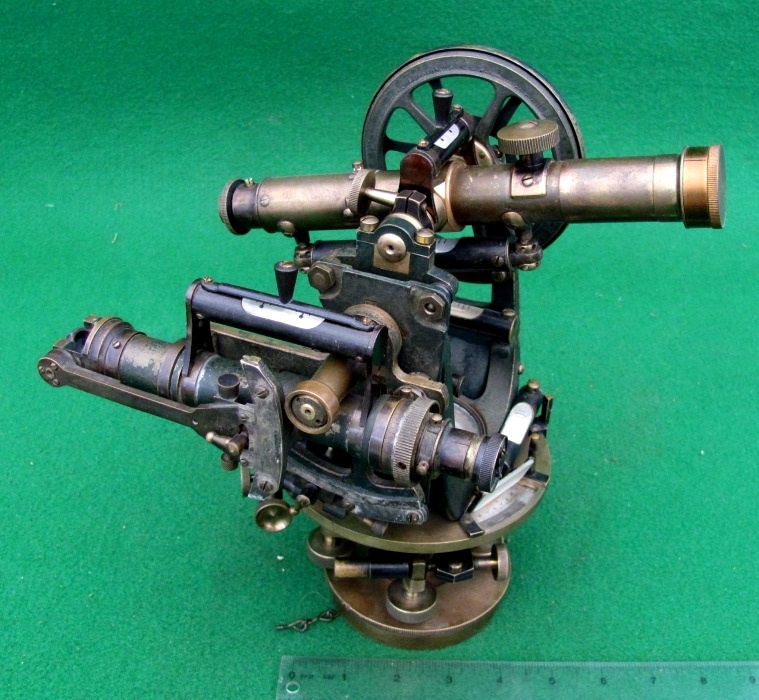 Buff Solar Transit w/ Smith Patent Solar Attachment
in Original Box
This unusual Buff solar transit came from the Bureau of Land Management and was used in the Pacific Northwest to check
lines and boundaries on government properties. From the serial #24846 we can surmise this Buff solar transit was manufactured in the 1920's - 1930's
after the breakup of the Buff and Berger company back near the turn of the century. The original firm
of Buff & Berger split into two companies with each principal
going into business with family members of the same name, hence the names, Buff & Buff, and Berger & Sons
on later instruments.
Buff Solar Transit w/ Smith Patent Solar Attachment
in Original Box
This unusual Buff solar transit came from the Bureau of Land Management and was used in the Pacific Northwest to check
lines and boundaries on government properties. From the serial #24846 we can surmise this Buff solar transit was manufactured in the 1920's - 1930's
after the breakup of the Buff and Berger company back near the turn of the century. The original firm
of Buff & Berger split into two companies with each principal
going into business with family members of the same name, hence the names, Buff & Buff, and Berger & Sons
on later instruments.Solar transits were developed so that the user could accurately determine his location without relying on the compass in the field. Because of magnetic deviations compasses were not an accurate means to determine ones location in many areas. The idea was to use the position of the sun and the horizon to determine ones location, much as a sextant or octant would be used to determine ones true location on a boat in open water with no visible reference points.
There are a number of different versions of solar attachments that were patented and used on surveying instruments. The Burt solar attachment which was used on Gurley Instruments, and the Saegmuller solar used on K & E instruments being the most frequently seen. Both of those types mounted on the top of the scope. Smith Patent Solar Attachments mount on the side of the instrument and are much more unusual.
The instrument has developed a nice even patina. The transits main scope is 9" long which would make this a light mountain size transit. It has an image erect and the optics are crisp and clear. The silvered compass works and is 4" with a tiny 2" needle. The silvered vertical circle is 4". All level bubbles are good, and there are 2 striding levels in the box as well. All motions operate as they should. The serial # on the box and instrument match. Even the leather strap is original and stamped with the serial # 24846. The box is very nice and has nearly all of its original finish. The counterweight is a molded piece of lead that is fitted to the opposite side in such a way to save space and making the box smaller and easier to transport in the field.
This is a rare instrument that will display very nicely and be a highlight of any collection of surveying related instruments.
Good + . . . . . . $2450.00 SOLD!!
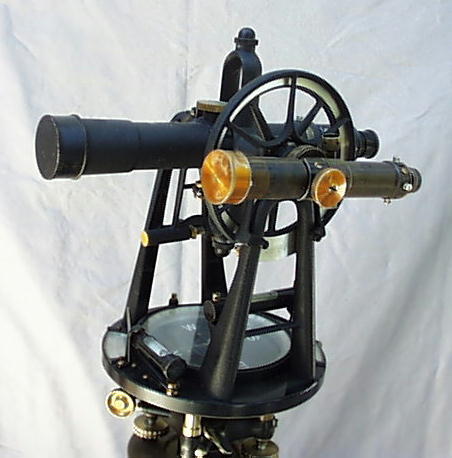
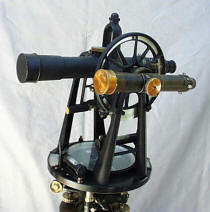
Berger Mining Transit w/ Aux. Mining Scope Attachment This was the third surveying instrument I bought that has a provision for taking an auxiliary scope mounting either on top or on the side of the transit. These auxiliary scopes were typically utilized in mining applications as a means to more readily determine locations and reference points, allowing the user to shoot straight down past the plate.
I have bought and sold a lot of transits and levels by various manufacturers over the years, and during that time saw very few surveying instruments that had this provision to take an auxiliary scope that this style of transit does. This example showed up on eBay one day with a BUY IT NOWicon and I hit it just a couple of hours after it had been listed. I figured I had done OK. Over the next month or so 3 more appeared on eBay, with each one bringing less than the previous. One of them was in absolutely immaculate condition, and I was the underbidder, with the next lower bidder at a lot less than I paid for this one. The other in lesser condition after 10 days
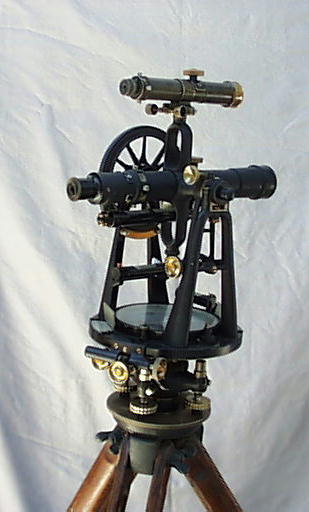 bought just about what I paid for this example. Is it a case of
them not being rare, or did these examples come out of the woodwork so to speak
because of the price paid for the first one, or was it simply a fluke of timing.
Over the years I have seen and / or been part of this kinds of scenario before.
Where you run into a pocket of something that was
previously considered very rare, and suddenly there are a dozen or more of them
available. The prices fluctuate, and are volatile for a while. I have
yet to figure out exactly where this instrument fits into this picture, but
it is a very nice example and comes complete with its tripod and box.
The auxiliary scope is a different finish, but that is to be expected and not
improper.
bought just about what I paid for this example. Is it a case of
them not being rare, or did these examples come out of the woodwork so to speak
because of the price paid for the first one, or was it simply a fluke of timing.
Over the years I have seen and / or been part of this kinds of scenario before.
Where you run into a pocket of something that was
previously considered very rare, and suddenly there are a dozen or more of them
available. The prices fluctuate, and are volatile for a while. I have
yet to figure out exactly where this instrument fits into this picture, but
it is a very nice example and comes complete with its tripod and box.
The auxiliary scope is a different finish, but that is to be expected and not
improper.The counterweight is present, as well s two different style sunshades. The box is in nice condition overall. and there are three different labels glued to the inside. The overall condition is very nice, and I believe that this instrument was factory refinished at one point it is so nice. All bubbles are good, and all of the screws and motions turn freely as they should. The collapsible tripod is very nice as well and is included in this offering.
Good . . . . .$850.00 SOLD
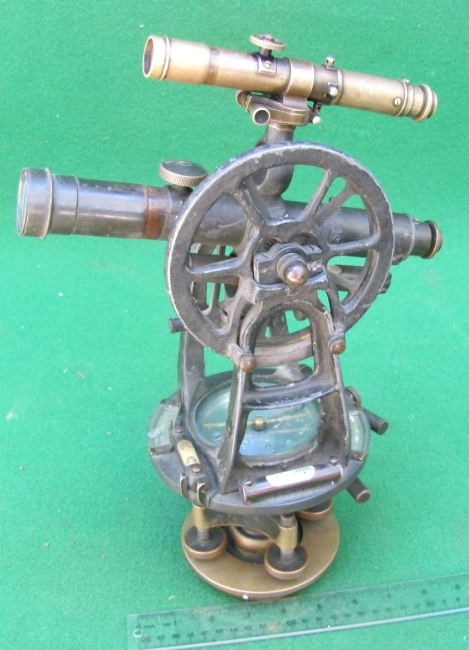 Buff
& Buff Mining Transit w/ Secondary Scope
This engineer size Buff mining transit is equipped with a second scope to
allow the user to shot over the edge of the plate when it is aimed straight
down. The second scope can also be mounted on the outside of the
transit on the main axle.This arrangement with 2 scopes was used
inside of mines to help in the layout of tunnels and shafts. I believe it
dates from sometime just after the turn of the century.
Buff
& Buff Mining Transit w/ Secondary Scope
This engineer size Buff mining transit is equipped with a second scope to
allow the user to shot over the edge of the plate when it is aimed straight
down. The second scope can also be mounted on the outside of the
transit on the main axle.This arrangement with 2 scopes was used
inside of mines to help in the layout of tunnels and shafts. I believe it
dates from sometime just after the turn of the century. The vertical circle is silvered and graduated to 30. So is the vernier on the plate.This graphic looking transit has a 4" compass needle. The compass works well, and the silvered face is nice. The optics are clear and the cross hairs are intact. The smaller scope has a cloud on the end lens. It is also stiff when trying to adjust it, but it does focus, and its crosshairs are present. There is no counterweight. All other motions are smooth, and work properly. The three level vials are full. There is no box. A very nice looking and hard to find mining transit that will display very nicely.
Good . . . . . . .$950.00 SOLD
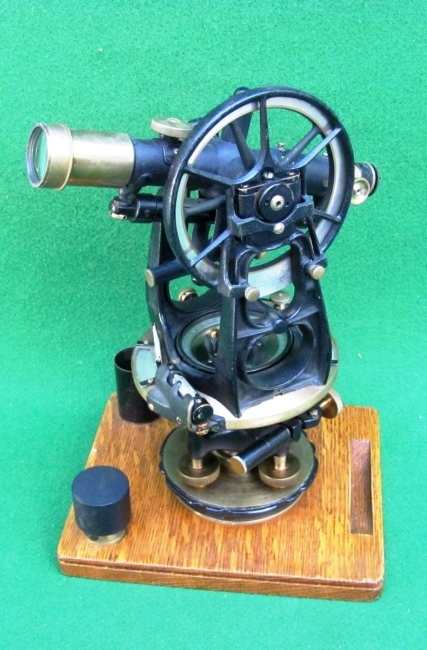 Berger Mining Transit
This engineer size Berger mining transit is set up to accept a second scope to
allow the user to shot over the edge of the plate when it is aimed straight
down. This arrangement with 2 scopes was used
inside of mines to layout tunnels and vertical shafts.There is no second
scope although the last pics show it with the scope from the instrument
listed above to show what it would look like.
Berger Mining Transit
This engineer size Berger mining transit is set up to accept a second scope to
allow the user to shot over the edge of the plate when it is aimed straight
down. This arrangement with 2 scopes was used
inside of mines to layout tunnels and vertical shafts.There is no second
scope although the last pics show it with the scope from the instrument
listed above to show what it would look like.The vertical circle is silvered and graduated to 30. So is the vernier on the plate.This graphic looking transit has a 3" compass needle and black face. The serial number is 17503. The compass works well. The optics are clear and the cross hairs are intact. The counterweight is present and attached to the base plate. It has a double telescopic effect when focusing it. The front extends out in 2 stages. There is also a thumbscrew near the eyepiece which does not operate or turn. The eyepiece focuses by twisting and pulling it out so I am not sure what this motion is there for. All other motions are smooth, and work properly. The three level vials are full. The box is nice, and has several paper labels inside. A very nice looking and hard to find mining transit that will display very nicely.
Good + . . . . . . .$975.00 SOLD!!
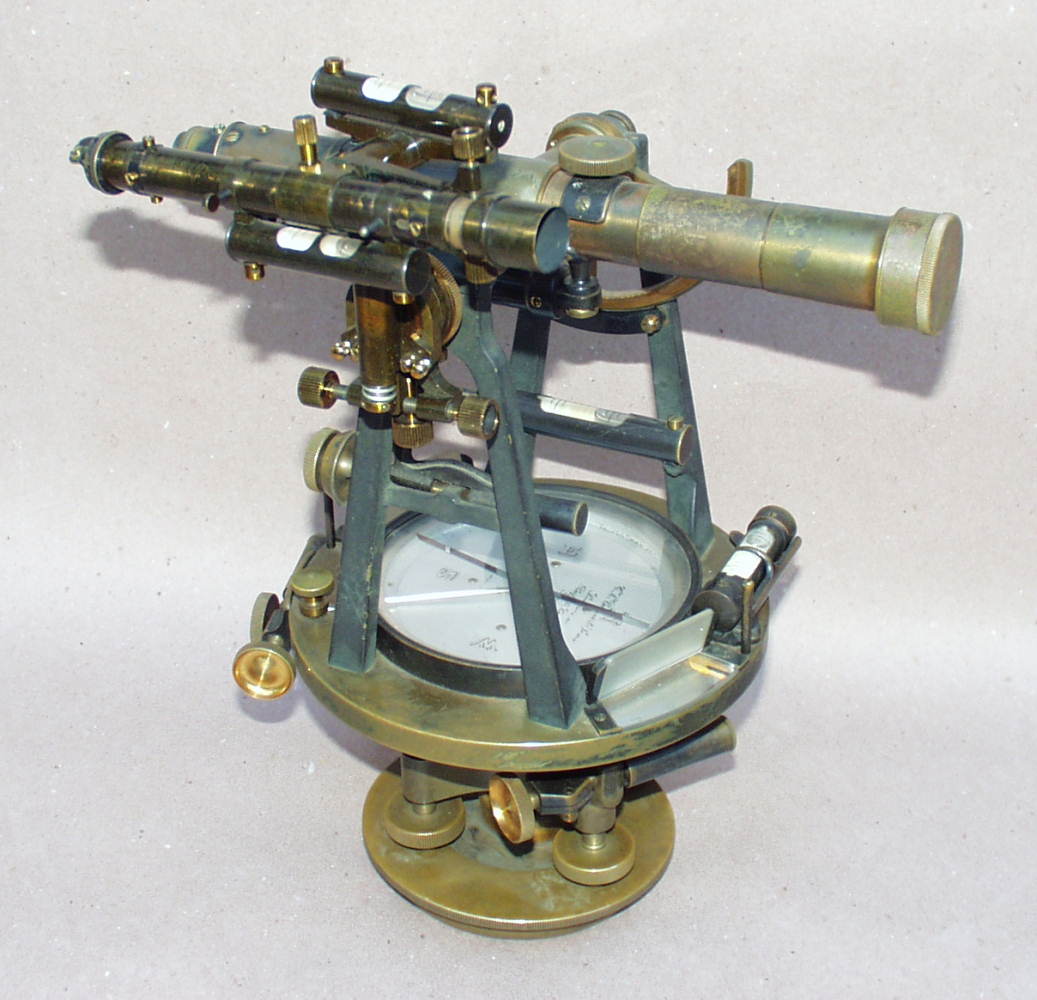 C.
L. Berger & Sons Solar Transit w/ Pearson's Patent Solar Attachment
This C. L. Berger & Sons solar transit dates from right
around the turn of the century. It is marked on the compass face "C. L. Berger
& Sons Successors to Buff & Berger Boston". The serial # is 3249 which would
date this from right around the turn of the century, and just after the breakup
of the original Buff & Berger Firm in 1898. From available company records this transit
was originally sold with the shown solar attachment.
C.
L. Berger & Sons Solar Transit w/ Pearson's Patent Solar Attachment
This C. L. Berger & Sons solar transit dates from right
around the turn of the century. It is marked on the compass face "C. L. Berger
& Sons Successors to Buff & Berger Boston". The serial # is 3249 which would
date this from right around the turn of the century, and just after the breakup
of the original Buff & Berger Firm in 1898. From available company records this transit
was originally sold with the shown solar attachment.The compass is very nice and operates properly. The compass face measures approx 5" and the silvered needle just over 4". The horizontal vernier is silvered and in excellent condition.The transit itself stands just over 12" tall, and the scope is approx 11" long. All motions are free and turn freely. The brass finish has developed a very nice patina. The transit focuses and the crosshairs consist of three horizontals and one vertical. The image is erect and not inverted. At the eyepiece end it seems there is cap missing, and the adjustment to bring the crosshairs into focus is tight / stiff. The half circle vernier is silvered and reads to 30 degrees. The half circle vernier has a slight bend of about 2 degrees on the right side, as if it had been bumped at some point. It still rides freely and reads from the scale just fine. It has a 3 1/4 inch tripod mount and I do not have the tripod. Different makers utilized different styles of solar attachments and Buff & Berger adopted the Pearson Patent Solar Attachment. The patent for the Pearson solar attachment was granted in 1882 about the same time as most other patents for these rare & unusual devices called solar attachments were issued.The Pearson patent, like the Saegmuller utilized a telescopic sight. Because of its design and the way it mounts this solar attachment uses the transits frame and settings for its set up. The Burt solar attachment and other top mounted style solar attachments had their own adjusters. This Pearson patent solar attachment appears to be NOS and retains nearly 100% of it original finish and Lacquer. It is marked on the inside of the attachment Buff & Berger which means it was made just before the transit and before the original Buff & Berger Co. broke up. It is stamped with the #3 which may be its serial # or an assembly #. The focus is crisp and the crosshairs present. As can be seen in the pics there is a dark lens cap, and a sun shade for it as well. There are places in the box these can be mounted to.
The transit has the proper box, and the cosmetic condition of it is pretty nice. There are several paper labels inside including instructions on what to and not to do. There is no place in the box for the attachment, but as I stated earlier, company records indicate the transit and attachment were originally sold together.
This style and form of transit with this unusual solar attachment was not widely distributed and thus is quite rare. Over the years I have seen dozens of Burt Style solar attachments offered for sale on Gurley and other make transits. I have seen and had a handful of the Saegmuller solar attachments that K & E, Lietz, and Dietzgen used, and I have even seen several of the later Smith patent solar attachment offered for sale, but this is the first Pearson solar attachment by this patentee and maker that I have had or seen offered. It will make a great addition to the collection of rare scientific or surveying related antiques.
Excellent . . . . . .$2250.00 sOLD!!
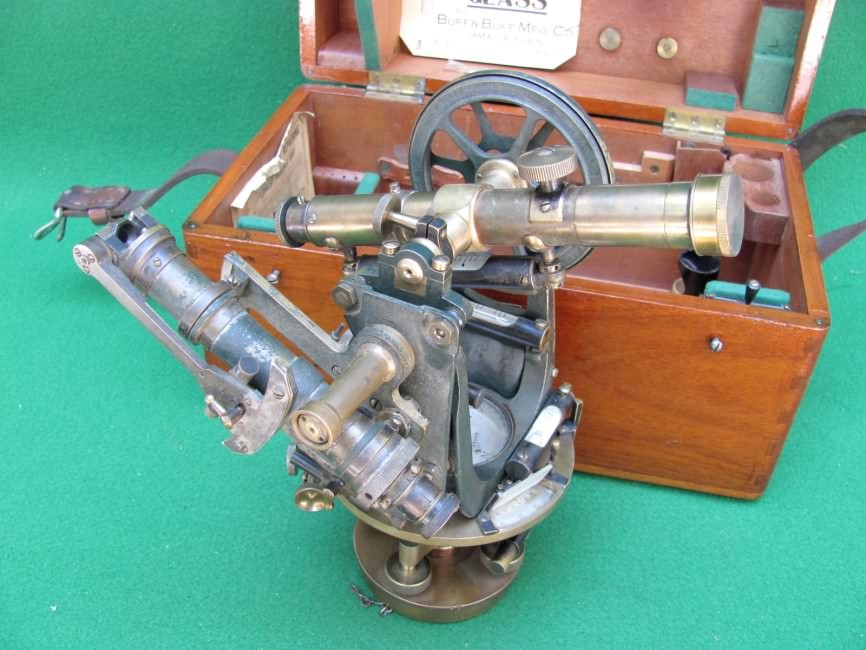 Buff
Solar Transit w/ Smith Patent Solar Attachment This unusual
Buff solar transit came from the Bureau of Land Management and was used in
the Pacific Northwest to check lines and boundaries on government
properties. From the serial #24846 we can surmise this Buff solar transit was
manufactured in the 1920's - 1930's after the breakup of the Buff and Berger
company back near the turn of the century. The original firm split
into two companies with each principal going into business with family members
of the same name, Buff & Buff, and Berger & Sons.
Buff
Solar Transit w/ Smith Patent Solar Attachment This unusual
Buff solar transit came from the Bureau of Land Management and was used in
the Pacific Northwest to check lines and boundaries on government
properties. From the serial #24846 we can surmise this Buff solar transit was
manufactured in the 1920's - 1930's after the breakup of the Buff and Berger
company back near the turn of the century. The original firm split
into two companies with each principal going into business with family members
of the same name, Buff & Buff, and Berger & Sons.Solar transits are a very hard to find surveying instrument that were developed so that the user could accurately determine his location without relying on the compass in the field. Because of magnetic deviations compasses were not an accurate means to determine ones location. The idea was to use the position of the sun, and the horizon to determine ones location, much as a sextant or octant would be used to determine ones true location on a boat in open water with no visible reference points. There are a number of different versions of solar attachments that were patented and used on surveying instruments. The Burt solar attachment which was used on Gurley Instruments, and the Saegmuller solar used on K & E instruments being the most frequently seen. Smith Patent Solar Attachments are much less frequently seen than those or others that were developed during the period of roughly 1850 to the turn of the century.
The transits main scope is 9" long which would make this a light mountain size transit to be used in the field . It has an image erect and the optics are crisp and clear. The silvered compass is 4" and operates properly. All other motions seem to operate as they should. The serial # on the box and instrument match. Even the leather strap is original and it too is stamped with the serial # 24846. The box is very nice and has nearly all of its original finish. The instrument itself has developed a nice even patina. The counterweight is a molded piece of lead that is fitted to the opposite side in such a way to save space and making the box smaller and easier to transport in the field.
This is a rare instrument that will display very nicely and be a highlight of any collection of surveying related instruments.
Good + . . . . . .$1950.00 SOLD!!
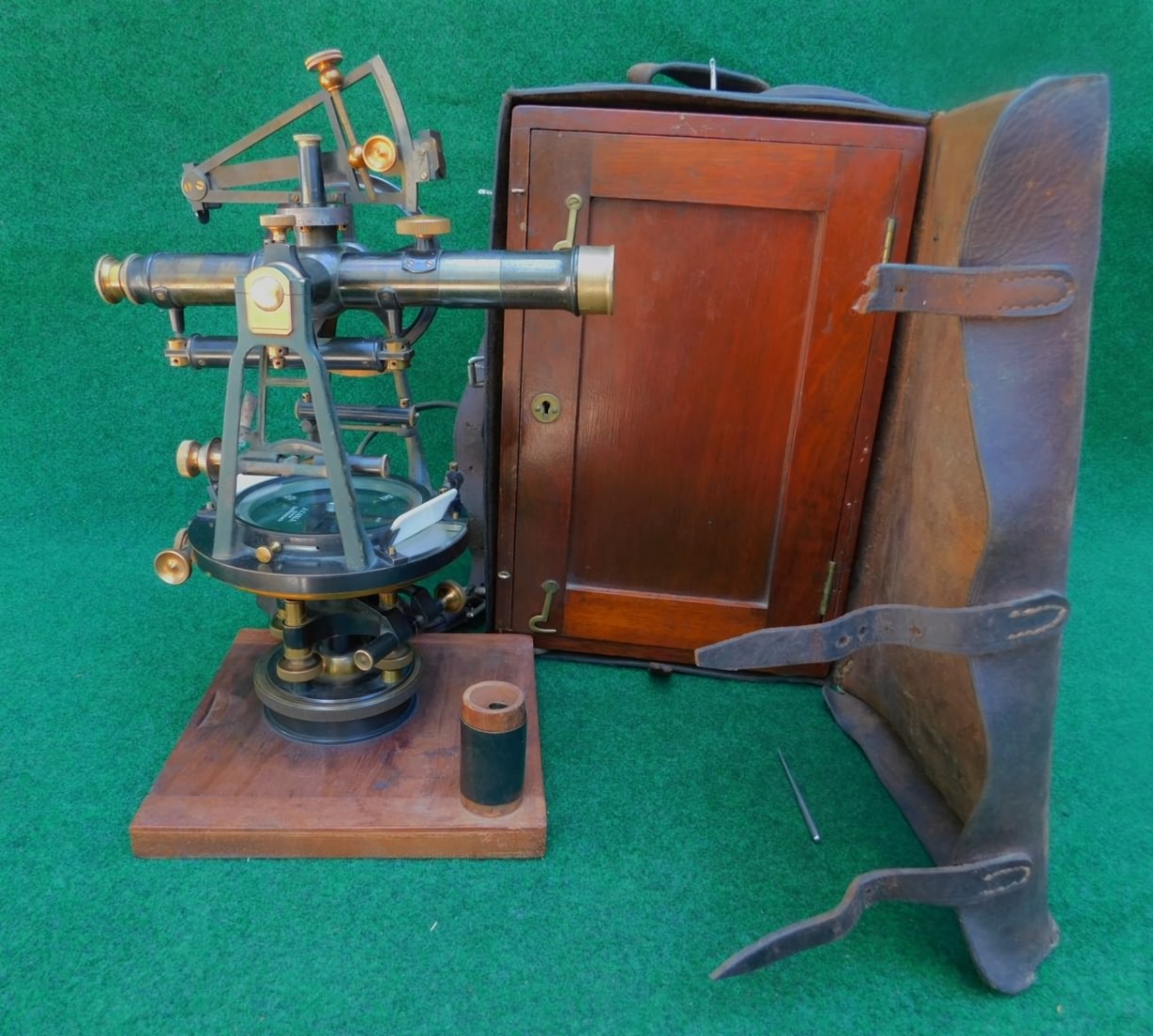 J. C. Sala
Solar Transit w/ Gurley Burt Solar Attachment
J. C. Sala one of the three famous West Coast Surveying Instrument
Makers from San Francisco working during the 19th century. They were
William Albert Schmolz, John Roach, and Joseph Charles Sala. Schmolz,
whose working dates were from the mid 1850's until his death in 1891 was responsible for patenting the idea to adapt the Burt Solar Apparatus
to a transit and was granted a patent for this idea in 1867. Gurley bought
the rights to this idea, and introduced their version around 1874, agreeing
to pay Schmolz $5.00 for each one they sold. Sala who was born in 1841 and at first
apprenticed to Roach was first listed in San Francisco Directories as Roach's
partner in the 1861 Directory and took over the business upon Roach's death in 1891.
This instruments serial # is1157 and was probably made shortly after the turn of the century. Sala died in 1916.
J. C. Sala
Solar Transit w/ Gurley Burt Solar Attachment
J. C. Sala one of the three famous West Coast Surveying Instrument
Makers from San Francisco working during the 19th century. They were
William Albert Schmolz, John Roach, and Joseph Charles Sala. Schmolz,
whose working dates were from the mid 1850's until his death in 1891 was responsible for patenting the idea to adapt the Burt Solar Apparatus
to a transit and was granted a patent for this idea in 1867. Gurley bought
the rights to this idea, and introduced their version around 1874, agreeing
to pay Schmolz $5.00 for each one they sold. Sala who was born in 1841 and at first
apprenticed to Roach was first listed in San Francisco Directories as Roach's
partner in the 1861 Directory and took over the business upon Roach's death in 1891.
This instruments serial # is1157 and was probably made shortly after the turn of the century. Sala died in 1916. This solar transit is in an amazing state of preservation. The box is dovetailed, and the original leather covering is very nice. The box has a repair near the bottom on the right side. The compass face has a black finish and the points are nicely engraved. There is a full vertical circle, and the vernier is silvered. All bubbles are good, and all motions are free. The cross hairs are present. The solar attachment is marked Gurley. The transits main scope is 11" long which would make this an engineers or surveyors transit . It has an erect image and the optics are crisp and clear. The compass face is nice, and the needle operates properly. All other motions seem to operate as they should.The instrument itself has developed a nice even patina. The proper tripod is available for an additional $200.00
Solar transits were developed so that the user could accurately determine his location without relying on the compass in the field. Magnetic deviations, especially here in the west, and in other locations where the geography contains large amounts of magnetic ore could throw off a magnetic compass and were not an accurate means to determine ones location in certain areas. The idea was to use the position of the sun, the horizon, and time of day to determine ones location. Much as a sextant or octant was used to determine ones true location on a boat in open water with no visible reference points prior to GPS.
There are a number of different versions of solar attachments that were patented and used on surveying instruments. The Burt solar attachment was used on Gurley instruments and on those by Sala and Roach. K & E used the Saegmuller style which was a small telescope that mounts above the main scope. Other types of solar attachments are the Smith and Pearson Patent Solar Attachments named after the patent holder or inventor.
This transit will display very nicely and be a highlight of any collection of surveying related instruments or California history. Different, and Nice!!
Fine . . . . . . $2495.00 SOLD!!
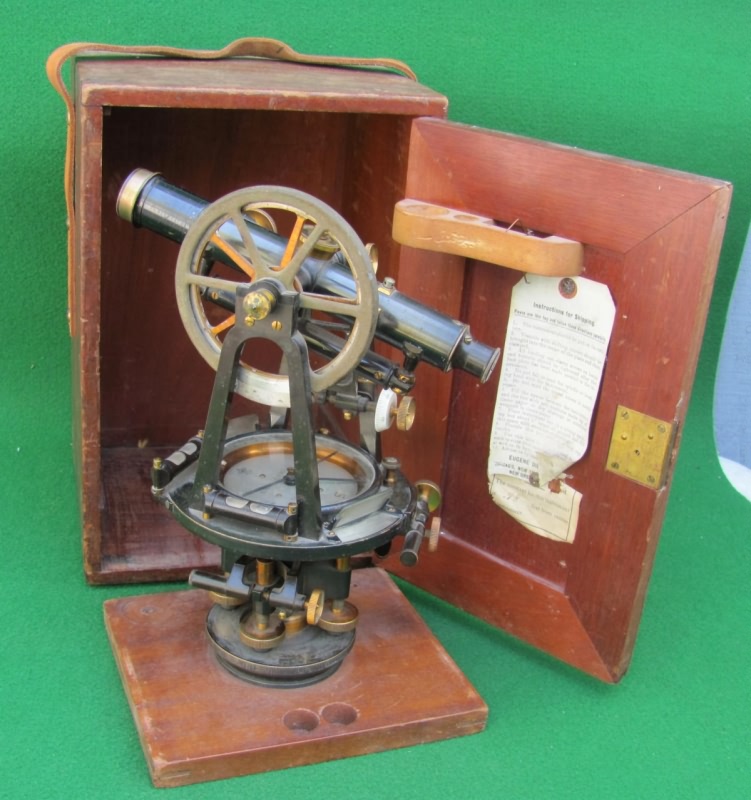 Dietzgen
Light Mountain Solar / Mining Transit
This is a
very nice condition Dietzgen Light Mountain size Solar / Mining transit.
I could not find the exact catalog # looking through several old catalogs,
but it is set up to take a solar attachment on the top of the scope,
and the main scope axle ends are threaded to accept an auxiliary
mining scope and counterweight there as well. Dietzgen referred to such set-ups as
"complete" in their catalogs. Problem is, this example is not complete as neither the
solar attachment nor the mining scope are present.
Dietzgen
Light Mountain Solar / Mining Transit
This is a
very nice condition Dietzgen Light Mountain size Solar / Mining transit.
I could not find the exact catalog # looking through several old catalogs,
but it is set up to take a solar attachment on the top of the scope,
and the main scope axle ends are threaded to accept an auxiliary
mining scope and counterweight there as well. Dietzgen referred to such set-ups as
"complete" in their catalogs. Problem is, this example is not complete as neither the
solar attachment nor the mining scope are present. Good + . . . . . $575.00 SOLD!!
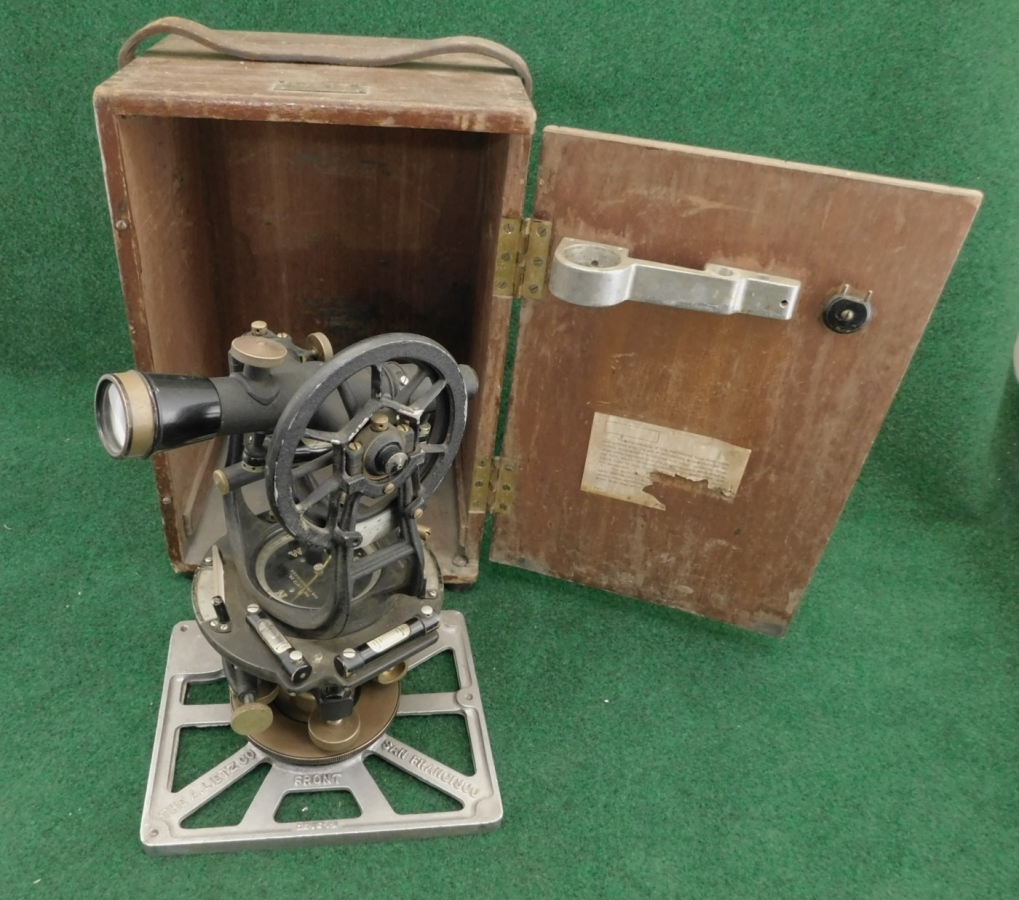 A.
Lietz San Francisco Light Mountain Mining Transit
This is a nice looking light mountain size transit by the well known
California make A. Lietz of San Francisco. The serial number of 17,301.
It looks to date from prior to WWII. The overall condition is nice. Cross hairs are present, and the optics are good.
All bubbles are full. All motions are free and smooth. The
compass points north. Note how the caps on the ends of the scope axles
are threaded to allow a second scope to be affixed there. That scope
is missing. Different, and Nice!!
A.
Lietz San Francisco Light Mountain Mining Transit
This is a nice looking light mountain size transit by the well known
California make A. Lietz of San Francisco. The serial number of 17,301.
It looks to date from prior to WWII. The overall condition is nice. Cross hairs are present, and the optics are good.
All bubbles are full. All motions are free and smooth. The
compass points north. Note how the caps on the ends of the scope axles
are threaded to allow a second scope to be affixed there. That scope
is missing. Different, and Nice!! Good + . . . . . . $225.00 SOLD!!
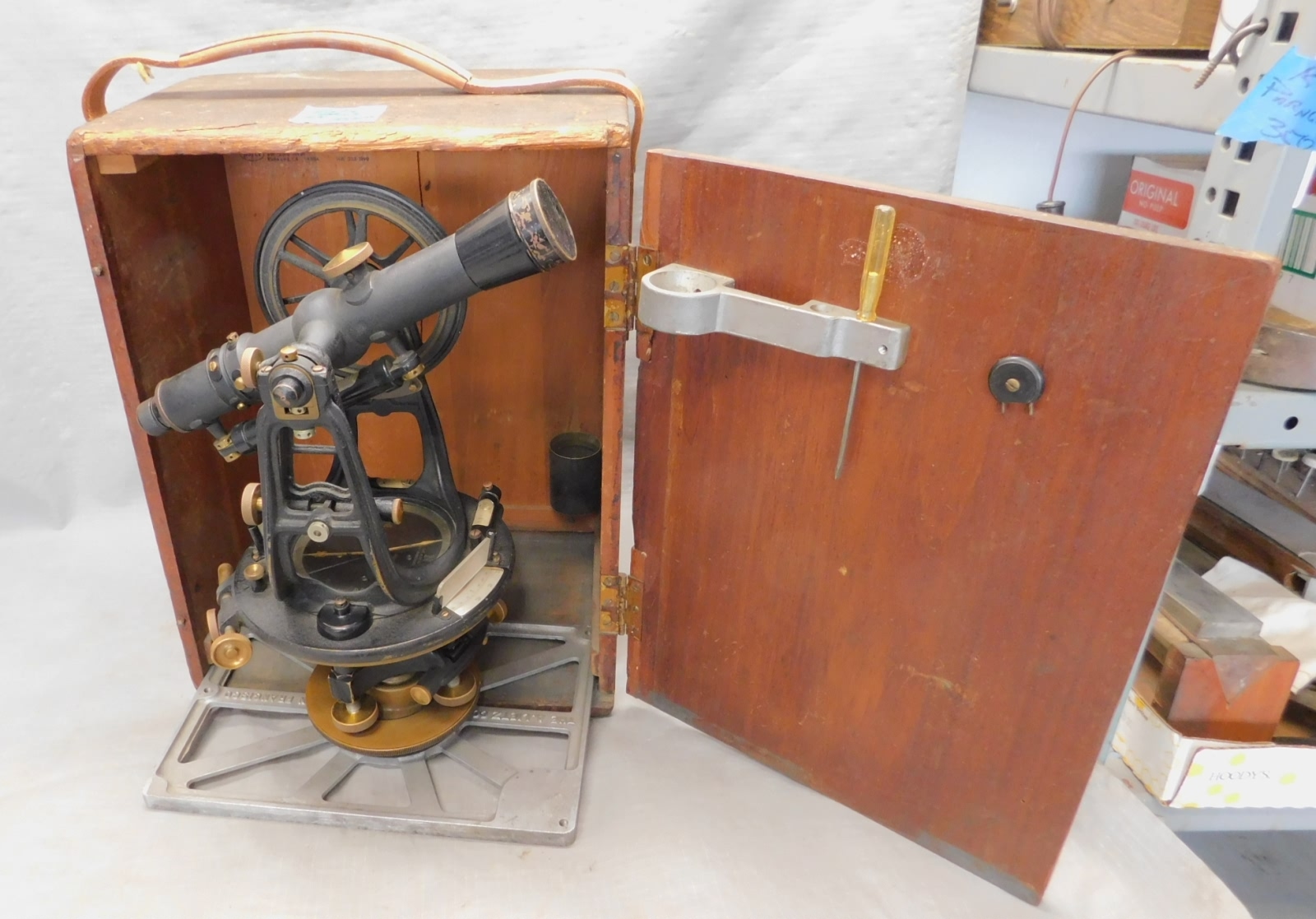 Lietz
Surveyor / Engineer's Mining Transit
This Lietz Mining Transit is a large and
commanding instrument in good overall condition. The A. Lietz Co. of San
Francisco stopped making instruments around the beginning of WWII and opened
up shop shortly before the turn of the century.The name info is under the
glass below the north point on the compass face. The serial # is 1X026.
Lietz
Surveyor / Engineer's Mining Transit
This Lietz Mining Transit is a large and
commanding instrument in good overall condition. The A. Lietz Co. of San
Francisco stopped making instruments around the beginning of WWII and opened
up shop shortly before the turn of the century.The name info is under the
glass below the north point on the compass face. The serial # is 1X026.This transit would date from some point before the beginning of WWII and after the turn of the century. Note how the ends of the scope axles have threaded caps for mounting a second scope and counterweight on the opposite side. The black finish is 90% or better. The optics are OK, and crosshairs present. The box is present and nice. A nice display piece.
Good + . . . . . . $175.00 SOLD!!
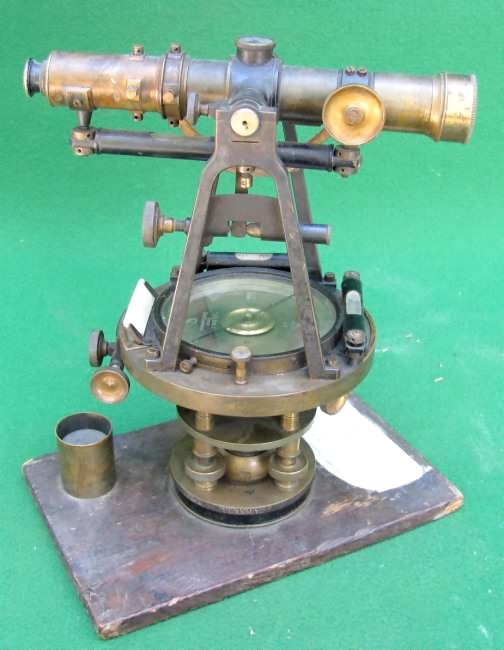 J. C. Sala Transit w/ Saegmuller Solar
Attachment
Mount J. C. Sala was a California surveying
instrument maker who worked with John Roach, one of California's earliest
instrument makers and later took over the business
after Roaches death. Sala died in
1916. His instruments are uncommon and are a well made example of
precision quality. The serial # on this transit is 815 which I would think would date this from right around the turn of the century. There is a paper tag on
the base with a short bio of his working dates and history that the previous owner
found in Smarts book on instrument makers, and included for reference.
J. C. Sala Transit w/ Saegmuller Solar
Attachment
Mount J. C. Sala was a California surveying
instrument maker who worked with John Roach, one of California's earliest
instrument makers and later took over the business
after Roaches death. Sala died in
1916. His instruments are uncommon and are a well made example of
precision quality. The serial # on this transit is 815 which I would think would date this from right around the turn of the century. There is a paper tag on
the base with a short bio of his working dates and history that the previous owner
found in Smarts book on instrument makers, and included for reference.
Burt solar attachments
were typically the style used by Gurley
and Roach on their instruments. Roach had patented the idea of
applying a solar attachment to transits and sold the rights to that idea to
Gurley. This transit is set up to
accept a solar attachment with the threaded attachment point on the top of
the scope. It probably looked like a Saegmuller as Burt solar attachments,
which resembles a miniature sextant, usually set down over a post. I
suppose Sala offered either design as options as I have seen Sala
instruments with a Burt solar.
Solar transits were developed so that the user could
accurately determine his location without relying on the compass in the
field. Magnetic deviations, especially here in the west, and in
other locations where the geography contains large amounts of magnetic ore could throw off a compass and were not an accurate means to determine ones
location in certain areas. The idea was to use the position of the sun, and the horizon,
to determine ones location. Much as a sextant or octant would
be used to determine ones true location on a boat in open water with no
visible reference points. There are a number
of different versions of solar attachments that were patented and used on
surveying instruments. The Burt solar attachment was used on Gurley
instruments and on those by Sala and Roach. K & E used the Saegmuller
style which was a small telescope that mounts above the main scope. Other
types of solar attachments are the Smith and Pearson Patent Solar Attachments
named after the patent holder or inventor.
The transits main
scope is 11" long which would make this an engineers or surveyors transit .
It has an erect image and the optics are crisp and clear. The silvered
compass face is nice, and the needle operates properly. All other motions
seem to operate as they should. The box is nice. The instrument itself has
developed a nice even patina.
This transit will display very nicely and be a
highlight of any collection of surveying related instruments or California
history.
Good + . . . . . . $895.00 SOLD!!
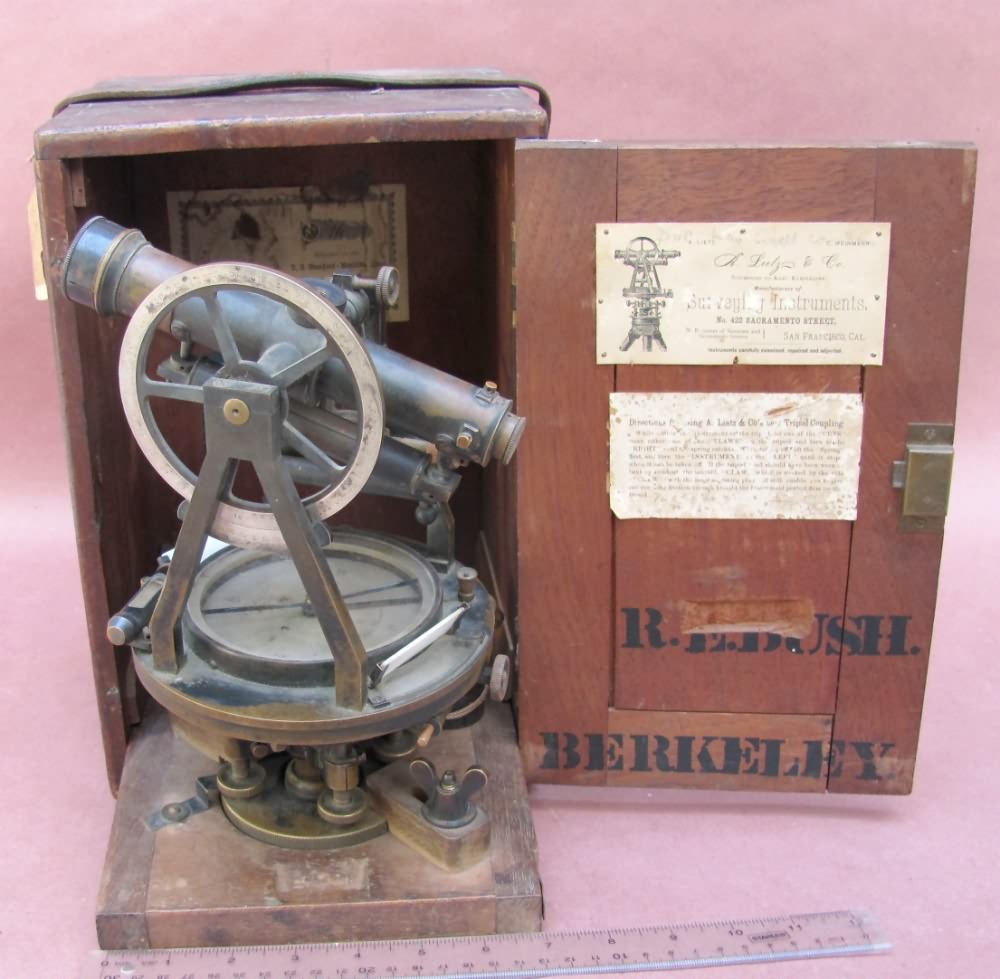 A.
Lietz & Co. Solar Transit
This A. Lietz solar transit has a serial # 74 and was probably made
during Adolph Lietz's first year or two being in operation in San Francisco
California. Smart
states in his book on surveying instrument makers that he first opened for
business in 1882.
A.
Lietz & Co. Solar Transit
This A. Lietz solar transit has a serial # 74 and was probably made
during Adolph Lietz's first year or two being in operation in San Francisco
California. Smart
states in his book on surveying instrument makers that he first opened for
business in 1882. This unusual transit is in overall nice condition. It is a small compact size transit set up to receive a solar attachment on the top of the scope. That attachment is not present. I believe that Lietz utilized the Saegmuller style attachment similar to those found on K & E / Keuffel & Esser instruments but this is set up with a threaded mount, and not a dovetail as typically seen on the K & E version..
The main scope is 7" long and so this could be referred to as either a light mountain or explorer / expedition size transit. It has developed a nice patina over the last 100 plus years. The compass face is marked with the maker name, location and #74 serial number. All motions are free and the optics are good. It has a full vertical silver vernier circle. The mahogany box is OK. This instrument would sell for 3 to 4 times the listed price if one could find the solar attachment that fits on it.
Good + . . . . . . .$750.00 SOLD!!
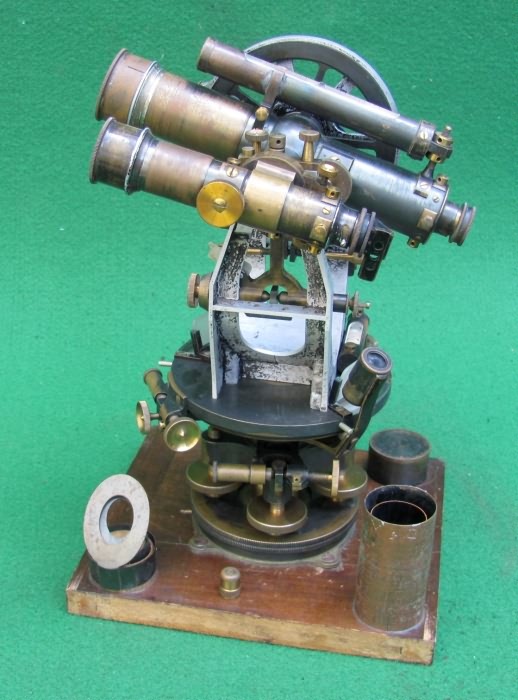 P & R Wittstock / Berlin "Scott's" Mine Tachymeter / Mining Transit
The overall condition of this unusual surveying instrument is very nice. This style transit / theodolite is
pictured online in the book titled "The evolution of mine-surveying instruments" by Dunbar Scott. That online book,
published in the 1890's, illustrates, discusses and makes claims for this style instrument as being very useful and an
advanced design. The serial # on this piece is 604. Other than the reference noted above there is little info to be
found on this maker or instrument online. Wittstock is not listed in Smarts, and there are no examples in the Smithsonian collection.
P & R Wittstock / Berlin "Scott's" Mine Tachymeter / Mining Transit
The overall condition of this unusual surveying instrument is very nice. This style transit / theodolite is
pictured online in the book titled "The evolution of mine-surveying instruments" by Dunbar Scott. That online book,
published in the 1890's, illustrates, discusses and makes claims for this style instrument as being very useful and an
advanced design. The serial # on this piece is 604. Other than the reference noted above there is little info to be
found on this maker or instrument online. Wittstock is not listed in Smarts, and there are no examples in the Smithsonian collection. The leather cover for the box is coming apart at the seams and is very fragile. It did a good job protecting the wooden box which is in fine condition. (see pics) The instrument itself, and the auxiliary scope are very nice. The main scope is approx. 8" and the smaller one 6". Both have sun shades and reflectors. There are also lens covers for both. The counterweight which mounts opposite the aux. scope screws onto the wooden base when not in use. There is a spot built inside the box for the second scope but no means to lock it in place. The optics are good, and crosshairs are present in both scopes. There are also 2 right angle eyepieces with a sliding feature for 3 different lenses. Note the 2 magnifiers to aid in reading both the vertical and plate vernier scales. All motions operate smoothly. The leveling head and plate are made of brass. The instrument frame is cast aluminum. The scopes are constructed of both brass and aluminum making for interesting contrasts. The maker info and serial # are stamped onto the top plate. The collapsible leg tripod in the last pic is included. It is a small light weight piece in nice condition. The cap for it is a C.L. Berger but it fits the instrument properly and i believe is original to it. Nice!!
This transit looks great and will display very nicely in, and be a highlight of, any collection of surveying related instruments or mining related collection.
Fine . . . . . . $1950.00 SOLD!!
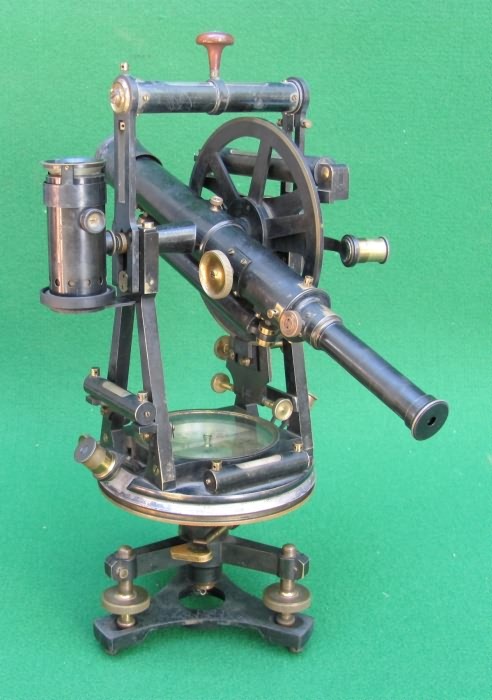 Cary
/ London Mining Theodolite / Transit w/ Aux. Oil Wick Light
This unusual English Mining Transit / Theodolite is in superb original condition.
It dates from near the turn of the century. Be sure to look at all the pics
to see the details and how it is fitted into the original Mahogany
Cary
/ London Mining Theodolite / Transit w/ Aux. Oil Wick Light
This unusual English Mining Transit / Theodolite is in superb original condition.
It dates from near the turn of the century. Be sure to look at all the pics
to see the details and how it is fitted into the original Mahogany
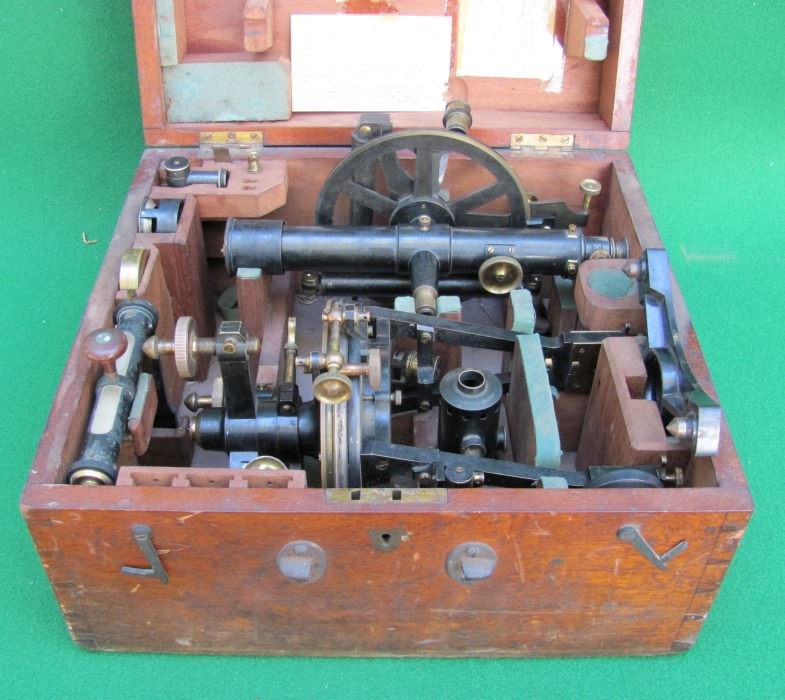 box.
It is complete and then some. Some features are as follows. There are 3 different
interchangeable rear eyepieces.
A short one, a long one, and a right angle one. There is also an extra
set of crosshairs in a small brass container in the box.
box.
It is complete and then some. Some features are as follows. There are 3 different
interchangeable rear eyepieces.
A short one, a long one, and a right angle one. There is also an extra
set of crosshairs in a small brass container in the box. The most unusual feature of this mining transit / theodolite is the small oil fired aux light for use in mines or poor lighting conditions that is still present and complete in the box. (See pic of different parts) It is mounted on the left side of the theodolite in the left side pic above. This small auxiliary light can be mounted on either side of the transit. The main scopes axis is hollow and has a lens on both sides that this light would shine light into illuminating the inside of the scope so the user could see better for use in mines or other poor lighting conditions. Note also that this instrument has four small magnifiers to aid in reading the scales. 2 on the lower plate and 2 for the vertical circle vernier. The plate vernier is silver and beveled. The compass operates and points north. The compass face is silvered and very nice. This instrument also has a removable striding level which fits crosswise on top after the instrument has been set up. A wonderful and very graphic looking instrument.
Fine. . . . .$2950.00 SOLD!!
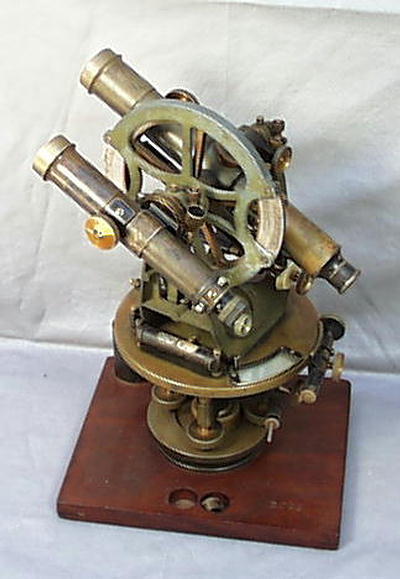
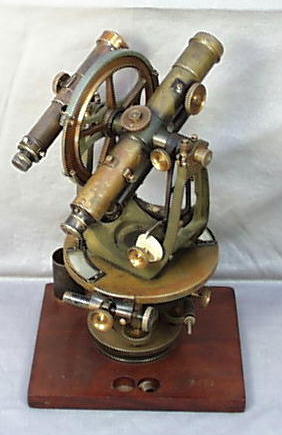 Dietzgen
Transit w/ Aux. Mining Scope Attachment & Scope w/ Setup for
Solar Attachment This transit dates from just
after the turn of the last century. I have an auxiliary sighting scope
that fits onto the outboard attachment point, but
I am also in the market for the small solar attachment that the top of this
transit is set up to accept. I believe it is a similar looking telescope
affair that is mounted in a U shaped yoke with a center threaded rod that would
go into the fitting visible on the top. It is a female receptacle, and
a different size from the base of the other scope that is present now.
Dietzgen
Transit w/ Aux. Mining Scope Attachment & Scope w/ Setup for
Solar Attachment This transit dates from just
after the turn of the last century. I have an auxiliary sighting scope
that fits onto the outboard attachment point, but
I am also in the market for the small solar attachment that the top of this
transit is set up to accept. I believe it is a similar looking telescope
affair that is mounted in a U shaped yoke with a center threaded rod that would
go into the fitting visible on the top. It is a female receptacle, and
a different size from the base of the other scope that is present now.
Good . . . . .$1250.00 SOLD
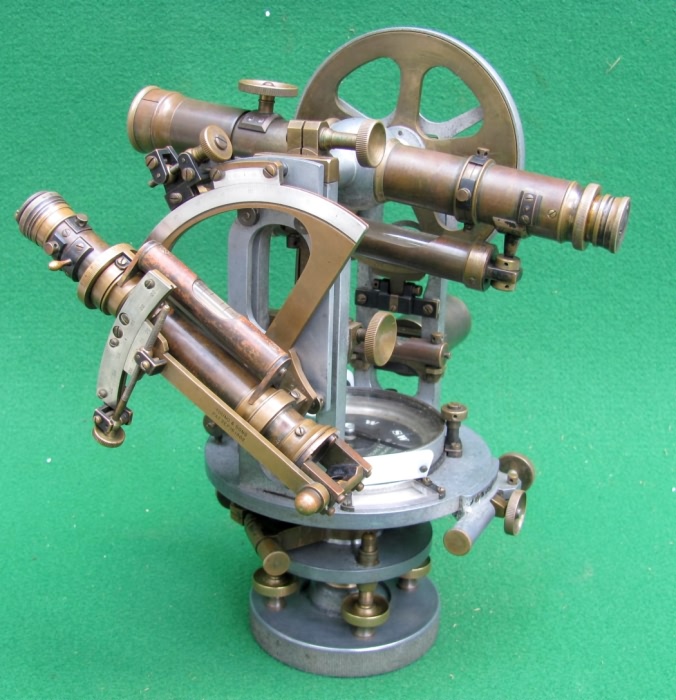 Young
& Sons Solar Transit with Smith Patent Telescopic Solar Attachment in Original Box This
is a rare c. 1913 Young solar transit with an unusual Smith Patent
Telescopic Solar attachment.This transit is
called off as No. 10 in an early Young catalogs. The
patent for the solar attachment was first granted in 1880. This
example is an improved model that was patented in 1902. The serial number on
the transit indicates it dates from shortly after the turn of the century.
Young
& Sons Solar Transit with Smith Patent Telescopic Solar Attachment in Original Box This
is a rare c. 1913 Young solar transit with an unusual Smith Patent
Telescopic Solar attachment.This transit is
called off as No. 10 in an early Young catalogs. The
patent for the solar attachment was first granted in 1880. This
example is an improved model that was patented in 1902. The serial number on
the transit indicates it dates from shortly after the turn of the century. Young's use of Aluminum for many of the different parts of the transit is very unusual for an instrument from this time period. It has a 4½" horizontal circle, a 4" silvered vertical circle, a 3.3" needle, and a 10" main telescope. The telescope on the Smith solar unit is 7" long, and is inscribed "Pat Sep 16, 1902." There is a counterweight that mounts on the standard opposite the side with the solar unit. All motions are free and move smoothly. The compass works as it should. Note that there is a vernier scale on the outside plate, and another under the glass.
Fine . . . . . . $3750.00 SOLD!!
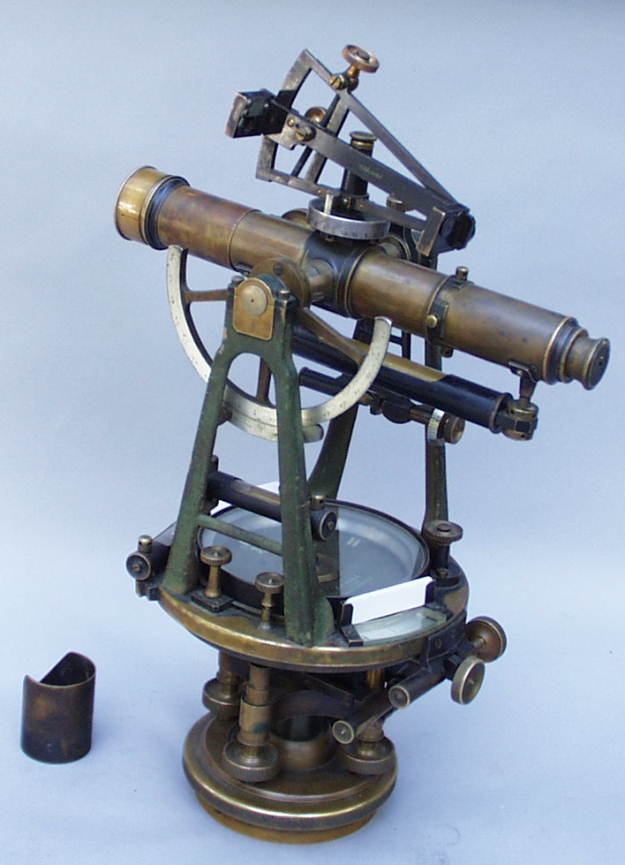 Sala
Transit w/ Burt Style Solar Attachment This
transit was made by one of the three famous West Coast Surveying Instrument
Makers out of San Francisco During the 19th century. These makers were
William Albert Schmolz, John Roach, and Joseph Charles Sala. Schmolz,
whose working dates were from the mid 1850's until his death in 1891 was the
person first responsible for patenting the idea to adapt the Burt Solar Apparatus
to a transit and was granted a patent for this idea in 1867. Gurley bought
the rights to this idea, and introduced their version around 1874, agreeing
to pay Schmolz $5.00 for each one they sold. This agreement expired in
1884 when the patent became part of the public domain. This instrument
dates from some point after that, as Sala who was born in 1841 and at first
apprenticed to Roach was listed first in San Francisco Directories as Roach's
partner in the 1861 Directory took over the business upon Roach's death in 1891.
This instrument is #934 and was probably made just after the turn of the century.
Sala died in 1916.
Sala
Transit w/ Burt Style Solar Attachment This
transit was made by one of the three famous West Coast Surveying Instrument
Makers out of San Francisco During the 19th century. These makers were
William Albert Schmolz, John Roach, and Joseph Charles Sala. Schmolz,
whose working dates were from the mid 1850's until his death in 1891 was the
person first responsible for patenting the idea to adapt the Burt Solar Apparatus
to a transit and was granted a patent for this idea in 1867. Gurley bought
the rights to this idea, and introduced their version around 1874, agreeing
to pay Schmolz $5.00 for each one they sold. This agreement expired in
1884 when the patent became part of the public domain. This instrument
dates from some point after that, as Sala who was born in 1841 and at first
apprenticed to Roach was listed first in San Francisco Directories as Roach's
partner in the 1861 Directory took over the business upon Roach's death in 1891.
This instrument is #934 and was probably made just after the turn of the century.
Sala died in 1916. This instrument is in an amazing state of preservation. The box is dovetailed, and has a later Lietz sticker in the top of the lid The compass face has a green finish and the points are nicely engraved. There is a half vertical circle, and the vernier is silvered. The solar attachment is clearly marked Sala, and is basically identical with the version put out by Gurley.
Good . . . . .$4000.00 SOLD
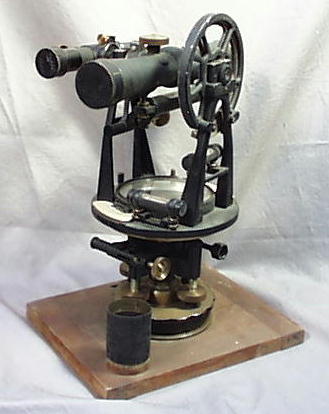 Heller
& Brightly Transit w/ Aux. Mining Scope Attachment
Transits set up to take an Auxiliary Scopes for either mining
related work or other precise applications are a unusual configuration. This
style of surveying instrument that was basically used in only one or two specific
applications. They were not widely distributed and thus quite hard to
find. With this example, the transit was made by Heller and Brightly of
Phila. PA., and the scope is unmarked, but I have been told is a Lietz who were
an established West Coast supplier, distributor, and manufacturer of quality
optical equipment and surveying supplies. It is a nice looking instrument.
Heller
& Brightly Transit w/ Aux. Mining Scope Attachment
Transits set up to take an Auxiliary Scopes for either mining
related work or other precise applications are a unusual configuration. This
style of surveying instrument that was basically used in only one or two specific
applications. They were not widely distributed and thus quite hard to
find. With this example, the transit was made by Heller and Brightly of
Phila. PA., and the scope is unmarked, but I have been told is a Lietz who were
an established West Coast supplier, distributor, and manufacturer of quality
optical equipment and surveying supplies. It is a nice looking instrument.
Good . . . . .$1450.00
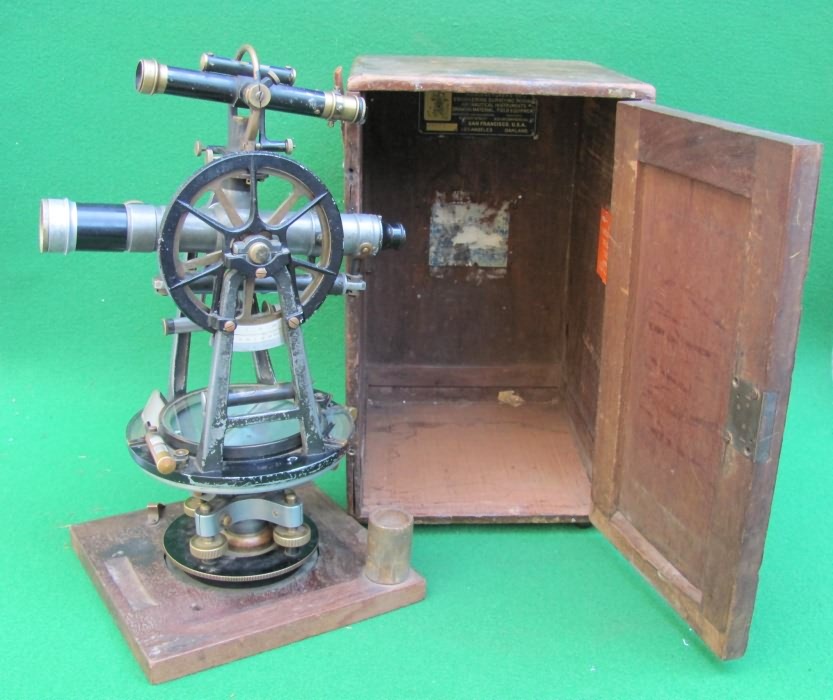 A.
Lietz Aluminum Solar Transit w/ Saegmuller Solar Attachment
This A. Lietz Solar transit is a very nice instrument
that has a great look when all set up. The entire instrument is made of
Aluminum except for the lower clamp brackets and leveling head parts which are
brass. This transit is set up to accept the Saegmuller solar attachment seen
mounted on the instrument in the first pic. K & E used a dovetail sliding
arrangement to mount their Saegmuller solar on their instruments. This
marked Lietz version used a threaded mount and is proper and right for the
instrument.
A.
Lietz Aluminum Solar Transit w/ Saegmuller Solar Attachment
This A. Lietz Solar transit is a very nice instrument
that has a great look when all set up. The entire instrument is made of
Aluminum except for the lower clamp brackets and leveling head parts which are
brass. This transit is set up to accept the Saegmuller solar attachment seen
mounted on the instrument in the first pic. K & E used a dovetail sliding
arrangement to mount their Saegmuller solar on their instruments. This
marked Lietz version used a threaded mount and is proper and right for the
instrument.The transits main scope is 11" long which would make this an engineers or surveyors transit. It has an erect image and the optics are OK.The compass is operable, and the silvered face is very nice. The serial # is 1346. I would think this transit dates from just after the turn of the century. Aluminum was a new material at this point in time, and very few tools or instruments were made using it. Note that the solar attachment platform is part of the original casting and not an added mount as is usually seen. The solar attachment is marked Lietz as seen in the pics. It is made of brass and finished in black. All motions seem to operate as they should on both the transit and the attachment. The box is OK. There is no tripod.
Solar transits were developed so that the user could accurately determine his location without relying on the compass in the field. Magnetic deviations, especially here in the west, and in other locations where the geography contains large amounts of magnetic ore could throw off a compass reading and were not an accurate means to determine ones location in certain areas. The idea with solar instruments was to use the position of the sun and the horizon to determine ones location. Much as a sextant or octant would be used to determine ones true location on a boat in open water with no visible reference points.
There are a number of different versions of solar attachments that were patented and used on surveying instruments. The Burt solar attachment was used on Gurley instruments and on those by Sala and Roach. K & E used the Saegmuller style which was a small telescope that mounts above the main scope. Other types are the Smith and Pearson Patent Solar Attachments named after the patent holder or inventor.
This unusual aluminum solar transit will display very nicely and be a highlight of any collection of surveying related instruments.
Good + . . . . . .$1950.00 SOLD!!
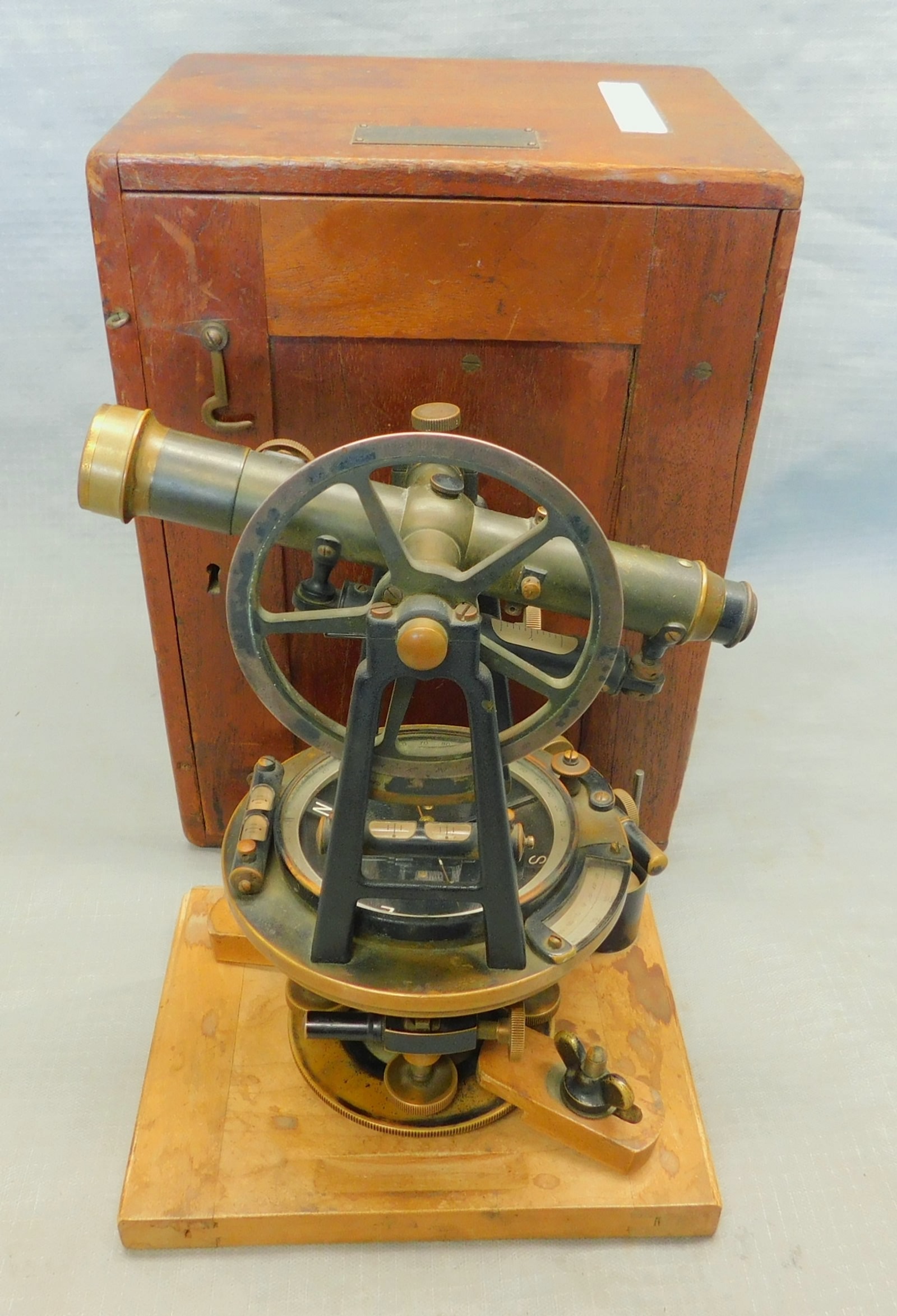 Lietz
"Universal Junior" Solar Transit Nice
overall condition. This small recon or preliminary size transit is drilled to accept a solar
attachment on the top of the scope. The transit is in very nice
overall condition. All motions are free, good optics, good bubbles,
crosshairs, etc. Box is nice. An unusual instrument by the famous San Francisco
maker.
Lietz
"Universal Junior" Solar Transit Nice
overall condition. This small recon or preliminary size transit is drilled to accept a solar
attachment on the top of the scope. The transit is in very nice
overall condition. All motions are free, good optics, good bubbles,
crosshairs, etc. Box is nice. An unusual instrument by the famous San Francisco
maker. Good + . . . . . . $495.00 SOLD!!
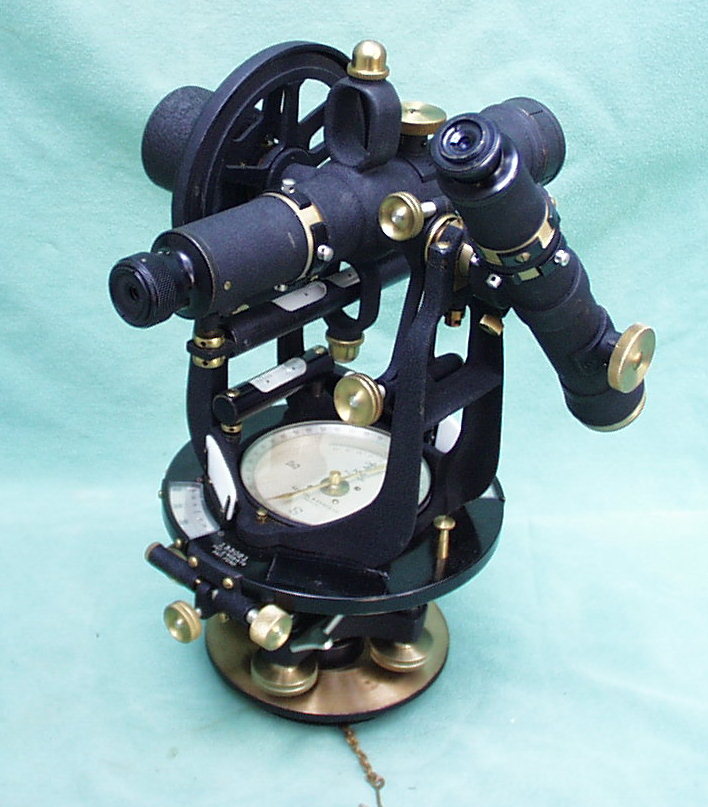 Keuffel
& Esser #5081 1/2 C Mining Transit w/ Auxiliary Scope
This is a super nice Keuffel & Esser Paragon Mining transit. The # 5081 1/2
C is designated as a mining transit, and it is specially designed to accept a secondary
scope that mounts either to the top of the main scope or to the outboard side as
shown in the pics. Mining transits with these secondary scopes are very unusual
and hard to come by.
Keuffel
& Esser #5081 1/2 C Mining Transit w/ Auxiliary Scope
This is a super nice Keuffel & Esser Paragon Mining transit. The # 5081 1/2
C is designated as a mining transit, and it is specially designed to accept a secondary
scope that mounts either to the top of the main scope or to the outboard side as
shown in the pics. Mining transits with these secondary scopes are very unusual
and hard to come by. This mining transits serial # is 133021 indicating it was made in the 50's. The black matt finish is near perfect. It shows little signs of use and just a few minor box
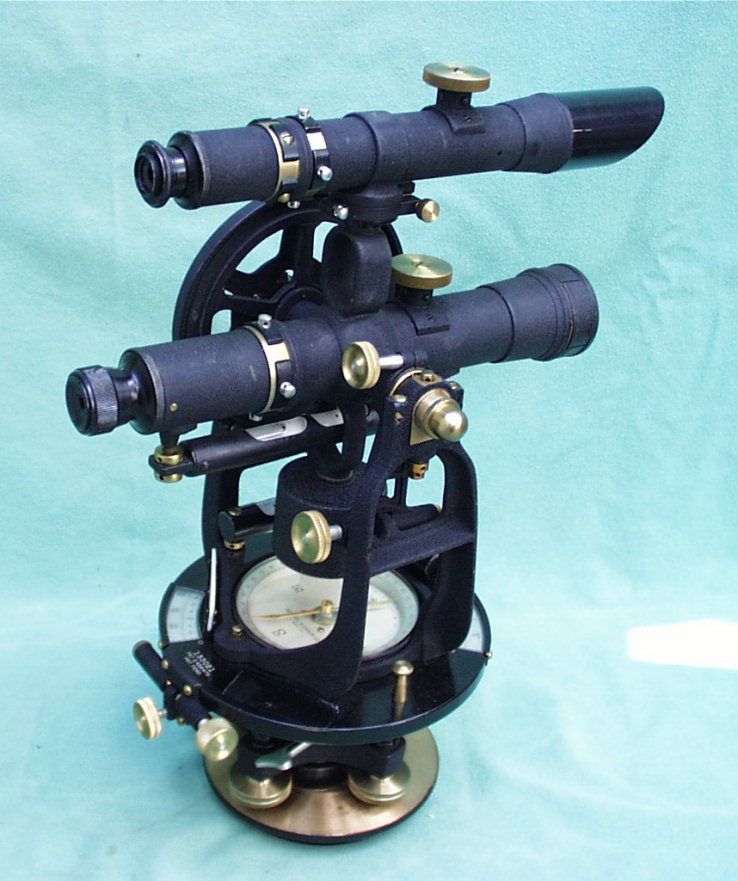 scuffs at high points to the finish.
The optics are crisp and clear. The fitted box is nice as well, and set up
to accept the auxiliary scope and weight you see.
scuffs at high points to the finish.
The optics are crisp and clear. The fitted box is nice as well, and set up
to accept the auxiliary scope and weight you see. The main scope is 10" long and has a 20 power magnification. The horizontal limb is 5 1/2" and graduated to half degrees. It has double vernier windows set to 30 degrees that read to a minute. The compass needle is approx 3 1/2" and is gold plated. It functions properly. All motions are free and turn smoothly. The rear eyepiece focus works well.. The 4 1/2" vertical circle is graduated on silver and also reads to a minute.
The auxiliary scope is 6 5/8" long and 14 power. It is designed to mount either to the top of the scope or just outside the standards on the side.
Mining transits were used in situations where the operator had to shoot down vertical shafts or odd angles and the horizontal plate would interfere. When mounted on either the top or side it projected past the plate to allow the user to shoot that line. Different manufacturers used different approaches to solve the problem, and K & E used the two point attachment system with counterweight which allowed for different setups in different situations. Others include the Buff version where the main scope could be released and moved into another position on the standards above the plate. There is also a version with a leaning frame to allow for the same effect.
Excellent . . . . . $1995.00 SOLD!!
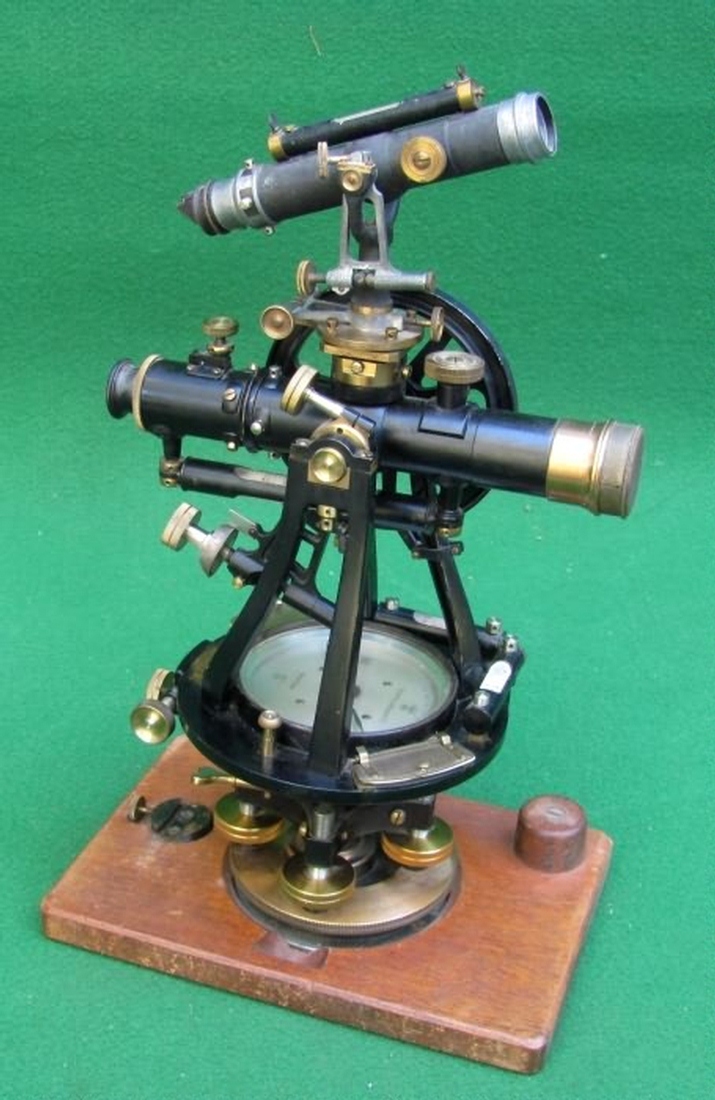 K
& E / Keuffel & Esser c. 1907 Twisted Frame Solar Transit w/Saegmuller Solar Attachment in Original Box This
is a very nice condition solar transit. It looks to have
seen little use. The original finish on the Mahogany box is covered is in like new
condition noting minor scuffs.
K
& E / Keuffel & Esser c. 1907 Twisted Frame Solar Transit w/Saegmuller Solar Attachment in Original Box This
is a very nice condition solar transit. It looks to have
seen little use. The original finish on the Mahogany box is covered is in like new
condition noting minor scuffs.The distinctive looking twisted frame standards K & E used on this instrument were only offered for about 10 years or so. The serial # 13371 is found on both the box, and the plate of the instrument. That dates this transit from 1907 according to the charts available at www.surveyhistory.org. The matte black finish on the instrument is very nice. The loupe, plumb bob, and spanner are all present. There is
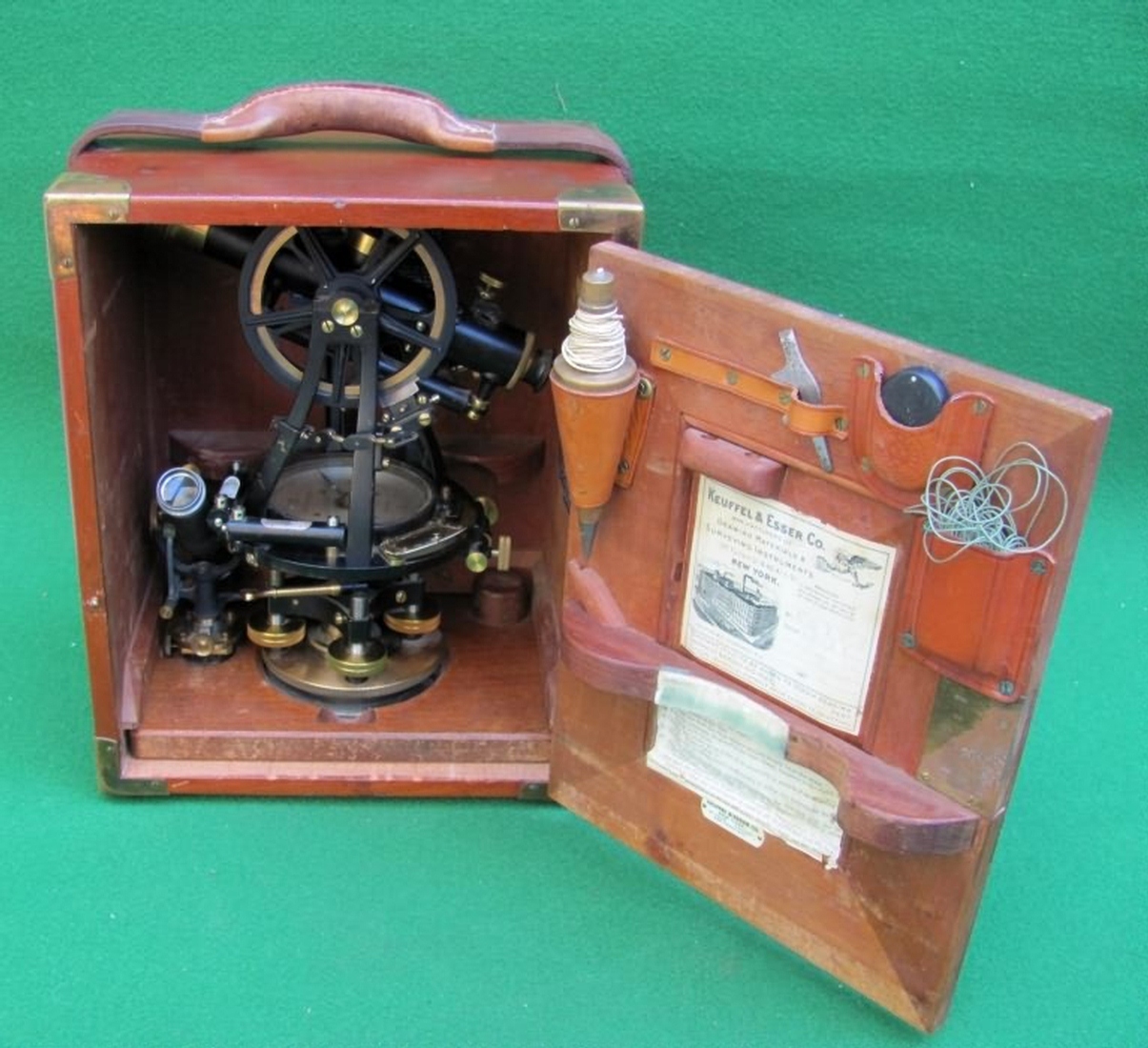 also a jointed holder for a magnifier attached to the standards. The
solar attachment has a mounting platform on the inside of the box on a side
wall.Please look at all the pics to see the
exceptional condition.
also a jointed holder for a magnifier attached to the standards. The
solar attachment has a mounting platform on the inside of the box on a side
wall.Please look at all the pics to see the
exceptional condition. Solar attachments were developed for use in the field to facilitate finding ones location using the sun and horizon much as seafarers would do with sextants or octants. There use was made necessary where ore deposits would adversely affect the accuracy of a regular compass. Each surveying instrument maker developed or adapted one or more different designs for use on their instruments. Other patented versions were named after the inventor such as Burt, Smith, Pearson, and others.
All motions operate smoothly. The silvered compass face is flawless, and the compass swings north. Cross hairs are present in both scopes. A super nice example of a rare instrument that will display very nicely in any number of settings.
Fine . . . . . . $2250.00
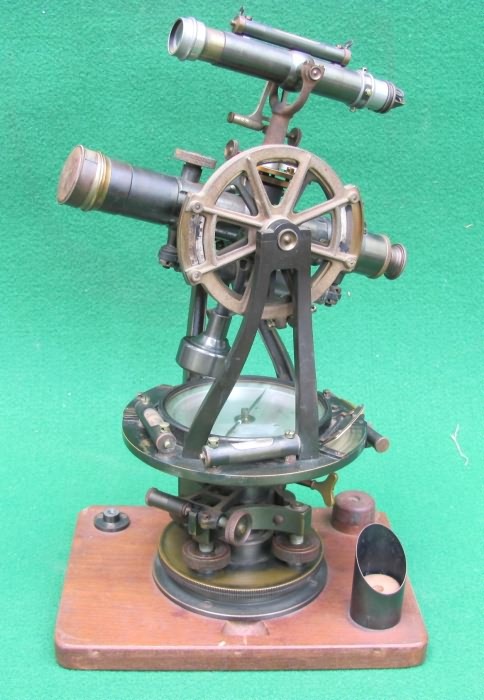 K
& E / Keuffel & Esser c. 1910 Twisted Frame Solar Transit w/ Saegmuller Solar Attachment in Original Box This
is the most complete, and nicest condition solar transit I have ever seen or
offered for sale. It hardly looks to have
never been used. The box is covered in canvas and is in like new
condition noting minor wear or fraying of the cloth at the corners.
K
& E / Keuffel & Esser c. 1910 Twisted Frame Solar Transit w/ Saegmuller Solar Attachment in Original Box This
is the most complete, and nicest condition solar transit I have ever seen or
offered for sale. It hardly looks to have
never been used. The box is covered in canvas and is in like new
condition noting minor wear or fraying of the cloth at the corners.The distinctive looking twisted frame standards K & E used on this instrument were only offered for about 10 years or so. The serial # 23632 is found on both the box, and the plate of the instrument. That dates this transit from 1911 according to the charts available at www.surveyhistory.org. The matte green lacquer finish on the instrument is near pristine.Nearly every holder for small tools on the door is full. The loupe, plumb bob, oil can, and more are all present. The solar attachment has a mounting platform on the inside of the box on a side wall. Please look at all the pics to see the exceptional condition.
Solar attachments were developed for use in the field to facilitate finding ones location using the sun and horizon much as seafarers would do with sextants or octants. There use was made necessary where ore deposits would adversely affect the accuracy of a regular compass. Each surveying instrument maker developed or adapted one or more different designs for use on their instruments. Other patented versions were named after the inventor such as Burt, Smith, Pearson, and others.
All motions operate smoothly. The silvered compass face is flawless, and the compass swings north. Cross hairs are present in both scopes. NO apologies. You will never find a nicer example. The nicest example of a rare instrument that will display very nicely in any number of settings.
Fine + . . . . . . $3250.00 SOLD!!
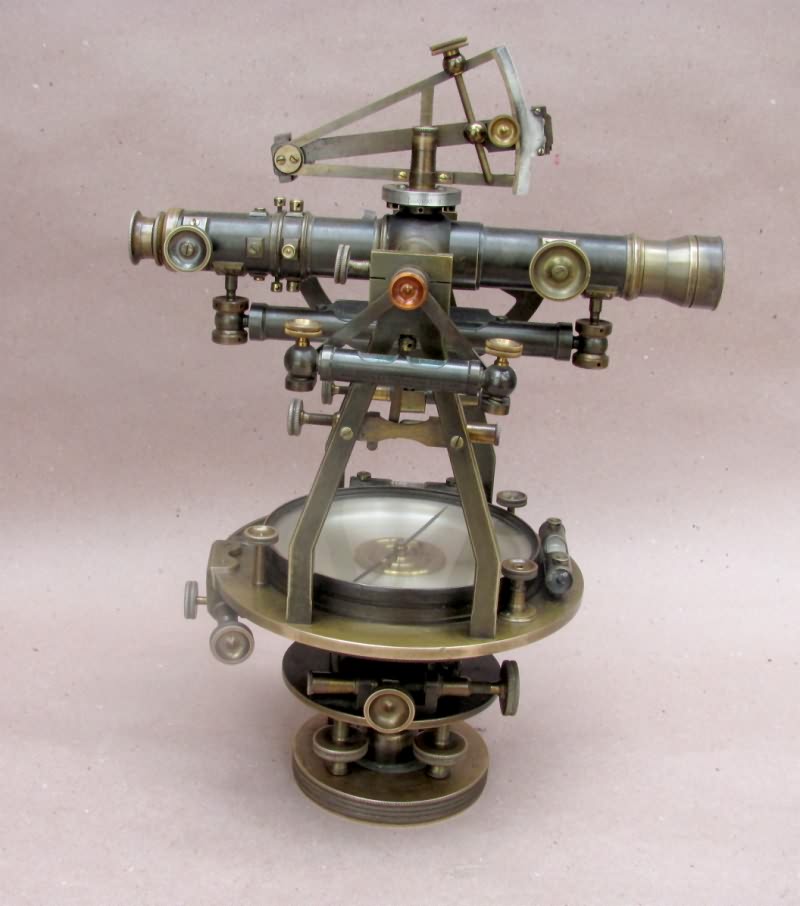 W&
L. E. Gurley #17 Engineers Surveying Transit w/ Burt Solar Attachment
This is a Gurley engineers solar transit equipped with a factory and
properly marked Burt Patent Solar Attachment. Solar transits are one of
the most desirable and sought after of all surveying instruments to be
found. They are graphic, historically important, rare, and represent
an important aspect of surveying history.
W&
L. E. Gurley #17 Engineers Surveying Transit w/ Burt Solar Attachment
This is a Gurley engineers solar transit equipped with a factory and
properly marked Burt Patent Solar Attachment. Solar transits are one of
the most desirable and sought after of all surveying instruments to be
found. They are graphic, historically important, rare, and represent
an important aspect of surveying history.This example is a #17 Engineers transit with a 11" scope and has a large and commanding presence that will make for a great display piece. It has a 5" needle, and a 6" half vernier circle that reads to 20 degrees. It weighs close to 18 lbs or almost twice what a similar looking but smaller light mountain or recon transit would weigh. The picture below on the right gives you an idea of just how large and commanding this transit is compared to a recon size Gurley. The optional / auxiliary side mount level is present as well.The adjusting tool is also stored in the box.
This instrument is in very nice overall condition and dates from the early part of the last century. There is no serial number and so predates 1908 when Gurley started to use them. It has never been cleaned and the brass has a wonderful mellow patina. The box is nice as well noting just some scuffing on the exterior.All motions and the screw are
free. The compass works, and the silvered compass face is very nice. The idea behind solar instruments, either transits or compasses, was that in certain areas the magnetic deviation was so great, and the errors it could cause so great, that these unusual and significant devices were developed as a way to compensate for this effect. The Burt Solar attachment was first Patented in the 1830's to be used on solar compasses. Gurley later bought the rights and offered this style with their instruments. . A solar instrument enabled the user to find a true reference or location using the horizon and the position of the sun instead of the standard method employing the compass. Even though the concept had been around and employed in seafaring navigation for centuries, very few of them were actually made for use in the field w/ transits or compasses. They are very rare.
Each major surveying instrument maker made a transit that came equipped with one form or another of these devices. The best known names in the surveying instrument field were Gurley and Keuffel & Esser, but Berger, Buff, Dietzgen, Lietz, Sala, and others offered versions of a solar transit. Different attachments are typically known by the name of the inventor, and the examples designed and developed by Saegmuller, Smith, & Burt being the best known solar attachments. The Saegmuller and the Smith utilized secondary small scopes, while the Burt design more closely resembled a octant or sextant in design and used a peep site.
Gurley was located in Troy New York at this time, and their reputation for the manufacture of quality instruments was unsurpassed. This Solar Transit is surely one of the most striking and graphic of forms of surveying instrument that are available not to mention one of the most avidly sought by collectors. Rarely seen or offered for sale in this large size, this transit is the piece that will move your collection to the head of the line. A super piece.
Good+ . . . . . .$2500.00 - 4000.00 SOLD!
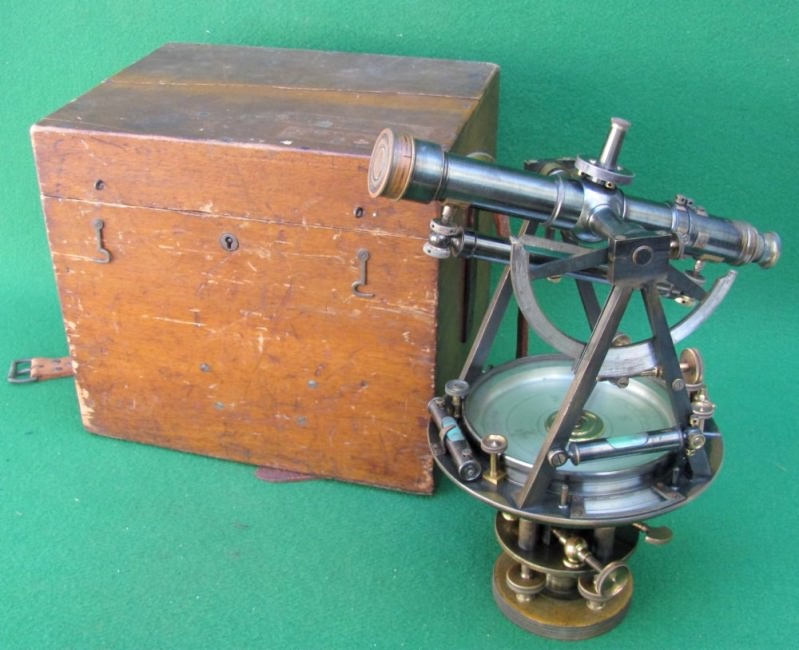 W.
& L. E. Gurley Engineers / Surveyor's Solar Transit This
large, early, and unusual Gurley transit is in very nice original condition.
This engineers / surveying
solar transit dates from 1880. There is no
serial # under the glass, but upon examination the 1880 date is stamped inside
under the main plate. It is also stamped #10 there. Other
features that indicate early manufacture and help date this include the straight A shaped
legs or standards holding the scope. Also the tangent lock is found atop
of the plate, and is not spring loaded.
W.
& L. E. Gurley Engineers / Surveyor's Solar Transit This
large, early, and unusual Gurley transit is in very nice original condition.
This engineers / surveying
solar transit dates from 1880. There is no
serial # under the glass, but upon examination the 1880 date is stamped inside
under the main plate. It is also stamped #10 there. Other
features that indicate early manufacture and help date this include the straight A shaped
legs or standards holding the scope. Also the tangent lock is found atop
of the plate, and is not spring loaded.
This transit is set up for a Burt Solar Attachment with the post seen on the
top of the scope to accept it. There is a place for it in the box, but the
attachment itself has gone missing. The scope measures just about 11" and
the transit stands approx 12" tall. The compass face is hand engraved, and the
Troy NY location is at the top with the Gurley name.The silvered face
is nice, and engraving is very nice. The compass face measures about 6" and
the compass needle is 5 inches. It works properly as does the
lifer lock for it. The original green lacquer finish is
well over 90%. It is not paint, but rather colored lacquer to help
keep down the glare. It has a great look and appeal. The
optics are clear, and the crosshairs are present. All motions are free,
and all 3 level bubbles are original and good with the typical early blue liquid
filling. The dovetailed Mahogany box is nice noting the one crack
across the top. The leather strap is a replacement.The tripod is in super nice condition as well and looks
great with its tapered legs. Some of the threads are a bit banged up,
but the transit does thread on OK.
Again, the condition of this
Gurley Solar Transit is exceptional. With a proper Burt attachment
this instrument would be worth 3 - 4 times the price I am asking. A very nice looking
instrument that will display very nicely
in most any setting.
Good+ . . . . . . .$1095.00 SOLD!!
 W.
& L. E. Gurley # 276 Pocket Solar Compass Gurley pocket solar compasses are a rare
and unusual surveying instrument. The condition of this
example is second to none. It is near mint!!
W.
& L. E. Gurley # 276 Pocket Solar Compass Gurley pocket solar compasses are a rare
and unusual surveying instrument. The condition of this
example is second to none. It is near mint!!The basic idea behind solar attachments and their use in surveying was first developed by William Burt in the 1830's. Gurley bought the rights to use his idea and incorporated it into both their transits and their line of compasses. Gurley first introduced this near miniature solar size compass in 1880. It was discontinued in about 1918 when it no longer appeared in their catalogs.In their catalog description Gurley claimed that this style compass was nearly as accurate as their larger models, far lighter and easier to carry into the field. It weighs in at under 5 lbs, while the standard size compass was closer to 15 lbs.
Solar compasses were developed to be used in place of regular compasses that were subject to error due to large deposits of iron that would adversely affect a regular compass. The idea was to use the sun and horizon to accurately find ones position. Much as early sea faring adventurers had done, and do with instruments like sextants and octants.
The overall condition is near mint with original patina. The lacquer finish is near perfect with just minor losses. It has never been cleaned, and when you move the hour arc you can see the original polished silver scales under the clamps. This points to just how little this instrument was ever used. All motions operate freely, and the plate and both verniers move freely. The 3" needle swings freely. The compass face is inscribed with the Gurley name and Troy NY location. One sight vane is marked with a name and Canada location. The serial # is 9215 which would indicate this dates from 1909. There is an example of one of these pictured in the Skerritt book that illustrates Charles Smart's collection of surveying instruments. In it he states that Smart's Pocket Solar Compass was Smarts favorite instrument in the collection.
This instrument was designed to be used on either a staff or tripod. There is both a leveling head and the swivel ball joint stored in the box. I do have a small light weight tripod that will fit the mount that can be purchased separately. I also have NOS staffs that will work well with this instrument listed on another page.
An important surveying related instrument ready for inclusion in the finest collection of surveying instruments, Scientific instruments, or significant Americana. Highly recommended.
Fine . . . . . . $8000.00 SOLD!!
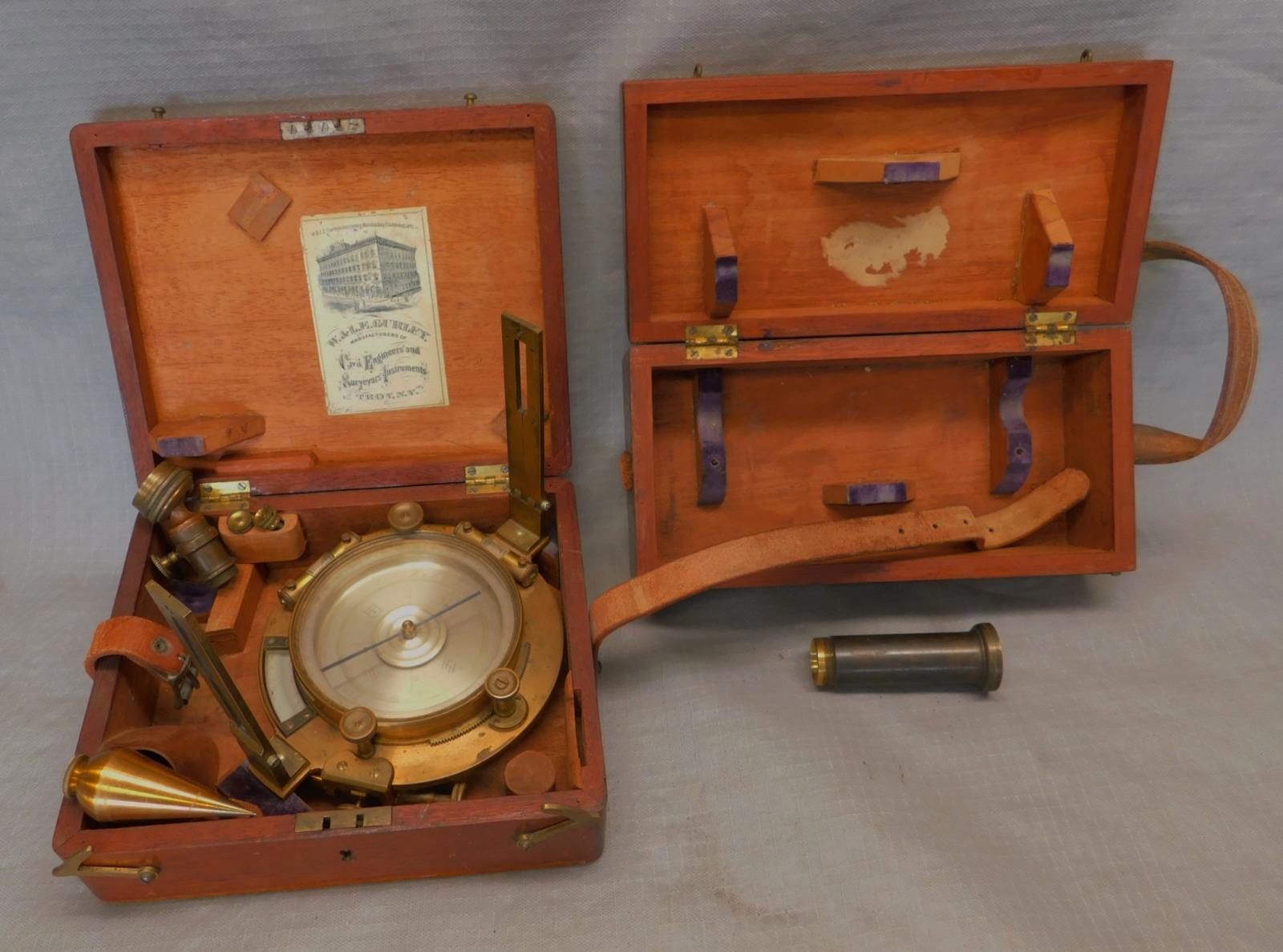 Gurley # 285 Pocket Railroad Compass
and Auxiliary Scope Box
The overall condition of this small compact
Gurley pocket railroad compass is pretty nice.
The 3 1/2" needle functions, and the silvered and engraved compass face is
very nice. All the motions on the compass are free and operable. The knuckle
joint is present. I am offering it with a second box that I believe
held the auxiliary scope for it. The scope itself is missing.
Both boxes are marked the same way, and someone, at some time point a long
time ago scratched out a name on both boxes. There is also another piece
shown in front of the empty box that seems after market and fits the knuckle
joint. The correct plumb bob is also
present.
Gurley # 285 Pocket Railroad Compass
and Auxiliary Scope Box
The overall condition of this small compact
Gurley pocket railroad compass is pretty nice.
The 3 1/2" needle functions, and the silvered and engraved compass face is
very nice. All the motions on the compass are free and operable. The knuckle
joint is present. I am offering it with a second box that I believe
held the auxiliary scope for it. The scope itself is missing.
Both boxes are marked the same way, and someone, at some time point a long
time ago scratched out a name on both boxes. There is also another piece
shown in front of the empty box that seems after market and fits the knuckle
joint. The correct plumb bob is also
present.Gurley pocket railroad compasses came in 2 different sizes and different features or accessories could be ordered for them. This is the #285 with a 3 1/2 needle, the smallest size Gurley made. You could order auxiliary scopes with or without circles, and a pocket model compass with a solar attachment. I believe the original buyer ordered the regular compass and then ordered the scope separately.
There is no serial number which would date this from before 1908. The Troy New York location is at the north which on most compasses and other Gurley instruments indicates an early manufacture date. From the label style of box, and other features I would guess that this compass dates from the 1880s or before.
A very nice piece of surveying history that is very hard to find!
Good + . . . . . . $695.00 SOLD!!
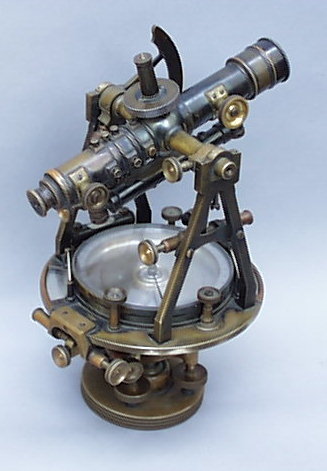 W&
L. E. Gurley Mountain & Mining Solar Transit w/o Attachment
This Gurley light mountain transit is
designed to accept a Burt Solar Attachment and has the mounting post for
the solar attachment, but it is long gone. The box and leather covering are nice. This Solar Transit is
surely one of the most striking and graphic of forms of surveying instrument
that are available not to mention one of the most avidly sought. Rarely
seen or offered for sale one of these instruments will move your collection
to the head of the line if you have the missing piece. .
W&
L. E. Gurley Mountain & Mining Solar Transit w/o Attachment
This Gurley light mountain transit is
designed to accept a Burt Solar Attachment and has the mounting post for
the solar attachment, but it is long gone. The box and leather covering are nice. This Solar Transit is
surely one of the most striking and graphic of forms of surveying instrument
that are available not to mention one of the most avidly sought. Rarely
seen or offered for sale one of these instruments will move your collection
to the head of the line if you have the missing piece. .
Good . . . . .$1095.00 SOLD
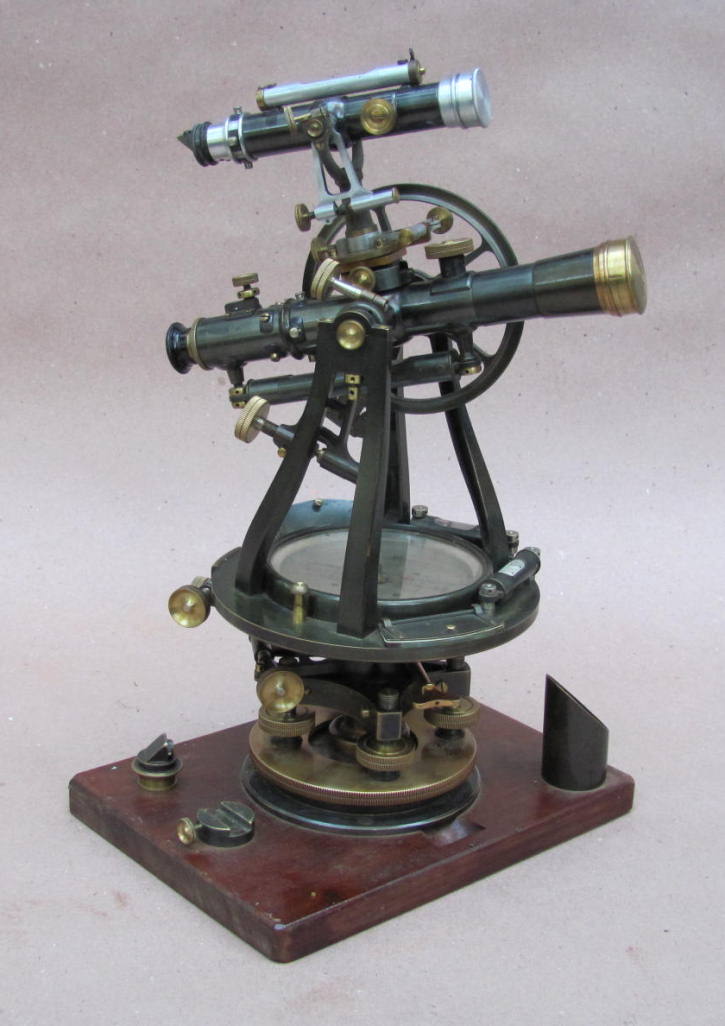 Keuffel & Esser # 5076 Light Mountain Transit
w/ Saegmuller Solar Attachment
This K & E 5076
Solar Transit an early,
rare, and desirable American Surveying Instrument. The
superb condition
and completeness of this wonderful
K & E transit w/ its Saegmuller solar attachment is second to none.Note all the accessories inside the door are present, including the
magnifier, brush, plumb bob, adjusters, and even the oil can, which you never see.
It also has 2 sunshades, and the right angle aux eyepiece for the main
scope.
Keuffel & Esser # 5076 Light Mountain Transit
w/ Saegmuller Solar Attachment
This K & E 5076
Solar Transit an early,
rare, and desirable American Surveying Instrument. The
superb condition
and completeness of this wonderful
K & E transit w/ its Saegmuller solar attachment is second to none.Note all the accessories inside the door are present, including the
magnifier, brush, plumb bob, adjusters, and even the oil can, which you never see.
It also has 2 sunshades, and the right angle aux eyepiece for the main
scope. Keuffel & Esser or K & E began operations in the mid 1870's as a partnership between 2 brothers. The company was founded in NJ and were quite well known for both their surveying instruments as well as their line of drafting supplies and slide rules. There is a short and interesting bio on the firm, and the introduction of this style of transit with its distinctive twisted leg standard at the Smithsonian site.
This transit has an 9" scope and is designated as a Light Mountain model. Only the Expedition model transit with its 6' scope is smaller.This particular example dates from the early 1900's has a serial # of 11287. The number on the box tag matches. It is factory fitted with a mount on the top of the scope to accept the #5090 solar attachment. There is a dedicated mount on the wooden board to accept the # 5090 solar attachment that K & E manufactured when not in use or for storage and transport. Solar attachments gave the user a very exact way to determine their exact location using the sun and the horizon. They were especially useful here in the west or places where large deposits of ore could affect the magnetic compass allowing for mistakes in the work being performed.
The Smithsonian has a near identical solar transit in their collection, and that example can be viewed there along with the write-up they have for it.
It is a wonder that something that was made with the intention to be used in the field could be in such exceptional condition nearly 100 years later. This transit came out of a foothill community here in northern CA and was obviously stored in a dry and clean environment for the last 100 years. The box shows just a few minor scuffs from storage. The clear green lacquer finish on the transit is near perfect. All motions are free and turn as they should. The optics are perfect and exhibit no cloudiness or other problems. The crosshairs 1 vertical, 3 horizontal, and 2 crossed in the middle are present. It will be a long time before another example in as nice condition appears if ever.
The tripod size is 3 1/2 x 8. A very nice and proper tripod is available separately for $200.
Excellent . . . . . . .$2995.00 SOLD!
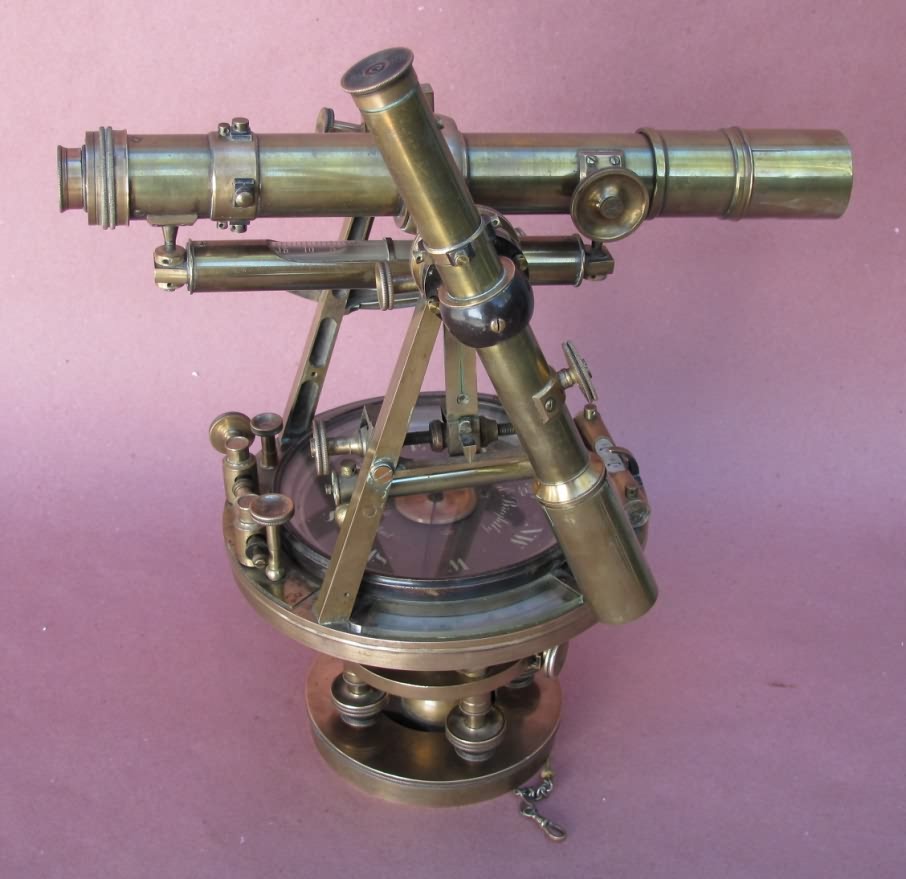 Heller & Brightly Mining Transit w/ Auxiliary Scope
& Tripod The main scope on this
large surveyor's or engineers transit is 11" long. The serial # is
4928 which from published records we can assume dates this mining transit from
right around 1876 just a few years after Heller and Brightly formed their
partnership in 1870. Heller had worked for Young, and before Young died
in 1870 he had become a partner in that firm. This was before teaming up with Brightly
soon after Young's death and starting the new firm of Heller & Brightly.
Heller & Brightly Mining Transit w/ Auxiliary Scope
& Tripod The main scope on this
large surveyor's or engineers transit is 11" long. The serial # is
4928 which from published records we can assume dates this mining transit from
right around 1876 just a few years after Heller and Brightly formed their
partnership in 1870. Heller had worked for Young, and before Young died
in 1870 he had become a partner in that firm. This was before teaming up with Brightly
soon after Young's death and starting the new firm of Heller & Brightly. The transit is fitted for, and has the secondary auxiliary scope making this what would be termed a mining transit. Heller & Brightly instruments in this form are very rare. The box is fitted for the scope and other auxiliary pieces as well. This transit is set to accept the secondary scope on just the right side and not on top. It has a very unusual split nut fitting that uses friction to hold the scope onto the spindle provided. The axle on the other side of the instrument is set up to take a counterweight, and there is a place for a counterweight in the box, but it is missing. The idea for a second scope is to allow the user to shoot angles that would otherwise be impossible because of the plate being in the way such as at very steep angles, or straight down.
The overall condition of this rare mining transit is very nice. The natural brass finish has developed a nice even patina. This transit has been on display in an office for the last 25 years or so. It was found in Oregon, and the story was that it had come from PA where it had originally been in use. Also of note is that the serial numbers on the instrument, box, and tripod all match. The tripod is OK noting that it appears one leg has an early glue repair on a split in one rail. The original screwdriver is in the box, and both scopes have sunshades. All level vials are all good. All in all a pretty rare instrument that will not turn up often and will make for a great display in the mining collection, or the surveying instrument collection.
Good+ . . . . . . .$3250.00 SOLD!!
Info on Heller & Brightly from the Smithsonian Site
Heller & Brightly Charles S. Heller (1839–1912) was born in Germany, and moved with his family to the United States in the late 1840s. He went to work for William J. Young in 1855, and became a partner in William J. Young & Co. in 1865. Charles H. Brightly (1817–1897) was born in England, arrived in the United States in the 1830s, and worked as a machinist in Philadelphia before going into partnership with Heller in 1870. Within a few years Heller & Brightly were said to have "done more than any other [firm] in this country of late years to increase competition in the trade, and to wake up the different makers to a sense of the many improvements that may be made in the instruments in common use." Heller & Brightly instruments were used in every state in the union, and in several foreign countries. The firm was incorporated in 1926, and remained in business until 1968.Heller & Brightly was a traditional craft workshop. There were only a few employees at any one time, each could produce an entire instrument, and each was reasonably well paid. They produced some 100 instruments per year from 1870 to 1887. Annual production rose to 216 instruments in 1891, then dropped precipitously and remained at modest levels thereafter. Each instrument has a serial number, the first being #4400. Most Heller & Brightly instruments were ordered directly from the shop, with only a few sold in stores.
Ref: Robert C. Miller, "The Heller & Brightly Records," Rittenhouse 4 (1990): 43–55.
W& L. E. Gurley Mountain & Mining Transit w/ Burt Solar Attachment This form of surveying instrument, a transit equipped with a factory Solar Attachment or auxiliary mining scope is one of the most desirable and sought after of all surveying related devices ever offered. The idea was that in certain areas the magnetic deviation was so great and the errors it could cause so great that these unusual and significant devices were developed as a way to compensate for this effect, and enabled the user to find a true reference or location using the horizon and the position of the sun instead of the standard methods employing just the compass. Even though the concept has been around for many years very few of them were actually made for use in the field. Each major company that made surveying instruments had a version of their transit that came equipped with one form or another of these devices.
The two best known names in this field were Gurley and Keuffel & Esser, but Berger, Buff, Dietzgen and others offered them as well for their instruments. Different attachments were known by the name of the inventor, and the versions designed and developed by Saegmuller, Smith, & Burt being the best know attachments. This instrument is in very nice overall condition and dates from the early part of the last century. The serial number on it indicates the date of manufacture as being 1913. It has never been cleaned and the brass has a wonderful mellow patina. Gurley was located in Troy New York at this time, and their reputation for the manufacture of quality instruments was unsurpassed. The box and leather covering are nice as well noting some of the sewn seams coming undone and the small straps showing wear. This Solar Transit is surely one of the most striking and graphic of forms of surveying instrument that are available not to mention one of the most avidly sought. Rarely seen or offered for sale one of these instruments will move your collection to the head of the line.
Good . . . . .$2500.00 - 3500.00 SOLD
Antique & Collectible
Survey Instrument
Solar & Mining Attachments
The
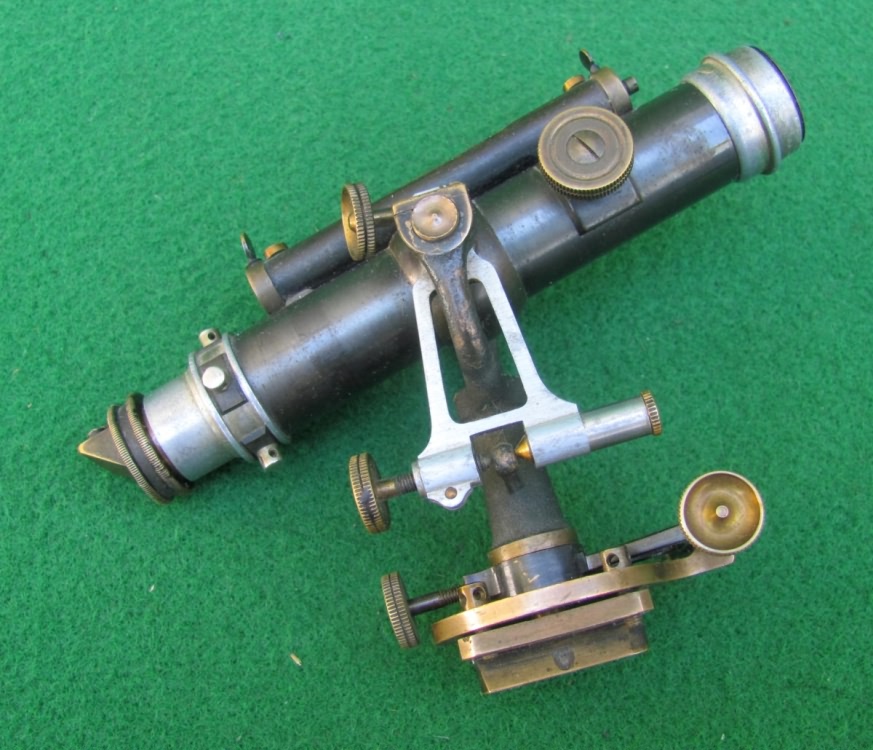 Keuffel
& Esser Saegmuller Type Solar Attachment This
K & E Saegmuller type solar attachment is in nice overall condition.The
optics are OK. There are 6 crosshairs, and the image is inverted. It is
unmarked as to maker, but has the distinctive K & E slide in dovetail mount
on the base. It is
called off as model # 5090 in K & E catalogs. There is no way to exactly date it, but it looks to be from near or just after the turn of the century.
It will fit on any size K & E instrument that has the proper dovetailed
receiver on the top of the main scope.
Keuffel
& Esser Saegmuller Type Solar Attachment This
K & E Saegmuller type solar attachment is in nice overall condition.The
optics are OK. There are 6 crosshairs, and the image is inverted. It is
unmarked as to maker, but has the distinctive K & E slide in dovetail mount
on the base. It is
called off as model # 5090 in K & E catalogs. There is no way to exactly date it, but it looks to be from near or just after the turn of the century.
It will fit on any size K & E instrument that has the proper dovetailed
receiver on the top of the main scope.Solar attachments were developed for use in the field to facilitate finding ones location using the sun and horizon much as seafarers would do with sextants or octants. There use was made necessary when there was a danger of ore deposits affecting the accuracy of a regular compass. Each surveying instrument maker developed or adapted one or more different designs for use on their instruments. Other patented versions were named after the inventor such as Burt, Smith, Pearson, and others.
A nice example of a rare piece that will make an otherwise standard looking instrument into a rare and desirable instrument that display well.
Good + . . . . . . $895.00 SOLD!!
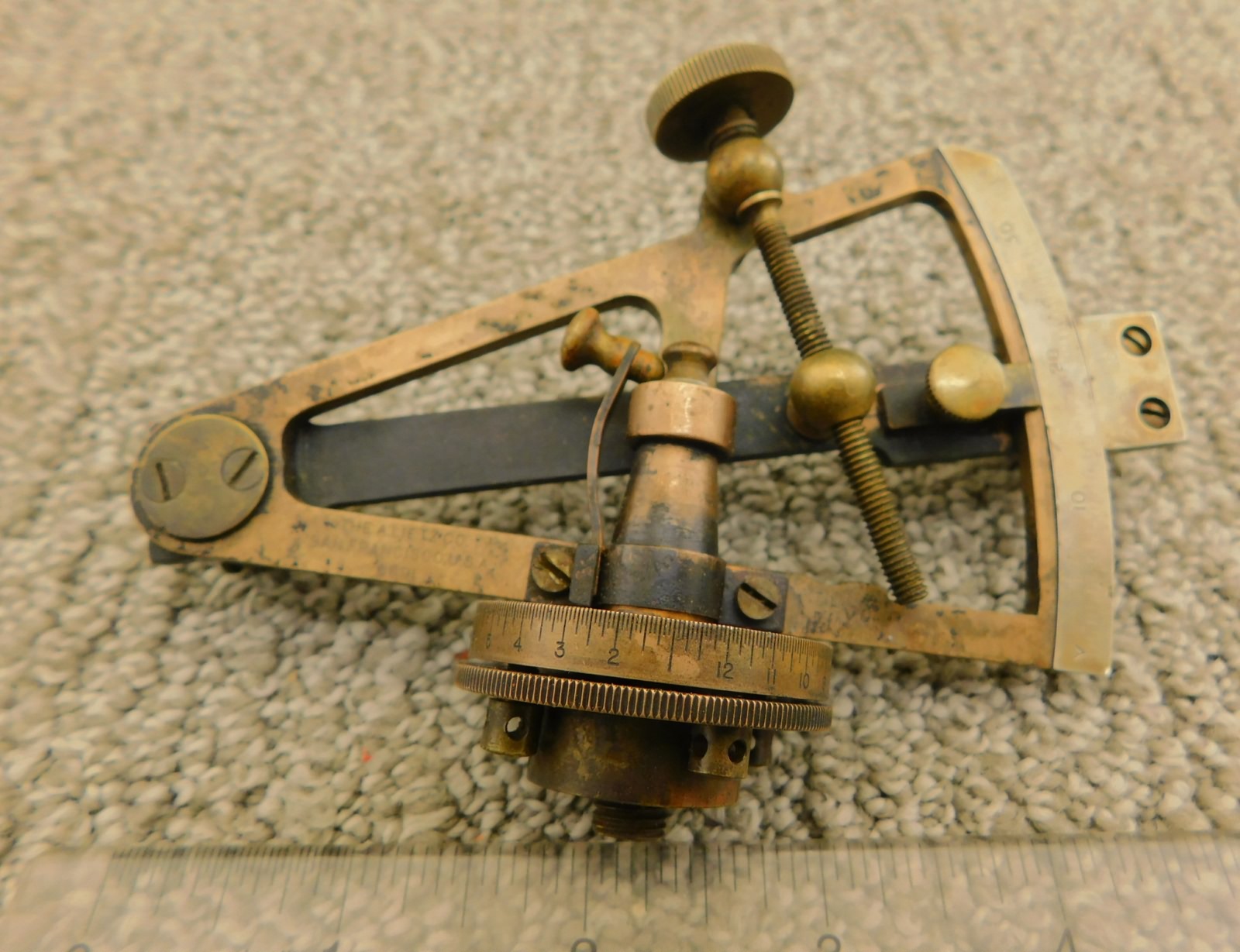 Lietz
Burt Patent
Solar Attachment This solar attachment is marked with the
Lietz name and a serial #. It is in fine condition. The Burt style
solar attachment was used by several different makers for their instruments.
Most notably Gurley who first purchased the patent rights.
Some are marked some not. Some have minor design differences or looks.
This one has a quick release feature I have not seen before. The base
could be screwed into place and then the top half was dropped down onto the
tapered post eliminating the typical problem of not being able to turn the
entire unit due to the vertical circle getting in the way. An
interesting design feature.
Lietz
Burt Patent
Solar Attachment This solar attachment is marked with the
Lietz name and a serial #. It is in fine condition. The Burt style
solar attachment was used by several different makers for their instruments.
Most notably Gurley who first purchased the patent rights.
Some are marked some not. Some have minor design differences or looks.
This one has a quick release feature I have not seen before. The base
could be screwed into place and then the top half was dropped down onto the
tapered post eliminating the typical problem of not being able to turn the
entire unit due to the vertical circle getting in the way. An
interesting design feature. Solar attachments were developed for use in the field to facilitate finding ones location using the sun and horizon much as seafarers would do with sextants or octants. There use was made necessary when there was a danger of ore deposits affecting the accuracy of a regular compass. Each surveying instrument maker developed or adapted one or more different designs for use on their instruments. Other patented versions were named after the inventor such as Burt, Smith, Saegmuller, and others.
A nice example of a rare piece that will make an otherwise standard looking instrument into a rare and desirable instrument that display well.
Good + . . . . . . $950.00 SOLD!!
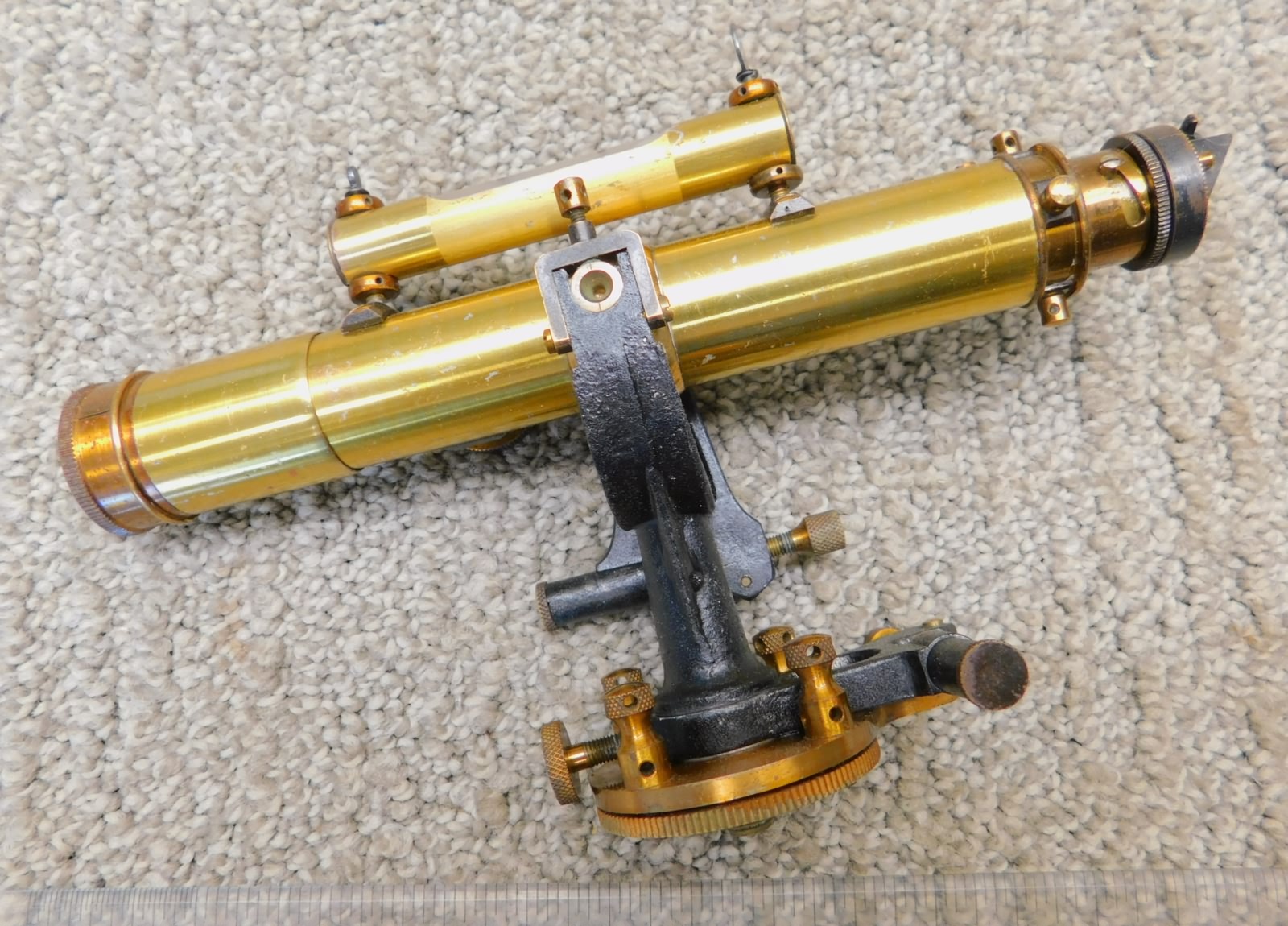 Buff Saegmuller Patent
Solar Attachment This Buff made Saegmuller Patent solar attachment is in
near pristine condition. It is unmarked but has Buff characteristics. Saegmuller style
solar attachments were used by several different surveying instrument makers including
K & E, Dietzgen, Warren Knight, Lietz and others. Some are marked some
not.
Buff Saegmuller Patent
Solar Attachment This Buff made Saegmuller Patent solar attachment is in
near pristine condition. It is unmarked but has Buff characteristics. Saegmuller style
solar attachments were used by several different surveying instrument makers including
K & E, Dietzgen, Warren Knight, Lietz and others. Some are marked some
not.Solar attachments were developed for use in the field to facilitate finding ones location using the sun and horizon much as seafarers would do with sextants or octants. There use was made necessary when there was a danger of ore deposits affecting the accuracy of a regular compass. Each surveying instrument maker developed or adapted one or more different designs for use on their instruments. Other patented versions were usually named after the inventor such as Burt, Smith, Pearson, Saegmuller, and others.
A nice example of a rare piece that will make an otherwise standard looking surveying instrument into a rare and desirable solar transit. Nice!!
Fine . . . . . . $995.00 SOLD!!
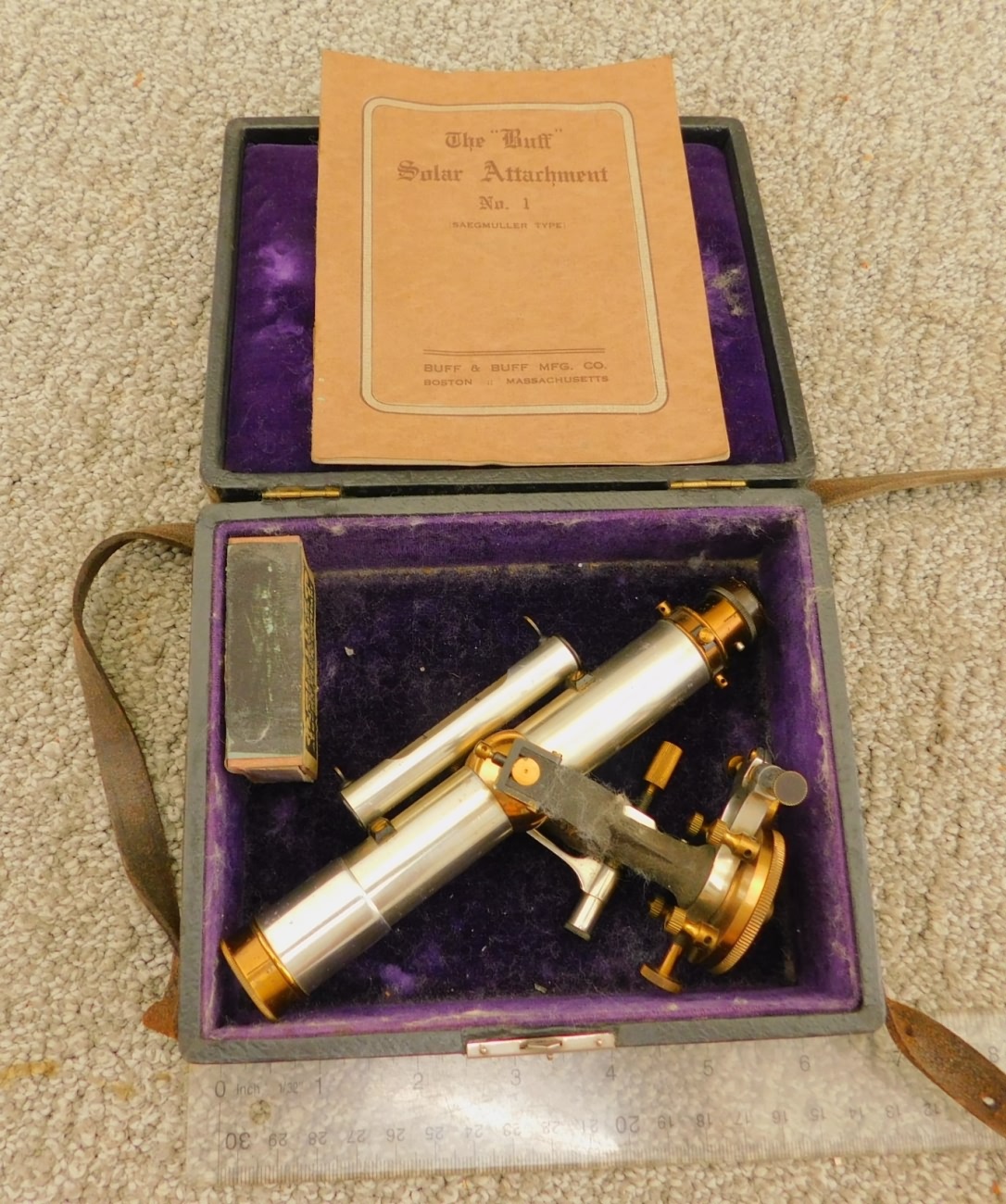 Buff & Buff Saegmuller Patent
Solar Attachment This Saegmuller Patent
Buff & Buff solar attachment is in
near pristine condition in its original box and also includes the original instruction
booklet.
Buff & Buff Saegmuller Patent
Solar Attachment This Saegmuller Patent
Buff & Buff solar attachment is in
near pristine condition in its original box and also includes the original instruction
booklet.The Saegmuller style solar attachment was used by several different instrument makers including K & E, Dietzgen, Warren Knight, Lietz and others to name a few. This example is unmarked save for the label on the box and the instructions and could be adapted to a number of different makers transits or instruments.
Solar attachments were developed for use in the field to facilitate finding ones location using the sun and horizon much as seafarers would do with sextants or octants. There use was made necessary when there was a danger of ore deposits affecting the accuracy of a regular compass. Each surveying instrument maker developed or adapted one or more different designs for use on their instruments. Other patented versions were usually named after the inventor such as Burt, Smith, Pearson, Saegmuller, and others.
A nice example of a rare piece that will make an otherwise standard looking instrument into a rare and desirable instrument. None nicer!!
Fine . . . . . . $1295.00 SOLD!!
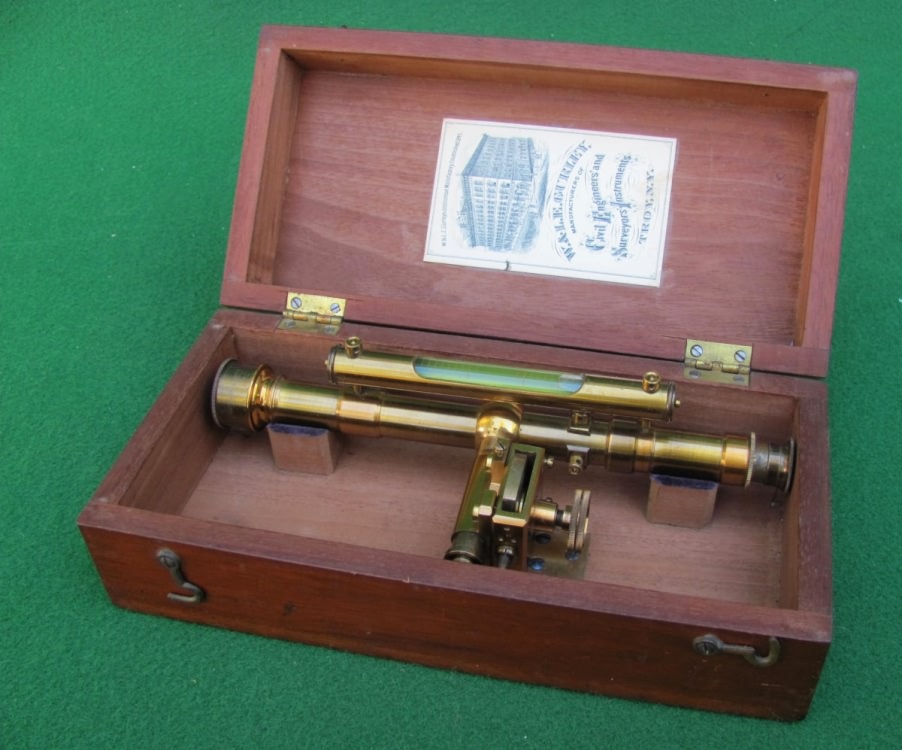 Gurley
Auxiliary Scope for Surveying Compass The auxiliary scope is designed to fit on one
compass sight vane of a surveyors compass. It is in nice condition
and just shows minor box tarnish. It is marked Gurley on the mounting
block and on the label inside the box. It is also marked with a 1878 patent date. The optics are
good
and the crosshairs are there. It is a slight variation of the one
offered with a compass above. A graphic looking instrument that will display very nicely
and make a standard looking compass by any number of makers be a stand out
addition in any collection.
Gurley
Auxiliary Scope for Surveying Compass The auxiliary scope is designed to fit on one
compass sight vane of a surveyors compass. It is in nice condition
and just shows minor box tarnish. It is marked Gurley on the mounting
block and on the label inside the box. It is also marked with a 1878 patent date. The optics are
good
and the crosshairs are there. It is a slight variation of the one
offered with a compass above. A graphic looking instrument that will display very nicely
and make a standard looking compass by any number of makers be a stand out
addition in any collection.
Fine . . . . . . $895.00 SOLD!!
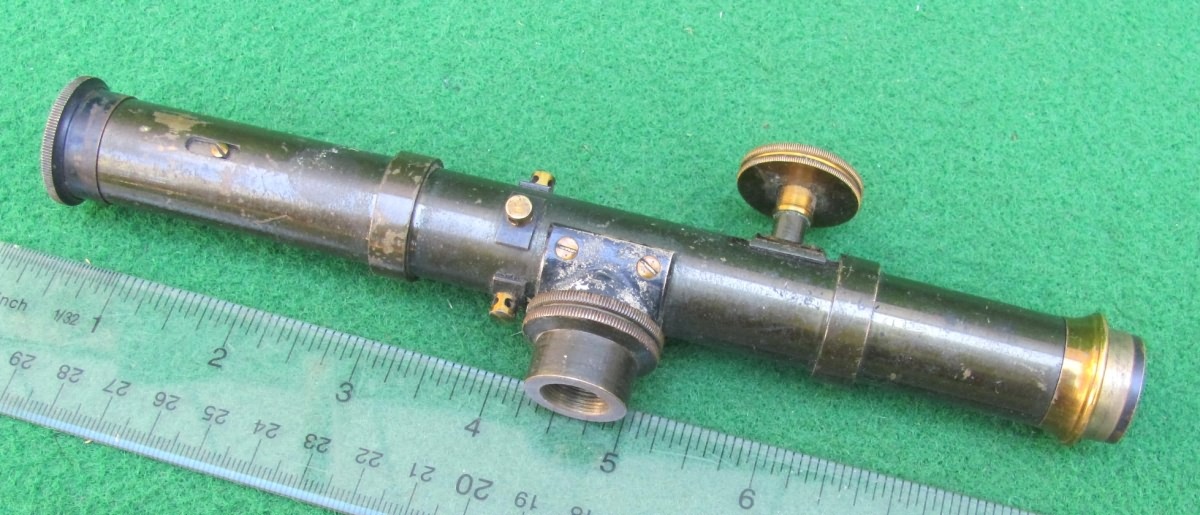 Auxiliary
Scope for Mining Transit This
Auxiliary Scope is unmarked as to maker. It has been suggested it may be a Young or Queen product.
It is meant to mount onto a male stud on the end of the transit axle, or on
a stud mounted on top of a transit scope. The female mount measures approx
3/8 " x ?? TPI It is approx. 9" long. The
optics are OK. There is no way to exactly date it, but it looks
to be from near the turn of the century or before.
Auxiliary
Scope for Mining Transit This
Auxiliary Scope is unmarked as to maker. It has been suggested it may be a Young or Queen product.
It is meant to mount onto a male stud on the end of the transit axle, or on
a stud mounted on top of a transit scope. The female mount measures approx
3/8 " x ?? TPI It is approx. 9" long. The
optics are OK. There is no way to exactly date it, but it looks
to be from near the turn of the century or before.Auxiliary Mining Scopes / Transits were developed for use when in locations or situations where the operator had to shoot a line where the plate would interfere with the work at hand. That is why they were mounted over or outside of the plate line.
A nice example of a rare piece that will make an otherwise standard looking instrument into a rare and desirable instrument that display well.
Good + . . . . . . $795.00 SOLD!!
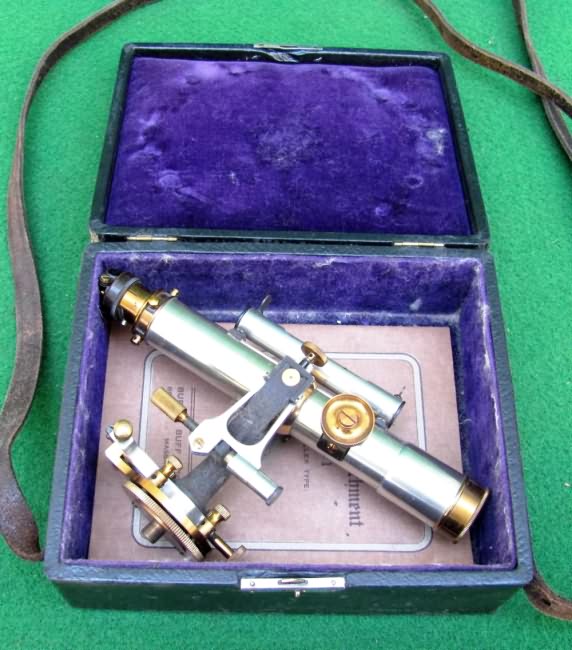 Buff
& Buff Saegmuller Type #1 Solar Attachment in Original Box This
rare Saegmuller type solar attachment is for use on a surveying transit and looks to have
never been used. The hard leatherette covered carry case is like new.
The original instructions are like new. The finish on the instrument
is near pristine. Please look at all the pics to see the
exceptional condition.
Buff
& Buff Saegmuller Type #1 Solar Attachment in Original Box This
rare Saegmuller type solar attachment is for use on a surveying transit and looks to have
never been used. The hard leatherette covered carry case is like new.
The original instructions are like new. The finish on the instrument
is near pristine. Please look at all the pics to see the
exceptional condition.Solar attachments were developed for use in the field to facilitate finding ones location using the sun and horizon much as seafarers would do with sextants or octants. There use was made necessary when there was a danger of ore deposits affecting the accuracy of a regular compass. Each surveying instrument maker developed or adapted one or more different designs for use on their instruments. Other patented versions were named after the inventor such as Burt, Smith, Pearson, and others. A nice example of a rare piece that will display very nicely on any number of instruments.
Fine + . . . . . . $1295.00 SOLD!!
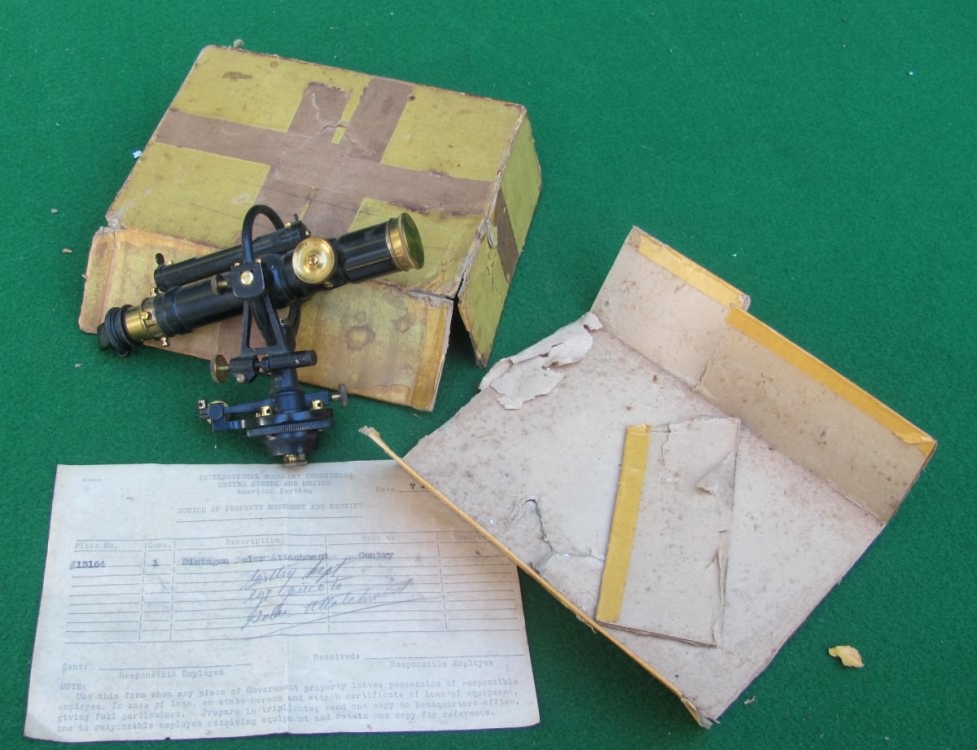 Dietzgen Saegmuller Type
Solar Attachment This
Dietzgen Saegmuller type solar attachment is for use on a surveying transit and looks to have
little if any use. It is still in the remains of its original box, and
comes with its original receipt dated 1934. It appears it was owned by
the government at one time and meant for use laying out the Mexico / US
border. Probably in preparation for a wall like Trump now proposes. The original black finish on the instrument
is near pristine. It is marked Dietzgen on the base. It is
called off as # 6098 in a catalog from that era. Note that the base
has a scope mount attached meaning that this attachment could be adapted to
fit different transits. Please look at all the pics to see the
exceptional condition.
Dietzgen Saegmuller Type
Solar Attachment This
Dietzgen Saegmuller type solar attachment is for use on a surveying transit and looks to have
little if any use. It is still in the remains of its original box, and
comes with its original receipt dated 1934. It appears it was owned by
the government at one time and meant for use laying out the Mexico / US
border. Probably in preparation for a wall like Trump now proposes. The original black finish on the instrument
is near pristine. It is marked Dietzgen on the base. It is
called off as # 6098 in a catalog from that era. Note that the base
has a scope mount attached meaning that this attachment could be adapted to
fit different transits. Please look at all the pics to see the
exceptional condition.Solar attachments were developed for use in the field to facilitate finding ones location using the sun and horizon much as seafarers would do with sextants or octants. There use was made necessary when there was a danger of ore deposits affecting the accuracy of a regular compass. Each surveying instrument maker developed or adapted one or more different designs for use on their instruments. Other patented versions were named after the inventor such as Burt, Smith, Pearson, and others. A nice example of a rare piece that will display very nicely on any number of instruments.
Fine + . . . . . . $850.00 SOLD!!
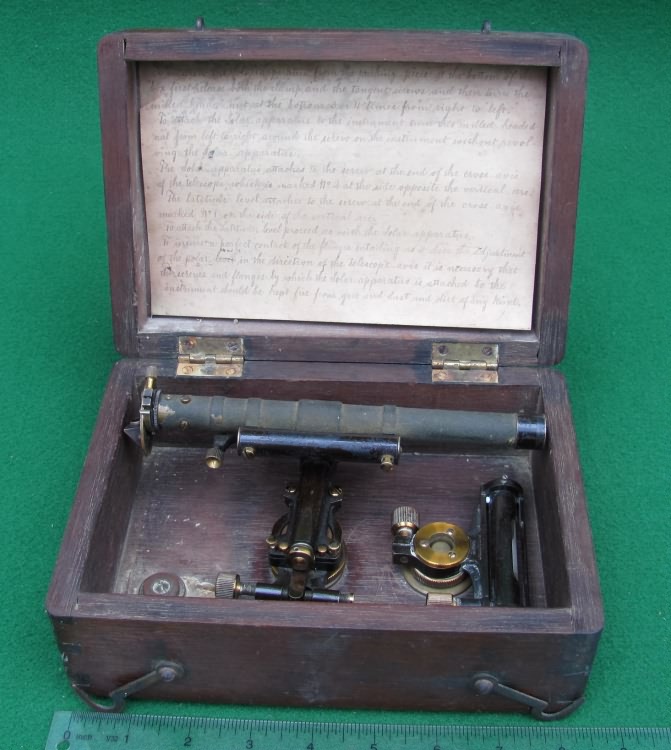 Buff
& Berger's Pearson Patent
Solar Attachment The Buff & Berger
partnership first appeared in the 1870's and was dissolved in 1898 when both
principals opened firms under their own names with the addition of other
family members. Hence the later instrument maker names Berger & Sons, and Buff & Buff.
That would date this rare Buff & Berger solar attachment as pre 1898.
Buff
& Berger's Pearson Patent
Solar Attachment The Buff & Berger
partnership first appeared in the 1870's and was dissolved in 1898 when both
principals opened firms under their own names with the addition of other
family members. Hence the later instrument maker names Berger & Sons, and Buff & Buff.
That would date this rare Buff & Berger solar attachment as pre 1898. Pearson was first granted the patent for this telescopic solar attachment in 1875, and Buff & Berger offered an improved version after 1878. Also note the handwritten instructions that are glued into the top of the box. Faded but legible.
Solar attachments were developed for use in the field to facilitate finding ones location using the sun and horizon much as seafarers would do with sextants or octants. Their use was made necessary when there was a danger of ore deposits affecting the accuracy of a magnetic compass. Each surveying instrument maker developed or adapted one or more different designs for use on their instruments. Other patented versions of solar attachments were named after the inventor such as Burt, Smith, Saegmuller, and others.
A nice example of a rare piece that will make an otherwise standard looking transit into a rare and desirable solar instrument that will display well.
Good + . . . . . . $1250.00 SOLD!!
This is just a sample of the many antique surveying instruments we have sold.Click link to see other Sales Archive Pages on this Site.
We Buy Quality Surveying Related Antiques
Contact Us at
AntiqBuyer@gmail.com
Our current offering of Antiques for sale are at our sister Website Patented-Antiques.com.
This website is Copyrighted
Larry & Carole Meeker