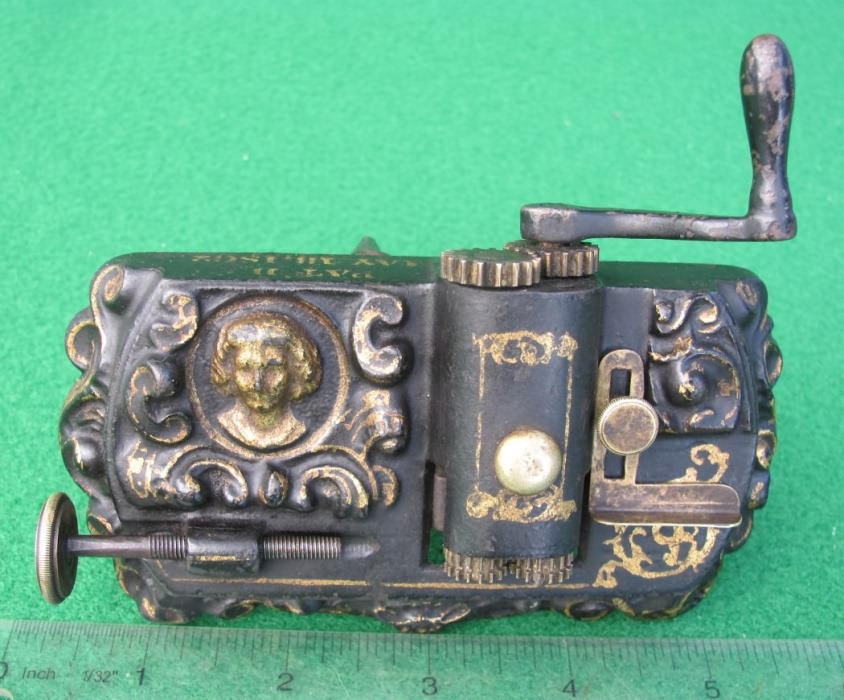
We are active, experienced dealers in rare and historically important American patented
sewing machines. We specialize in pre 1870 sewing machines and we are always interested in
buying early & unusual antique sewing machines.
You are currently at
www.AntiqBuyer.com,
our antique buying and general information website about antiques and antique sewing
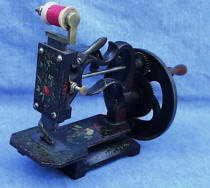 machines. To see past sales
results for both rare full size, and toy antique sewing
machines click the
relevant links in the right column. If you are looking for
info on later more common sewing machines
click this link.
machines. To see past sales
results for both rare full size, and toy antique sewing
machines click the
relevant links in the right column. If you are looking for
info on later more common sewing machines
click this link.
We conduct sales for
antique and vintage sewing machines, including Singer Featherweight
221 and 222 sewing machines from our sister website
www.Patented-Antiques.com.
Please visit that site if you are in the market to buy rare antique
sewing machines or a good 221 or 222 Singer Featherweight.
We have a separate
Singer 221 Sewing Machine informational page at this
site as well.
Examples
of Desirable Antique Sewing Machines
Below are a series of pictures that graphically
illustrate some of the vintage and antique sewing machines we buy,
sell,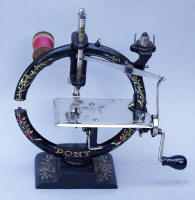 and deal in.
Past sales results for rarer machines will be found on the sewing archive pages (Links on the right).
and deal in.
Past sales results for rarer machines will be found on the sewing archive pages (Links on the right).
An important thing to understand about antique sewing machines is that there is a huge difference in the look,
rarity, and values of sewing machines that were manufactured before
the 1870's compared to sewing machines that were manufactured after that time.
Hand-Held Style Sewing Machines
On the left is what is known as an American Hand scissors-style
sewing
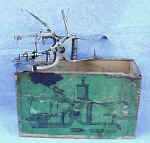 machine. Other examples of this style sewing machine
would be the Goodbody patent, Hendrick patent, and Beckwith sewing machines.
This type of machine is similar to the products that
are being hawked and sold on late night TV today. Cheap, basically unworkable, and
gimmicky, Features that make them great collectibles today.
machine. Other examples of this style sewing machine
would be the Goodbody patent, Hendrick patent, and Beckwith sewing machines.
This type of machine is similar to the products that
are being hawked and sold on late night TV today. Cheap, basically unworkable, and
gimmicky, Features that make them great collectibles today.
Many different inventors / designers came up with
novel designs to try and get a share of the growing sewing machine market. By
the 1880's most of the innovative ideas had been introduced to the
market. By the 1890's there were literally millions
of sewing machines being produced by the largest manufacturers and sold
to every household in America.
Although "later" (1880 and beyond) machines
are "antique"
in the sense of their age, they do not have the same historical significance
or values as earlier models from the 1850's thru 1870's.
Some antique sewing machines, such as Wilcox &
Gibbs, and most Wheeler & Wilson sewing machines carry early patent
dates but also carry much later patent dates and were produced well
into the 19th and even 20th Century. They are bought by
collectors and decorators, and their value is based more on their
decorator appeal rather than on their historical significance.
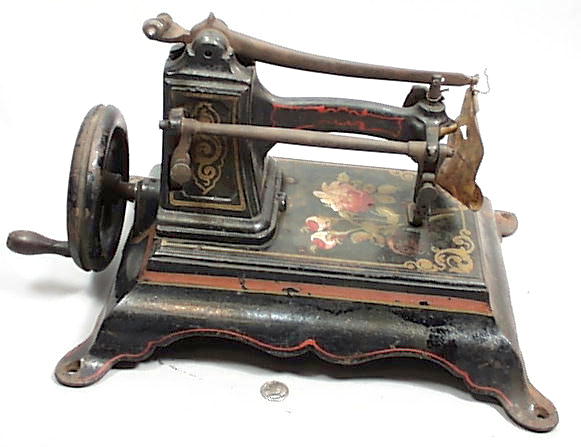
Clamp-On Sewing
Machines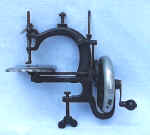
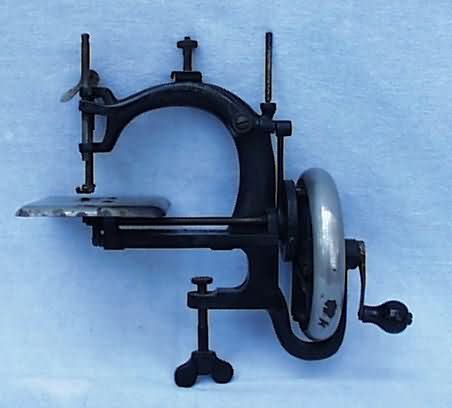
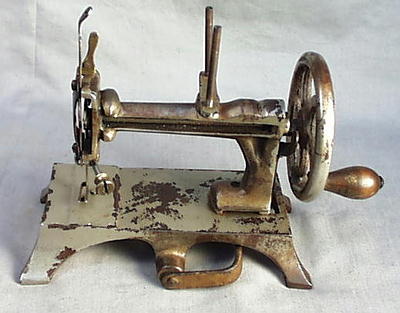
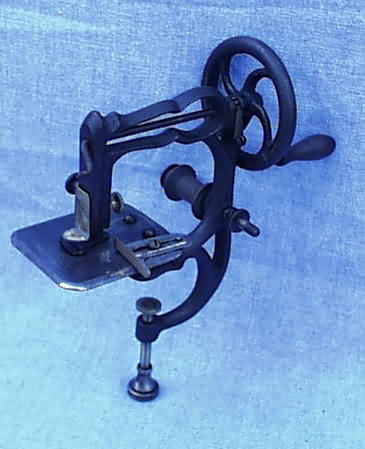
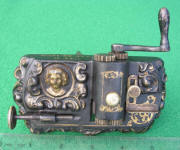
On the right is a "Cute" sewing machine. It is
an 1870's patent and has an unusual gearing mechanism. Note it
has an integral clamp. There were a number of other sewing machines
that were small and portable with built in clamps, including one by
Charles Parker, the Hardie patent, the various Hancock patent sewing
machines, and others. All are desirable and collectible and
examples of many can be seen
in the sale archives linked in the right column..
We are primarily interested
in buying pre-1870 patented sewing machines, or sewing machines that
are of a style that is distinctly different from the common look of
most later "antique" sewing machines. If you have or know of an example
of one of these earlier and different looking sewing machines please contact us at
AntiqBuyer@gmail.com anytime.
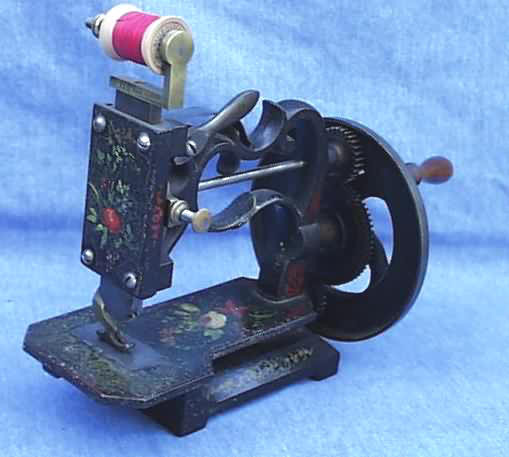
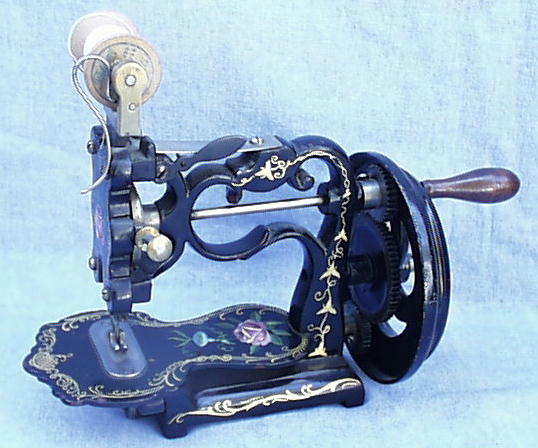
"New England" Style Sewing
Machines
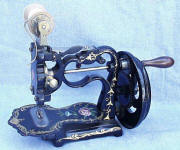
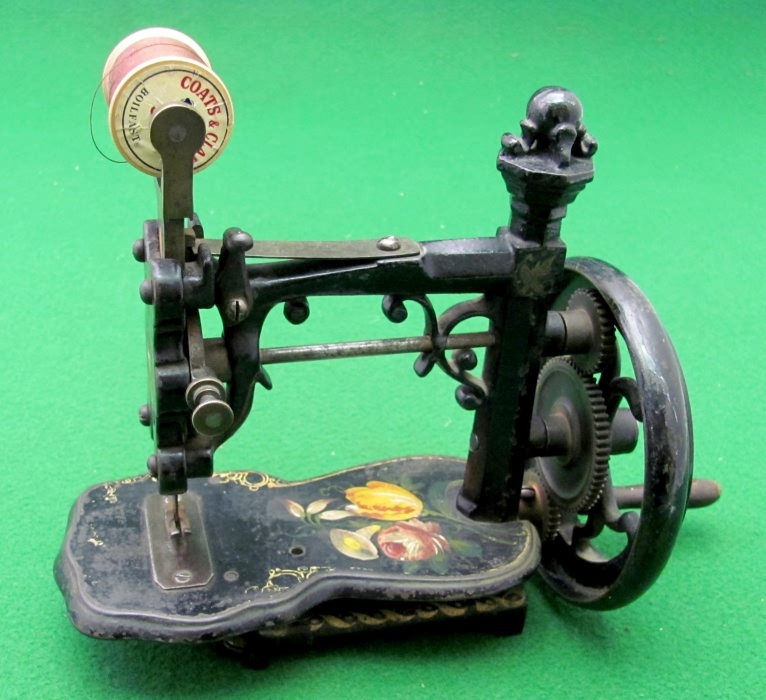
There are a seemingly endless variety of machines collectively referred
to as New England
 sewing
machines. They were manufactured by a number of different companies
with slightly different variations in features and decoration.
The most notable thing about these machines is that they utilized a
"walking presser foot" to move the fabric along.
sewing
machines. They were manufactured by a number of different companies
with slightly different variations in features and decoration.
The most notable thing about these machines is that they utilized a
"walking presser foot" to move the fabric along.
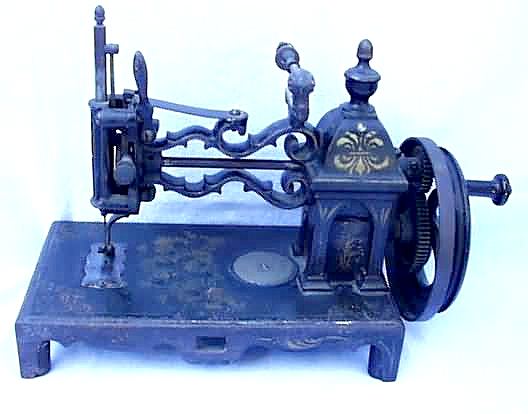
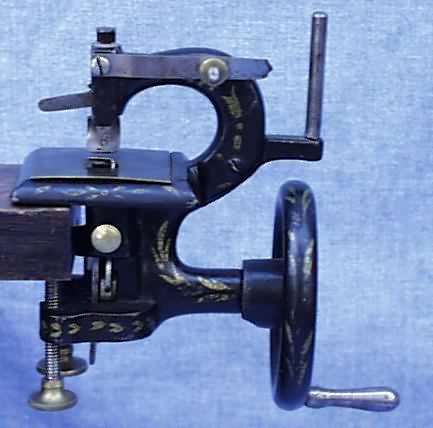
These antique sewing
machines were made in the 1860's and 1870's and in general have fancy
open-work body styles and decorative paintwork. A
critical factor in determining value of these antique sewing machines
is the condition of the paint and decoration. "Dogs"
with little or no decoration sell for little, while pristine examples in their boxes with accessories
command a premium.
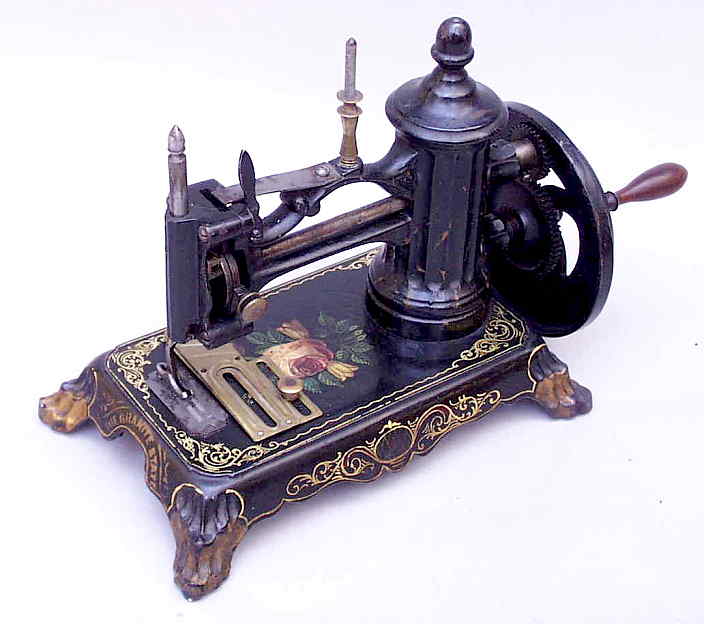
Paw Foot Antique Sewing Machines
Another style of early patented sewing machine are called
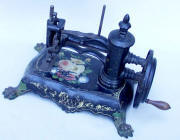 "pawfoot" sewing machines. Shaw and Clark was a major manufacturer. "Ketchem's
Patent", Monitor, Wilson, Atwater, Goodspeed & Wyman,
"pawfoot" sewing machines. Shaw and Clark was a major manufacturer. "Ketchem's
Patent", Monitor, Wilson, Atwater, Goodspeed & Wyman,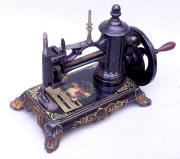 Hodgkin's patent,
Granite State, are other names that can be found.
Hodgkin's patent,
Granite State, are other names that can be found.
They are typically hand-crank machines.
Many had grooved wheels
to be
adapted to a treadle machine. They are sometimes referred to as having
a "fire hydrant" shaped body. This
is sometimes topped with an acorn finial or other decorative element
such as a ball. Other machines are nicknamed after the body style and referred
to as open pillar, closed pillar, skinny pillar, square pillar, or fat
pillar. The values of this type sewing machine are largely
dependent
on the condition. Marked examples are worth more, and some
body styles are harder to find than others.
More Pawfoot-Style Sewing
Machine Variations
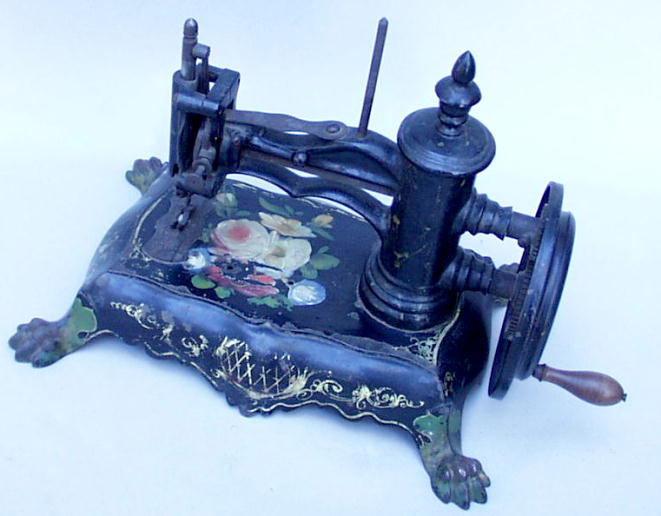
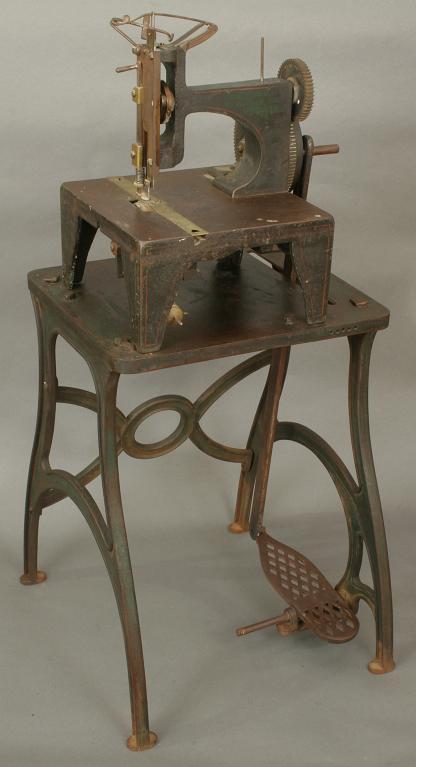
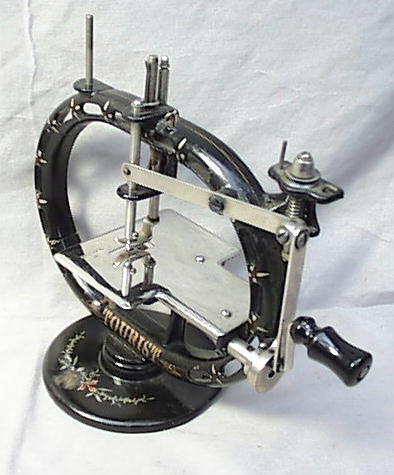
Other similar looking machines dating
from this
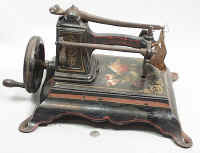 era
are the Watson patent sewing machines like
the example pictured here. The Folsom patent sewing machine that
was manufactured in or near Winchendon,
era
are the Watson patent sewing machines like
the example pictured here. The Folsom patent sewing machine that
was manufactured in or near Winchendon,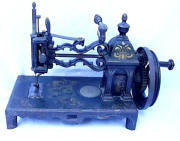 Massachusetts or Biddeford,
Maine in the 1860's
is another example. Again, condition is really important
and when you see an example in pristine condition
you'll understand!
Massachusetts or Biddeford,
Maine in the 1860's
is another example. Again, condition is really important
and when you see an example in pristine condition
you'll understand!
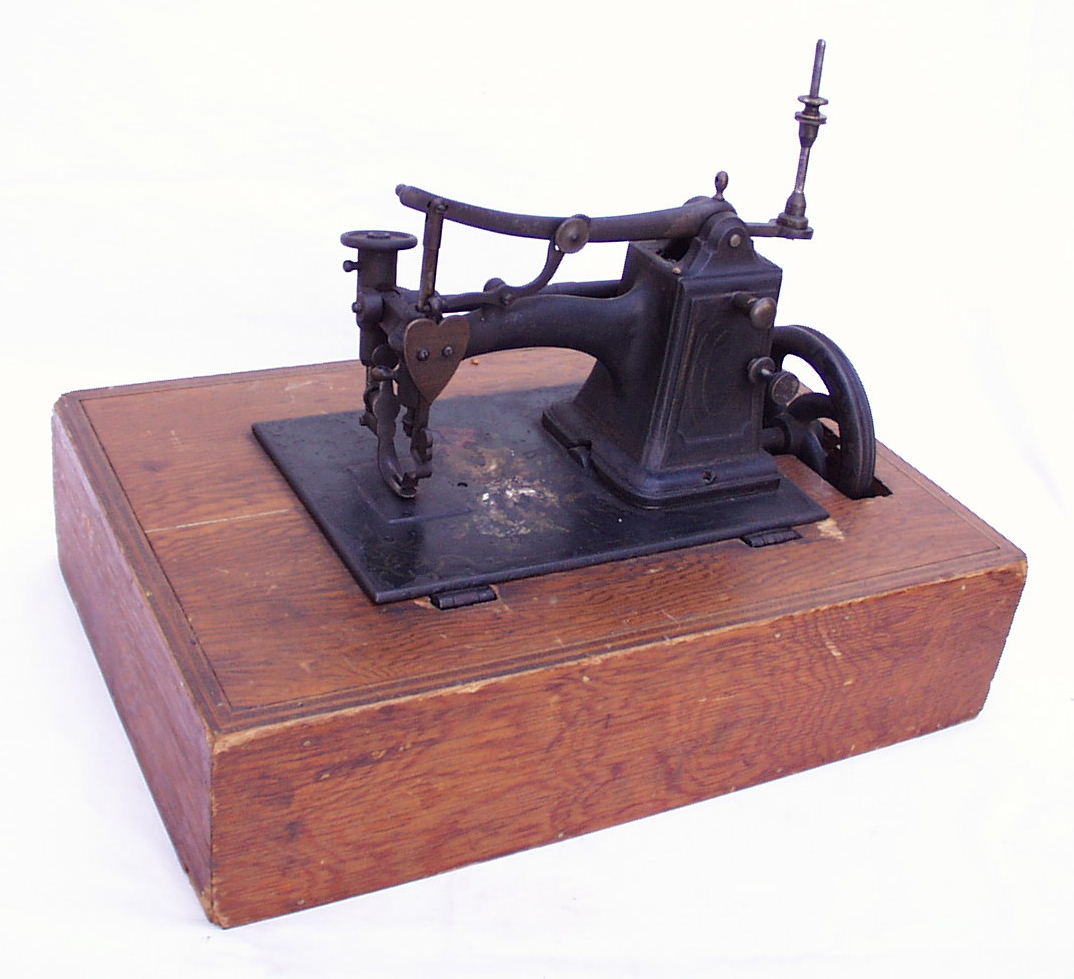
Other historically important and desirable early patented
antique sewing machines bear names like Secor,
Thomson, Leavitt, Pratt, Blodgett & Lerow, Blees, Battelle, Parker,
Holly, and others dating prior to 1870.
Singer Sewing
Machines
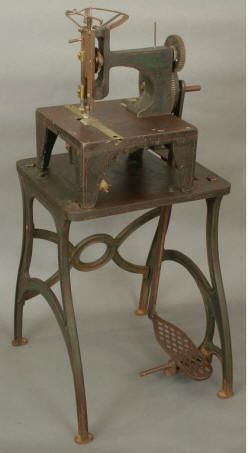 Singer is by far the best known name of sewing
machines in the world. Though most Singer sewing machines are
very common and frequently found, Singer
produced
some very rare and desirable machines in the early years (pre 1860),
and the best of these are known as the Singer Model 1, and the Singer Model
2. The Model 1 and 2 are very large primitive looking sewing machines. After that came the Singer Turtleback which was a much more refined
looking machine. Another desirable model from this early
era is the Letter A. These earliest Singer machines typically
sell for several thousand dollars.
Singer is by far the best known name of sewing
machines in the world. Though most Singer sewing machines are
very common and frequently found, Singer
produced
some very rare and desirable machines in the early years (pre 1860),
and the best of these are known as the Singer Model 1, and the Singer Model
2. The Model 1 and 2 are very large primitive looking sewing machines. After that came the Singer Turtleback which was a much more refined
looking machine. Another desirable model from this early
era is the Letter A. These earliest Singer machines typically
sell for several thousand dollars.
There is some interest in the more ornate
or later Singer cabinet and treadle model sewing machines after the
Turtleback and Letter A. Most later Singers are considered relatively
common, and fall into the period of mass production and are bought
today mostly for their decorative value.
Singer Featherweight
221 and 222 Sewing Machines
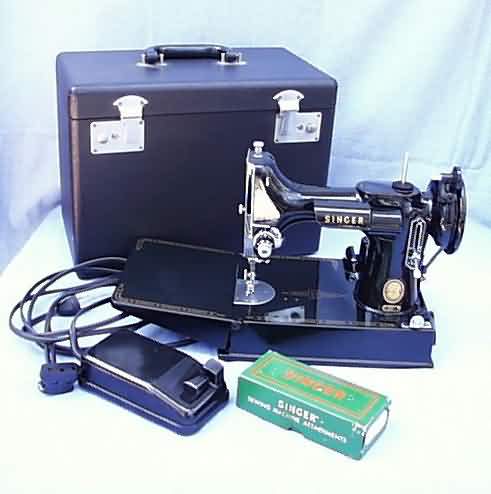
The major exception to all the "rules" above is the Singer Mo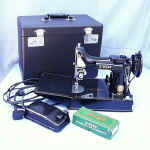 del 221 and 222 Featherweight
sewing machines. There were close to two million
of these machines made so in general they are not considered rare.
They were manufactured from the 1930s through the 1960s so they are
really not "antique".
del 221 and 222 Featherweight
sewing machines. There were close to two million
of these machines made so in general they are not considered rare.
They were manufactured from the 1930s through the 1960s so they are
really not "antique".
They enjoy immense popularity as "user"
and collector machines with
today's quilters, craftspeople, and other seamstresses. They are
a testament to the quality of the product design that Singer put out.
There are a few hard to find variants of these machines to be found,
most notably those marked as coming from the 1936 Texas Centennial
Exhibition, the 1934 Chicago Worlds fair, and the 1939 San Francisco Expo.
The difference in these machines is how they are marked on the ID
badge. There is also what is known as the Crinkle finish model
that was produced during WWII that is highly sought after.
If you would like to read more about Singer Featherweights
be sure to see the special
Featherweight
Sewing Machine page we have dedicated to them on this site.
If you would like to buy a Singer Featherweight
221 or 222 please see our Singer Featherweight sales page at
www.Patented-Antiques.com.
Toy Sewing Machines / TSMs
We are active, knowledgeable, experienced, and
specialized dealers in both rare and
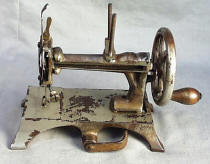 historically important American
patented sewing machines and child size or toy sewing machines also
known as TSM's.
historically important American
patented sewing machines and child size or toy sewing machines also
known as TSM's.
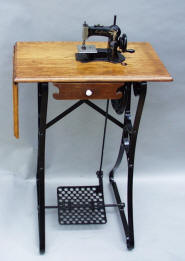 Past Sales Results for many antique sewing machines can be found by
clicking
this link or finding the appropriate link in the
right column.
Past Sales Results for many antique sewing machines can be found by
clicking
this link or finding the appropriate link in the
right column.
We sell antique
TSM / Toy Sewing Machines, and
antique and vintage sewing machines, including Singer Featherweight 221
and 222 sewing machines from our sister Website www.Patented-Antiques.com.
Below are
a series of pictures that graphically illustrate some of the types and vintage
of antique toy sewing machines
(TSMs)
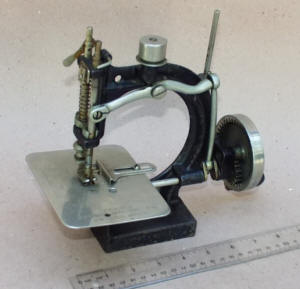 we
buy.
we
buy.
Many small antique sewing machines were marketed as travel or
mending machines, and at other times they were sold as children's machines. Very few
of these small antique sewing machines utilized a shuttle and made a
lockstitch. Most of these
"child size" antique sewing machines were designed to
make a simple single thread chain stitch, hardly suitable for mending or
regular use.
This would indicate that their true market was as toys and that the rest was marketing ploys.
Hancock Patent Sewing Machines
There are a whole
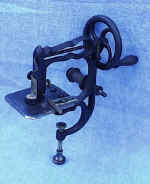 series of early patented sewing machines commonly referred to as "Hancocks"
after the original inventor / patent holder. The original patent was
granted in the 1860's. These
sewing machines were sometimes marketed under other names, such as the
"Household Pet", Lake Patent, and others. They are almost always missing their needle which was
an odd design in itself.
series of early patented sewing machines commonly referred to as "Hancocks"
after the original inventor / patent holder. The original patent was
granted in the 1860's. These
sewing machines were sometimes marketed under other names, such as the
"Household Pet", Lake Patent, and others. They are almost always missing their needle which was
an odd design in itself.
We know of three or four different variations of these sewing
machines with different tables or thread positions or body styles.
Other names of "integral clamp" sewing machines machines
are Bartlett, Novelty, Cute,
Beckwith, Boynton, Hook, and a few others. All of these early patented American
small handcrank sewing machines are sought.
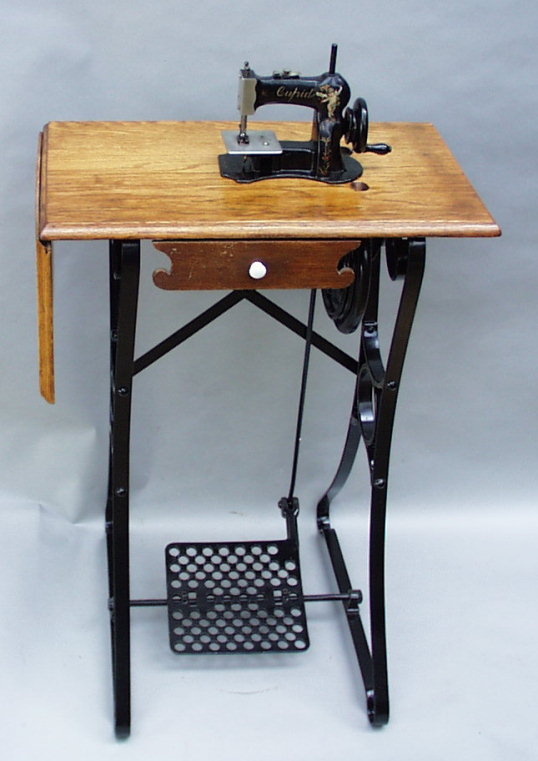
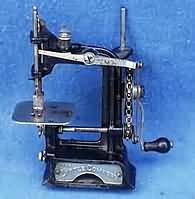
The
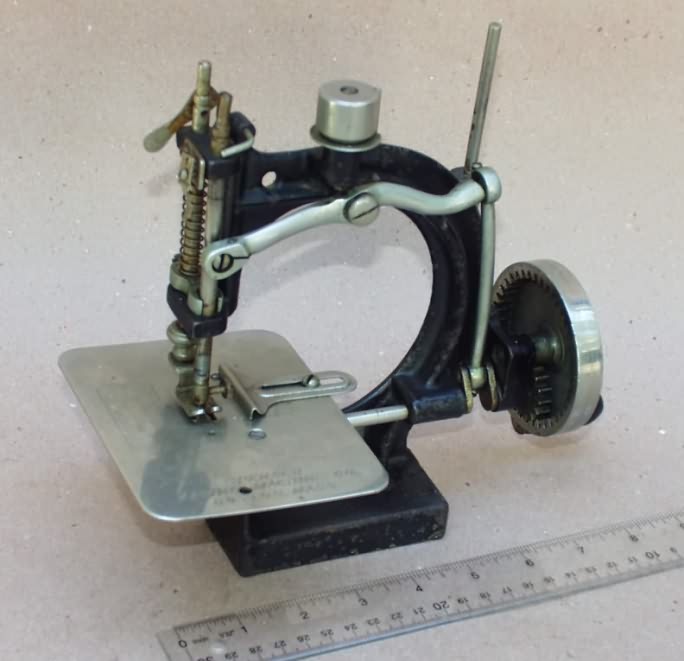
Hook Sewing Machine
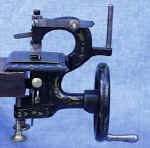
This wonderful small cast iron sewing machine measures just 4"
tall and was
patented in the early
1860's. It was only manufactured for a very short period of time. It is referred to as the
Hook and is very similar to the Hardie, another early patented
sewing machine which is slightly larger. This machine also has a built-in clamping mechanism and is another example
of a desirable antique sewing machine from the mid 1800's. Although
functional, it would hardly be useable.
Smith &
Egge / Little Comfort Chain Drive Sewing Machine
This is an example of a mass produced cast iron child size toy sewing
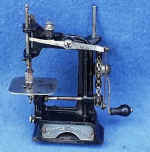 machine
that dates from near the turn of the 20th century.
This is the type antique sewing machine that can often be found in near mint condition in their
original boxes. These early sewing machines originally sold for
a dollar or two, and were sold as both toys / child-size machines and as
travel / mending machines through large distributors like Sears, Montgomery Wards and the like.
machine
that dates from near the turn of the 20th century.
This is the type antique sewing machine that can often be found in near mint condition in their
original boxes. These early sewing machines originally sold for
a dollar or two, and were sold as both toys / child-size machines and as
travel / mending machines through large distributors like Sears, Montgomery Wards and the like.
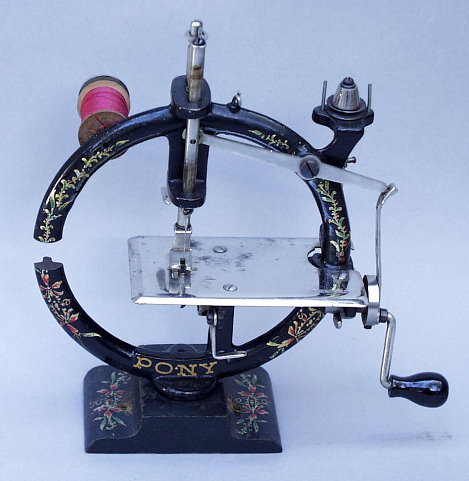
Double marketing was a ploy to sell as many as possible. Other similar TSM sewing machines carry names like
Spenser, Universal, Pony, Triumph, Gem, Tourist, F & W Automatic, American
Gem, and more. Harder to find variations include round models in both wood and metal.
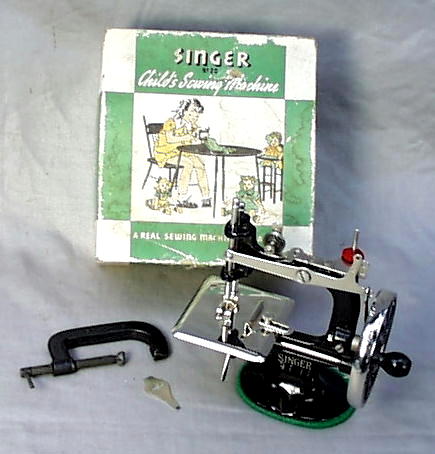
Singer Toy Sewing Machines
Singer made a line of toy or
child-size sewing machines starting in the 'teens and continuing through
today. These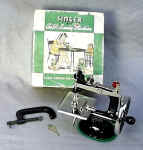 sewing machines
are
often mistakenly called
"salesman sample" sewing machines.
sewing machines
are
often mistakenly called
"salesman sample" sewing machines.
All of the different Singer Model
20 small sewing machines were marketed as real sewing machines or
toys for girls, and often given away to help implant the Singer name in
the mind of the future sewing machine buyer or junior seamstress of
tomorrow.
In general, the values for most of these small toy Singer sewing machines
runs from under $100 to $500 or more for a few of the rare variations /
colors that have surfaced.
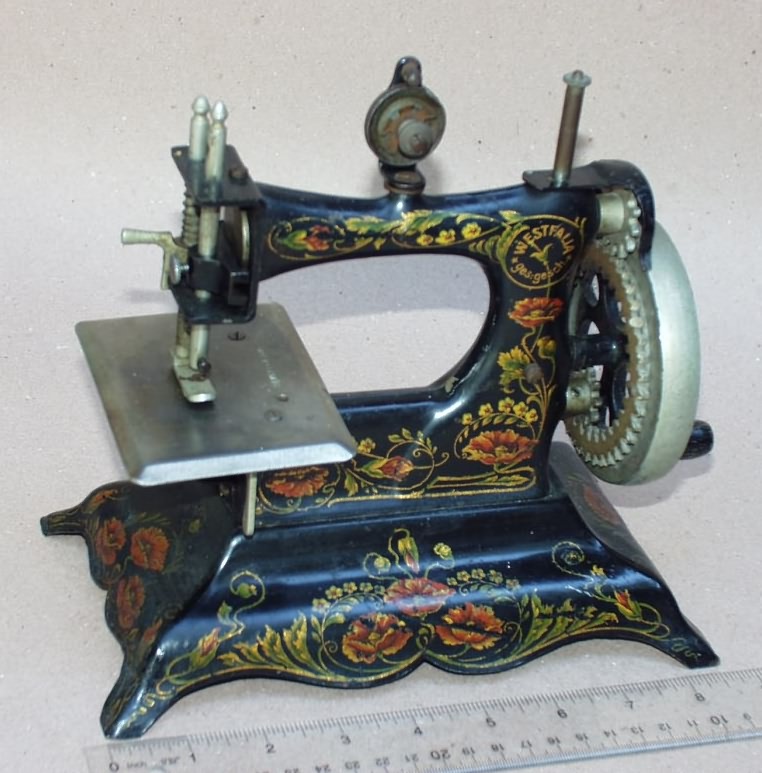
German Toy Sewing Machines
The next style of
toy sewing machines, which generally dates a bit later, and spans up into the
1960's or so,
are the toy machines
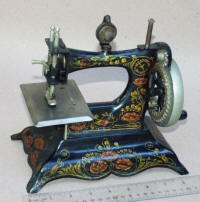 which are usually referred to as "tinnies" or sheet steel
models. There are examples of this style machine from the US and all over the
world. Some of them were produced in great numbers and are
quite common, while others are considered quite rare and desirable.
which are usually referred to as "tinnies" or sheet steel
models. There are examples of this style machine from the US and all over the
world. Some of them were produced in great numbers and are
quite common, while others are considered quite rare and desirable.
Many of these were made in Germany prior to and after WWII.
There are hundreds of different variations and many are pictured and
discussed in the now out of print books by Glenda Thomas. The leading manufactures were Casige, and Mueller. Both of these companies also
made Cast Iron toy sewing machines, some of which are considered to be the rarest and
most desirable of all TSM's that can be found.
The above sewing machines are examples of the
caliber, condition and quality of antique sewing machines that we are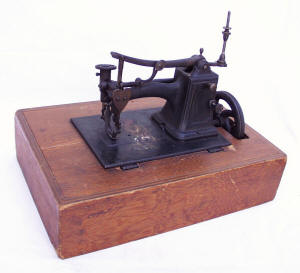
 primarily interested in.
Past sale archives for many
early sewing machines can be viewed by
clicking the links. Past sales results for other antiques can be
seen from links in the right column
primarily interested in.
Past sale archives for many
early sewing machines can be viewed by
clicking the links. Past sales results for other antiques can be
seen from links in the right column
IIf you have quality antique sewing
machines similar to those that you see
on this page that you want to sell, please contact us at
LCM@AntiqBuyer.com
To see examples of antique sewing machines that
we currently have for sale, please go to our sister site
at www.Patented-Antiques.com.
Thank you!!
Larry & Carole
 Larry & Carole Meeker